
Game review
The Happyhills Homicide 2: Out For Blood
6.5 / 10
- Developer
- Copperbolt
- Publisher
- Copperbolt
- Released
- 3 April 2025
- Platforms
- Windows
- Genre
- Adventure, Indie
- Players
- Single-player
The short version
Biggest strengths
- A well-liked, VHS-styled retro slasher aesthetic carried over and refined from the original game, with graphic, over-the-top pixel gore that reviewers consistently enjoy
- An expanded three-protagonist structure — a detective, the serial killer himself, and a vengeful father — that returning fans widely credit as a genuine, meaningful improvement over the first game's single perspective
- Multiple reviewers who played both games specifically call the sequel better than a well-regarded original, a rare and notable outcome for a follow-up
Biggest weaknesses
- A recurring, independently corroborated save-corruption bug wipes all player progress on relaunch, reported by multiple separate reviewers as a genuinely serious, unresolved problem
- A separate, specific game-breaking bug tied to a quick-time event partway through the story reportedly prevents some players from finishing the game entirely
- No options menu exists at all — no keybinding, resolution, or audio settings — a real accessibility and quality-of-life gap for a full-price commercial release
6.5 / 10
Pale Grin returns, and brings a bigger story with him
The Happyhills Homicide 2: Out For Blood picks up six years after the events of its predecessor, resurrecting mass killer John Wade — the Pale Grin — to terrorize the broken town of Happyhills once more, this time with more on his mind than simple murder. It's a direct sequel to a well-liked, VHS-styled retro slasher, and based on the available English-language review sample of 435 reviews — 416 positive, 19 negative, landing at an overall Very Positive rating — it's achieved something genuinely uncommon for a follow-up: a large share of returning fans specifically describe it as an improvement on an original they already enjoyed. "What are you waiting for? Buy it! The first game was already amazing, but this one exceeded all my expectations! I feel like it's rare for a sequel to be better than the original, and this one absolutely does," one reviewer writes, directly naming the specific difficulty of a sequel surpassing its predecessor as a benchmark this one clears.
The expanded structural ambition draws consistent, specific praise. "You get to play as three different characters: a detective, a serial killer, and a father out for revenge, with whom you get to choose whether to spare your enemies or kill them," the same reviewer explains, describing a meaningfully broader narrative canvas than the original game's single-perspective structure. A separate reviewer who played both games back to back frames the improvement in terms of visible creative growth: "I played the first game right before this and it was really cool to see how the creator has grown, in style, game mechanics, and story! It was a really fun play and I'd highly recommend it to others!"
A save-corruption bug that recurs across multiple accounts
The single most serious, most independently corroborated technical problem in this review sample concerns a bug that wipes player progress entirely. "The game's fun for what it is, but there's a bug that killed my enjoyment of the game. I completed Act 14 and decided to close the game to take a break. I open the game about 5 minutes later and it erased all of my data and I'd have to start over from the beginning," one reviewer writes. A separate reviewer reports the identical failure mode independently: "there's currently a major bug where you lose all progress when you exit the game. You CANNOT continue the game where you left off. Until this is fixed, I would not recommend this game." A third reviewer confirms the same specific pattern while cataloguing other issues: "doesn't save when you log out despite having a continue button and saying it was saving." When three separate reviewers independently describe the exact same failure — a functioning-looking save system that silently fails to actually preserve progress — that's a strong, corroborated signal of a genuine, unresolved bug rather than an isolated technical fluke.
A separate, distinct bug blocks some players from finishing the game at all. "As much as I want to like this game, me and many others are stuck, unable to get past a game breaking bug in chapter seven," one reviewer writes, while a different reviewer identifies the same specific point of failure with more mechanical detail: "Broken, I cannot get past the quick time event in the club. No matter how much I spam 'e' it doesn't work. If it wasn't for this bug, I would give it a positive review." Both reviewers frame their negative recommendation as circumstantial — driven entirely by an unresolved bug rather than dissatisfaction with the underlying game — which is worth taking seriously as a distinct category of complaint from genuine creative or design criticism.
No settings menu at all
A separate, more structural quality-of-life gap draws real frustration: the complete absence of any options menu. "There's no options menu, you can't change the resolution, can't change the audio or anything, and a ton of it's super annoying in the background, and doesn't save when you log out despite having a continue button and saying it was saving, selecting chapter doesn't work," one detailed reviewer writes, cataloguing several related interface gaps in a single account. A separate reviewer frames the missing keybinding options specifically: "the kills are graphic and over the top, which, let's be honest, is the main reason you're buying this game. However, there are no options to rebind the keys nor adjust the audio settings." For a commercial, full-price release rather than a free game jam project, the absence of even basic accessibility options is a real, fair gap to flag directly.
A story ambitious enough to draw real critical engagement
Beyond the technical issues, the story's more ambitious themes draw genuinely substantive critical pushback from at least one detailed reviewer, worth including because it reflects real engagement with the narrative's intent rather than dismissal. One reviewer describes the game's central twist and thematic resolution — involving the killer's abusive upbringing and a message about who deserves forgiveness versus condemnation — and argues the execution doesn't land the moral weight it's clearly reaching for. That's a fair, considered critical take on a horror game attempting more narrative ambition than its genre typically demands, and it's worth weighing against the many reviewers who found the same plot twists genuinely surprising and effective. A separate reviewer raises a related, more specific complaint about player choice: "you can feel that the game got rushed towards the end, its a shame that our sparing and killing actions do not affect the end game result" — a real structural letdown if the choice system is framed as consequential without actually branching the outcome.
Notably, The Happyhills Homicide 2 has no Steam achievement system at all, consistent with its predecessor, leaving no structural markers of the game's roughly twenty-episode content scope beyond what reviewers report directly. Several reviewers describe total playtime in the one-and-a-half to two-hour range, consistent with the low asking price and the game's positioning as a short, focused horror experience rather than a lengthy campaign.
Where this leaves it
The Happyhills Homicide 2: Out For Blood succeeds at the genuinely difficult task of improving on a well-liked original, expanding its scope with a three-protagonist structure and refined controls that returning fans consistently credit as real, meaningful growth. What holds it back from an easier recommendation is a cluster of specific, corroborated technical problems — a save-corruption bug reported independently by multiple players, a separate game-breaking bug blocking some from finishing, and a complete absence of basic settings options — alongside more considered criticism of how well its more ambitious narrative themes actually land. Worth the very low price for slasher-horror fans and returning series followers willing to tolerate real, currently unresolved bugs; hold off if a fully save-reliable experience matters more than getting an early look at the story's conclusion.
Pros and cons
Pros
- A well-liked, VHS-styled retro slasher aesthetic carried over and refined from the original game, with graphic, over-the-top pixel gore that reviewers consistently enjoy
- An expanded three-protagonist structure — a detective, the serial killer himself, and a vengeful father — that returning fans widely credit as a genuine, meaningful improvement over the first game's single perspective
- Multiple reviewers who played both games specifically call the sequel better than a well-regarded original, a rare and notable outcome for a follow-up
- A very low asking price that nearly every reviewer, positive or critical, agrees represents fair value for a short, focused horror experience
Cons
- A recurring, independently corroborated save-corruption bug wipes all player progress on relaunch, reported by multiple separate reviewers as a genuinely serious, unresolved problem
- A separate, specific game-breaking bug tied to a quick-time event partway through the story reportedly prevents some players from finishing the game entirely
- No options menu exists at all — no keybinding, resolution, or audio settings — a real accessibility and quality-of-life gap for a full-price commercial release
- Player choices around sparing or killing enemies are reported by at least one detailed reviewer not to meaningfully affect the ending, despite being framed as consequential during play
- At least one detailed reviewer found the story's central moral resolution around abuse and forgiveness poorly executed relative to its ambition
Screenshots
-

The Happyhills Homicide 2: Out For BloodImage: Copperbolt via Steam -

The Happyhills Homicide 2: Out For BloodImage: Copperbolt via Steam -

The Happyhills Homicide 2: Out For BloodImage: Copperbolt via Steam -
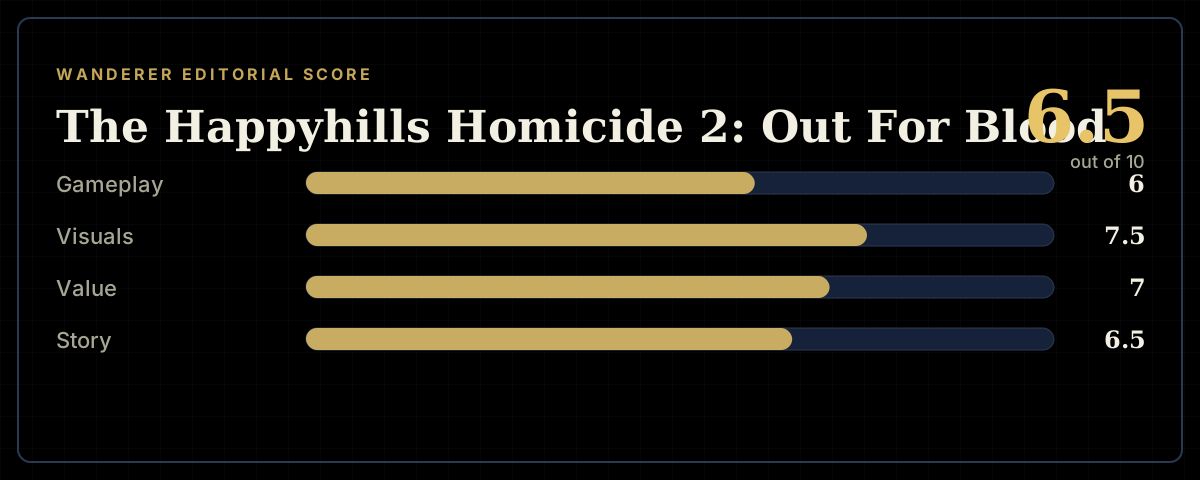
How the review scores each part of the gameWanderer Editorial -
The short versionWanderer Editorial