
Game review
Gladiators IDLE
3.5 / 10
- Developer
- Pixelabor
- Publisher
- Pixelabor
- Released
- 17 December 2020
- Platforms
- Windows
- Genre
- Idle RPG
- Monetisation
- Paid, one-time purchase. NZ$4.79 base price, frequently discounted (40% off, NZ$2.87, at time of review).
- Players
- Single-player only.
The short version
Gladiators IDLE's own store page answers "is this an asset flip" directly in its FAQ, which tells you most of what you need to know about the company it's been forced to keep. It's a small, genuinely hand-made idle gladiator-training game — train a fighter, send him to the arena, spend gold on upgrades — that its own developer describes as deliberately, proudly simple. Reviewers from launch agree it's competent but thin. What makes it worth covering years later is what the developer said after launch: the project's files were lost in 2021, meaning it can never be patched again, and a 2025 post titled "This game is being retired!" confirms the project is over — yet it remains for sale today, discounted, with none of that history visible to a new buyer on the store page itself.
Biggest strengths
- The core train-fight-upgrade loop works exactly as a simple idle RPG should, and its own achievement data shows a real, if small, population of players progressing through its rank tiers.
- The developer answers the "is this an asset flip?" accusation directly and specifically in the store page's own FAQ, naming a Discord community as evidence the pixel art is original.
- Openly and repeatedly honest about its own limitations, both in its store description ("isn't rich in number of features") and in later developer posts about the project's problems.
Biggest weaknesses
- Reviewers consistently describe the game as too simple and too easy, with several using nearly identical language — "commonplace," "the easiest game I've ever played" — across the small review sample.
- The developer's own 2021 news post states the project's source files were lost, meaning bugs and balance issues flagged by reviewers can never be addressed.
- A 2025 developer post titled "This game is being retired!" confirms active development has ended, but the store page carries no notice of this to a prospective buyer.
Who it's for: Only players who specifically want the simplest possible idle-RPG loop and don't mind buying a game its own developer has since called permanently unpatchable and retired.
Our recommendation: Skip unless the rock-bottom sale price and bare-bones concept specifically appeal — go in knowing the developer has said, in their own words, that this game can never be fixed or updated again.
3.5 / 10
What it is, in the developer's own words
Gladiators IDLE doesn't pretend to be more than it is, and it says so directly in its own store description. Asked in its own FAQ "what should I expect on Gladiators IDLE," the developer answers: "Gladiators IDLE isn't rich in number of features... The game's 'selling point' is its simplicity." That's an accurate description of what's on offer — train a gladiator's stats, send him into the arena for gold, spend that gold on gear and training, and slowly climb the rank ladder, all automatable in the idle-game tradition the store page name-checks (Clicker Heroes and Firestone Idle are cited as reference points). Official screenshots show a small five-button hub — Arena, Market, Train, Halls, Options — and short pre-fight dialogue exchanges between named gladiators, a nice small touch of character for a game this stripped down. Steam's own achievement data confirms a real, if modest, population actually played it: 68% of tracked players started the game, dropping gradually to 44.5% reaching Rank 200, a normal engagement curve for a small idle title rather than an empty shell.
Reviewers from the game's brief active review period, clustered almost entirely in early 2021, back up the developer's own framing rather than contradicting it. The praise and the criticism are oddly aligned: "Overall a good indie game for idle fans... not to say it has any unique features," reads one; "the game is too simple, need more content," reads another; a third calls it "purely plus for the efforts, but in reality, the game is too commonplace, even for such a genre as a clicker." Nobody in the sample calls it broken or badly made. Several call it forgettable. That's a coherent, fair critical consensus for what the developer itself advertises as a minimal, low- ambition idle game.
The FAQ that answers an accusation the visible reviews don't make
One detail in the store page's FAQ is worth flagging on its own: the developer directly answers the question "Is this an asset flip like the reviews says?" — plural "reviews," even though the only negative review visible in the current public sample is a single unexplained "Very BAD :((((." That mismatch suggests the asset-flip accusation is a recurring one aimed at the developer's wider catalog rather than this specific title, which fits the broader pattern here: Pixelabor's own news feed for this game doubles as advertising space for a long list of similarly small, similarly-named idle releases — Empire IDLE, Horus IDLE, Mission IDLE, Greed Knights, Autocraft, Greed and Grind — each announced inside this unrelated game's news posts. Producing many small idle games quickly is not inherently dishonest, and the developer's direct, specific rebuttal (pointing to a Discord community as evidence of original art) is a reasonable answer to a serious accusation. But it does mean a review of any single entry in this catalog has to weigh the game on its own narrow terms rather than as a singular, focused project.
Lost files, and a quiet retirement
The most important facts here aren't in the store description at all. A 4 May 2021 news post, titled "Removal from Store!", is remarkably candid: the developer admits to being "kind of an amateur," calls the game's own code "a real mess" from being new to the Construct 3 engine at the time, and says outright that many of the problems reviewers raised were valid. A later post the same year, "Free to Play??", goes further — the developer states plainly, "I lost the main Files of this Game that means I cant patch it," and floats making the game free as a result, while noting Steam won't process refunds for existing buyers and offering a free copy of a future game via Discord as informal compensation instead. Nearly four years after that, a 17 April 2025 post titled "This game is being retired!" closes the loop.
None of that history is visible anywhere on the current store page. There's no delisting notice, no banner acknowledging the lost files or the 2025 retirement — the listing looks, to a new visitor, like any other actively available small idle game, currently discounted 40% as part of a wider sale across the developer's catalog. A buyer who doesn't specifically go looking through the news tab has no way to know they're purchasing something its own creator has said, in writing, can never be fixed again.
Weighing the honesty against the outcome
There's a real tension worth sitting with here rather than resolving too neatly. Very few small developers admit their own code is "a real mess," concede reviewer complaints were fair, or explain a lost-files situation in plain language rather than going silent — the instinct in a hobbyist storefront like Steam's small-indie tier is almost always to say nothing and hope nobody notices a game has stopped receiving attention. Pixelabor did the opposite, repeatedly, across several years and several posts, which is a genuinely uncommon level of transparency for this tier of release. The problem isn't the honesty; it's that the honesty lives entirely in a news feed a buyer has no reason to check before purchasing, while the storefront listing itself — price, screenshots, sale banner — presents no different from any other currently-supported small idle game. Crediting the developer for candour and still flagging the sale listing as misleading by omission are not contradictory positions, and this review means to hold both at once.
Final verdict
Judged purely as a design object, Gladiators IDLE does what it says it will: a simple, honestly modest idle gladiator loop that a small real audience engaged with, rated positively but without enthusiasm, back in early 2021. Judged as a product currently for sale, it's harder to defend. Its own developer has said the source files are gone, the bugs reviewers flagged five years ago are therefore permanent, and the project has since been formally retired — facts a buyer today has no way to discover without reading years-old news posts the storefront itself doesn't surface. The core idea is fine for what it modestly aims to be. The way it's still being sold, discount banner and all, without any acknowledgment of its own creator's retirement announcement, is the part that should give a prospective buyer pause.
Pros and cons
Pros
- The core train-fight-upgrade loop works exactly as a simple idle RPG should, and its own achievement data shows a real, if small, population of players progressing through its rank tiers.
- The developer answers the "is this an asset flip?" accusation directly and specifically in the store page's own FAQ, naming a Discord community as evidence the pixel art is original.
- Openly and repeatedly honest about its own limitations, both in its store description ("isn't rich in number of features") and in later developer posts about the project's problems.
Cons
- Reviewers consistently describe the game as too simple and too easy, with several using nearly identical language — "commonplace," "the easiest game I've ever played" — across the small review sample.
- The developer's own 2021 news post states the project's source files were lost, meaning bugs and balance issues flagged by reviewers can never be addressed.
- A 2025 developer post titled "This game is being retired!" confirms active development has ended, but the store page carries no notice of this to a prospective buyer.
- Part of a large catalog of similarly simple idle games from the same developer, cross-promoted in each game's own news feed, which strains the claim that this particular entry represents a serious individual effort.
Screenshots
-

Gladiators IDLEImage: Pixelabor via Steam -

Gladiators IDLEImage: Pixelabor via Steam -

Gladiators IDLEImage: Pixelabor via Steam -
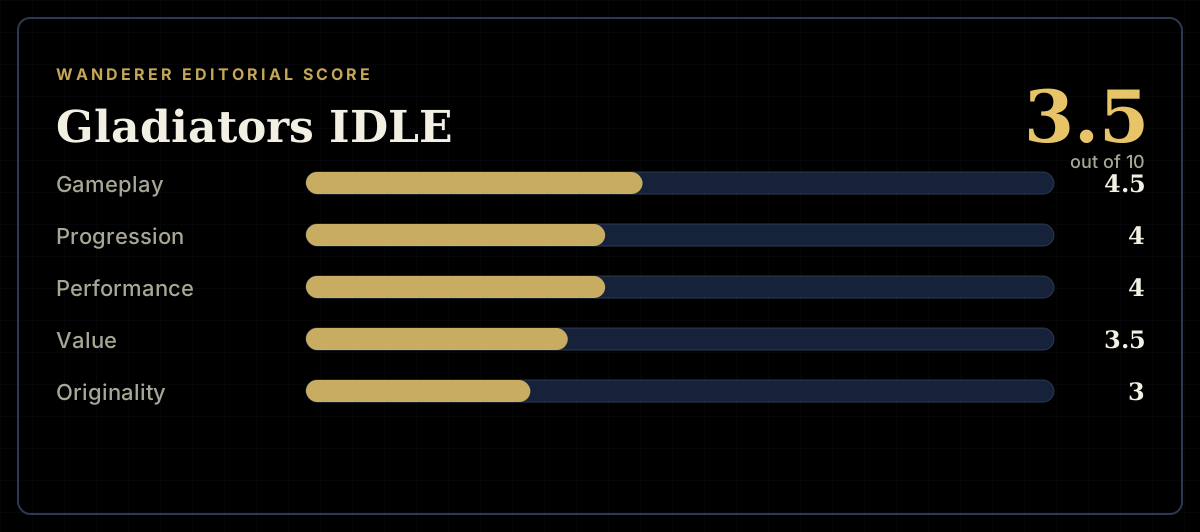
How the review scores each part of the gameWanderer Editorial -
The short versionWanderer Editorial