
Game review
Gambonanza Review
6.5 / 10
- Developer
- Blukulélé
- Publisher
- Sidekick Publishing / Stray Fawn Publishing
- Released
- 1 May 2026
- Platforms
- ["Windows", "macOS", "Linux"]
- Genre
- Strategy
Chess Meets Balatro, And Reviewers Can't Stop Saying So
Gambonanza, from developer Blukulélé and published by Sidekick Publishing and Stray Fawn Publishing, released on Steam on May 1, 2026, at $14.99. It reimagines chess as a roguelike deckbuilder: instead of checkmating a king, players win by capturing every enemy piece, spending money earned between rounds on "gambits" (Balatro-style joker items), special board tiles, and extra pieces, while a "crumble" mechanic punishes stalling by collapsing the board if too many turns pass without a capture. Across a large pool of English reviews read in full here, out of an all-language pool of 1,701 reviews sitting at 76% positive, "Mostly Positive," this is a genuinely divided review pool, and the division follows one consistent fault line: whether bolting a Balatro-style economy onto chess actually works.
The Comparison Isn't A Cheap Shot, It's The Entire Design Argument
Nearly every review in this pool, positive or negative, opens with some version of "Balatro, but chess," and the comparison runs far deeper than surface aesthetics. "Bashing this game for not being Stockfish is like bashing Balatro for allowing five Aces," wrote one defender, while a detailed critical review made the opposing case explicit: "Chess is not poker. It is not, in any way, a game of chance. Every move on the board is strategic, and even a pawn's placement can decide the outcome of a game... Balatro was able to make poker compelling by adding in new variables which broaden the potential for skilled play." That specific argument, that Balatro's genius was adding skill-expression to a game of chance, while Gambonanza does the reverse by adding chance to a game of pure skill, recurs across multiple detailed negative reviews independently, and it's the closest thing this pool has to a unifying theory for why the format sits uneasily on some players.
A Widely Corroborated Complaint: The Chess AI Doesn't Play Chess
The single most repeated specific criticism in this pool, showing up in reviews on both sides of the recommend line, is that the enemy AI behaves erratically rather than strategically. "The 'enemy AI' is generally terrible and will often blunder pieces for no reason," wrote one reviewer, while another, self-identified as roughly 2000-rated on chess.com, put it more precisely: "95% AI player moves is worse than 'bad' in chess.com... sometimes it acts like it doesn't know the rules at all and keeps sending its stuff to die for no reason." Multiple reviewers describe the resulting optimal strategy as waiting rather than playing: "the 'best' move is often to just burn turns and wait for the AI to inevitably make a huge mistake, which it will." Notably, even several reviewers who recommend the game acknowledge this pattern rather than deny it, arguing instead that the deeper gambit-synergy layer compensates for it once players push past the early stages.
Permanent Piece Loss And The Crumble Mechanic Draw The Sharpest Design Criticism
Beyond the AI, reviewers converge on a specific structural complaint: losing a piece in Gambonanza removes it for the rest of the run, which several argue breaks chess's core incentive to trade. "Losing a piece loses it for the whole run, so you're always disincentivized to trade. The end result is that games devolve into making waiting moves until a free capture shows up," wrote one reviewer, a sentiment echoed by another with a stated 1700 chess.com rating: "Losing pieces permanently after rounds end results in just a simply less fun experience... how it's executed (at least for now) relies too heavily on RNG for it to be worth enjoying." The crumble mechanic, meant to prevent that exact waiting behavior by forcing the board to collapse after too many idle turns, is itself criticized as a blunt fix: "The crumble mechanic is necessary to prevent indefinite stalling for the opponent to misplay, but it's frustratingly random," as one reviewer summarized it, and several others report boss encounters that force stalling by design, directly colliding with the crumble penalty in ways that feel arbitrary rather than tactical.
Balance Complaints Are Specific And Consistent: The Queen Dominates, The Economy Escalates
A third recurring thread concerns build variety and pacing. Multiple reviewers independently flag the same piece as the dominant strategy: "Queens are default the best unless you get a special relic that says otherwise," and another reviewer specifically wished the game would rebalance around this: "I would prefer if the queen were harder to get, that way other pieces have time in the spotlight." Shop economics draw similarly specific complaints, with one reviewer detailing how "on Strain TWO out of 6 it increases all shop prices by 20% in ADDITION to making your income threshold 1 per 15 instead of 1 per 10," a pace several other reviewers separately describe as outstripping the money a typical run earns. A number of reviewers also report that a large share of the roughly 200 available gambits feel weak or situational compared to a small handful of dominant picks, flattening what should be a wide space of possible builds into a narrower one.
What Convinces The Positive Majority: Presentation, Accessibility, And A Game That Rewards Learning Its Own Rules
Despite the detailed criticism above, a clear majority of this pool does recommend Gambonanza, and their reasoning is consistent: judged as its own roguelike rather than as chess, it holds up. "I feel like a lot of the reviews that mention the AI being bad or there being no actual deckbuilding haven't actually gone past stage 3. The further you go into the game the harder it gets, but there are a bunch of synergies you can make with gambits," wrote one reviewer, while another praised its on-ramp for non-chess-players specifically: "Someone who doesn't know how to play chess can actually play this... nothing else matters except the pieces and their movements." Reviewers across the pool, win or lose on the core debate, single out the presentation, music, UI, and boss variety as executed at a clearly professional level, and several specifically credit the developer's active post-launch balance patches for keeping the game feeling alive rather than abandoned.
Verdict
Gambonanza takes a genuinely inventive premise, chess rebuilt as a Balatro-style roguelike economy, and executes it with real polish in its presentation while running into exactly the friction its own reviewers predicted a game like this would run into: an AI that plays chess badly rather than tactically, a permanent-piece-loss system that fights against chess's own instincts around trading, and a crumble mechanic that punishes stalling without always giving players a real way to avoid it. The queen-dominance and escalating-economy complaints are specific and corroborated rather than vague grumbling, and the developer's active patch cadence suggests at least some of this is being worked on rather than ignored. At $14.99, this is a reasonable pick for roguelike-deckbuilder fans who don't mind their chess theming loosely worn, and a more cautious buy for anyone hoping the Balatro formula would finally crack real chess strategy, because by this pool's own detailed account, it mostly hasn't yet.
Screenshots
-
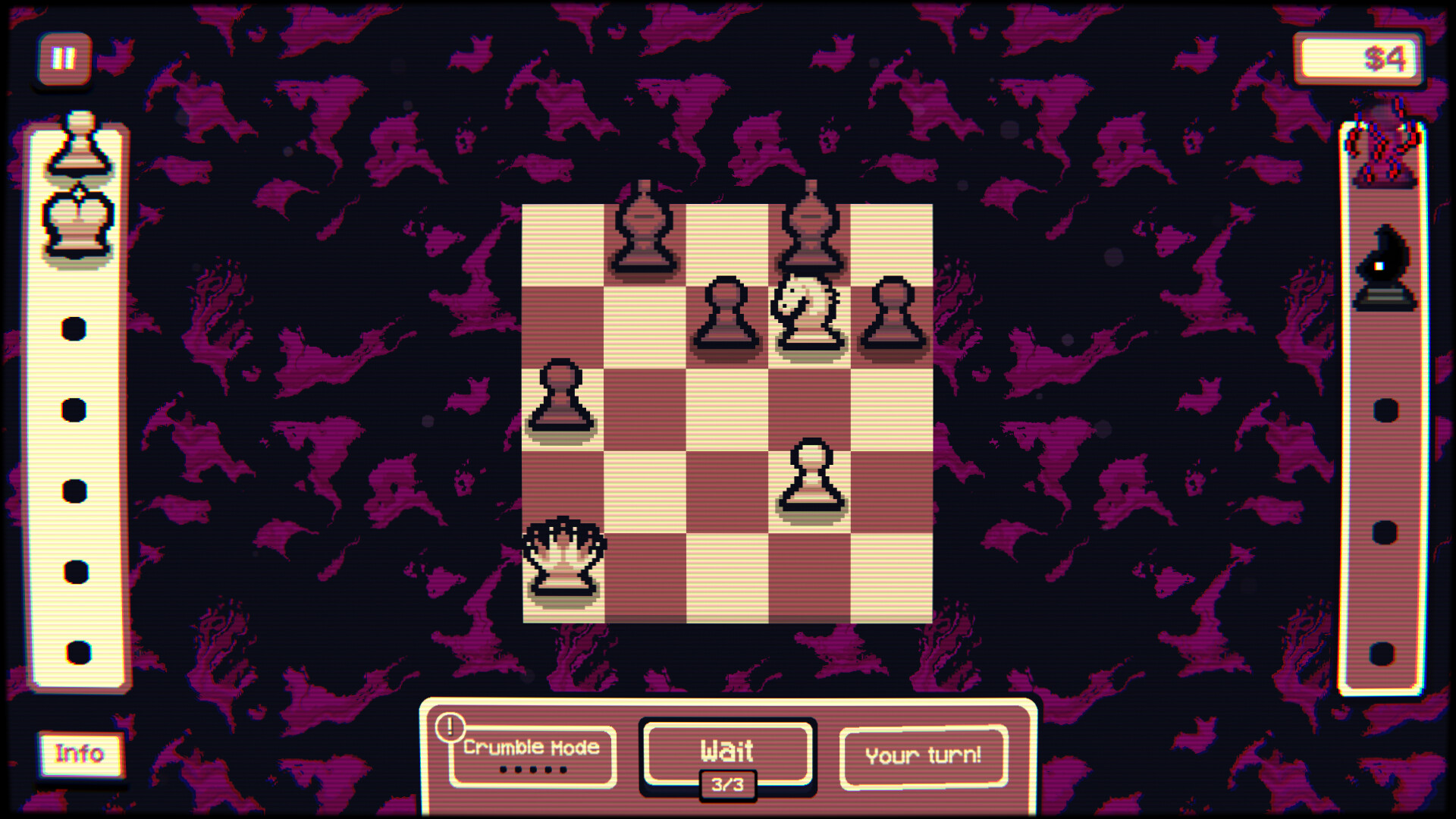
A match in progress, with the Crumble Mode meter ticking down in the corner, the mechanic that forces the board to collapse if too many turns pass without a capture.Image: Blukulélé via Steam -
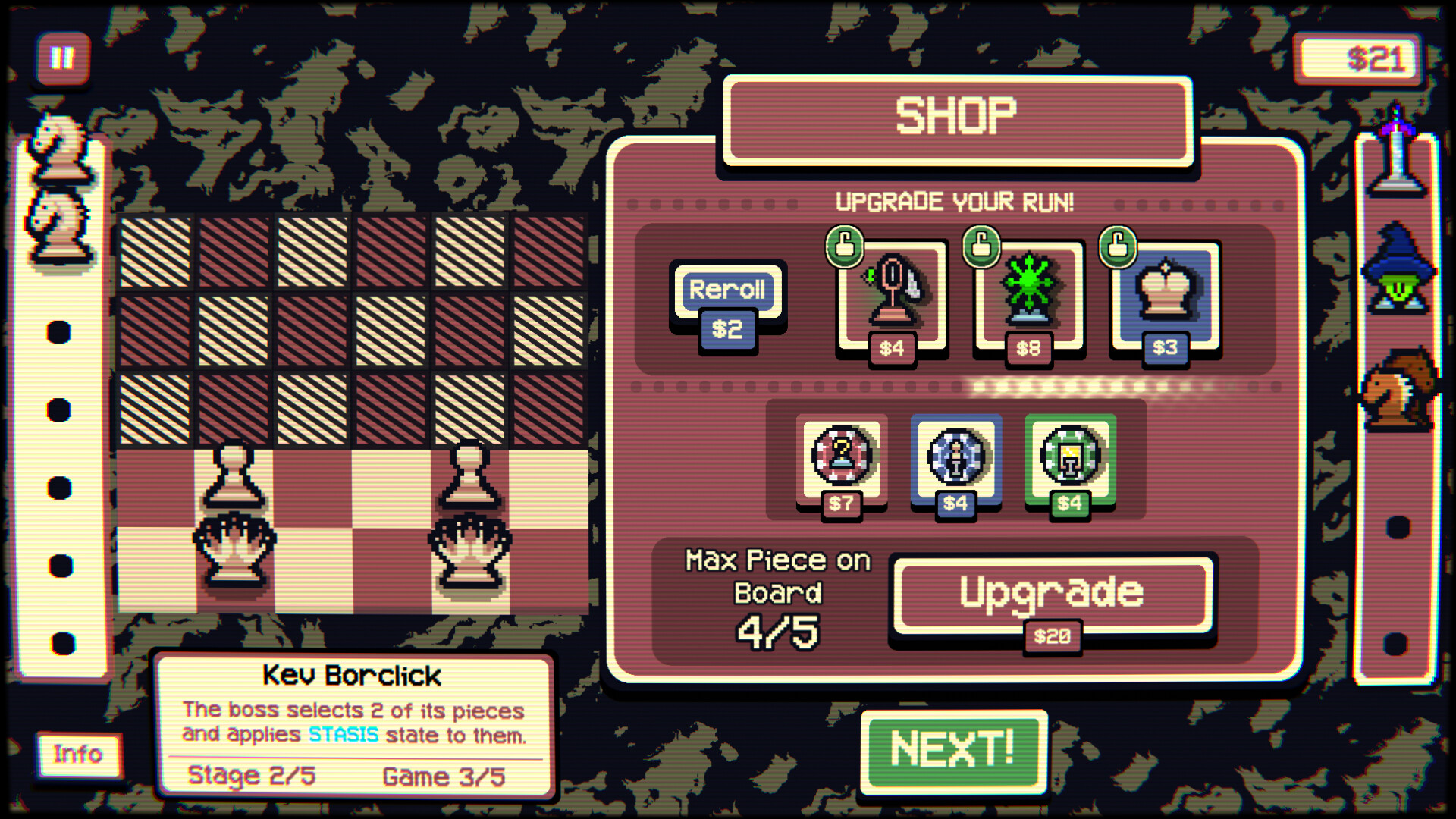
The shop screen between rounds, where run earnings buy gambits, relics, and board upgrades before the next boss fight.Image: Blukulélé via Steam -
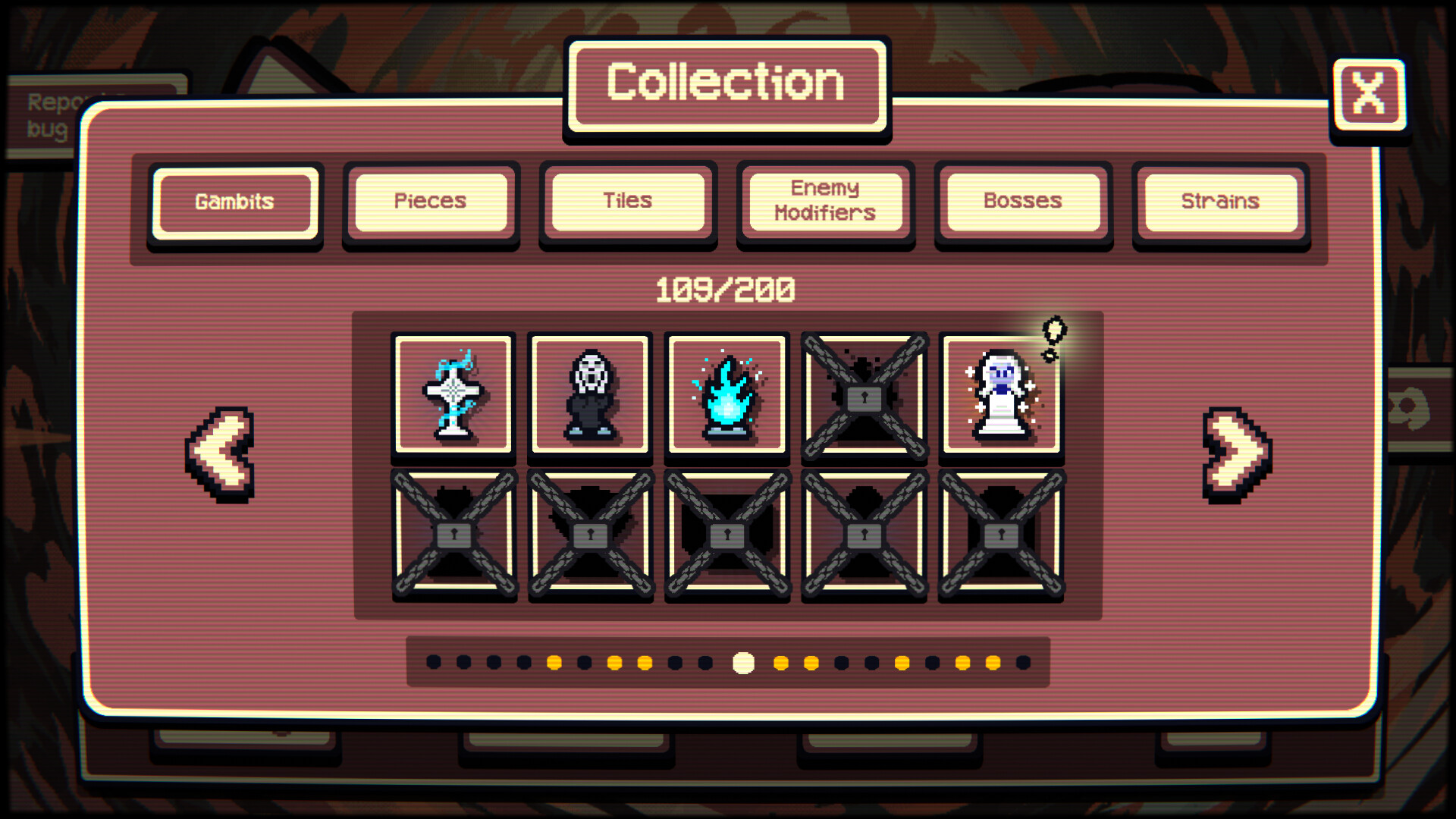
The Collection screen, tracking progress toward the roughly 200 gambits, pieces, and modifiers reviewers say only a fraction feel truly build-defining.Image: Blukulélé via Steam