
Game review
Foxhole
6.5 / 10
- Developer
- Siege Camp
- Publisher
- Siege Camp
- Released
- 27 July 2017
- Platforms
- Windows
- Genre
- Massively multiplayer persistent war sandbox
- Monetisation
- One-off purchase, no in-game currency, ads or gameplay-affecting purchases; every major update across nine years of development has been free
- Players
- Core to the entire design — servers hold hundreds of simultaneous players split into two factions, with wars typically running for one to several weeks before a decisive victory
The short version
Foxhole is one of the few genuinely unique things on Steam: a persistent, weeks-long war fought entirely by real players filling every role, from the soldier holding a trench to the logistics driver keeping that trench supplied with shells it can't fight without. Its own longtime players — some with playtimes running past five thousand hours — describe real, singular moments this design makes possible that nothing else on the platform can replicate. Set against that is an equally consistent, equally credible set of complaints from players with comparably enormous investment: persistent cheating (aimbots, "night hacks" exploiting visibility) that experienced players say has gotten worse as the aiming system itself changed, a ban and reporting system multiple reviewers describe as exploitable by organized groups against individual players with little recourse, and balance decisions contentious enough that one detailed review alleges the developers deliberately skewed faction tuning to counter an organized review-bombing campaign. Nine years of continuous, substantial free updates — a full naval warfare expansion, an airborne update, a proper 1.0 release, and new content as recently as this year — proves a real, sustained commitment to the project that the "abandoned early access husk" framing some critics reach for simply doesn't fit. What it doesn't resolve is a genuine, ongoing tension between the game's emergent highs and a community layer its own most dedicated players say needs real structural fixing.
Biggest strengths
- A genuinely unique, emergent large-scale war sandbox where logistics, base-building, and combat all depend on real players rather than AI, producing singular moments reviewers say nothing else on Steam replicates
- An extraordinary nine-year record of continuous, substantial free content — naval warfare, airborne combat, a full 1.0 release, and new updates as recently as mid-2026 — with no monetisation beyond the one-time purchase
- A real, if divided, sense of community investment; multiple reviewers frame even harsh, mixed reviews as coming from players who love the game and want it improved rather than players who've given up on it
Biggest weaknesses
- Persistent, credible cheating reports (aimbots, exploits affecting night visibility) from extremely high-playtime reviewers, with at least one attributing worsening aim-assist complaints partly to changes in the base aiming system itself
- A moderation and reporting system multiple independent reviewers describe as exploitable, citing organized groups mass-reporting individual or solo players and having bans issued without apparent review
- A specific, serious allegation that faction balance was deliberately skewed in response to an organized review-bombing campaign rather than tuned on competitive merit alone — reported here as one detailed reviewer's claim, not independently verified
Who it's for: Players specifically drawn to large-scale, slow-burn, cooperative-and-competitive warfare who want their individual actions to matter inside something much bigger than themselves, and who can tolerate real friction with other players along the way. Not recommended for anyone wanting a polished, curated multiplayer experience free of griefing, cheating concerns, or community-run politics.
Our recommendation: Worth trying for the genuinely unmatched concept, with realistic expectations set by its own veteran community: extraordinary highs are real and achievable, but so is real frustration with cheaters, faction balance, and how disputes between players get resolved.
6.5 / 10
Foxhole's premise is genuinely rare on Steam: thousands of real players, split into two factions, fighting a single persistent war that can run for weeks, where every rifle round, truck, and trench is built and moved by someone actually playing the game rather than generated by a system behind the scenes. It entered Early Access in July 2017 and didn't reach 1.0 — subtitled "Inferno" — until September 2022, five years later; the storefront's own metadata only surfaces that later date, but the developer's own partner-events history confirms the Early Access launch is the game's true original release. Across those nine years and counting, Foxhole has built one of the largest, most dedicated communities encountered anywhere in this research window — nearly 29,600 English reviews, 78% Mostly Positive — and reading through them means confronting a genuinely complicated picture: extraordinary praise for what the design makes possible, and equally serious, specific complaints from players who've invested thousands of hours in the same game.
A design nothing else on Steam quite replicates
The core praise across the sample centers on scale and consequence. One reviewer with 1,343 minutes of early playtime describes recruiting "a bunch of Australians into my new dirty dozen squad," using explosives to breach an enemy wall, and derailing an entire enemy operation in a single coordinated action — the kind of emergent, player-authored moment the design is built to produce. Another, with years of continuous play, frames the appeal plainly: "there is something for everyone that likes the genre," from front-line combat to the logistics work of keeping supply lines running. A veteran player who deliberately switches to whichever faction is losing after each war, specifically to experience "both Warden and Colonial factions," describes this as making "the fight more rewarding" precisely because the game's persistent stakes give that choice real meaning. These aren't casual endorsements — they're detailed accounts from players with the kind of investment (thousands of logged hours in several cases) that lends real weight to the claim that Foxhole does something genuinely singular.
Cheating, reported by the people with the most to lose
Set against that is a specific, credible thread of complaints about cheating, made more notable by who's making them. One reviewer with over 7,000 hours logged writes: "After many fun hours in Foxhole, I've finally had enough of the hacks (night hacks, aimbot). I kinda understand the aimboting, because the aiming system in Foxhole has become worse over the last few updates." Another, more recent review states flatly: "Blatant cheating, extremely imbalanced mechanics between the two factions that are extremely frustrating and have no real counter play." These aren't complaints from players bouncing off the game early — they're accounts from people who stayed long enough to watch a specific problem get worse, which is a meaningfully different and more concerning signal than an early negative review venting about difficulty.
A ban system its own veterans call exploitable
A second serious, recurring complaint concerns how disputes between players get resolved. One reviewer with over 100,000 minutes (well over 1,600 hours) logged describes a specific structural problem: "big regies [regiments] dont allow you to do anything. There is no support you can make tickets but they never even look at them. Alt accounts will mass report you and you get banned without anyone even looking into it." A separate reviewer corroborates the shape of this complaint independently, describing being "mass reported" by a regiment after taking vehicles and getting banned as a solo player, calling the incident evidence the playerbase skews toward organized groups able to weaponize the report system against individuals. Two independent, high-playtime accounts describing the same specific failure mode — reports acted on without apparent review, disadvantaging solo or smaller players against organized groups — is strong enough convergence to treat as a real, structural weakness rather than sour grapes from banned players.
A specific, serious balance allegation
The most serious single claim in the sample comes from a detailed, heavily-upvoted review alleging deliberate manipulation: "what I can't live with is a faction being over tuned because they did an organized review bomb of the game. Devs have intentionally thrown any semblance of balance in order to artificially keep winrates near even." This review found no way to independently verify a claim about the developers' internal motivations, and reports it here as exactly that — one detailed reviewer's serious, specific allegation, not a confirmed fact. It's worth noting alongside it that other veteran reviewers explicitly frame Foxhole's often-mixed recent review period differently: one states directly that "the mixed reviews come from a community that loves foxhole and want to see the devs keep making changes that improve the game," not from a community that's given up. Both readings come from serious, invested players, and this review presents them as the genuine, unresolved disagreement they are rather than picking a side.
Nine years of updates that contradict the "abandoned" framing
Whatever the merits of the balance and cheating complaints, one claim doesn't survive a direct check against the record: that Foxhole is an early-access project the developers let stagnate. The partner-events history shows an almost unbroken cadence of numbered major updates from launch through the present — 66 and counting as of this review — including a full Naval Warfare expansion in 2023, an Airborne combat update in early 2025, and new content shipping as recently as August
- One detailed critical review does raise a more specific, more defensible version of a
similar complaint: that the studio has "focused on adding more content" — new vehicles, new theaters of war — "instead of fixing the core game issues and refining the gameplay loop." That's a fair, distinct criticism from claiming the game was abandoned, and it's worth preserving that distinction rather than treating every long-term-player complaint as the same accusation.
Verdict
Foxhole remains a genuinely singular achievement in scale and design, and its own most invested players are proof the highs it makes possible are real. It's equally true, by the account of players with comparable investment, that cheating, an exploitable moderation system, and contentious balance decisions are real, ongoing problems that nine years of substantial free content haven't resolved. Both things are true at once, and a reader deciding whether to join a community this large and this passionate should weigh both honestly rather than picking whichever half of the story is more convenient.
Sources: Steam store page and appdetails API (release date, pricing, platform data); Steam's aggregate review data (query_summary totals, English-language sample); individually read user reviews, both positive and negative, sorted by helpfulness and recency, with particular attention to reviewer playtime as a credibility signal; Steam's global achievement statistics API (confirmed no achievement schema exists, typical for this kind of persistent MMO); Siege Camp's own partner-events history, an unbroken record of major updates from the Early Access launch in July 2017 through August 2026.
Pros and cons
Pros
- A genuinely unique, emergent large-scale war sandbox where logistics, base-building, and combat all depend on real players rather than AI, producing singular moments reviewers say nothing else on Steam replicates
- An extraordinary nine-year record of continuous, substantial free content — naval warfare, airborne combat, a full 1.0 release, and new updates as recently as mid-2026 — with no monetisation beyond the one-time purchase
- A real, if divided, sense of community investment; multiple reviewers frame even harsh, mixed reviews as coming from players who love the game and want it improved rather than players who've given up on it
- Faction-switching between wars lets dedicated players experience both sides of the conflict, which several reviewers say deepens rather than dilutes their long-term investment
- The scale of persistent, weeks-long wars with real material stakes (supply lines, captured territory) gives individual actions consequences most multiplayer games can't match
Cons
- Persistent, credible cheating reports (aimbots, exploits affecting night visibility) from extremely high-playtime reviewers, with at least one attributing worsening aim-assist complaints partly to changes in the base aiming system itself
- A moderation and reporting system multiple independent reviewers describe as exploitable, citing organized groups mass-reporting individual or solo players and having bans issued without apparent review
- A specific, serious allegation that faction balance was deliberately skewed in response to an organized review-bombing campaign rather than tuned on competitive merit alone — reported here as one detailed reviewer's claim, not independently verified
- Community friction is a real, recurring theme distinct from the mechanics themselves: reports of teamkilling, theft of player-built resources, and unhelpful or unresponsive support tickets
- Core movement and combat mechanics are described by at least one detailed reviewer as clunky, citing specific frustrations like unreliable stance transitions under pressure
Screenshots
-

FoxholeImage: Siege Camp via Steam -

FoxholeImage: Siege Camp via Steam -

FoxholeImage: Siege Camp via Steam -
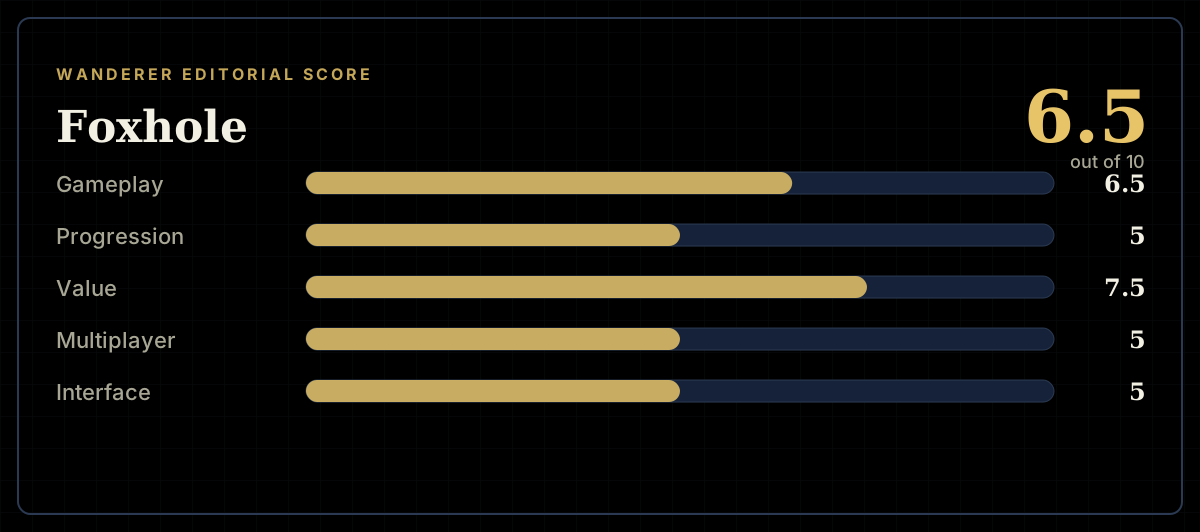
How the review scores each part of the gameWanderer Editorial -
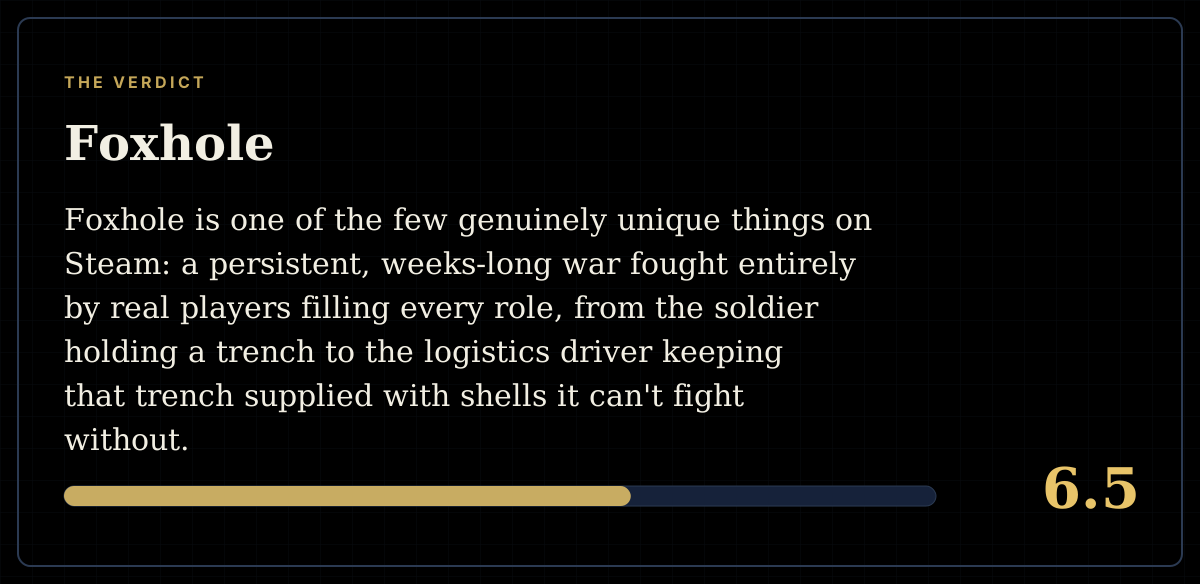
The short versionWanderer Editorial