
Game review
Farmer and Ghost Review
6 / 10
- Developer
- Lê Trang Hoàng Huy
- Publisher
- Lê Trang Hoàng Huy
- Released
- 17 August 2026
- Platforms
- ["Windows", "Mac", "Linux"]
- Genre
- RPG
A Twenty-Fifth Consecutive Launch Without a Single Review
Farmer and Ghost released on Steam on 17 August 2026 and has zero user reviews at the time of writing, extending this stretch's run of unreviewed launches to a quarter-century of consecutive titles. It's also a genuinely solo effort — the store page lists a single named individual, Lê Trang Hoàng Huy, as both developer and publisher, with no studio branding attached. A day/night farming-and-monster-hunting hybrid with a specific, rarely-depicted cultural setting is a distinctive enough pitch that its total silence a month after launch is worth noting. This review is built entirely from the developer's own store page description, not from verified play.
A Farmer by Sun, a Mage by Moon
The structural hook is a clean day/night split: by day, players plant, water, and harvest rice, vegetables, and fruit as "an ordinary farmer," building up a plot of land in the peaceful countryside; by night, "an ancient evil awakens" and the same character becomes "a powerful mage," fighting off ghosts and monsters to protect the village market before dawn. That's a more literal and thematically justified version of a device several farming-adjacent RPGs use loosely — rather than treating farming and combat as two disconnected minigames stitched together, the framing here ties them to a single in-fiction daily cycle, with the farmer's daylight labour and the mage's nighttime defense both belonging to the same person and the same stakes. Whether that day/night split ends up feeling like two genuinely balanced halves of a game, or whether one side (most likely the combat, given the "boss battles" and "powerful magic system" billing) ends up as the main event with farming reduced to a resource-gathering chore, is the kind of pacing question only actual play could settle.
A Mekong Delta Setting, Rarely Seen in RPGs
The game's most distinctive asset isn't a mechanic but its setting: a pixel-art countryside "inspired by the Mekong Delta of Vietnam," featuring rivers, rice fields, fruit gardens, temples, and forests alongside "mysterious haunted locations." Farming RPGs are a crowded genre built almost entirely around Western or Japanese rural iconography, so a game explicitly grounded in Vietnamese countryside geography and, per its supported-languages listing, offering full Vietnamese-language voice audio alongside English, is a meaningfully different cultural lens on a familiar genre shape rather than a reskin. That specificity extends to the game's antagonists too — rather than generic slimes or skeletons, the nighttime threats are framed as ghosts and demons drawn from the setting's own folklore context, tying the horror half of the pitch to the same cultural grounding as the daytime farming half instead of importing a separate, disconnected monster-design vocabulary.
Craft by Firelight, Fight Before Dawn
Progression is built around crafting and upgrading "magical weapons, farming tools, protective gear, and powerful equipment" from gathered materials, which suggests the day and night halves feed into each other mechanically as well as thematically — presumably, resources harvested or found during the day get turned into the gear a player needs to survive that same night's demon attack. The central combat structure revolves around defending the village market, which comes under attack from "powerful demons" every few nights; failing to defeat them before sunrise costs villagers their lives, giving the nightly defense a stated failure consequence beyond a simple game-over screen. Rewards for successful defenses are described only generically as "valuable," and "stronger enemies" are promised as a sign of escalating difficulty, though the store page gives no detail on how many distinct boss types exist or how steeply that escalation ramps.
That villager-stakes framing is a smart way to make the market-defense loop feel consequential rather than just another wave-survival minigame, but it also raises a question the store page doesn't answer: what actually happens if a defense fails. Whether losing villagers is a soft narrative beat, a hard fail-state that ends a run, or a permanent loss that reshapes the village going forward would meaningfully change how much pressure the nightly combat carries, and a single-developer game at this price point may reasonably lean toward the gentler end of that spectrum to keep the overall experience relaxing rather than punishing.
A Modest, Focused Solo Release
Farmer and Ghost supports Windows, Mac, and Linux, offers full audio in both English and Vietnamese, and is priced at NZ$6.39 with no discount at the time of writing — a budget entry point that fits a solo developer's likely scope rather than promising a sprawling, systems-heavy RPG. No in-app-purchase category is listed on the store page, so crafting and equipment progression appear to run entirely on materials gathered through play rather than any real-money shortcut, which is the expected and appropriate default for a game this modestly priced. The listed accessibility options — custom volume controls and playable-without-timed-input support — are fairly minimal compared to some other titles in this run, though not unusual for a small, single-developer project working with limited resources.
Verdict
Farmer and Ghost pairs a well-worn farming-sim structure with genuine cultural specificity — a Mekong Delta setting, full Vietnamese voice audio, and folklore-rooted nighttime threats — inside a day/night loop that at least on paper ties its two halves together thematically rather than bolting them on as separate minigames. As a solo developer's budget release, its ambitions are appropriately modest, and its central open question is whether the farming and combat halves are balanced well enough that neither feels like filler for the other. A month without a single review says little either way for a solo release at this price point, where visibility rather than quality is often the bigger obstacle; this assessment rests entirely on the developer's own description rather than anyone's actual playthrough.
Screenshots
-
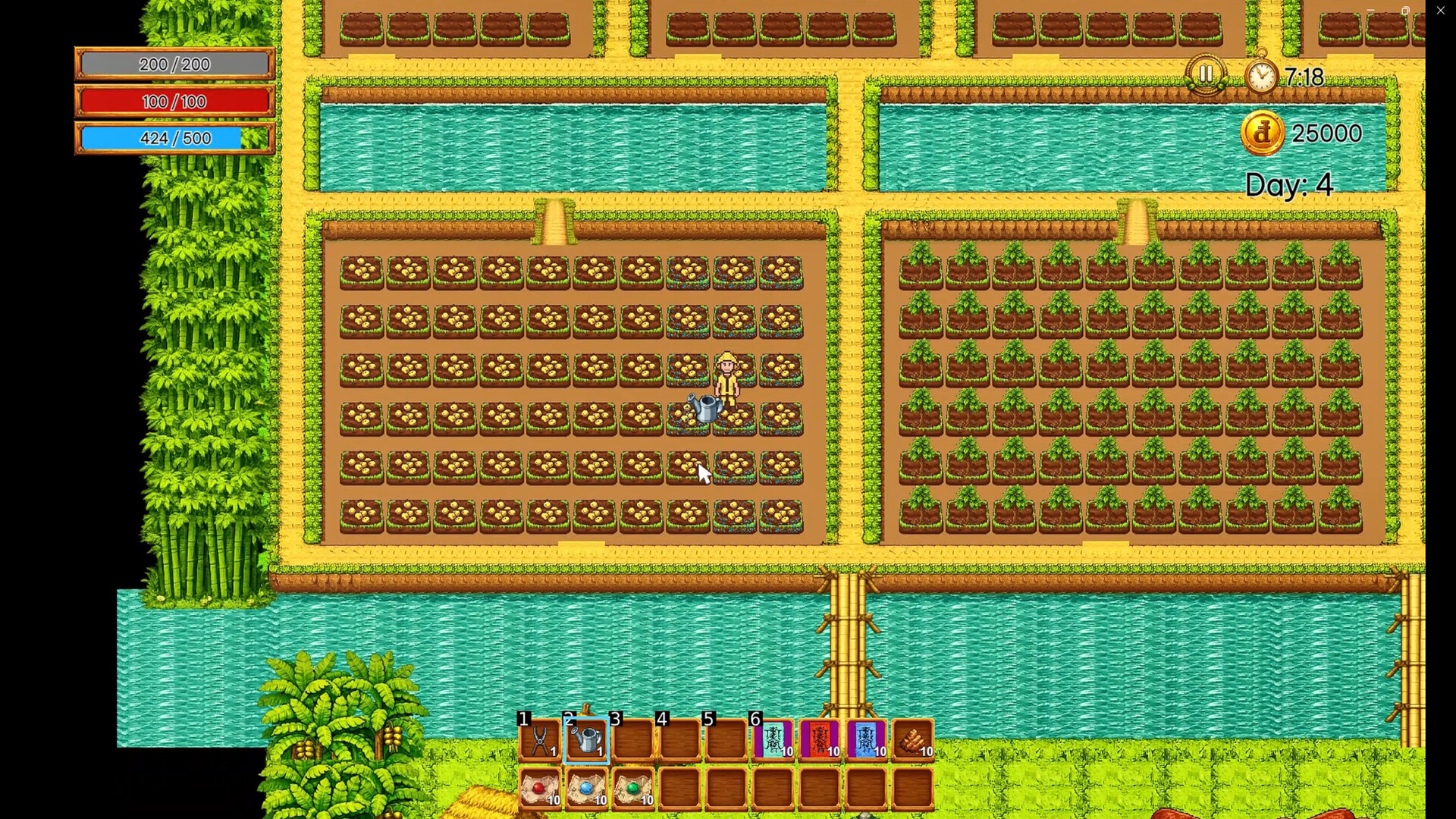
Tending watered crop rows on the farm, with the day/night clock and currency tracked in the corner HUDImage: Lê Trang Hoàng Huy via Steam -
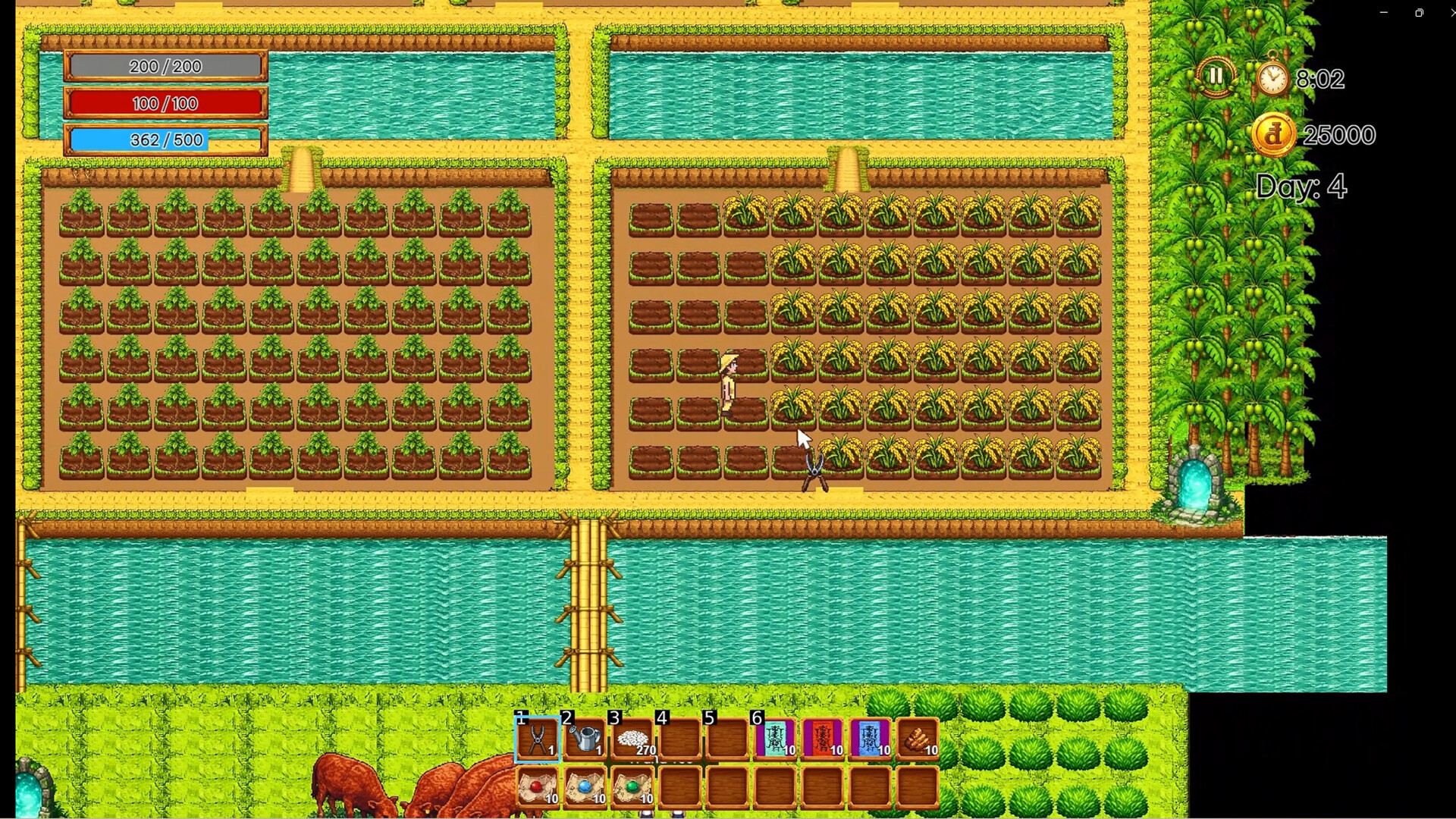
A more developed section of the farm, with rice ready for harvest and livestock nearbyImage: Lê Trang Hoàng Huy via Steam -
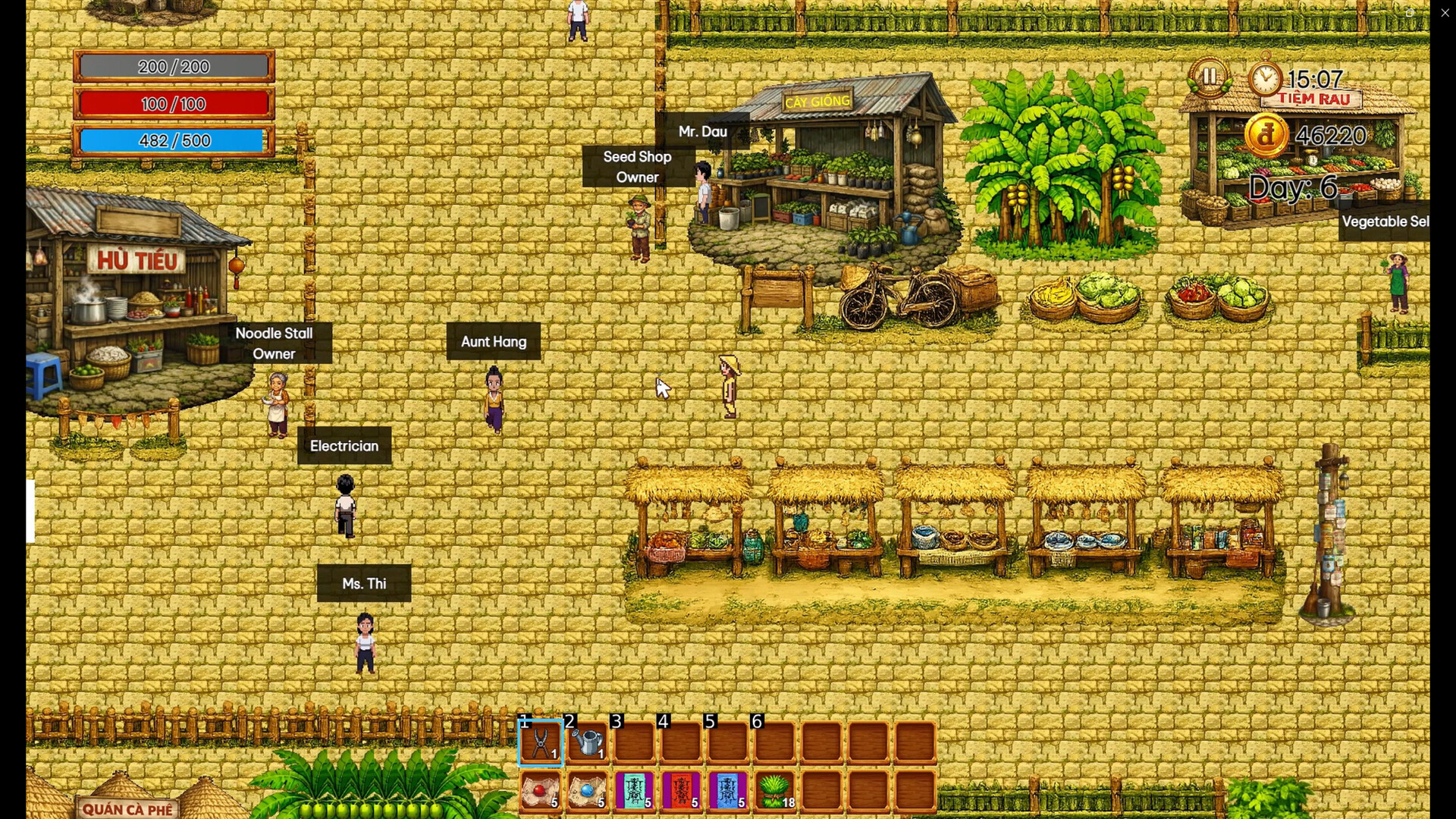
The village market hub, populated by named NPCs and Vietnamese-language shop signage — the location players defend from nightly attacksImage: Lê Trang Hoàng Huy via Steam