Game review
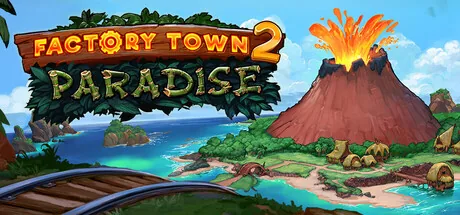
Factory Town 2: Paradise
8 / 10
- Developer
- Erik Asmussen
- Publisher
- Erik Asmussen
- Released
- 14 July 2026
- Platforms
- Windows, macOS
- Genre
- Factory Automation / Town Builder
- Monetisation
- One-time purchase, no in-app purchases, no ads, no DLC
- Players
- Single-player
The short version
Factory Town 2: Paradise takes everything Erik Asmussen built in the original Factory Town and rebuilds it around a controllable avatar, water-driven power, catapults, ziplines and a giant volcano that rewards you for feeding it. It asks longtime fans to unlearn habits from a game they already loved, and a vocal minority never forgives it for that. Everyone who sticks around past the first few hours generally comes out the other side agreeing it's the better game.
For an Early Access release barely three weeks old at review time, it's remarkably complete — a full campaign arc from a single island to a saved world is already playable — and the asking price buys a game with no further monetisation lurking behind it. The interface still needs real work, and multi-island logistics can turn into a genuine headache before you've unlocked the tools to fix it, but the bones underneath are excellent.
Biggest strengths
- Water wheels, ziplines and catapults give you real alternatives to conveyor-belt spaghetti, and workerless early automation via water power changes how the opening hours actually play
- Villagers now act as independent agents who travel to gather, deliver, craft and rest rather than sitting fixed at one building, adding a believable town-simulation layer on top of the factory logic
- The volcano quest chain gives Early Access a real, playable campaign arc from a single island to a multi-island economy, rather than a sandbox with no throughline
Biggest weaknesses
- The playable avatar adds a layer of physical movement to a genre whose fans generally came for top-down planning, and a meaningful slice of veteran players find it gets in the way rather than adding anything
- Worker behaviour (gather, deliver, craft, sleep) isn't clearly explained, and figuring out what a villager is doing at any given moment takes more guesswork than a management sim should require
- Once a second or third island is in play, market placement and worker travel time become a real bottleneck with few tools to diagnose or rebalance it before you've earned better logistics tech
Who it's for: Existing Factory Town and Factory Town Idle players curious what a from-scratch sequel looks like, and factory-automation fans who want something gentler than Factorio or Satisfactory without losing real depth. Less suited to players who want a finished, fully polished release right now, or who specifically want to route belts without ever touching a movement key.
Our recommendation: Worth buying now if you're comfortable with Early Access rough edges and want to shape where the game goes; worth waiting for full release if you'd rather get the complete, QoL-polished version on day one.
8 / 10
Erik Asmussen had a working formula. Factory Town, his original 2018-to-2021 release, is a spatial logistics game about laying conveyor belts and pipes across 3D terrain and watching goods physically travel from mine to market — patient, top-down, satisfying in the way good factory games always are. He also had a menu-driven idle reimagining of that same economy, stripped of the belts entirely. Factory Town 2: Paradise is neither of those things. It keeps the belts and the terrain, but rebuilds almost everything else: you now walk your own avatar around a tropical island, villagers wander off to gather and deliver goods on their own initiative, water wheels and catapults replace or supplement the old delivery chain, and the whole economy exists to feed a benevolent, hungry volcano that hands out superpowers in exchange for tribute. It's a sequel that changes more than most players asked for, and it takes real commitment before it becomes obvious that changing that much was the right call.
An island, a volcano, and a lot more moving parts than the original
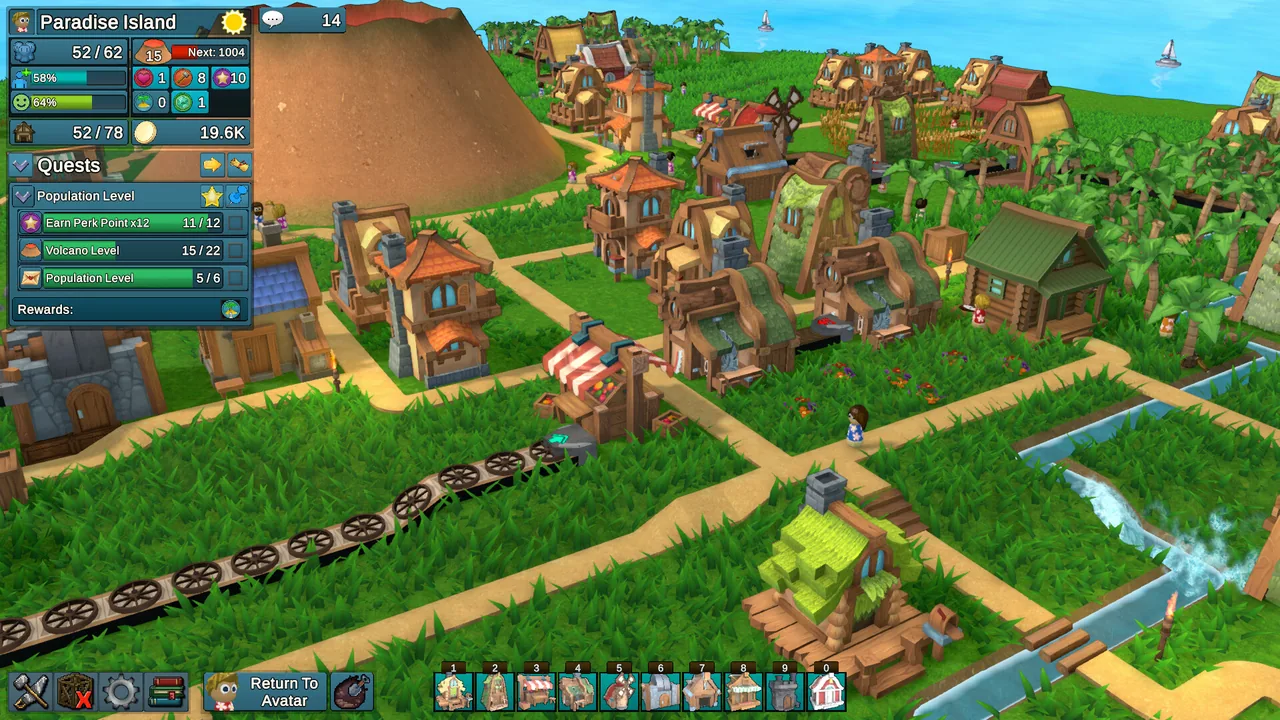
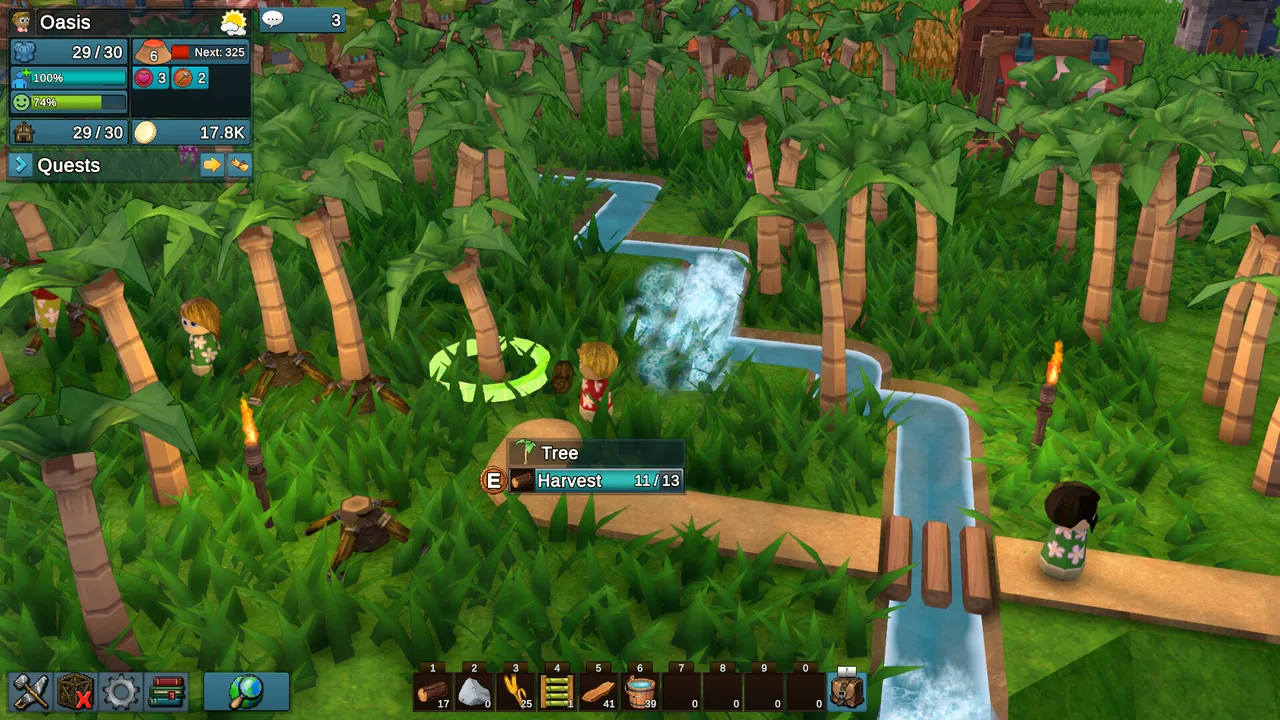
The setup is disarmingly simple: you wash up on an uninhabited island, harvest a handful of raw resources, and start building houses, shops and roads to attract villagers who take over your production tasks. From there the game escalates fast. Water physics let you dig trenches and place dams to route spring water down to farms and reservoirs, and waterwheels turn that flow into either mechanical boost for processing buildings or electricity that runs down power lines to refrigerators and furnaces — a genuinely new layer of infrastructure the original never had, and one that rewards thinking about terrain the way the belt-and-pipe system used to. Catapults handle last-mile delivery over obstacles a road can't cross, ziplines move villagers quickly between distant points, and trains eventually connect islands once your economy outgrows a single landmass. None of this replaces the conveyor belt — it's still there, still doing the job it always did — it just stops being the only tool in the box, which is the single biggest structural change from the original game.
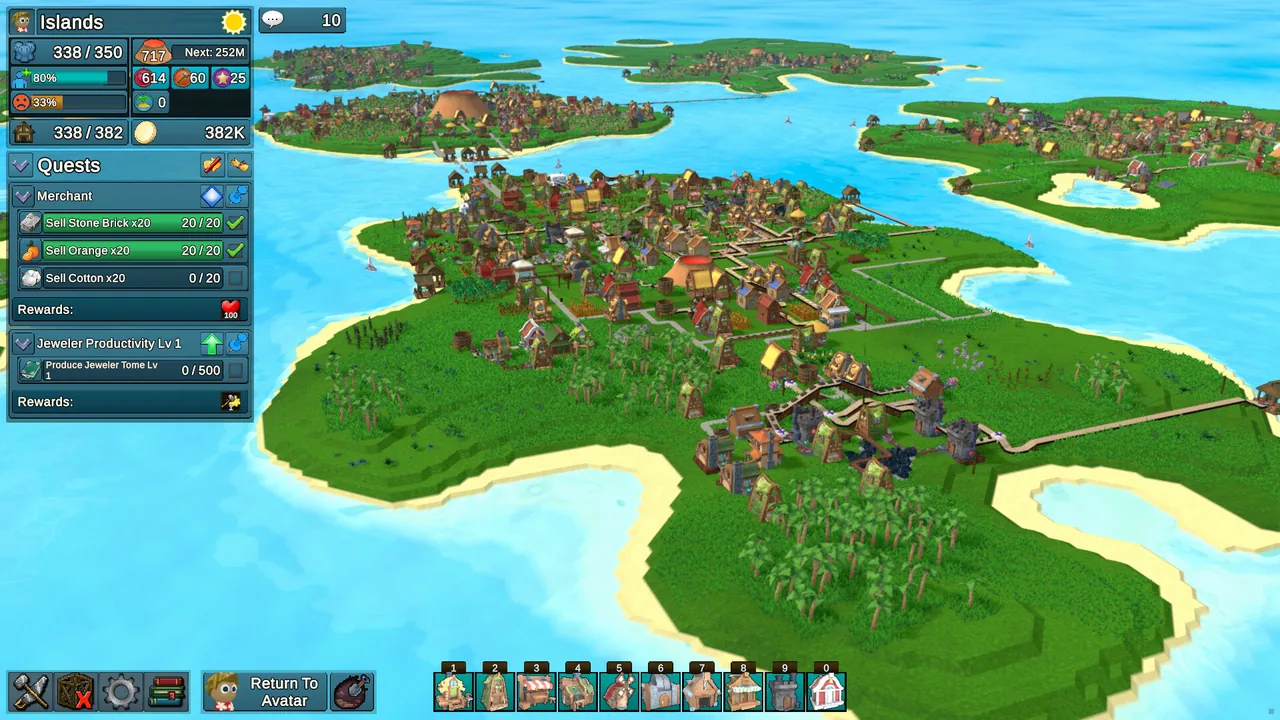
Sitting above all of it is the volcano, a genuinely charming set-piece that gives the whole campaign a spine the sandbox-first original never had. Feed it the right items and it grants new recipes, technology and upgrades, occasionally summoning new islands out of the ocean when your existing land runs out of room. It's a lightweight framing device rather than a deep narrative, but it turns "build whatever you want" into "build whatever you want, with a reason to keep going," and Early Access already supports a full arc from that first banana offering through to a saved, multi-island economy — a rarer thing to find this early in an Early Access factory game than the genre's reputation for endless unfinished sandboxes might suggest.
The avatar is the fault line
Every piece of player feedback around Factory Town 2 eventually runs into the same fork in the road: what you think of the controllable character. Where the original let you plan an entire economy from a fixed top-down camera, the sequel puts you on the ground, walking your avatar between buildings, interacting with the world directly, and switching to the overhead planning view only when you actually want to lay out belts and buildings. For a meaningful number of returning players — including some with hundreds of hours in the first game — that's simply the wrong direction for a genre they came to for spatial puzzle-solving from a bird's-eye view, not for character movement. The complaint shows up again and again in early reviews: the avatar "gets in the way," makes simple tasks feel like extra steps, and turns a genre built around zooming out into one that occasionally asks you to zoom back in and walk somewhere.
The counter-argument, which shows up just as often from players who pushed past the first few hours, is that the avatar mode stops mattering once the economy is running and you're spending most of your time in the overhead camera anyway — several reviewers describe the game only really "clicking" for them around the six-hour mark, once they'd stopped fighting the movement and started treating it as an occasional tool rather than the main interface. That's a real design tension rather than a simple mistake: the avatar genuinely does add friction to the pure planning loop the original nailed, but it also lets Asmussen build interactions — the direct feeding of the volcano, the physical sense of walking your own island — that a fixed camera couldn't support. Whether that trade is worth it depends heavily on what you came to this genre for in the first place.
Villagers with their own agenda
The other structural change is how villagers behave. In the original Factory Town, assigning a worker to a building meant they stayed there, doing that job, full stop. In the sequel, villagers cycle through gathering, delivering, working and resting on their own schedule, moving between tasks as an independent agent rather than a fixed cog. It's a smarter simulation on paper — it means your town looks and feels more like a living place, with people visibly walking to market and back rather than standing at a single tile forever — but it comes at the cost of legibility. Several players have raised the same specific frustration: it isn't obvious what a given villager is actually doing at any moment, whether a building needs more workers or just better logistics, or what a sleeping villager's building is doing while they're off the clock. The original's simplicity had a real virtue that the sequel's more sophisticated system hasn't fully replaced with equivalent clarity.
That legibility problem compounds once a second or third island enters the picture. Markets need stock, and workers travel to markets to buy the goods that keep their needs met — but if every market sits on your main island, workers on a satellite island can spend more time commuting than producing, and there's little in the current interface to help you see that happening before your whole outer-island economy quietly stalls. It's the same fragile-supply-chain problem that showed up in Factory Town Idle's production stats, translated into a physical, travel-time version instead of an abstract one — and it's the area where "Early Access" is doing the most legitimate work as an excuse, because the tools to diagnose it clearly don't exist yet.
Presentation, pacing, and no clock chasing you
Visually, Factory Town 2 is a clear step up from its predecessor: a day-night cycle, volumetric water that actually behaves like water when you dam or trench it, and a warm, tropical-island palette that suits the volcano framing better than the original's more generic biomes did. Clark Aboud's soundtrack — the same composer behind the first Factory Town and the Slay the Spire scores — returns and does a lot of the same work here, giving the whole thing a relaxed, unhurried atmosphere that matches the design philosophy explicitly stated on the store page: no harsh penalties, no time pressure, room to experiment. That philosophy holds up in practice. Nothing in Factory Town 2 punishes you for trying an inefficient layout and tearing it down later, which keeps the whole experience closer to a sandbox you're gently guided through than a game you can lose.
Recipe discovery is the one place that stated philosophy runs into friction. You can only see the full recipe list for an ingredient once you've unlocked the building that consumes it, rather than being able to plan a supply chain in advance — which means players frequently build a production line, unlock the next tier, and discover the new recipe needs an ingredient from clear across the island they've already committed resources to elsewhere. It's a small thing individually, but it recurs often enough in player feedback to count as a genuine design gap rather than a one-off annoyance, and it sits awkwardly next to a game that otherwise goes out of its way to avoid punishing experimentation.
Value and where Early Access actually stands
At NZ$38.49 with no additional in-app purchases, ads, subscription or announced DLC, Factory Town 2 follows the same honest, one-time-purchase model as both of Asmussen's earlier releases — you're not buying into a live-service roadmap with a monetisation layer waiting behind it. What you are buying into is Early Access, and it's worth being precise about what that means here three weeks after launch: the core loop, the campaign arc, and the late-game multi-island structure are already playable start to finish, which is genuinely unusual for a factory game this early in its Early Access life. What's still rough is exactly what you'd expect from a young Early Access build — onboarding that assumes more genre knowledge than a first-time player has, missing stats and diagnostic screens, and quality-of-life gaps around trains and worker management that the developer is visibly iterating on in response to community feedback rather than ignoring. A track record of finishing and supporting his last two releases gives reasonable confidence that most of this resolves over the game's Early Access life, but it isn't resolved yet, and the asking price should be weighed against buying an unfinished game rather than a finished one.
Final verdict
Factory Town 2: Paradise is a braver sequel than its marketing lets on. It would have been easy for Erik Asmussen to reskin Factory Town with a tropical coat of paint and call it done; instead he rebuilt the delivery systems, the worker behaviour, the power infrastructure and the framing device almost entirely from scratch, and accepted that a slice of his existing fanbase would resent the result. The playable avatar and the newly autonomous villagers are the two biggest swings, and both add real friction in the opening hours before their upside becomes clear — which is exactly the kind of trade-off that splits a Steam review section down the middle even when the finished experience is genuinely stronger for having made it. The interface hasn't caught up to the simulation's added complexity yet, and multi-island logistics can turn into a real headache before you've earned the tools to manage it, but neither problem feels structural in a way Early Access patches can't reach.
Existing Factory Town veterans should go in expecting to relearn habits rather than simply enjoying more of what they already had, and should give it past the first few hours before deciding whether the avatar and the new worker AI are for them. Newcomers to the series, or to factory automation generally, have a gentler, better-looking, more forgiving entry point than the original ever was — and unlike a lot of Early Access factory games, there's already a complete campaign here rather than a promise of one.
Players who like watching an economy run itself while they're away from the keyboard, but want that progression wrapped around a persistent RPG rather than an island factory, may also enjoy Wanderer. Readers curious about Asmussen's other take on this same underlying economy — menus instead of belts, spent as an idle game rather than a sim — should read our review of Factory Town Idle.
Pros and cons
Pros
- Water wheels, ziplines and catapults give you real alternatives to conveyor-belt spaghetti, and workerless early automation via water power changes how the opening hours actually play
- Villagers now act as independent agents who travel to gather, deliver, craft and rest rather than sitting fixed at one building, adding a believable town-simulation layer on top of the factory logic
- The volcano quest chain gives Early Access a real, playable campaign arc from a single island to a multi-island economy, rather than a sandbox with no throughline
- No harsh failure states or time pressure means the depth comes from optimisation choices you make voluntarily, not from a clock punishing you for experimenting
- A one-time NZ$38.49 price with no further in-app purchases, ads or DLC roadmap so far keeps the whole game behind a single purchase
Cons
- The playable avatar adds a layer of physical movement to a genre whose fans generally came for top-down planning, and a meaningful slice of veteran players find it gets in the way rather than adding anything
- Worker behaviour (gather, deliver, craft, sleep) isn't clearly explained, and figuring out what a villager is doing at any given moment takes more guesswork than a management sim should require
- Once a second or third island is in play, market placement and worker travel time become a real bottleneck with few tools to diagnose or rebalance it before you've earned better logistics tech
- Recipe visibility is gated behind unlocking the building that uses an ingredient, so planning a supply chain in advance means running into locked information rather than reading ahead
- Being three weeks into Early Access, expect visible rough edges around trains, stats screens and onboarding that the developer is actively patching rather than a finished product
Screenshots
-
Factory Town 2: ParadiseImage: Erik Asmussen via Steam -
Factory Town 2: ParadiseImage: Erik Asmussen via Steam -
Factory Town 2: ParadiseImage: Erik Asmussen via Steam -
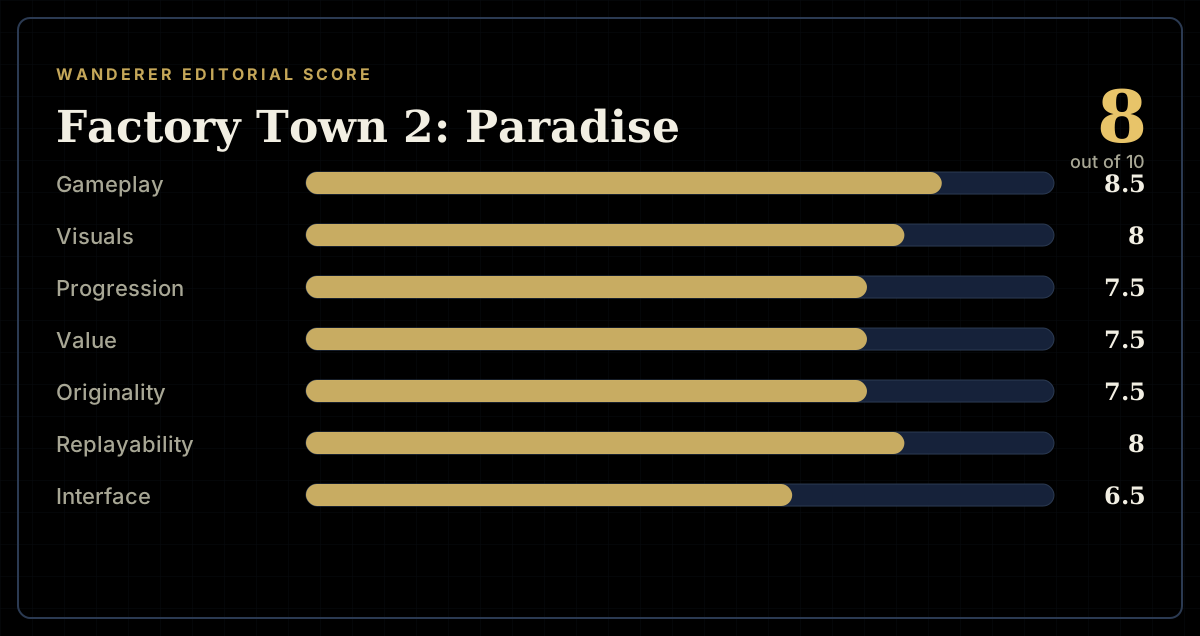
How the review scores each part of the gameWanderer Editorial -
The short versionWanderer Editorial