
Game review
Expeditions: Viking
7 / 10
- Developer
- Logic Artists
- Publisher
- THQ Nordic
- Released
- 27 April 2017
- Platforms
- Windows
- Genre
- Tactical RPG
- Monetisation
- Paid, one-time purchase, plus a small cosmetic DLC pack.
- Players
- Single-player only.
The short version
Expeditions: Viking casts the player as the chieftain of a small Danish clan raiding 8th-century England, and its 1,944 reviews land Very Positive, with reviewers consistently comparing it favourably to Baldur's Gate and Pillars of Eternity for its reactive, historically grounded storytelling and genuinely deep tactical combat. What holds the score back from higher is a specific, well-documented complaint about a largely hidden in-game timer that can end a playthrough abruptly after dozens of hours, and a rocky launch — extensively documented in Logic Artists' own patch notes — that took roughly six months of major updates to stabilise.
Biggest strengths
- Genuinely reactive, historically grounded storytelling that reviewers consistently rank alongside Baldur's Gate and Pillars of Eternity for narrative depth and consequence.
- A deep, positioning-focused turn-based combat system with meaningful character build synergies that reward deliberate party composition.
- A distinctive, fully historical Viking-age setting with no fantasy elements, praised by multiple reviewers as a refreshing change from more common high-fantasy party RPGs.
Biggest weaknesses
- A largely hidden campaign timer penalises exploration and slow, careful play, and multiple reviewers describe losing a long playthrough abruptly once the clock ran out with no clear in-game warning.
- The game launched with heavy, well-documented bugs — crashes, broken quests and skill issues — that the developer's own patch notes confirm took roughly six months of major updates through late 2017 to substantially resolve.
- A minority of reviews report occasional quest-blocking bugs persisting well after launch, including a specific report of a required NPC failing to trigger dialogue.
Who it's for: Fans of old-school, choice-driven party RPGs who value grounded historical setting and deep tactical combat over graphical polish, and who are willing to plan around a real, if avoidable, campaign time limit.
Our recommendation: A genuinely strong pick for tactical-RPG fans, especially on sale; read up on the campaign timer mechanic before committing to a long, unhurried playstyle.
7 / 10
A historically grounded party RPG that earns its Baldur's Gate comparisons
Expeditions: Viking puts the player in charge of "a small band of Norse warriors" landing "on the shores of England" circa 790 AD, building a clan, recruiting a warband and making choices that shape how "history will remember you." Reviewers repeatedly credit the game with delivering on that pitch in ways that go beyond a typical licensed-history skin over generic RPG mechanics. "By Odin. It is a baldur's gate-like game, with nords and realism. It has lair construction, faction choice, deep, and meaningful choices," reads a 2018 review. A 2021 review makes the comparison even more directly: "Game is fantastic! Even better than the PoE or Divinity series (which are all great!), because the viking-story is highly atmospheric and very plausible." What stands out across the sample is how often reviewers single out the complete absence of fantasy elements as a genuine strength rather than a limitation — a grounded, plausible Viking Age setting that several reviewers describe finding more immersive than higher-fantasy alternatives specifically because of that restraint.
Combat depth that rewards deliberate play
Underneath the narrative, reviewers consistently praise the tactical combat as genuinely deep rather than a simple turn-based formality. "Combat is compelling and challenging. Charakter [builds and party synergy pay off if used effectively]," reads a 2018 review. A 2018 review structures its praise specifically: "Interesting character development - Enjoyable turn based combat - Build synergies among your characters pays off if used effectively." This isn't universal — several reviewers who prioritise story over combat describe the fighting as "repetitive" over a long campaign — but even critical reviews rarely dispute that the underlying tactical systems are well designed; the complaints tend to concern balance and pacing rather than the fundamental combat design.
A specific, well-documented complaint: the hidden timer
The most consistently repeated criticism concerns a genuinely unusual design choice: the main campaign runs against a largely hidden clock. "There is a timer in this game. Its artificial and to be honest so poorly thought out that many people playing the game will not even know there is one. Once your time runs out its game over. Any movement on the main map counts against you," reads a 2018 review. A January 2025 review describes the consequence in stark terms after significant investment: "In spite of my 72 hour investment, spent marching from one cru[sade to the next], I was interrupted abruptly by a message letting me know that I lost." A 2022 review frames the same mechanic from a different angle: "I stopped playing when I realized there was a time limit on the game, [I] want to build up my clan without being rushed." To be fair to the game, several other reviewers note the time limit is explained narratively and manageable once a player knows about it going in — the core complaint isn't that a timer exists, but that its rules and consequences aren't made clear enough before a long-invested playthrough can be lost to it.
A rocky launch, confirmed directly by the developer's own patch history
This review checked Logic Artists' own official news feed directly rather than relying solely on launch-era player complaints. The pattern is clear and self-confirming: following the 27 April 2017 release, the developer shipped "Version 1.0.5" in June, "Version 1.0.6: New Customisations, Custom Portraits, Toolset" in September, and "Version 1.0.7: Iron Man Mode, Workshop Integration, New Game Settings" in November — three substantial patches across roughly six months, exactly matching what launch-era reviews describe needing fixed. "Trouble is, there are a lot of issues... Buggy as hell: Crashes, Quests, Skills, UI," reads a launch-week 2017 review. A later review, from 2019, confirms the patches worked: "I know many were discouraged by the bugs at the initial release, now stable and fun to play." That's a genuine, verifiable improvement over time rather than an unresolved ongoing problem — though a small minority of reviews as late as 2023 still report occasional quest-blocking bugs, such as one describing a required story NPC failing to offer dialogue at all.
A franchise still very much alive, not an abandoned relic
It's worth placing this specific entry in the context of what Logic Artists has done since. This review checked the developer's news feed directly and found a well-received 2022 sequel, Expeditions: Rome, followed by a new entry, Expeditions: Samurai, currently in Early Access as of 2026 with active dev diaries being published as recently as August 2026. Several reviewers frame Viking specifically as the "black sheep" of the series relative to Rome's more polished, better-received systems — "I've already played Expeditions: Rome, which i[mproved on almost everything here]," reads a 2023 review — but that comparison should be read as a sign of a healthy, still-active studio refining its formula across multiple entries, not evidence that this specific game has been abandoned or left unsupported.
Weighing the ambush and difficulty complaints
A further, more specific complaint concerns encounter balance: "90% of all fights have me being surprised; which gives the enemy a full round of attacks before I can do anything but mov[e defensively into position]," reads a 2019 review. This is a real, mechanically specific criticism distinct from general difficulty tuning — an ambush-heavy encounter design that consistently removes the player's usual tactical-positioning advantage before a fight even begins. It's worth weighing this alongside the game's own emphasis on positioning as a core combat strength: a design that frequently negates that exact strength through surprise encounters is a real tension worth knowing about going in, even if several other reviewers don't flag it as a dominant issue in their own playthroughs.
Final verdict
Expeditions: Viking delivers a genuinely strong, historically grounded tactical RPG that earns its comparisons to genre classics like Baldur's Gate and Pillars of Eternity, built on deep combat and reactive, consequence-driven storytelling. What keeps the score short of full marks is a specific, well-corroborated pair of concerns: a hidden campaign timer capable of ending a long, invested playthrough abruptly, and a launch rocky enough that the developer's own patch history took half a year to substantially settle it down. Neither issue is disqualifying today, especially with those patches years in the past, but both are worth knowing about before committing to the kind of slow, exploratory playstyle the game's own systems otherwise reward.
Pros and cons
Pros
- Genuinely reactive, historically grounded storytelling that reviewers consistently rank alongside Baldur's Gate and Pillars of Eternity for narrative depth and consequence.
- A deep, positioning-focused turn-based combat system with meaningful character build synergies that reward deliberate party composition.
- A distinctive, fully historical Viking-age setting with no fantasy elements, praised by multiple reviewers as a refreshing change from more common high-fantasy party RPGs.
- An actively developed franchise, with a well-received 2022 sequel (Expeditions: Rome) and a new entry (Expeditions: Samurai) in Early Access as of 2026, showing the studio's continued investment rather than an abandoned series.
Cons
- A largely hidden campaign timer penalises exploration and slow, careful play, and multiple reviewers describe losing a long playthrough abruptly once the clock ran out with no clear in-game warning.
- The game launched with heavy, well-documented bugs — crashes, broken quests and skill issues — that the developer's own patch notes confirm took roughly six months of major updates through late 2017 to substantially resolve.
- A minority of reviews report occasional quest-blocking bugs persisting well after launch, including a specific report of a required NPC failing to trigger dialogue.
- Difficulty balance draws recurring complaints, particularly around frequent ambush encounters that give the enemy an opening round of attacks before the player can react.
Screenshots
-

Expeditions: VikingImage: THQ Nordic via Steam -

Expeditions: VikingImage: THQ Nordic via Steam -

Expeditions: VikingImage: THQ Nordic via Steam -
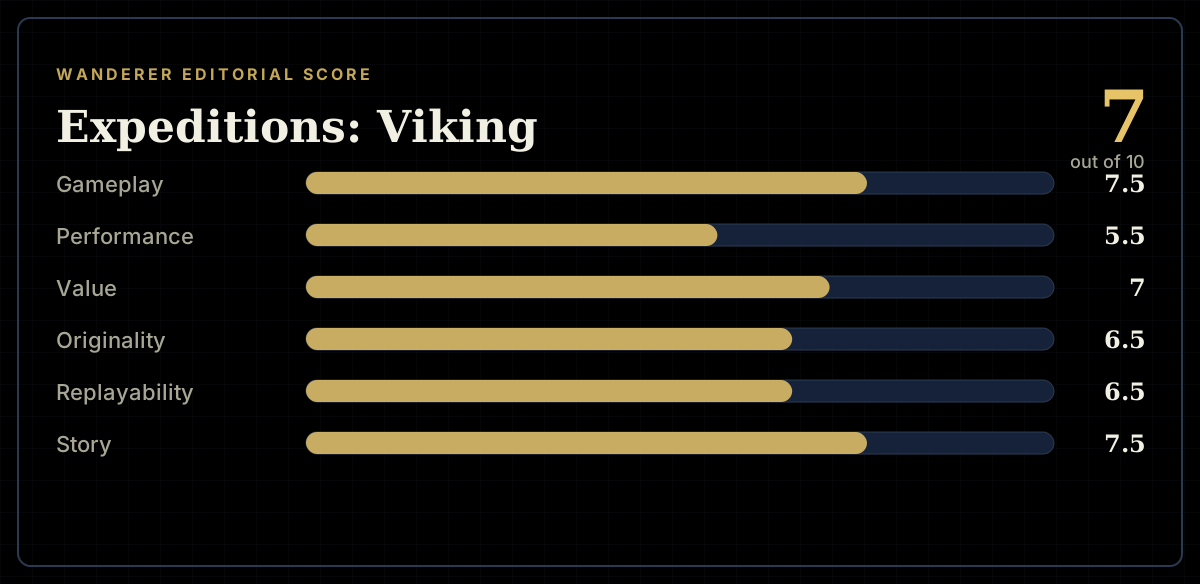
How the review scores each part of the gameWanderer Editorial -
The short versionWanderer Editorial