
Game review
Endless Immortal Path
5.9 / 10
- Developer
- Fengshi Games
- Publisher
- Fengshi Games
- Released
- 11 September 2026
- Platforms
- Windows
- Genre
- RPG
A Four-Review Game, So This Leans on the Store Page and Its Own Text
Endless Immortal Path launched on 11 September 2026 from solo-attributed Chinese developer and publisher Fengshi Games, and ten days later it has exactly four Steam user reviews — three positive, one negative — too small a sample for Steam's own descriptor tiers to kick in. That's not nothing: one of the positive reviews runs to 394 minutes of tracked play and reads as a genuinely considered account of the game's strengths and rough edges, not a drive-by vote. But it's a thin enough base that this review leans heavily on the store page's own description, its screenshot gallery, and those four reviews' specific claims, rather than any broader community consensus that doesn't yet exist.
A Xianxia Text Adventure First, an RPG Second
The store page's own English tagline calls this "a Xianxia text adventure centered on cultivation and world salvation," and the screenshots bear that framing out: painted mountain and courtyard backdrops carry dialogue boxes and narrated prose, with branching choice prompts — like a screenshot showing a sworn brother volunteering to draw an enemy's attention mid-fight — sitting alongside more conventional stat and inventory screens. Steam's own community tags list Word Game, Text-Based, Lore-Rich, Story Rich, and Multiple Endings alongside RPG and CRPG, which tracks with a game built around reading and choosing rather than real-time or tactical combat. One of the three positive Chinese-language reviews, from the 394-minute player, is unusually candid for a positive vote: 3.5 out of 5 on its own terms, bumped up half a point "because it's made by one person," with a specific complaint that the back half of the story blurs its cast together — "by the end I couldn't tell who was who, or what made them distinct" — which is a real ding against a game whose whole pitch rests on its narrative. That's a more useful, specific data point than a vague thumbs-up would be, and it's weighed accordingly in the story score below rather than smoothed over.
Cultivation Systems Sit Underneath the Narrative Layer
Beneath the story wrapper, the store page describes a genuine character-building system: every level-up grants Cultivation Points to freely allocate across four attributes — Constitution, Comprehension, Willpower, and Fortune — each pushing the build toward a different archetype (a body cultivator, a Five-Elements spell caster, or a soul cultivator, in the developer's own framing). A Character Details screen is meant to surface every active passive buff and debuff, weapons/armour/accessory slots plus three artifact slots round out equipment, and a Skill Cultivation Queue lets the player load a learned technique and have their character passively master it over time — the one piece of the design that earns this game a place in idle-adjacent coverage, even though it isn't tagged Idle or Incremental by Steam's own community voting. A Companion Details screen for reviewing allied stats and combat paths rounds out the systems the store page advertises. None of this is verifiable beyond the developer's own description and the reviews that touch on it, but the Chinese reviews that do engage with these systems treat them as real rather than cosmetic — one specifically criticises how few channels there are to acquire new cultivation techniques later in the game, leaving a single skill loadout carried for too long with damage that falls behind the curve, which reads as a genuine progression-pacing complaint rather than a stat-inflation nitpick.
Inventory Friction Comes Up Repeatedly and Specifically
Two of the three positive Chinese reviews raise the same inventory complaint independently, which is the kind of repeated, specific pattern worth taking seriously even from a four-review sample: the Storage Pouch caps out at 30 slots, items can only be sold or discarded one at a time rather than in bulk, and a full inventory blocks new pickups outright. One reviewer asks plainly for a stash tab; the other describes the one-at-a-time sell flow as tedious enough to note by name, alongside a request for clearer equipment-slot categorisation — not knowing what the last three gear slots are actually for. The store page's own "Art of Letting Go" pitch frames limited storage as a deliberate resource-management choice, and it can be exactly that in principle, but two independent reviewers flagging the same friction point as a chore rather than a meaningful decision is a real signal against that framing, not just a difficulty complaint.
A Slow Pace and a Language Gap Worth Flagging Plainly
The one negative review, in English, describes the game as slow and boring, with text loading in noticeably slowly and item management only becoming accessible during quests rather than freely from the sect hub — plus a levelling system the reviewer found opaque, gaining a level "every fight" without a clear sense of why or what it changed. That's a single voice, but it points at something the screenshots corroborate: this is a reading-heavy, text-forward game, and its pacing lives or dies on how much patience a player brings to prose-driven scenes rather than active combat. Separately, and independent of that complaint, Steam lists English as a supported language with full audio, but all three of this outlet's own screenshots — main menu, dialogue box, and narrated cutscene alike — show Chinese text exclusively, with no English UI or subtitle visible anywhere. That's worth stating plainly rather than assuming away: whatever English support exists may not be complete or may not have shipped yet, and an English-reading player should not assume day-one parity based on the store listing alone.
Verdict: A Personal, Visually Confident Project With Real Rough Edges
Endless Immortal Path is easy to respect as a one-person xianxia passion project — the courtyard-and-spectral-elder scene in its own screenshot gallery is a genuinely strong piece of scene-setting, and the attribute-and-skill-queue systems underneath the prose sound more considered than a typical reading-first indie bothers with. But the evidence available, thin as it is, points at real friction rather than mere small-scale roughness: a cramped, one-item-at-a-time inventory two independent reviewers singled out unprompted, a back half of the story that at least one attentive 394-minute player found hard to follow, and a English-supported listing that its own screenshots don't yet bear out. At a NZ$3.12 discounted price it's a low-risk pickup for readers who specifically want a xianxia visual novel with some RPG mechanics stapled on, but there isn't yet enough of a track record to call it more than a promising, unfinished-feeling work in progress.
Screenshots
-
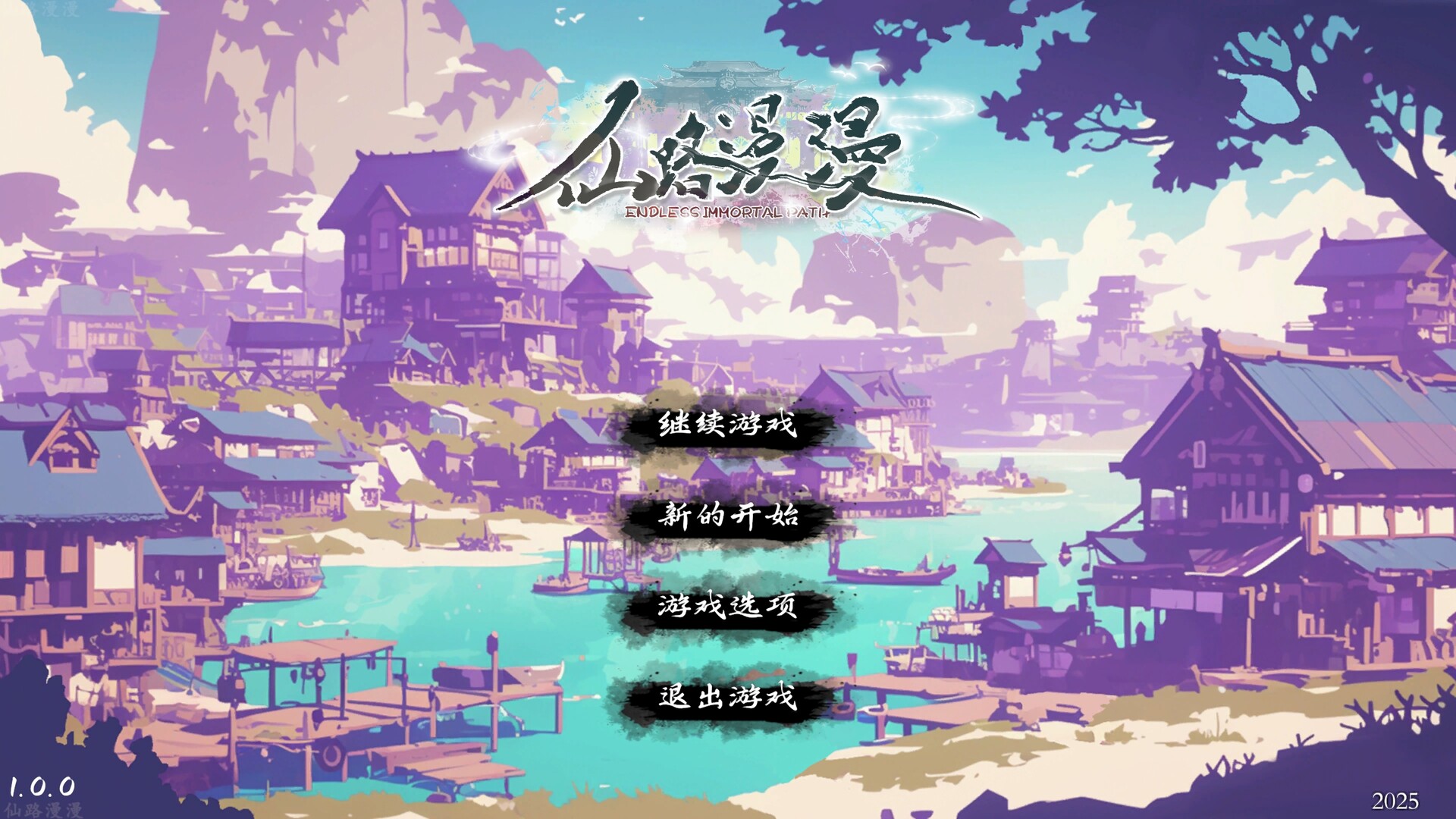
The main menu sets the tone with painted village art, but every option on it — like the rest of the game — is presented in Chinese only, despite English being listed as a supported language.Steam store page -
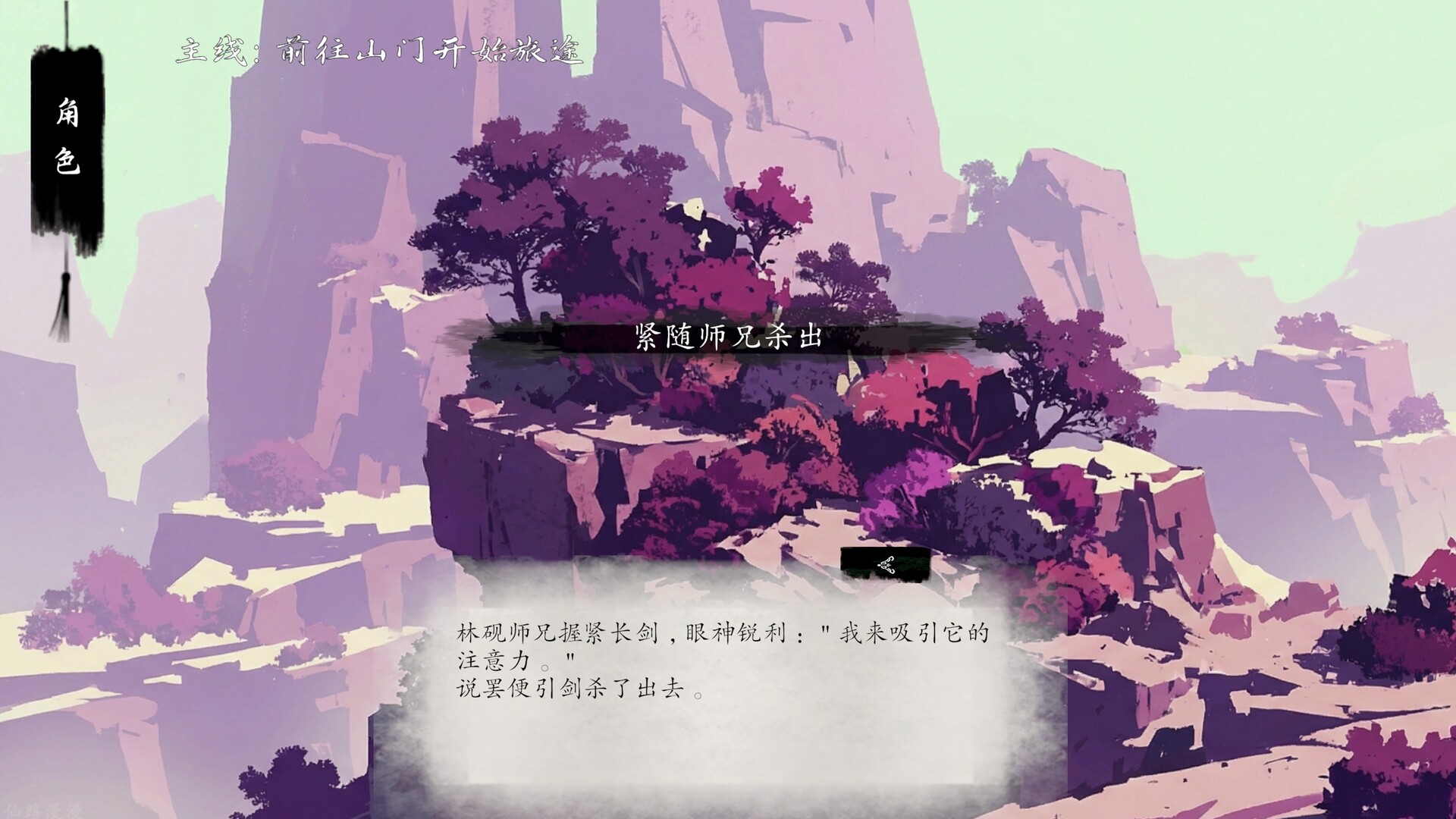
A branching story beat mid-journey: a companion volunteers to draw an enemy's attention, framed as a choice rather than a cutscene.Steam store page -
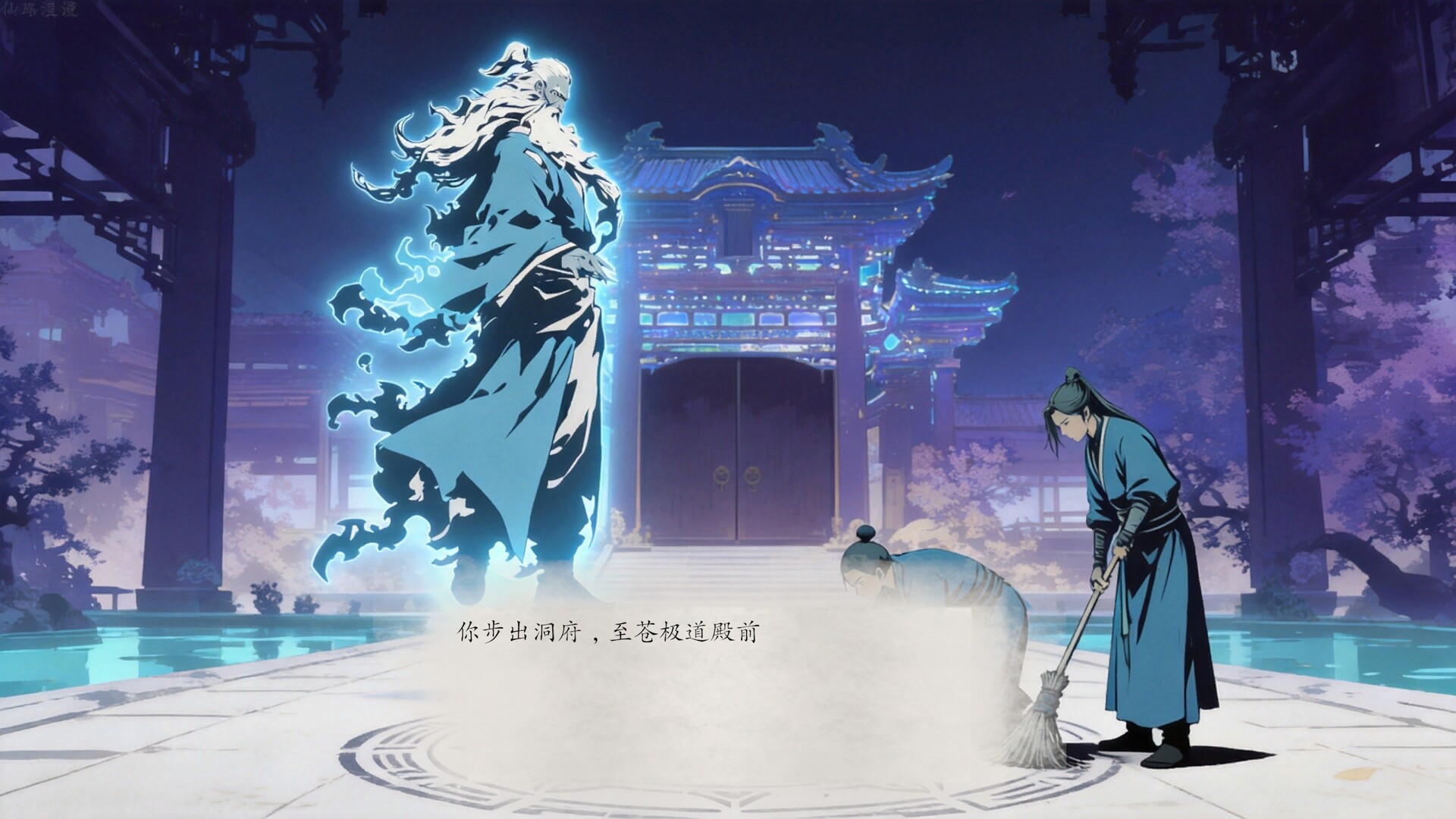
One of the game's stronger visual beats — a spectral elder's presence looming over the sect gate as the player character arrives for a story scene.Steam store page