Game review
Dustland Delivery
7 / 10
- Developer
- Neutron Star Studio
- Publisher
- Lilith Games
- Released
- 5 November 2024
- Platforms
- Windows
- Genre
- RPG, Simulation, Strategy
- Monetisation
- One-time purchase, no in-game store
- Players
- Single-player only
The short version
Dustland Delivery puts the player behind the wheel of a truck in a post-zombie-apocalypse wasteland, recruiting a rag-tag crew, trading scrap and salvage between settlements, and building a caravan business one delivery at a time. Developed by Neutron Star Studio and published by Lilith Games, it spent four months in Early Access before its 1.0 release on 5 November 2024. Its 1,029 English-language Steam reviews sit at Very Positive, roughly 88.5%, and reading the full negative sample alongside the top positives finds a game whose depth repeatedly earns comparisons to Kenshi, RimWorld and Mad Max, sitting behind an interface even its fans call confusing and a launch that shipped with visible unfinished placeholders.
Biggest strengths
- The core loop of trading, recruiting, managing supplies and building a caravan business draws strong, specific comparisons to Kenshi, RimWorld, X4 and Mad Max, praised for genuine systemic depth well beyond a simple buy-low-sell-high loop
- The price is repeatedly singled out as remarkable value relative to the amount of content and the number of interacting systems — fuel, food, water, tyres, relationships, combat and crafting
- The developers have kept shipping substantial content and system updates well past launch, including a "Sheol" content addition and a full rework of the sales-stall trading interface
Biggest weaknesses
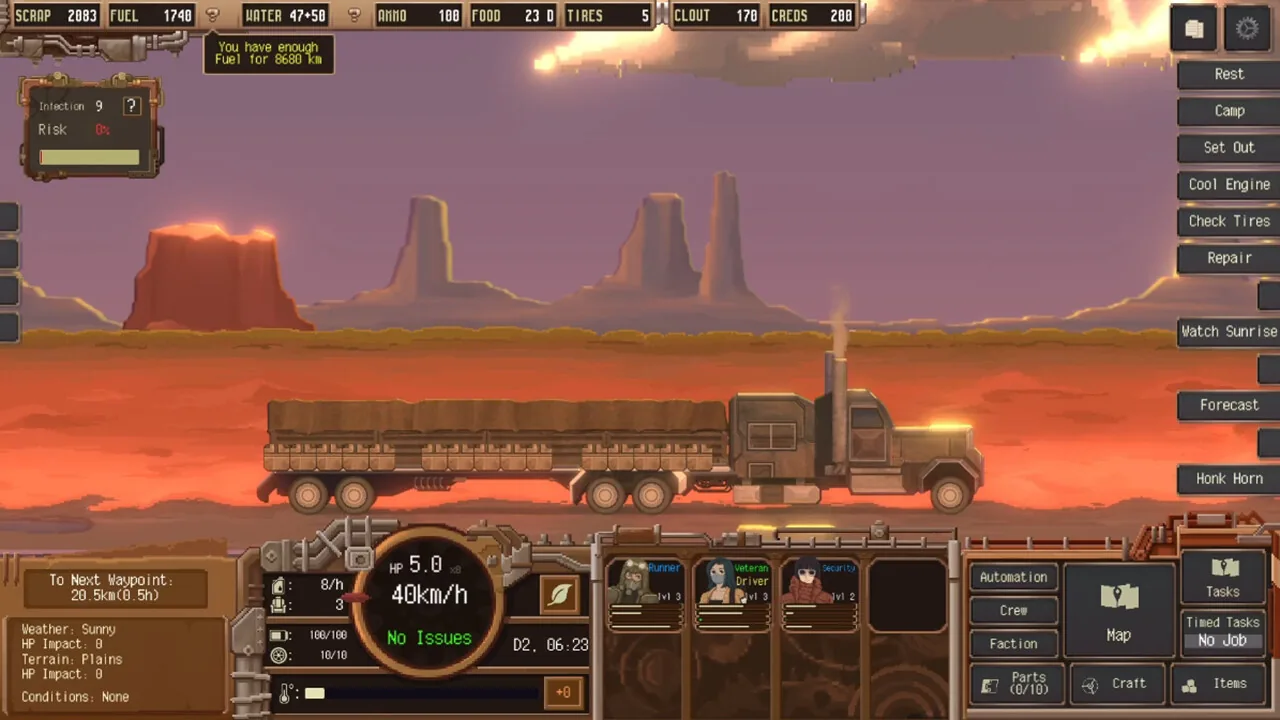
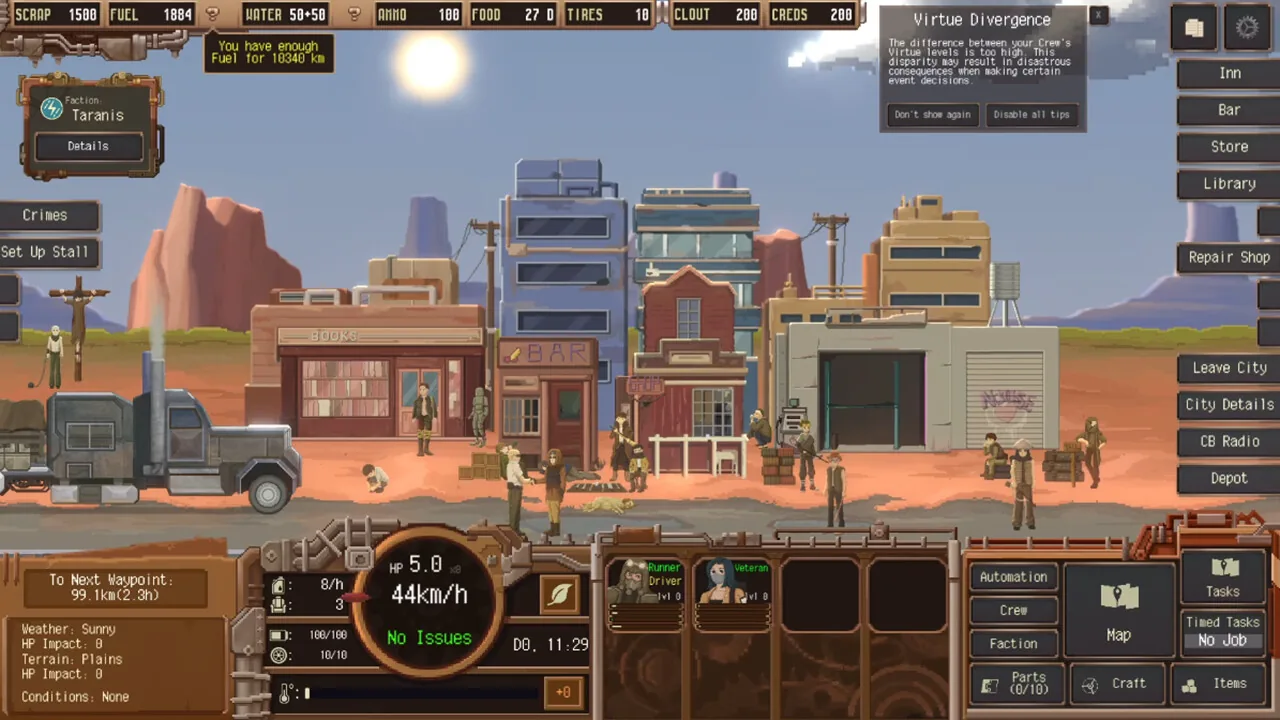
- The interface draws wide, specific criticism as confusing and under-explained, with even strongly positive reviews describing mechanics players only discovered by accident because the game never told them
- The game exited Early Access after only four months, and its most-upvoted negative review reports encountering menu options still marked "COMING SOON" days after the supposedly full 1.0 release
- Several reviewers, across both positive and negative reviews, describe a tonal mismatch between the grim post-apocalyptic setting and anime-style character portraits with a flirting mechanic, without an option to disable it
Who it's for: Fans of systemic, slow-burn survival-management games who don't mind a rough, under-explained interface in exchange for real depth; a poor fit for anyone who wants clear in-game guidance or is put off by clashing anime-style character art in a grim setting.
Our recommendation: A genuinely deep, absurdly cheap systems game that rewards patience with its interface, best approached expecting to consult a wiki rather than the game's own explanations.
7 / 10
Introduction
Dustland Delivery puts the player in the driver's seat of a truck picking its way across a post-zombie-apocalypse wasteland, building a business one delivery at a time — buying scrap and salvage cheap in one settlement, hauling it across dangerous roads, and selling it dear in another, while recruiting a crew, managing supplies and getting drawn into a huge pool of side quests and random encounters along the way. Neutron Star Studio developed it and Lilith Games published it, taking it from an Early Access debut on 11 July 2024 to a full 1.0 release just four months later, on 5 November 2024. Reading the full available negative sample of 100 reviews alongside the top 100 positives, out of 1,029 English-language reviews sitting at Very Positive (roughly 88.5%), finds a game whose systemic depth is rarely in question and whose presentation gets in its own way more than its price tag would suggest it should.
Depth that earns serious comparisons
Reviewers reach for genuinely strong reference points when describing what Dustland Delivery does well. One detailed positive review listed off Mad Max for the road-trading fantasy, Kenshi for settlement-building, RimWorld for character interaction and X4 for supply-chain complexity, calling the combination "well worth the price" for fans of any of them. Another, more concise, called it simply "Kenshi with a big rig." That's serious company for a budget indie title to keep, and the comparisons hold up under scrutiny: reviewers describe a genuine web of interacting systems — fuel, food, water, tyre wear, character relationships, combat and crafting — layered under what looks on the surface like a simple pixel-art trading game. The setting's variety draws its own praise, with one reviewer noting the sheer number of unique story events and quests keeps the loop from feeling like the same handful of scripted encounters on repeat. The community's own tag votes on Steam back this framing, with Simulation, RPG, Management, Survival, Strategy and Trading all clustering closely near the top rather than any single genre dominating.
An interface that fights its own fans
The most consistent complaint in the sample isn't about what the game does, but about how badly it explains doing it. Even strongly positive reviews describe mechanics discovered by accident rather than by any in-game guidance — one reviewer, over 180 hours in, admitted they only learned they could buy extra trailers by stumbling into the right town, and noted contextual menus sat undiscovered on the side of the screen for a long stretch of play. A more pointed review, written after just an hour, laid out concrete usability failures: inconsistent use of Escape as a back button, unclear which button confirms an action, and general "UI fatigue" from menus that don't follow standard conventions. This isn't a vague "the UI could be better" complaint — it's a specific, repeated pattern across independent reviewers describing a game whose actual systems are good enough that players push through the friction to learn them anyway, which says as much about the depth underneath as it does about the interface itself.
A 1.0 that arrived a little early
A second, more concrete complaint concerns the transition out of Early Access. The single most-upvoted negative review in the sample, posted three days after the full release, reported directly encountering game menu options still displaying "COMING SOON" — a clear sign that content originally slated for the Early Access period hadn't fully landed by the time the game dropped its Early Access label. Four months is a short runway by this library's standards for a systems-heavy game of this scope, and while the developers have continued shipping substantial updates since — including a "Sheol" content expansion in April 2025 and a full rework of the sales-stall trading interface in June 2025 — the launch-week experience for at least some buyers was genuinely incomplete rather than merely rough.
A tonal note worth flagging
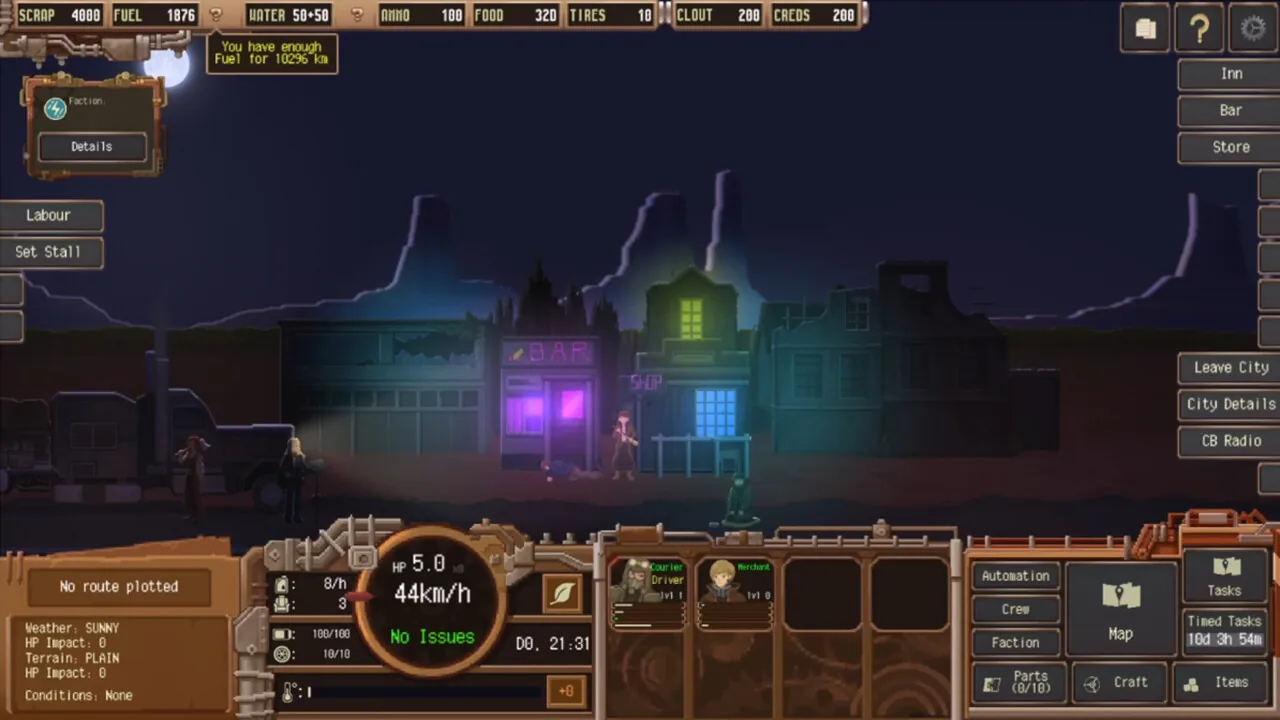
A smaller but recurring thread, appearing independently in both positive and negative reviews, concerns the game's character art and a built-in flirting mechanic rendered in an anime-influenced style that several reviewers say clashes with the grim post-apocalyptic setting. One reviewer who otherwise recommended the game called it "the biggest weakness," and multiple others specifically asked for an option to turn the character portraits off. It's a matter of taste more than a design flaw, but it appears often enough, and from reviewers on both sides of the recommendation split, that it's worth flagging plainly for a reader deciding whether the game's tone will land for them.
Final Verdict
Dustland Delivery is a genuinely deep, systemically rich survival-trading RPG selling for a remarkably low price, and its Very Positive score is earned by the strength of what's underneath its rough edges rather than in spite of some fundamental flaw. The interface is the real, specific problem this review's sample keeps returning to — not a matter of taste but a repeated pattern of players learning core mechanics by accident rather than instruction — compounded by a 1.0 launch that arrived with visibly unfinished corners after a short Early Access run. Buy it expecting to consult outside guides for a while, and the depth comparisons to Kenshi and RimWorld hold up well enough to make that investment worthwhile.
Pros and cons
Pros
- The core loop of trading, recruiting, managing supplies and building a caravan business draws strong, specific comparisons to Kenshi, RimWorld, X4 and Mad Max, praised for genuine systemic depth well beyond a simple buy-low-sell-high loop
- The price is repeatedly singled out as remarkable value relative to the amount of content and the number of interacting systems — fuel, food, water, tyres, relationships, combat and crafting
- The developers have kept shipping substantial content and system updates well past launch, including a "Sheol" content addition and a full rework of the sales-stall trading interface
- Its post-apocalyptic setting supports a genuinely varied event and quest pool, with a huge library of unique story encounters rather than repeating the same handful of scripted events
Cons
- The interface draws wide, specific criticism as confusing and under-explained, with even strongly positive reviews describing mechanics players only discovered by accident because the game never told them
- The game exited Early Access after only four months, and its most-upvoted negative review reports encountering menu options still marked "COMING SOON" days after the supposedly full 1.0 release
- Several reviewers, across both positive and negative reviews, describe a tonal mismatch between the grim post-apocalyptic setting and anime-style character portraits with a flirting mechanic, without an option to disable it
- A cluster of reviews reports the crafting system's costs and benefits are poorly communicated, leading to players investing resources into upgrades that turn out to be worse than store-bought alternatives
Screenshots
-
Dustland DeliveryImage: Lilith Games via Steam -
Dustland DeliveryImage: Lilith Games via Steam -
Dustland DeliveryImage: Lilith Games via Steam -
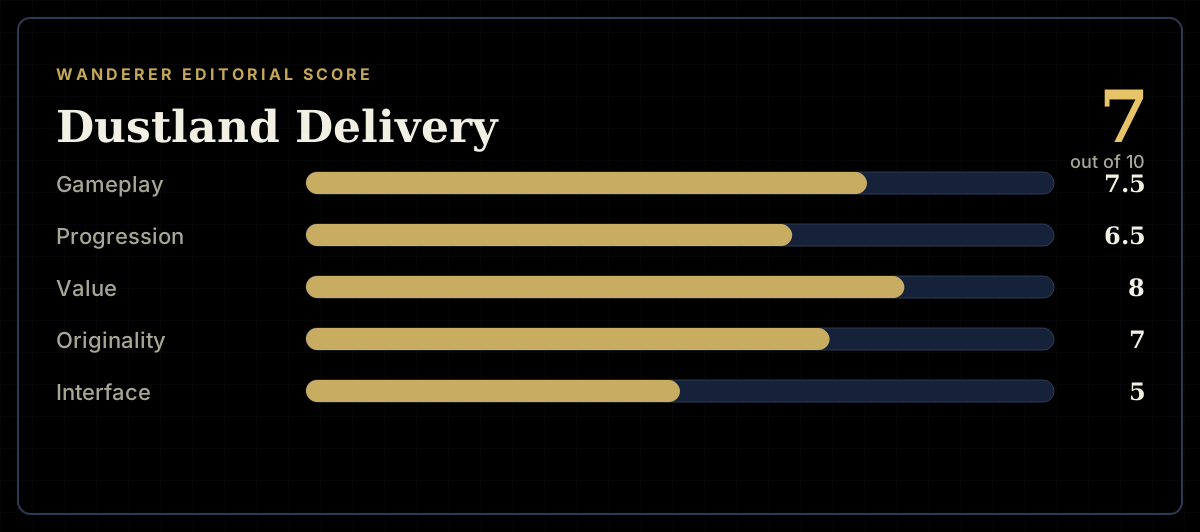
How the review scores each part of the gameWanderer Editorial -
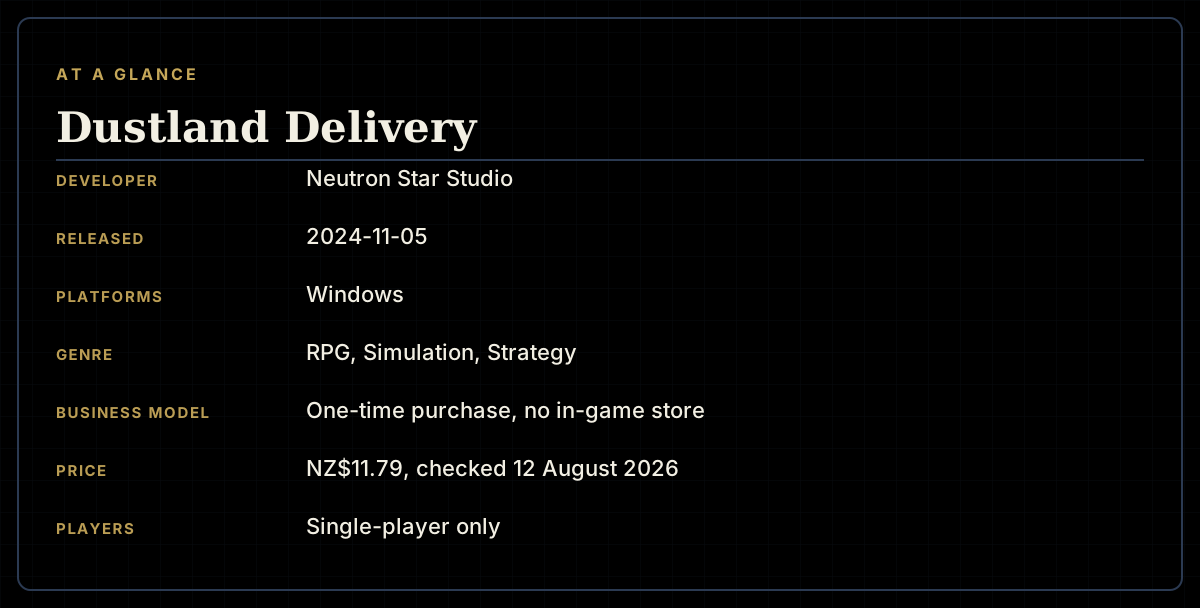
The essentials at a glanceWanderer Editorial -
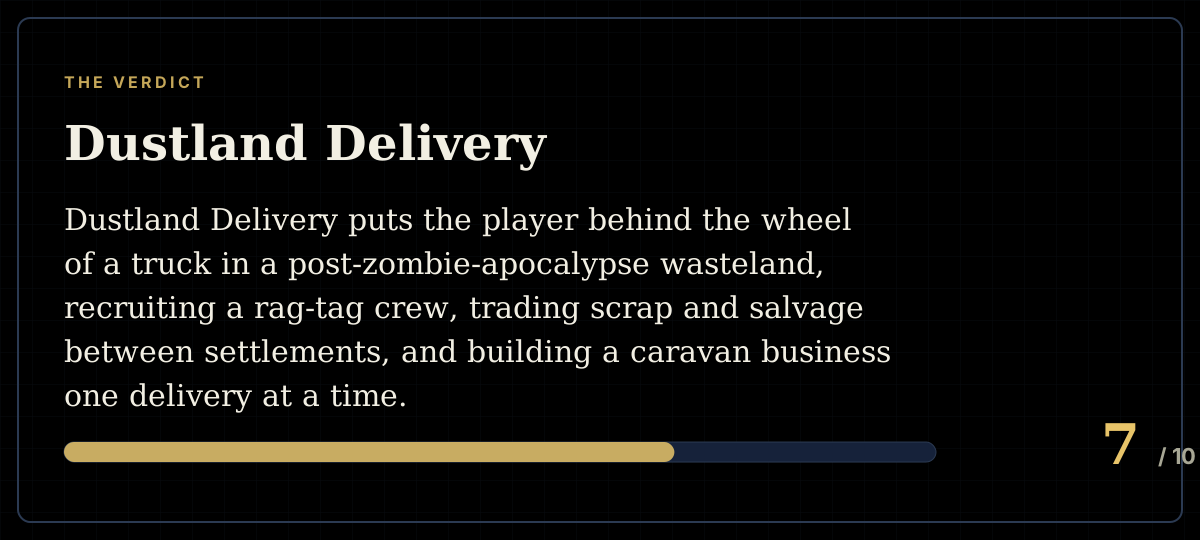
The short versionWanderer Editorial