
Game review
Dragon Cliff
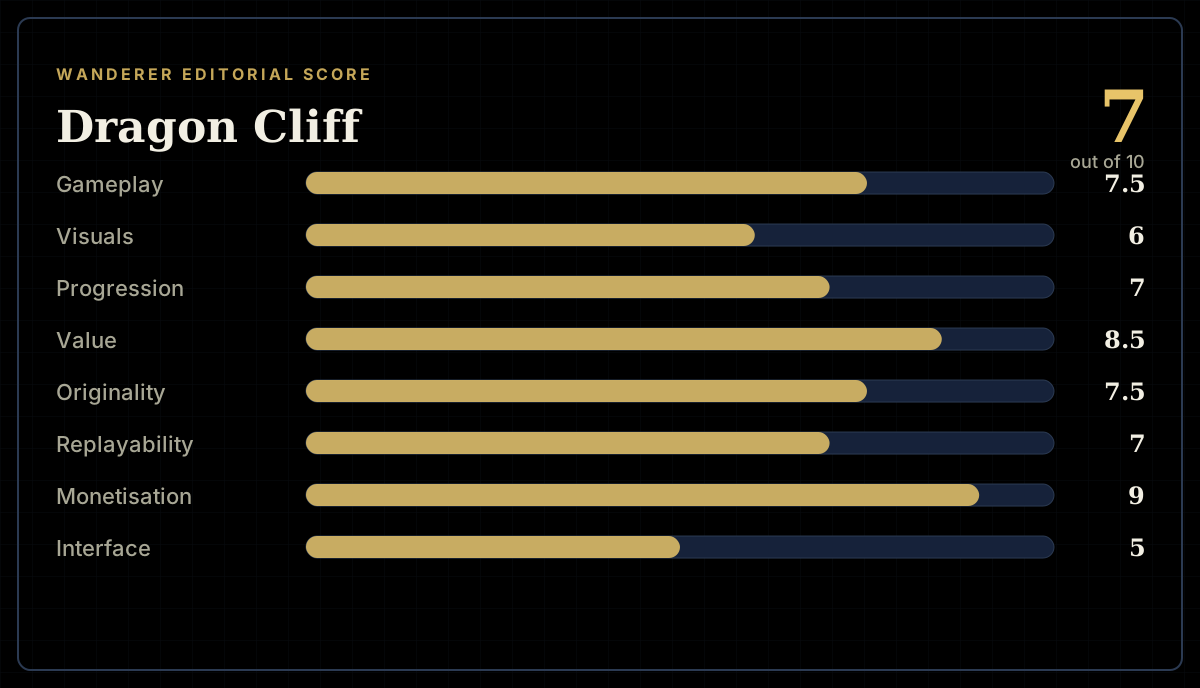
7 / 10
- Developer
- Meta Interaction
- Publisher
- Meta Interaction
- Released
- 11 May 2018
- Platforms
- Windows
- Genre
- Semi-Idle RPG
- Monetisation
- Premium one-off purchase; no in-app purchases, ads, energy systems, loot boxes or DLC found
- Players
- Single-player only
The short version
Dragon Cliff sells itself on itemization, and for once that isn't marketing puffery. Between talent trees, enchanting, reforging, effect transfer, gem sockets and a scroll system that layers extra effects onto gear, there's a genuinely deep build game buried in here, and the price for reaching it is low by any standard — nine dollars for a hundred-plus hours isn't a hard sell.
The problem is what stands between you and that depth. Recruiting the adventurer you actually want, or rolling the equipment stats a build needs, leans on RNG heavy enough that some players report hundreds of attempts without the result they were chasing, and the English localization is rough enough in places that whole systems only make sense once you've puzzled them out yourself. It's a game that asks for patience before it lets you see what it's good at.
Biggest strengths
- Enchanting, reforging, effect transfer and gem sockets stack into a genuinely deep gearing system that supports very different team builds across the roster of adventurer classes
- Nearly a hundred active and passive skills give the Time Based Command battle system real tactical range once a party is built around them
- A clean one-time purchase with no in-app purchases, energy timers, ads or loot boxes — rare in a genre mobile ports have trained players to distrust
Biggest weaknesses
- Rough, occasionally broken English localization leaves some systems and tooltips genuinely hard to parse without outside help
- Recruiting specific adventurers and hitting desired equipment rolls leans on RNG heavy enough that some players report hundreds of attempts without the result they wanted
- Progression can stall into sudden difficulty walls that push players toward long AFK grinding sessions rather than active problem-solving
Who it's for: Players who enjoy min-maxing gear and builds more than they enjoy combat itself, and who don't mind a game that leaves its systems half explained until you've fought through them.
Our recommendation: Worth the low asking price if deep itemization and long AFK sessions appeal to you — go in expecting to tolerate some jank and translate a few tooltips yourself.
7 / 10
Introduction
Dragon Cliff has been sitting on Steam since May 2018, and it has aged into exactly the kind of game a genre publication is supposed to circle back for: a small-studio semi-idle RPG that never had a marketing budget, never chased a mobile port's monetisation playbook, and has quietly kept an audience of players logging genuinely enormous hour counts years after release. Meta Interaction built it around a single pitch — collect adventurers, kill monsters, and bury yourself in itemization until you've assembled the strongest team the game's systems allow — and it is far more honest about that pitch than most games in this space manage to be.
The Time Based Command battle system
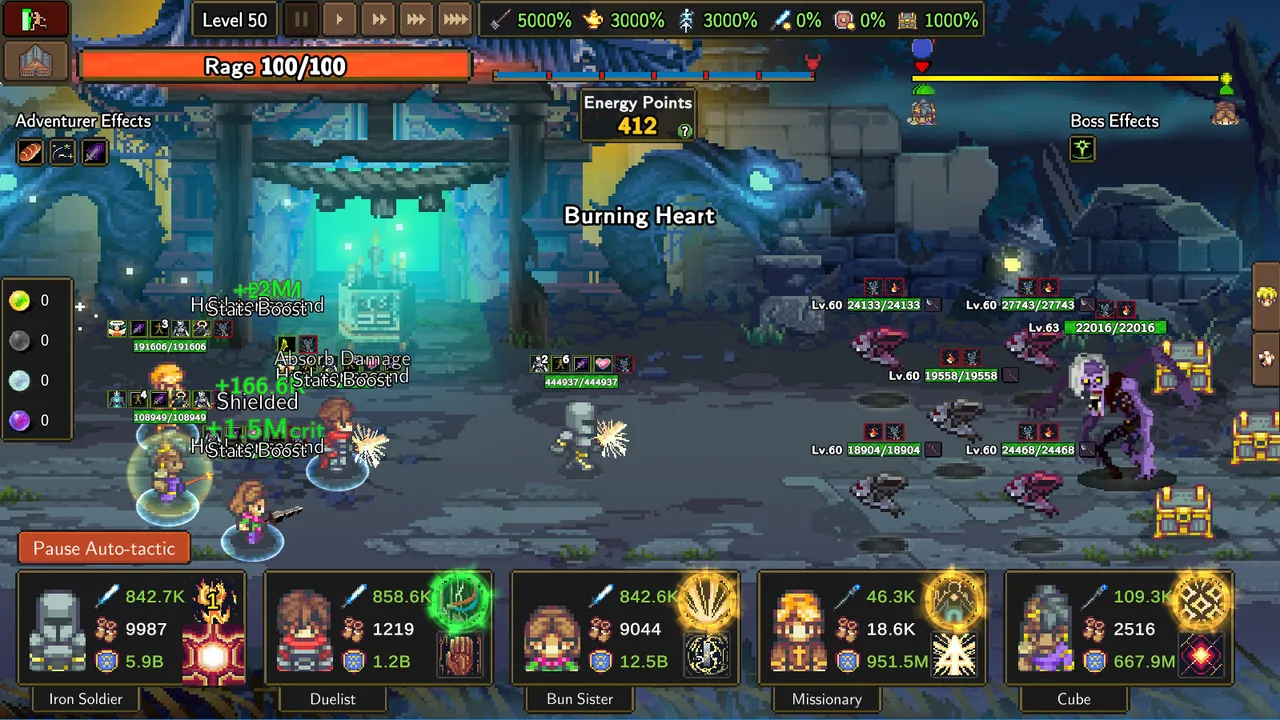
Combat runs on what the game calls a Time Based Command system: your party acts automatically on a timeline built from each character's stats and abilities, while Rage Points accumulate to let you fire off manual tactical skills on top of the automation. It's a familiar shape for anyone who has played an idle-adjacent ARPG before — the fights largely play themselves once a team is assembled, and your actual decisions happen in party composition and skill selection rather than in the moment-to-moment combat. With up to 25 adventurer classes and close to a hundred active and passive skills to draw from, there's enough raw material here that two players' "optimal" party rarely look identical, which is the whole appeal of the genre working as intended.
Where it falls short of a genuine tactics game is in how little the moment-to-moment fighting rewards attention. Positioning and turn order exist, but the loop mostly rewards having built the right team beforehand rather than reacting well during the fight itself — a fair trade for a game explicitly built around semi-idle play, but worth knowing going in if you want combat that stays interesting to watch.
Itemization: the game's actual selling point
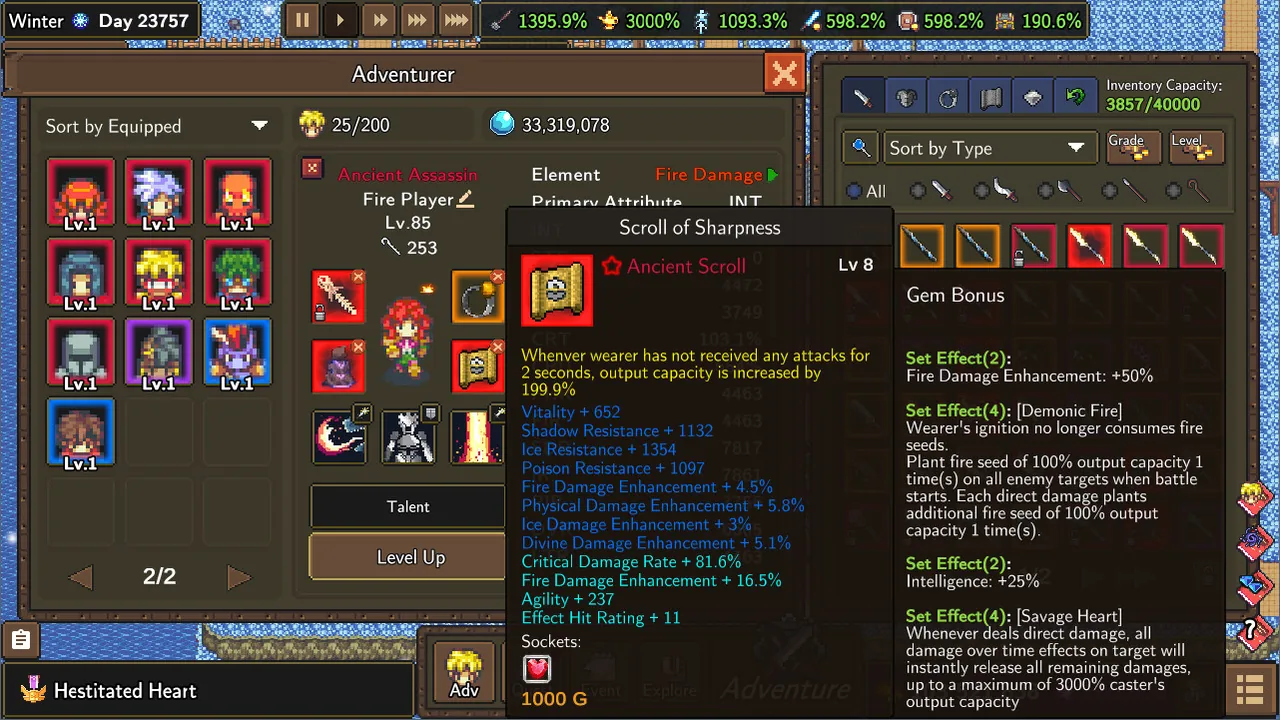
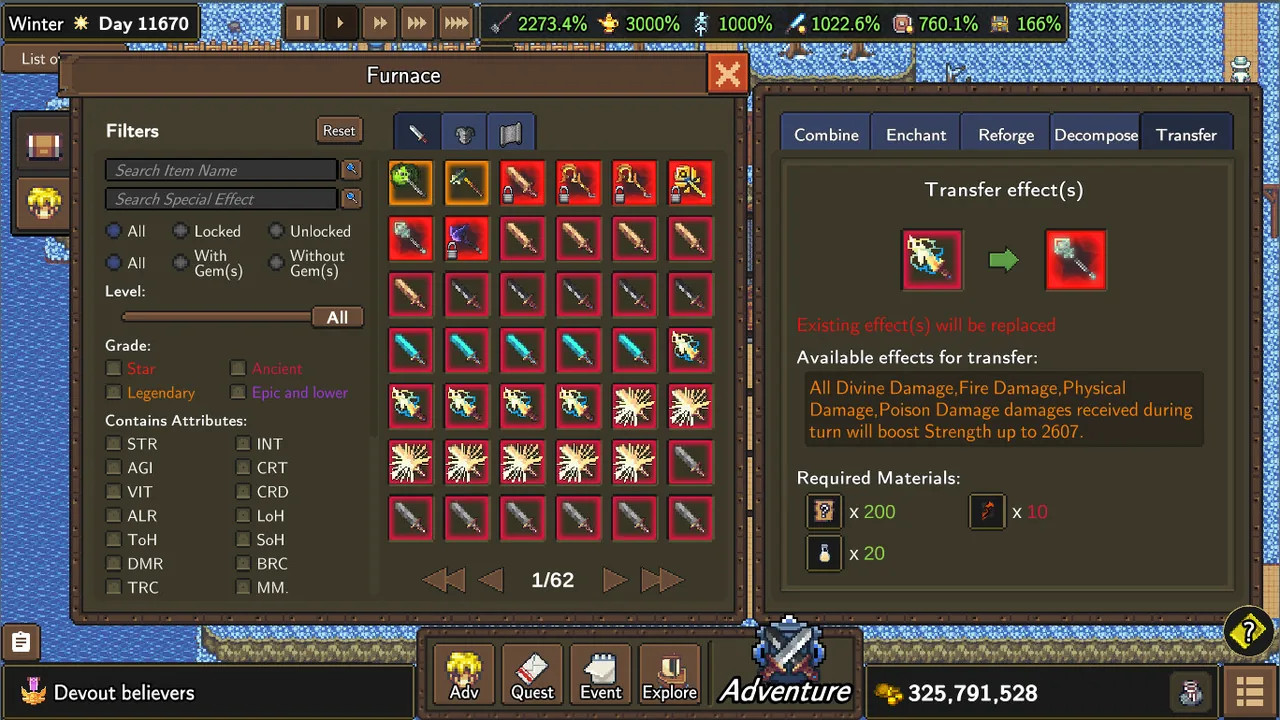
This is where Dragon Cliff earns its keep. Gear isn't just found and equipped — it's enchanted, reforged, and passed through an effect transfer system that lets you move a bonus off one piece of equipment and onto another, on top of a gem-socket system and set bonuses that reward building a full loadout around one archetype. Layered over all of that are scrolls: consumable-style items that discover and apply their own effects to gear, adding another axis of customization independent of the base stat roll. Advancement runs through talent trees per adventurer, so a class isn't just defined by its starting kit — it's shaped over dozens of hours into whatever role your team needs filled.
The combined effect is a genuinely deep gearing game, closer in spirit to a loot-heavy ARPG's endgame than to the shallow equip-and-forget systems a lot of idle RPGs settle for. It's also the source of the game's steepest learning curve: comparing two pieces of gear here means weighing a stack of modifiers, socketed gems, transferred effects and scroll bonuses against each other, and the interface doesn't do much to make that comparison easy. Players who enjoy spreadsheet-adjacent optimization will find a lot to chew on. Players who want a quick read on whether an item is an upgrade will spend real time squinting at tooltips.
Recruiting adventurers, and the RNG behind it
Building a team means recruiting adventurers, and that system leans hard on randomness. Getting a specific class, or the right mix of classes to fill out a party's roles, isn't something you can reliably work toward — you roll, and the pull rate for the adventurer you actually want can run cold for a long stretch. Steam reviews describe players chasing a specific healer or support class for many hours without landing it, even with automated pull systems running in the background. The same randomness shows up again in equipment crafting, where hitting a desired stat roll can take a large number of attempts. None of this is disguised — the game is upfront that it's a randomness-driven itemization loop — but it's worth going in with the expectation that "the build I want" is a target you work toward over a long timeline rather than something you can plan out and simply execute.
Semi-idle pacing, not true idle
The "semi-idle" label matters and is worth taking literally. Dragon Cliff rewards long AFK sessions with your party auto-fighting and auto-crafting in the background, and player reviews consistently describe it as well suited to running alongside other work — the kind of game you check on rather than actively play for a solid stretch. What it doesn't offer is true offline progression: closing the game or letting your PC sleep stops the clock, so the idle loop only pays off while the client is actually open and running. That's a meaningfully different proposition from a mobile idle RPG that keeps crunching numbers while your phone is in your pocket, and it's a distinction some players clearly expected the "idle" branding to cover and didn't get. Progression can also stall into sudden difficulty walls once you've cleared the early content, which tends to convert into exactly the kind of long, passive AFK grinding the game is built around — satisfying if you're doing something else at the same time, frustrating if you're watching and waiting for a wall to break.
Interface and localization
This is the review's biggest asterisk. Dragon Cliff's interface is dense even by the standards of itemization-heavy RPGs, and the English localization is rough enough in places that some systems are genuinely difficult to understand from the game's own text alone — players describe leaning on outside guides to make sense of specific mechanics rather than working them out from in-game tooltips. None of this breaks the game, and none of it is unique to Dragon Cliff among small-studio Steam releases from a solo or near-solo team. But it's a real barrier to entry that sits directly in front of the itemization systems that are the game's whole reason for existing, and it costs the game more than it should.
Value and monetisation
There's very little to complain about here. Dragon Cliff is a ten-dollar one-time purchase with no in-app purchases, no premium currency, no energy timers and no loot boxes — a genuinely clean deal in a genre where mobile ports have trained players to expect the opposite. Steam achievements and community reviews both point to a long tail of content past the main campaign, including an endless late-game mode for players who've exhausted the core progression. For the asking price, the amount of system depth on offer is hard to argue with, even accounting for everything above that makes reaching it more work than it should be.
Final verdict
Dragon Cliff is a game whose reputation and its actual design line up almost exactly: deep, RNG-driven itemization wrapped in presentation and localization that undersell it. The talent trees, enchanting, reforging and scroll systems are exactly as substantial as the store page claims, and the price makes the whole package an easy recommendation for anyone who already knows they like min-maxing gear more than they like watching combat play out. It's a harder recommendation for anyone expecting a polished, true idle experience that keeps working while the game is closed, or anyone who isn't willing to fight through some rough English and a lot of randomness to get to the good part. The players still logging thousands of hours years after launch are proof the core loop holds up; the interface and the pull rates are proof it could have reached a much wider audience if either had been given more attention.
Players who want that same kind of long-haul, gear-driven progression without the RNG walls and translation friction may also want to look at Wanderer, which is built around a similar promise of always having something worth grinding toward.
Pros and cons
Pros
- Enchanting, reforging, effect transfer and gem sockets stack into a genuinely deep gearing system that supports very different team builds across the roster of adventurer classes
- Nearly a hundred active and passive skills give the Time Based Command battle system real tactical range once a party is built around them
- A clean one-time purchase with no in-app purchases, energy timers, ads or loot boxes — rare in a genre mobile ports have trained players to distrust
- Steam reviews from players with four- and five-figure hour counts back up the claim that there's a long tail of content here for the price
Cons
- Rough, occasionally broken English localization leaves some systems and tooltips genuinely hard to parse without outside help
- Recruiting specific adventurers and hitting desired equipment rolls leans on RNG heavy enough that some players report hundreds of attempts without the result they wanted
- Progression can stall into sudden difficulty walls that push players toward long AFK grinding sessions rather than active problem-solving
- Despite the "semi-idle" label, meaningful progress stops the moment the game isn't actually running — this is not a true background-idle title
- Interface and presentation show their 2018 age next to newer entries in the genre, with dense inventory screens that reward patience over clarity
Screenshots
-
Dragon CliffImage: Meta Interaction via Steam -
Dragon CliffImage: Meta Interaction via Steam -
Dragon CliffImage: Meta Interaction via Steam -
How the review scores each part of the gameWanderer Editorial -
The short versionWanderer Editorial