Game review
Doomsday Diner
6 / 10
- Developer
- Space Rock Games
- Publisher
- Space Rock Games, UNIKAT Label
- Released
- 23 July 2026
- Platforms
- [Windows]
- Genre
- Simulation
- Monetisation
- Paid
- Players
- Single-player only
The short version
Doomsday Diner's premise — running the last hot dog stand at the end of the world while raiders shoot at you between orders — is funny enough to carry an hour or two on its own. The physics-based cooking and Fallout-tinged art direction land well, but the run-based structure repeats itself without adding much new, and at least some players never get past a genuinely rough control scheme and tutorial.
Biggest strengths
- Genuinely funny post-apocalyptic hot dog stand premise, well-supported by art and music
- Physics-based cooking gives orders a satisfying, slightly chaotic skill ceiling
- Short sessions work well for a quick 15–30 minute sit-down
Biggest weaknesses
- No story or campaign structure — it's wave survival dressed as a diner sim
- Runs restart from day 1 on death, with little carrying over between attempts
- Some upgrades are permanent and can actively make play worse once bought
Who it's for: Fans of short, silly cooking sims who don't mind a wave-survival structure layered on top, and who are prepared to push through an unclear early tutorial.
Our recommendation: A fun, cheap novelty for an evening or two, but temper expectations for long-term depth — the loop is largely the same on day 20 as it is on day 3.
6 / 10
Hot Dogs, Raiders, and a Very Specific Sense of Humour
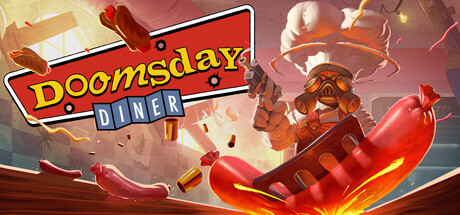
Doomsday Diner's pitch is simple and immediately funny: civilisation has collapsed, hot dogs are somehow still cheap, and the player is running the last functioning diner willing to sell them. Customers queue up with orders while raiders periodically storm the counter and have to be shot down before they make off with the day's takings. It's a mash-up that reviewers keep reaching for the same two comparisons to describe — Fallout for the wasteland aesthetic and post-collapse scavenger vibe, and Borderlands for the cel-shaded art style and gleeful, slightly juvenile tone. One reviewer summed up the appeal neatly: the art, UI and music "work well together to create a nice blend of Fallout and Borderlands," and it's a description that holds up across most of the positive reviews in the sample. The soundtrack and sound design pull real weight here too — several players singled out the deliberately gross noise the sausages make when they're handled, which tells you roughly the register the whole game is operating in.
The cooking itself uses physics rather than menu-clicking, which is both the game's best idea and its biggest source of friction. Hot dogs have to be placed on a grill, flipped, dunked in condiments and handed over, and everything is subject to momentum and gravity rather than snapping neatly into place — cook a dog too fast and it can roll straight off the grill, and order tickets can be accidentally flung over the counter and lost if a player isn't careful with how they're grabbed and passed along. It produces the kind of "pure chaos" one reviewer described enjoying on a busy day thirteen, and it's genuinely satisfying once a player has built the muscle memory to keep multiple orders moving without losing track of any of them.
A Job Sim Wearing a Shooter's Clothes
Underneath the cooking, Doomsday Diner runs on a day-by-day roguelite structure: survive a shift, bank whatever's been earned, spend on upgrades, and go again the next day as the raider waves get progressively tougher. It's here that the review sample splits most sharply. Several players are happy to treat it as exactly what it is — a short, silly, endlessly repeatable arcade loop, good for a chill fifteen-to-thirty-minute sit-down rather than a long campaign. Others went in expecting more structure and came away disappointed. One detailed critical review put it bluntly: there's "no story or real purpose other than basically wave survival," each day is a little bit harder but nothing fundamentally changes, and the whole loop resets to day one on death with limited sense of building toward anything. That same reviewer wanted something closer to a campaign with actual stakes — paying off a debt, working toward a specific goal — rather than an indefinite survive-and-restart structure with a hot dog skin on it.
The upgrade system adds a genuine design wrinkle on top of the repetition complaint: some purchases are permanent and can't be turned off once bought, and at least one reviewer described a specific upgrade — the ability to carry up to six items at once — turning out to be actively counterproductive, since anything the extra capacity touches gets dragged along involuntarily, making precise item management harder rather than easier while raiders are still shooting. That's a rare case of a resource-management sim punishing a player for engaging with its own progression system, and it's the kind of thing that would benefit from being reversible or at least clearly telegraphed before the purchase is locked in.
Getting In the Door Is Harder Than It Should Be
The single sharpest complaint in the sample isn't about the loop at all — it's about actually learning to play it. One reviewer described being unable to get past the opening tutorial, citing a "random floating hand" pointing at nothing useful, controller prompts that didn't seem to correspond to what was actually needed to apply condiments, and an order board that turns illegible when zoomed in due to poor texture quality. That review is an outlier in tone compared to the rest of the sample, but it's a legitimate signal that the onboarding experience isn't uniformly solid, and it lines up with a separate note from another player who assumed, after their first hour, that they must have missed an Early Access label somewhere — the pacing and rough edges felt closer to a demo than a finished release to that player, even though Doomsday Diner shipped as a full release from day one.
For players who do get past the opening minutes, the difficulty curve seems to land reasonably well — the sample includes reports of runs stretching past twenty hours, well beyond what a purely novelty premise usually sustains, suggesting there's a real skill ceiling for players willing to engage with the physics-cooking and shooting simultaneously. But the gap between "instantly clicks" and "borderline unplayable tutorial" for different players is wide enough to be worth flagging clearly before anyone buys in expecting a universally smooth first hour.
A Cheap Novelty That Knows Its Own Size
At NZ$15.75, Doomsday Diner isn't asking for much, and its scope matches its price. This isn't a game built for a forty-hour campaign — it's a tight, replayable arcade loop designed to be picked up for a session, put down, and returned to later. Reviewers who framed it that way came away satisfied: one called it simply "a good mix of genres" that "can only get better with updates," while another described it as exactly the kind of game they wanted for a quick fifteen-to-thirty-minute chill session with customers shooting at them thrown in as a novelty twist on the usual diner-sim formula. That's a reasonable way to price and scope a game this narrow, and it means the repetition complaints from longer-session players land more as a mismatch of expectations than a fundamental flaw — Doomsday Diner was never trying to be a long-haul management sim, and it doesn't cost like one either.
Where the value proposition gets shakier is in how much the game currently offers to unlock beyond raw difficulty. A handful of new upgrades and hot dog styles show up as days progress, but more than one reviewer wanted a wider variety of tools and recipe styles to reach for at later stages, rather than mostly facing the same handful of mechanics under escalating raider pressure. There's a clear ceiling on how much a NZ$15.75 arcade game can be expected to offer, but the request for more late-game variety is a fair one if the developer keeps supporting it post-launch, and it's the single most common wish across the otherwise positive reviews in the sample.
Verdict
Doomsday Diner gets its central joke right: a hot dog stand at the end of the world, staffed by someone who has to cook, serve and defend all at once, is a genuinely fun premise backed by solid art direction and a sense of humour that lands more often than not. Where it comes up short is depth — there's no story to chase, the day-based structure resets on death without much sense of accumulated progress, and at least one upgrade actively works against the player once purchased. A rough tutorial and control scheme kept at least some players from ever getting a fair look at the loop underneath. At its asking price, it's an easy recommendation for a session or two of silly, physics-driven chaos; it's a much harder sell as anything with staying power.
Pros and cons
Pros
- Genuinely funny post-apocalyptic hot dog stand premise, well-supported by art and music
- Physics-based cooking gives orders a satisfying, slightly chaotic skill ceiling
- Short sessions work well for a quick 15–30 minute sit-down
- Cheap enough to justify the novelty even if it doesn't hold for dozens of hours
Cons
- No story or campaign structure — it's wave survival dressed as a diner sim
- Runs restart from day 1 on death, with little carrying over between attempts
- Some upgrades are permanent and can actively make play worse once bought
- Tutorial and controls left at least a portion of players unable to get past the opening minutes
Screenshots
-
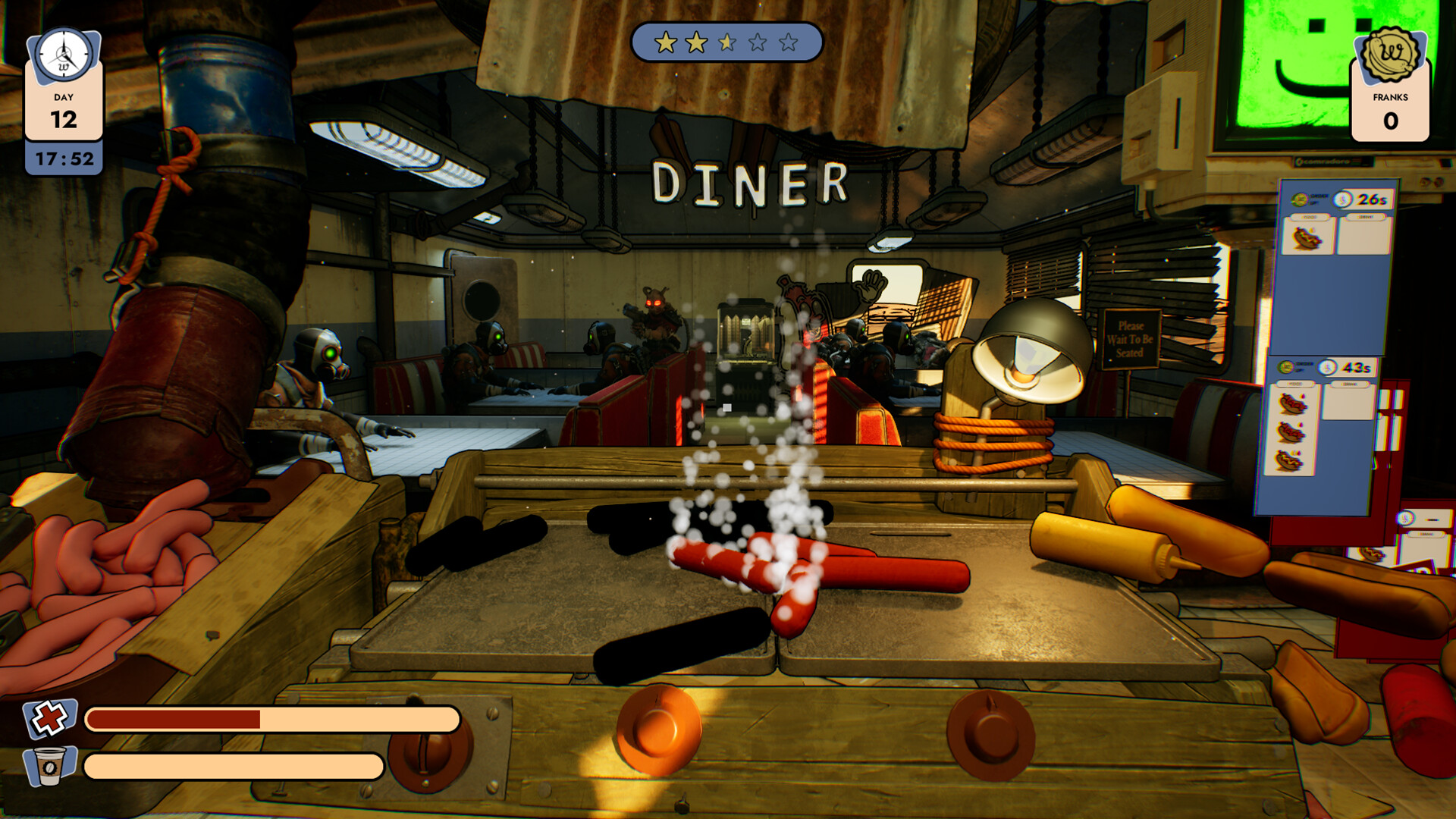
The physics-based grill is where the chaos happens — cook too fast and a hot dog rolls right offSpace Rock Games -
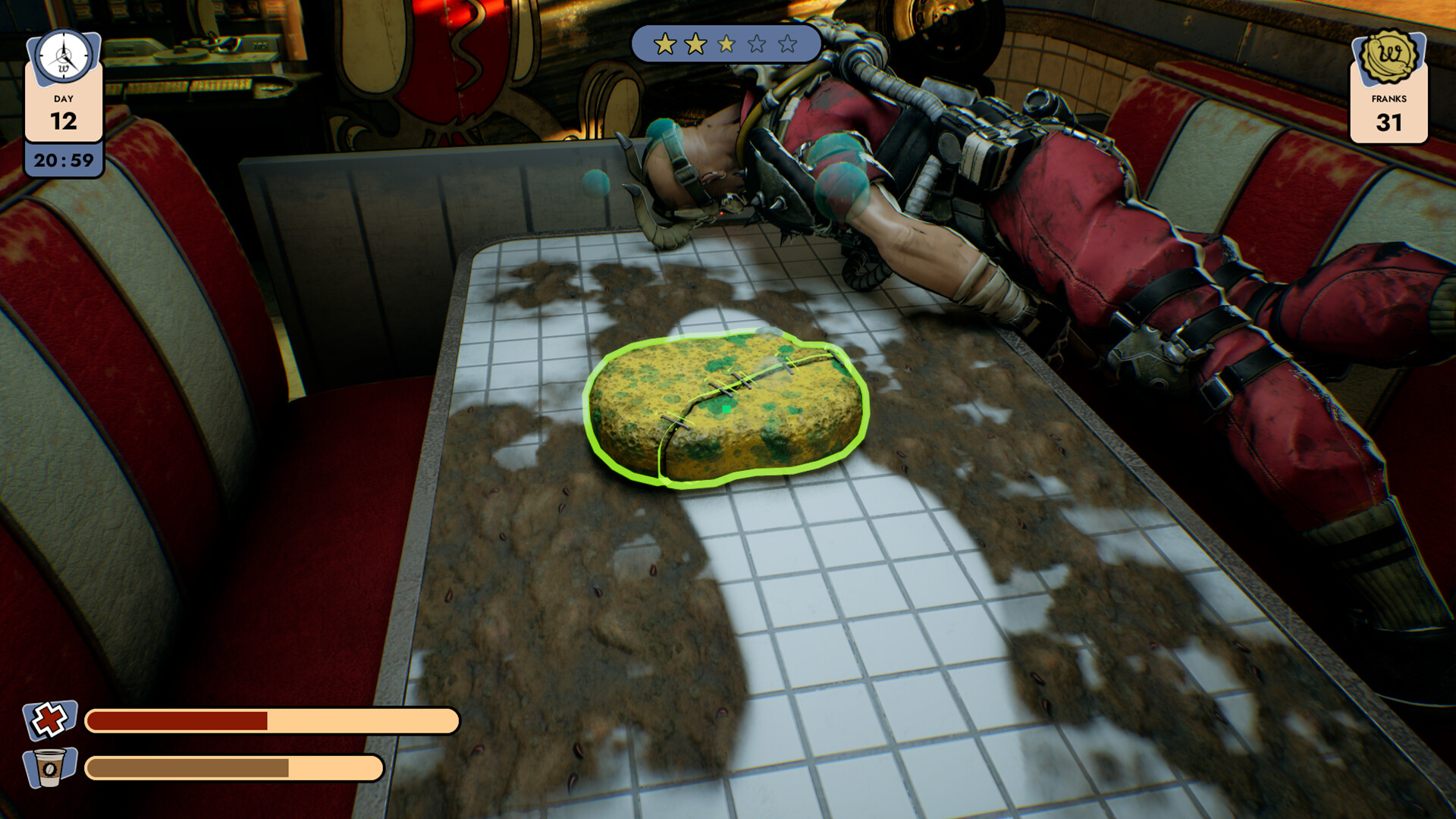
Not every customer just wants to eat — some are there to rob the till or worseSpace Rock Games -
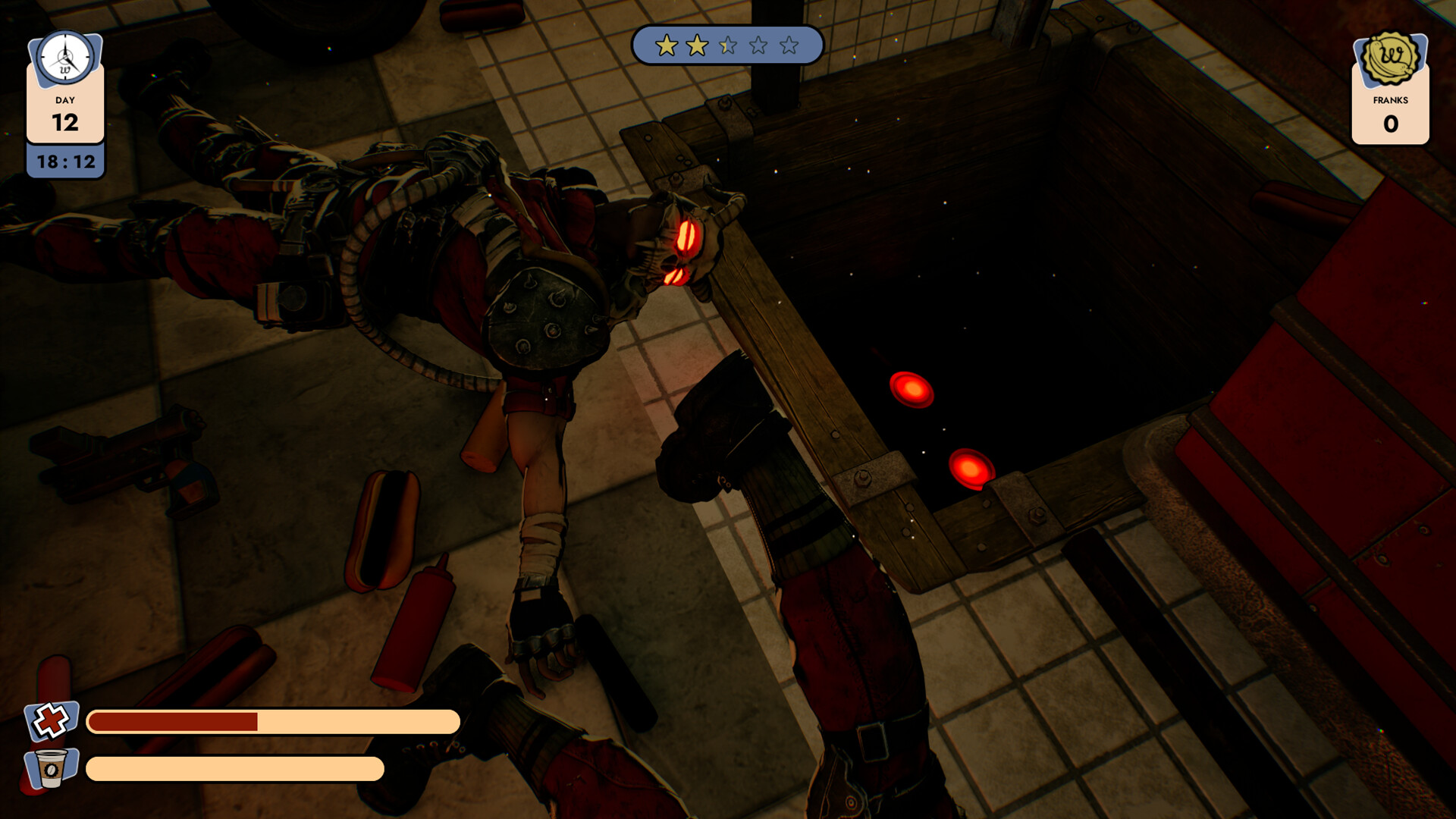
Cooking and combat share the same cramped counter, often at the same timeSpace Rock Games -
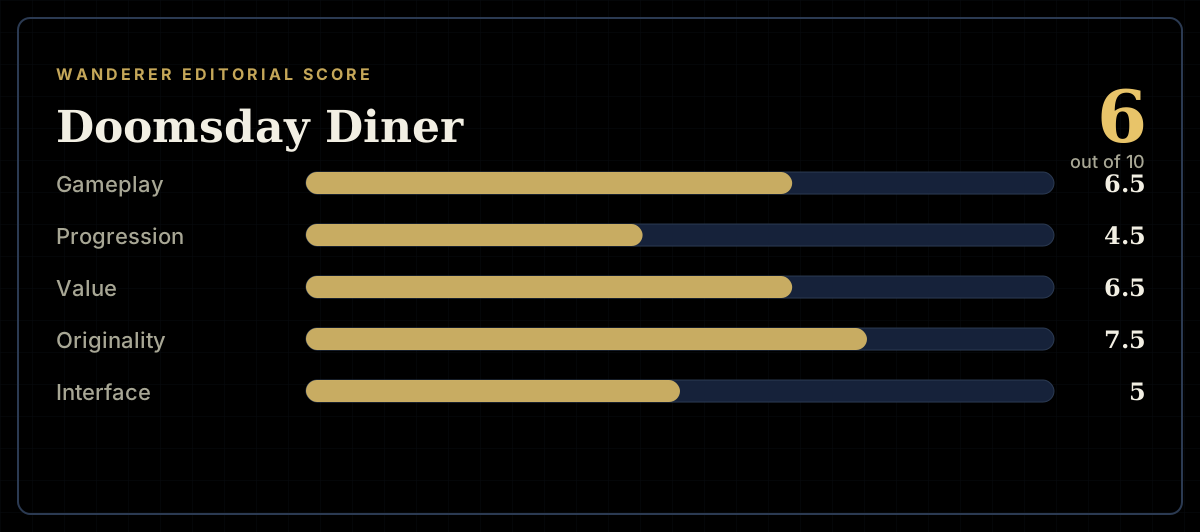
How the review scores each part of the gameWanderer Editorial -
The short versionWanderer Editorial