
Game review
Dice Eater: A Supernatural Mystery Card Game
6.5 / 10
- Developer
- Team Tetrapod
- Publisher
- Team Tetrapod
- Released
- 11 March 2025
- Platforms
- Windows
- Genre
- Adventure, Indie, Simulation, Strategy, Free To Play
- Players
- Single-player
The short version
Biggest strengths
- A genuinely clever central hook — your opponent is cheating using a supernatural power, and your job is to deduce exactly how before turning that same power against them
- Strong, consistent art and presentation carried over from the well-regarded Staffer Case universe this game spins off from
- Fully accessible to players with no prior experience in that series, according to multiple reviewers who tried it without that background
Biggest weaknesses
- Very short overall, with most reviewers completing everything, including all achievements, in roughly four to five hours
- Early encounters are criticized by at least one detailed reviewer as too easy once solved, since a correctly-identified trick becomes trivial to counter every time afterward, undercutting the tension the deduction premise is built around
- Deduction pacing can lag behind player intuition, with reviewers noting they often figure out an opponent's cheat well before the game actually lets them act on that knowledge
6.5 / 10
Figuring out exactly how you're being cheated
Dice Eater is a free deduction card game set in the world of Team Tetrapod's Staffer Case series, built around a simple but genuinely inventive premise: your opponent has a supernatural power that lets them cheat at a rock-paper-scissors-and-dice game, and your job is to work out exactly how before turning that same power back on them. Based on the available English-language review sample — a thin 13 reviews, 12 positive and 1 negative, landing at an overall Positive rating — reviewers consistently describe the deduction hook as the game's central, genuinely satisfying pleasure. "Dice Eater is a rock papers scissors card game with supernatural abilities in the Staffer Case universe. Such abilities are called 'skills,' and have specific triggers and abilities that greatly change many things considered normal, such as an enhanced detection of vibrations, manipulate fire or ice, change perception, among others," one detailed reviewer writes, laying out the mechanical premise precisely.
A separate reviewer frames the appeal in terms of a specific, relatable childhood fascination: "Mystery - You love to try and finding out how something 'mysterious' happens or searching for clues to puzzle out a trick? Even simpler, you loved Magicians when you were a kid? Say no more, you will love this game as you get to figure out how your opponents cheat and beat them at their own game!" It's also worth noting the game is explicitly designed to be approachable for newcomers to its parent series: "Awesome game concept that furthers the cool world-building in the other staffer games, furthermore it can be appreciated without playing either of the previous entries to the IP, so it's worth recommending even to new players," one reviewer confirms directly.
A puzzle that stops being a puzzle once solved
The most substantive criticism in this small review sample concerns what happens after a player has successfully figured out an opponent's trick. "Ultimately a very neat concept, but I find myself getting frustrated that the early game enemies are just 'solve the puzzle, win the game.' That doesn't feel very enticing when it's far more fun to be gambling, card counting and chucking dice. I'll support this since they have good ideas, I'd never recommend it," the sole negative reviewer writes, identifying a real structural tension: once the specific cheat is identified, the encounter reportedly loses most of its remaining challenge. A separate, more positive reviewer confirms the same underlying pattern in less critical terms: "But it has a really fun gameplay mechanic, which makes your first few rounds really hard, trying to figure out how to counter your opponent's gimmick. After you figure it out its piss easy tho."
A related pacing complaint concerns the gap between a player's own understanding and when the game actually lets them act on it. "It takes a bit too long to get into the deduction part, you're likely very aware of the fact your opponent is cheating long before the game allows you to take action and start deducing their powers," one reviewer writes, describing a real friction point between player intuition and the game's structured pacing.
Rule interactions that require inference
A separate, more technical complaint concerns specific edge cases in how the game's mechanics are explained. "It's a fun and interesting game that felt like it was going to be like a Kaiji/Usogui style gamble, but the mechanics are unclear and hold it back from being that. Like against the Monkey, to logically figure out the trick you need to also assume 'cards in hand are hidden from your opponent,' and 'putting your cards down and altering them before the altering phase is one action,'" one detailed reviewer writes, describing specific rule assumptions that aren't clearly stated but are necessary to solve a given puzzle correctly. That's a fair, specific critique for a game whose entire structure depends on players being able to reason confidently about what is and isn't possible within its rules.
A meaningful second part that deepens the challenge
One notably positive development mentioned across the review sample is a post-launch content update that added real, substantive depth. "The 'Applications' update added a second part to the game that was also fun, diving further into the story of the world and testing your understanding of what you learned in the first part by giving opponents multiple powers for you to try to sort out by process of elimination," one reviewer notes, describing exactly the kind of escalating complexity that could address the "too easy once solved" complaint from earlier in a run — stacking multiple supernatural tricks onto a single opponent, rather than relying purely on new individual gimmicks. A separate reviewer frames the overall arc plainly: "After episode 2 it really takes a nose dive to eh because the gimmicks are easy to find out or too hard without a clue. Yet, it was very satisfying every time" a correct deduction landed — a genuinely mixed but fair account of how the difficulty curve holds up across the full game.
Short, but that's part of the pitch given it's free
Given the game costs nothing to play, its short length reads more as a limitation on scope than a value complaint in this review sample. "An extremely fun and unique game. It's about puzzle solving above all else, but presented in a way that you have to figure out what the puzzles are for yourself. If anything the main critique I'd throw at the game is its extremely short, part 1 and 2 is easily completable in a few hours," one reviewer writes, framing brevity as a genuine, if minor, drawback rather than a dealbreaker given the price. The achievement data confirms real structural depth exists within that short runtime: across 23 total achievements, tied to specific opponent-hunter and expert-tier goals, completion ranges from 57.7% for the most accessible down to 6.4% for the hardest expert-level challenges — a real, wide spread for a game most reviewers finish in a single extended sitting.
Where this leaves it
Dice Eater delivers a genuinely clever, well-realized deduction hook wrapped in the strong presentation this developer's Staffer Case universe is known for, accessible to newcomers and free to try with no financial risk. Its main limitation is structural: once a specific opponent's trick is identified, the resulting encounter loses most of its remaining tension, and the overall experience runs short even accounting for a well-received expanded second part. Easy to recommend given the price of admission is nothing at all; puzzle and mystery fans specifically drawn to the "figure out the cheat" premise should find a satisfying, if brief, few hours here.
Pros and cons
Pros
- A genuinely clever central hook — your opponent is cheating using a supernatural power, and your job is to deduce exactly how before turning that same power against them
- Strong, consistent art and presentation carried over from the well-regarded Staffer Case universe this game spins off from
- Fully accessible to players with no prior experience in that series, according to multiple reviewers who tried it without that background
- A well-received "Applications" content update that added a genuinely deeper second part, testing players' accumulated understanding against opponents wielding multiple powers at once
- Free to play, making the short but satisfying deduction puzzle an easy, no-risk recommendation
Cons
- Very short overall, with most reviewers completing everything, including all achievements, in roughly four to five hours
- Early encounters are criticized by at least one detailed reviewer as too easy once solved, since a correctly-identified trick becomes trivial to counter every time afterward, undercutting the tension the deduction premise is built around
- Deduction pacing can lag behind player intuition, with reviewers noting they often figure out an opponent's cheat well before the game actually lets them act on that knowledge
- The story is described by multiple reviewers as comparatively minor and lore-focused rather than a fully developed narrative in its own right
- Some specific rule interactions are described as unclear or under-explained, requiring players to infer edge-case logic themselves
Screenshots
-

Dice Eater: A Supernatural Mystery Card GameImage: Team Tetrapod via Steam -

Dice Eater: A Supernatural Mystery Card GameImage: Team Tetrapod via Steam -

Dice Eater: A Supernatural Mystery Card GameImage: Team Tetrapod via Steam -
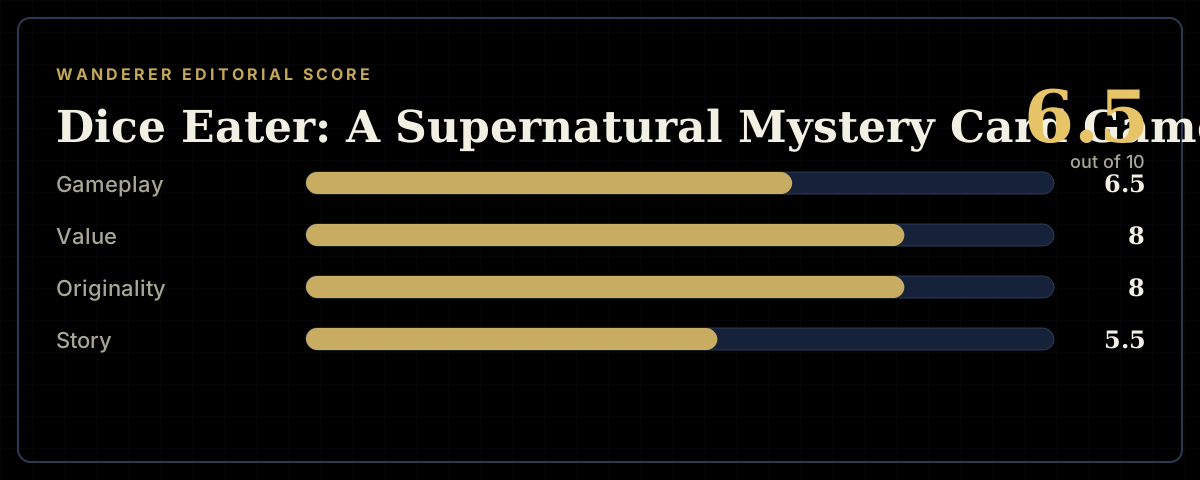
How the review scores each part of the gameWanderer Editorial -
The short versionWanderer Editorial