
Game review
Gladiator Fights
5.5 / 10
- Developer
- ZERO5GAMES
- Publisher
- ZERO5GAMES
- Released
- 7 May 2025
- Platforms
- Windows
- Genre
- Adventure, Casual, Indie, Simulation, Sports
- Players
- Single-player
The short version
Biggest strengths
- An intuitive, satisfying pre-battle planning loop where placement and resource management decide the outcome before the fighting even starts
- Pleasant, well-liked pixel art and a soundtrack reviewers consistently enjoy
- Extremely cheap, offering several hours of engagement for a very low price
Biggest weaknesses
- No direct or active control once a battle begins, which several reviewers say makes combat feel passive and disconnected compared to what its Totally Accurate Battle Simulator comparisons might suggest
- Described by multiple reviewers as monotonous or predictable once the core placement strategy is understood
- No plot, narrative framing, or long-term goals beyond the arena-to-arena loop itself
5.5 / 10
Plan the battle, then watch it unfold
Gladiator Fights strips combat down to its planning phase: place your fighters and defenders across a compact, hazard-laden arena, allocate limited resources, and then watch the resulting skirmish play out with minimal further input. Based on the available English-language review sample of 69 reviews — 63 positive, 6 negative, landing at an overall Very Positive rating — the comparison reviewers reach for most consistently is Totally Accurate Battle Simulator, scaled down to a cheap, pixel-art 2D form. "This game reminds me a lot of TABS, only in a cheaper form - 2D. In this game, everything is decided by planning. You can play for at least a few hours if you're bored," one reviewer writes, while a separate reviewer frames the same comparison more enthusiastically: "TABS 2.0 - Gladiator Edition. In this game, we fight the enemy army. To do this, we place our troops on the field and watch this epic battle. It seems to be easy, but in some moments the resources are very limited and you have to plan your strategy in advance. The game is intuitive and exciting, after each defeat the interest in trying again and reaching the end only becomes stronger."
One especially detailed reviewer offers a precise framing of the design philosophy at play: "'Gladiator Fights' is a small yet surprisingly focused tactical arena game that strips away the usual flash and spectacle of action titles and instead challenges the player to win battles through planning alone. Developed and published by ZERO5GAMES, it places you in the role of a commander orchestrating skirmishes inside compact, hazard-laden arenas. Rather than controlling fighters directly, you arrange your squad before the battle begins, choosing their positions and attempting to anticipate the behavior of a varied cast of enemies. Once the fight starts, the outcome depends entirely on the quality of your preparation" — a deliberate structural choice rather than a missing feature, according to this framing.
A lack of active control that splits opinion sharply
That same design choice — no direct control once a battle starts — is exactly where this review sample's negative reactions concentrate. "The game promises strategy, but in the end it all comes down to predictable tactics and monotony. The lack of active controls makes combat boring and tedious. Did not meet expectations," one reviewer writes, and a separate reviewer reaches a nearly identical conclusion: "I expected a deep tactical struggle, but the game seems too limited and static. Building teams is often pointless due to the lack of active control. The graphics are good, but the mechanics are disappointing." Both reviewers specifically frame their disappointment around the same structural gap: having invested effort into pre-battle planning, they wanted more agency during the fight itself rather than watching a fully automated resolution play out.
It's worth noting this isn't a universal complaint — plenty of positive reviewers describe the same hands-off structure as the game's core appeal rather than a shortcoming, similar to how genre touchstones like Totally Accurate Battle Simulator or Mindustry's combat sequences are enjoyed specifically for their emergent, watch-it-unfold quality. "Insanely simple tactics, with the placement of defenders on the playing field. Retro style, simple mechanics, boring but cheap," one more ambivalent reviewer writes, landing somewhere between the two camps — acknowledging the simplicity without fully condemning it given the low price.
No achievements, no plot, and one specific complaint about lasting appeal
The most pointed negative review in this sample raises a concern worth verifying directly rather than simply repeating. "A boring game that has no achievements, no plot, no other incentive to play it, and it is unclear why you should play it if you don't get anything for it," one reviewer writes. Checking Steam's own achievement data directly confirms this specific claim: Gladiator Fights currently has no achievements listed at all, a genuine structural gap that removes one of the more common tools smaller games use to give players concrete, trackable goals beyond the core loop itself. Combined with the complete absence of any narrative framing — no story, no characters beyond the abstract "gladiator" and "commander" roles — this is a game that offers essentially nothing beyond its core placement-and-watch mechanic to sustain engagement over a longer period.
What the fans specifically enjoy
Despite those structural gaps, the presentation itself draws real, consistent praise across the positive sample. "A simple game in which we have to not only fight with enemies, but also plan and strategize our actions, as well as make critical decisions for survival in the game world. Pixel graphics and pleasant soundtrack will not let us get bored and allow us to relax," one reviewer writes, crediting the audiovisual presentation directly as a reason the simple mechanics don't wear thin as quickly as they otherwise might. A separate reviewer frames their overall satisfaction in terms of the price-to-content ratio specifically: "The minimalistic design does not hurt the eye, everything is simple, neat and convenient, no frills. Every decision has weight, and you can overplay it strategically, and you can get trapped, well, as it goes. It's a simple game, I'm satisfied with everything, I love these games."
Where this leaves it
Gladiator Fights delivers exactly what its stripped-down premise promises: a genuinely satisfying pre-battle planning phase built around limited resources and careful placement, wrapped in pleasant pixel art at an extremely low price. Its most significant limitation is structural rather than a bug or a polish issue — the complete lack of active control once combat begins reads as either the game's core appeal or its central flaw depending entirely on what a given player wants from a tactics game, and the confirmed absence of any achievement system or narrative framing leaves genuinely little to sustain interest once the core loop's novelty settles. Worth its very low asking price for fans of watch-it-unfold tactics games in the TABS mold; a likely disappointment for anyone hoping for more hands-on control during the fights themselves.
Pros and cons
Pros
- An intuitive, satisfying pre-battle planning loop where placement and resource management decide the outcome before the fighting even starts
- Pleasant, well-liked pixel art and a soundtrack reviewers consistently enjoy
- Extremely cheap, offering several hours of engagement for a very low price
- Genuine tension around limited resources that rewards careful strategic thinking over reflexive play
Cons
- No direct or active control once a battle begins, which several reviewers say makes combat feel passive and disconnected compared to what its Totally Accurate Battle Simulator comparisons might suggest
- Described by multiple reviewers as monotonous or predictable once the core placement strategy is understood
- No plot, narrative framing, or long-term goals beyond the arena-to-arena loop itself
- Confirmed to have zero Steam achievements, a real structural gap that at least one reviewer specifically cites as removing any long-term incentive to keep playing
Screenshots
-

Gladiator FightsImage: ZERO5GAMES via Steam -

Gladiator FightsImage: ZERO5GAMES via Steam -

Gladiator FightsImage: ZERO5GAMES via Steam -
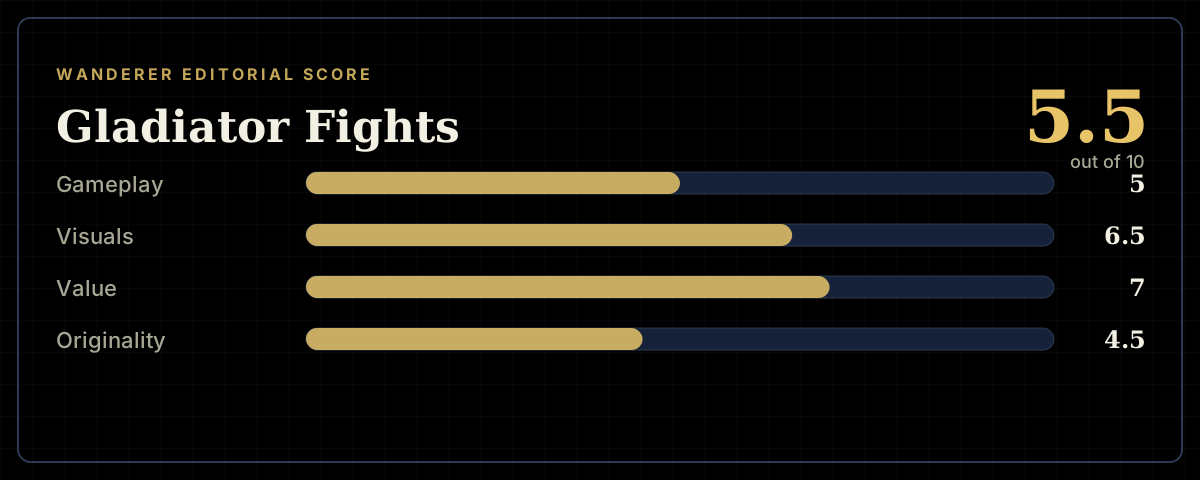
How the review scores each part of the gameWanderer Editorial -
The short versionWanderer Editorial