
Game review
Deus Ex: Human Revolution - Director's Cut
6 / 10
- Developer
- Eidos Montreal
- Publisher
- Eidos Interactive Corp.
- Released
- 23 August 2011
- Platforms
- Windows
- Genre
- Cyberpunk Action RPG
- Monetisation
- Paid, one-time purchase. Includes the Missing Link DLC integrated into the main campaign.
- Players
- Single-player only.
The short version
Deus Ex: Human Revolution's core design — genuine choice between stealth, combat and hacking approaches, augmentation-driven character building, and a cyberpunk story that still holds up — remains one of the best examples of its genre, and 25,000-plus mostly glowing reviews reflect that. What complicates a simple recommendation is that this game is sold today only as the Director's Cut re-release, and a remarkably consistent thread of reviews running from the re-release's 2013 launch through May 2026 describes it as built on an older, unpatched, buggier base than the original game it replaced — complete with a specific, ongoing stuttering problem that several reviewers say has never been fixed and has, if anything, worsened on modern hardware.
Biggest strengths
- Genuinely meaningful choice between stealth, direct combat, hacking and social approaches to almost every major obstacle, backed by a real augmentation-based character progression system.
- A well-regarded cyberpunk story and Adam Jensen's central "did I want this?" body-modification theme, which still resonates over a decade later.
- The Missing Link DLC is integrated directly into the main campaign's timeline in this edition, restoring narrative context some players felt was missing from the DLC's standalone original release.
Biggest weaknesses
- A remarkably consistent complaint spanning 2013 through 2026 describes this Director's Cut as built on an older, unpatched game version than the original release, reintroducing bugs that had previously been fixed.
- Multiple reviewers, including several from 2025 and 2026, report severe and unresolved stuttering on modern hardware that makes extended play uncomfortable or borderline unplayable.
- At least one detailed review describes a visual downgrade specifically, citing the removal of the original's distinctive gold colour filter.
Who it's for: Cyberpunk and immersive-sim RPG fans who want one of the genre's defining games, provided they're prepared to research and apply community performance fixes rather than expecting the Steam release to run cleanly out of the box.
Our recommendation: The game itself is a genre classic worth playing; budget time to track down community stuttering fixes before starting, since the current official release is widely reported to need them.
6 / 10
A genre-defining choice-driven RPG
Deus Ex: Human Revolution's reputation as one of the best immersive-sim RPGs of its era is well earned and not seriously disputed by even its harshest reviewers. The store page's own framing sets up the premise cleanly: "You play Adam Jensen, an ex-SWAT specialist... hand-picked to oversee the defensive needs of one of America's most experimental biotechnology firms," whose augmented body becomes the game's central thematic and mechanical hook after a black-ops attack changes everything he thought he knew about his job. The game backs that premise with real systemic depth — nearly every major obstacle can be approached through stealth, direct combat, hacking, or social manipulation, with an augmentation tree that meaningfully shapes which of those approaches actually works for a given playthrough. The official Director's Cut key art captures the tone well: Adam Jensen, augmented arm-blades visible, crouched behind cover studying a patrolling security robot in a moodily-lit facility corridor — exactly the kind of considered, options-open encounter design the game built its reputation on.
What "Director's Cut" changed, and what reviewers say it broke
This particular Steam release isn't the original 2011 game — it's a 2013 re-release that folded in the previously separate Missing Link DLC at its proper point in the story's timeline and reworked the original's widely-criticised mandatory boss fights, which had been outsourced to a different studio and famously clashed with the stealth-focused design most players had built toward. Those two changes are genuine improvements, and reviewers who focus purely on content agree. The trouble, according to a striking and unusually long-running pattern in the reviews, is everything else. "A downgrade, basically," reads a 2014 review, going on to describe the removal of "the gold filter" that defined the original's visual identity. A more technical 2014 review states plainly that "the game uses an old version of the original game, which means it has all the bugs that were patched years ago in THE ORIGINAL GAME." That specific claim — not a vague "it's buggy," but a description of a re-release regressing to a pre-patch build — repeats independently across years: a 2022 review warns "It is shocking that the graphics would actually be downgraded for a 'Director's Cut,'" and a 2021 review recommends "trying to play the original if you have it instead," describing this edition as "filled with lots of issues and bugs."
A stability problem that's persisted, not faded
If this were purely a decade-old complaint about an early, rough re-release, it would be reasonable to assume the situation has since improved. The review sample says otherwise. A March 2025 review states: "You'd think that a decade-old game would run well on modern machines which far exceeds the recommended hardware requirements, but it is so laggy and stutter every few minutes that it just borders on unplayable." A February 2026 review, from an account with two prior full playthroughs logged, is blunt about why it's leaving a negative review despite loving the game: "This version sucks. Its full of bugs and stuttering that were fixed in the original version." A May 2026 review — among the most recent in the entire sample — reports "a huge amount of stutters on current hardware," closing with a broader complaint about paying for a product that degrades rather than improves with time. Checking a sample of thirty recent negative reviews, seventeen raise this same stuttering or outdated-base complaint independently, spanning the full thirteen years since this edition's launch. That consistency, across that much time, is hard to read as anything other than a real, persistent, unaddressed technical problem specific to this release rather than the underlying game.
The Embracer question, reported but not adjudicated
One review raises a broader industry point worth including carefully rather than either amplifying or ignoring it. A January 2024 review states that "the Swedish gaming company Embracer Group owns this game," and describes a cancelled in-development Deus Ex sequel alongside "massive layoffs inside the studio" as reasons to avoid purchasing, framing the situation as having "effectively killed the franchise." Embracer's acquisition of Square Enix's Western studios including Eidos Montreal in 2022, and the subsequent restructuring across its portfolio, are documented facts of the period; this review hasn't independently verified every specific detail in that reviewer's account of a cancelled sequel or the scale of layoffs, and presents it here as one reviewer's characterisation of publicly-discussed industry events rather than confirmed reporting of its own. It's included because a prospective buyer weighing whether to support a franchise's current ownership with a purchase deserves to know the concern exists in the public review record, even where this review can't verify every claimed detail firsthand.
Final verdict
The design at the heart of Deus Ex: Human Revolution remains genuinely excellent, and this review has no reservations recommending the game itself to anyone interested in cyberpunk RPGs or immersive sims. What keeps the score from reflecting that design alone is that Steam only sells one version of it, and a remarkably long, remarkably consistent thread of reviews describes that specific version as a technical step backward from the game it replaced — reintroduced bugs, a visual downgrade, and stuttering multiple reviewers say has never been resolved, even as recently as a few months before this review. A prospective buyer should go in prepared to apply community-sourced performance fixes rather than expecting a clean, modern-feeling release out of the box, and shouldn't be surprised to find the game running rougher than its age alone would suggest.
Pros and cons
Pros
- Genuinely meaningful choice between stealth, direct combat, hacking and social approaches to almost every major obstacle, backed by a real augmentation-based character progression system.
- A well-regarded cyberpunk story and Adam Jensen's central "did I want this?" body-modification theme, which still resonates over a decade later.
- The Missing Link DLC is integrated directly into the main campaign's timeline in this edition, restoring narrative context some players felt was missing from the DLC's standalone original release.
- Multiple added boss-fight options in this edition addressed a widely-criticised weakness of the original 2011 release's mandatory, poorly-designed combat encounters.
Cons
- A remarkably consistent complaint spanning 2013 through 2026 describes this Director's Cut as built on an older, unpatched game version than the original release, reintroducing bugs that had previously been fixed.
- Multiple reviewers, including several from 2025 and 2026, report severe and unresolved stuttering on modern hardware that makes extended play uncomfortable or borderline unplayable.
- At least one detailed review describes a visual downgrade specifically, citing the removal of the original's distinctive gold colour filter.
- The original, non-Director's-Cut version of the game is not available for purchase on Steam at all, leaving buyers with only the more heavily criticised re-release as an option.
Screenshots
-

Deus Ex: Human Revolution - Director's CutImage: Eidos Interactive Corp. via Steam -

Deus Ex: Human Revolution - Director's CutImage: Eidos Interactive Corp. via Steam -

Deus Ex: Human Revolution - Director's CutImage: Eidos Interactive Corp. via Steam -
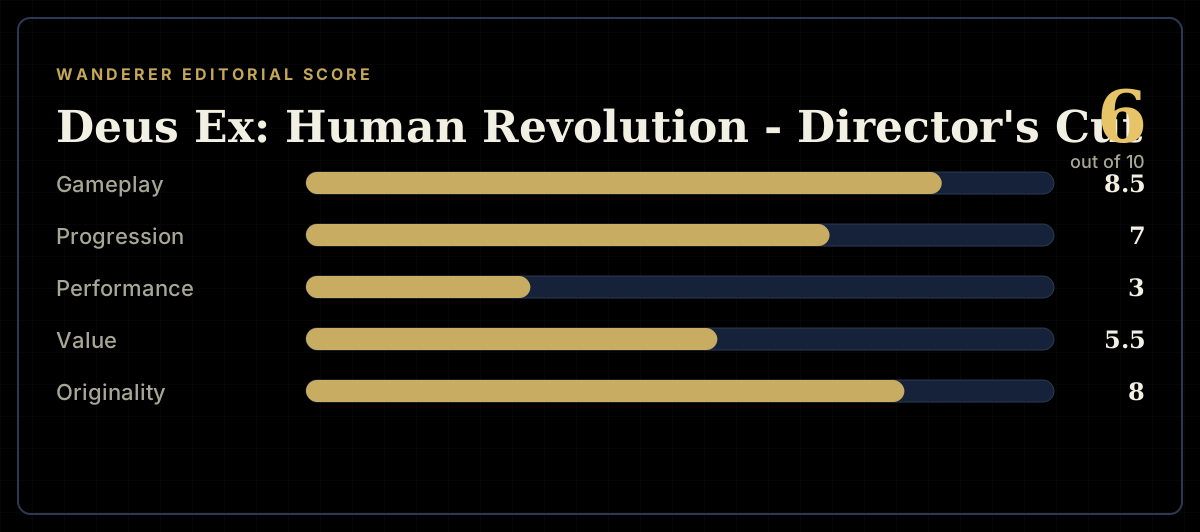
How the review scores each part of the gameWanderer Editorial -
The short versionWanderer Editorial