
Game review
Detention
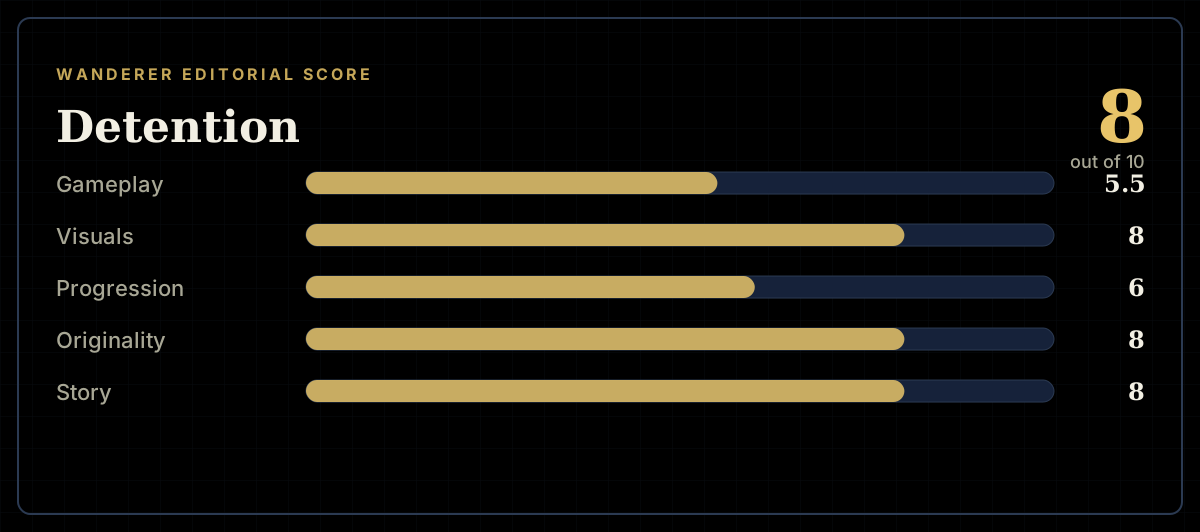
8 / 10
- Developer
- Red Candle Games
- Publisher
- Red Candle Games
- Released
- 12 January 2017
- Platforms
- Windows, macOS, Linux
- Genre
- Atmospheric horror point-and-click
- Monetisation
- One-off purchase, no in-game currency, ads or gameplay-affecting purchases
- Players
- None; single-player only
The short version
Detention sets its ghost story inside a specific, real historical horror few games have touched: Taiwan's White Terror, decades of martial law and political persecution the story treats with evident care rather than as exotic set dressing. That grounding gives the game's atmosphere and emotional weight a rare authenticity, and the near-unanimous praise across its review sample reflects real, specific engagement with the history rather than generic horror-game enthusiasm — multiple reviewers describe it as staying with them, drawing direct comparisons to Silent Hill 2 for how personal grief and political horror interlock. A real, more specific minority critique runs underneath that reception: several detailed reviews argue the puzzle-and-fetch-quest mechanics are thin enough that the game functions closer to a "walking simulator" than an adventure game, and at least one reviewer raises a serious, specific concern about how the narrative frames a predatory adult-student relationship central to its plot. Both threads are worth taking seriously without letting either erase what the game does exceptionally well: using real, specific history to make its horror mean something beyond the scare itself.
Biggest strengths
- A rare, specific historical setting — Taiwan's White Terror era — handled with evident care and used to genuinely deepen the horror rather than as superficial atmosphere
- Consistently praised 2D atmospheric presentation and sound design that reviewers describe as "flawless" and genuinely unsettling
- A story multiple reviewers describe as personally affecting and comparable to Silent Hill 2 in how it fuses psychological horror with real grief
Biggest weaknesses
- A recurring, specific critical thread describes the actual gameplay as thin — simple fetch quests and backtracking with two enemy types that "don't add a whole lot," leading several reviewers to call it closer to a walking simulator than a point-and-click adventure
- Multiple reviewers report the central mystery becomes clear well before the game confirms it, undercutting tension in the back half for players who pick up on early environmental hints
- At least one detailed review raises a serious, specific concern about how the narrative frames a predatory adult-student relationship at the story's center, arguing the framing doesn't fully reckon with its own subject matter — reported here as one reviewer's substantive critique worth taking seriously, not a content-suitability disqualifier
Who it's for: Players drawn to atmospheric, story-first horror with genuine historical and political weight, and anyone interested in a rare, culturally specific setting few other horror games attempt. Less suited to players who want substantial puzzle-solving challenge, since the mechanics here are intentionally secondary to the narrative and atmosphere.
Our recommendation: A strong recommendation at its typically low price for the story and atmosphere specifically — go in understanding the puzzles are simple and treat the experience as narrative-first rather than expecting deep adventure-game mechanics.
8 / 10
Detention traps two students inside a Taiwanese high school that has twisted into something otherworldly, but the ghost story underneath that premise is grounded in something specifically real: the White Terror, decades of martial law and political persecution in 1960s Taiwan that Red Candle Games treats as central to the horror rather than as background texture. Released in January 2017, it built an Overwhelmingly Positive reputation — 96.3% across nearly 2,840 English reviews — that later inspired a feature film and television adaptation, a rare trajectory for a small indie horror title. Reading through its review sample reveals a reception that's close to unanimous on the story's power, alongside a smaller, more specific critical thread worth taking seriously about whether the game underneath that story fully earns it.
History as the horror, not the backdrop
What separates Detention from generic Asian-horror atmosphere is how directly it engages its real setting. One reviewer frames the game's relevance plainly, connecting its themes to censorship and "prohibiting certain thoughts" as live concerns rather than historical curiosities. Another describes the emotional register achieved: "the combination of eastern religion horror, political propaganda and a school setting make Detention one of the most unique psychological horrors... teared up at the end." A third draws the comparison this review sample returns to more than any other: "of all the games that chased the glory of the original Silent Hill, Detention is the greatest that kept to its own style while capturing that wonderfully horrific world of personal grief." That's a specific, informed comparison from reviewers who clearly know the genre, not generic praise, and it's echoed closely enough across the sample to treat as an accurate account of what the game achieves.
A real critical thread about the mechanics underneath
Set against that praise, a meaningful minority of detailed reviews raise the same specific complaint from different angles: the actual point-and-click gameplay doesn't match the story's ambition. One reviewer states it directly: "the gameplay is made up of fetch quests and solving puzzles, which are very basic... there are 2 enemy types in the game... but they don't add a whole lot to the gameplay." A more pointed review goes further: "it's for the most part a walking simulator" with "little gameplay and random cuts." A third complaint sharpens the pacing critique specifically: the mystery's key reveals become apparent "very early in the game" through environmental hints, undercutting suspense the back half of the game is still trying to build. These are specific, substantive criticisms rather than a taste mismatch, and they're worth weighing seriously against the story-focused praise rather than treating the 96% score as settling the question of mechanical depth.
A specific narrative concern worth reporting directly
One detailed review raises a substantive concern distinct from ordinary gameplay criticism: the narrative's central relationship involves a school counselor and a student, and the reviewer argues the game's framing of that dynamic doesn't fully reckon with what it depicts, despite an otherwise strong ending. This review reports that critique attributively rather than adjudicating it — it's a serious, specific reading of how the story handles a genuinely difficult subject, made by a reviewer who otherwise found much to admire in the game, and it deserves the same direct treatment this review gives any substantive content critique rather than being smoothed over in service of an otherwise glowing consensus.
A reputation shaped partly by events outside this game
Worth stating factually: several reviews in the sample reference Red Candle Games having faced organized review-bombing "for a very stupid reason," a reference to a well-documented 2019 controversy surrounding the studio's later, separate game Devotion, which included content referencing Chinese president Xi Jinping and was pulled from sale after backlash, triggering retaliatory review campaigns against the studio's earlier catalogue including this game. That controversy has nothing to do with Detention's own content or quality, and reviewers citing it generally do so specifically to contextualize why some negative reviews in the corpus may reflect politics unrelated to the game rather than genuine critical assessment — worth knowing as context for reading the review sample as a whole, distinct from the substantive gameplay and narrative critiques detailed above.
A rare jump from indie horror game to national cinema
Detention's reach beyond its own review sample is worth noting directly: the game was adapted into a feature film in 2019 and later a television series, both produced in Taiwan and received as serious cultural works engaging with the White Terror era rather than as licensed video-game cash-ins. That trajectory — a small indie horror game inspiring mainstream film and television treatment of a real historical trauma — is a genuinely unusual achievement for the medium, and it corroborates from outside the Steam review sample what reviewers inside it consistently describe: that the game's engagement with its history reads as sincere and substantial enough to support adaptation into other, more traditionally "serious" media, rather than as a horror-genre exercise that happened to borrow real history for atmosphere.
Verdict
Detention succeeds at something genuinely rare: using a specific, real historical horror to give its ghost story emotional and political weight most genre entries never attempt, and its near-unanimous reception reflects real engagement with that achievement rather than empty enthusiasm. A real, more specific critical thread about thin mechanics and an under-examined central relationship is worth taking seriously rather than dismissed by the aggregate score. Play it for the story and the history it's built on; expect the puzzles themselves to stay simple throughout.
Sources: Steam store page and appdetails API (release date, pricing, platform data); Steam's aggregate review data (query_summary totals, English-language sample); individually read user reviews, both positive and negative, sorted by helpfulness and recency; Steam's global achievement statistics API; Red Candle Games' own partner-events patch and localization history from the January 2017 launch through 2018.
Pros and cons
Pros
- A rare, specific historical setting — Taiwan's White Terror era — handled with evident care and used to genuinely deepen the horror rather than as superficial atmosphere
- Consistently praised 2D atmospheric presentation and sound design that reviewers describe as "flawless" and genuinely unsettling
- A story multiple reviewers describe as personally affecting and comparable to Silent Hill 2 in how it fuses psychological horror with real grief
- Achievement data confirms two distinct, meaningfully different endings, giving the narrative a real branch point worth exploring
- Cultural and religious specificity (Taoism, Buddhist imagery, Taiwanese folklore) gives the game genuine identity distinct from generic East Asian horror tropes
Cons
- A recurring, specific critical thread describes the actual gameplay as thin — simple fetch quests and backtracking with two enemy types that "don't add a whole lot," leading several reviewers to call it closer to a walking simulator than a point-and-click adventure
- Multiple reviewers report the central mystery becomes clear well before the game confirms it, undercutting tension in the back half for players who pick up on early environmental hints
- At least one detailed review raises a serious, specific concern about how the narrative frames a predatory adult-student relationship at the story's center, arguing the framing doesn't fully reckon with its own subject matter — reported here as one reviewer's substantive critique worth taking seriously, not a content-suitability disqualifier
- The game's reputation was affected by review-bombing unrelated to its own quality, stemming from a real-world political controversy surrounding the developer's later, separate game; worth knowing this context exists in the review corpus rather than assuming all critical reviews reflect the game's actual content
- Pacing in the second half draws specific complaints as duller than the opening, with backtracking cited directly as a source of tedium by more than one reviewer
Screenshots
-

DetentionImage: RedCandleGames via Steam -

DetentionImage: RedCandleGames via Steam -

DetentionImage: RedCandleGames via Steam -
How the review scores each part of the gameWanderer Editorial -
The short versionWanderer Editorial