Game review
Dead Reckoning: The Long Drift
7 / 10
- Developer
- Garan Lorn
- Publisher
- Selenodrome
- Released
- 25 June 2026
- Platforms
- Windows
- Genre
- Indie, Simulation, Strategy
- Monetisation
- paid
- Players
- false
The short version
Biggest strengths
- A genuinely detailed crew and colony simulation, giving individual colonists small personal stories and histories rather than treating them as abstract numbers
- A strong sense of scale and dread around interstellar distances, which multiple reviewers describe as goosebump-inducing and emotionally affecting
- Distinct retro visual and audio presentation that several reviewers compare favourably to classic simulation games like Uplink
Biggest weaknesses
- No metaprogression between runs currently exists, meaning each colony's fate is fully isolated with nothing carried forward, a point several reviewers raised as the game's biggest current gap
- The flight/journey portion of the loop is widely reported to become repetitive after the first several hours, well ahead of the shorter, thinner colony-management portion
- Some reviewers find the event and log writing formulaic and impersonal in its current state, wishing it read with more distinct, human voice
Who it's for: Fans of slower-paced generation-ship and resource-management sims who want a text-driven, story-rich experience emphasizing hard choices over action, and are comfortable supporting an Early Access title still finding its final shape
Our recommendation: recommended with caveats
7 / 10
A thousand colonists, and every choice rewrites who they are
Dead Reckoning: The Long Drift puts players in charge of 1,000 colonists adrift between the stars, with every pragmatic decision reshaping what that population becomes by the time — if ever — it reaches its destination. It's a premise built for slow-burn dread rather than action, and reviewers who click with that pacing describe the experience in genuinely emotional terms. One review called it simply "one of the best games of the year," explaining that visualizing "these events and the incredible distances between stars... gives you goosebumps," and praising how the game "captures the experience of long-range interstellar travel in great detail, requiring you to plan every move years in advance." That's a high bar to set, but it's echoed by other reviewers describing the interface and mood as "perfect" and "a real escape from reality," with one comparing the retro presentation directly to Uplink and saying it "takes me back to the millennium era of gaming."
Detailed people, not abstract numbers
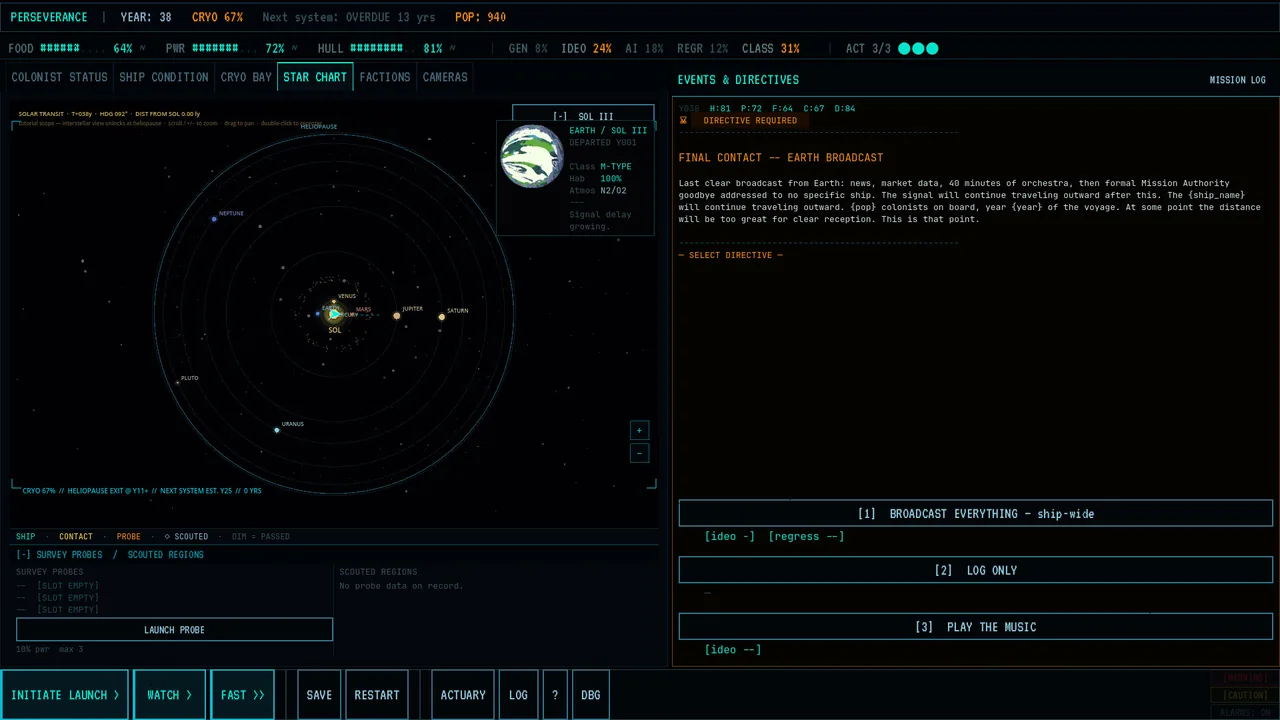
What consistently earns the game its strongest praise is how it handles individual colonists. One detailed review, weighing pros and cons carefully, praised the "detailed simulation of ship / crew," noting "not just a number, every crewmember has a small story, name and history," and comparing the resulting texture to "Dwarf Fortress'esque aesthetics" — high praise from a genre known for exactly that kind of emergent, personal storytelling. The same reviewer credited the game with going beyond a pure spaceship simulator by layering a genuine colony-management system on top, giving players "lots of options for 'roleplaying' your missions" with meaningfully different good and bad outcomes depending on the choices made along the way.
The gaps Early Access hasn't closed yet
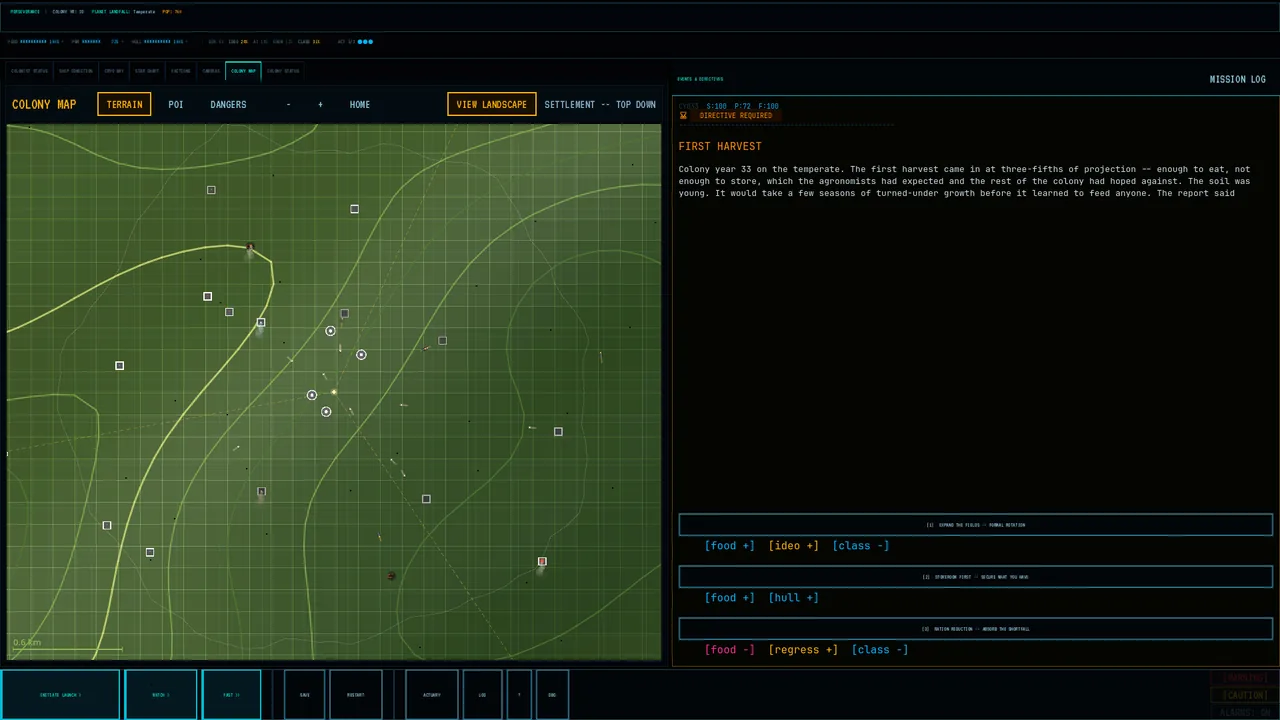
Set against that praise, the most consistent structural criticism is the current lack of any metaprogression between runs. The same detailed review that praised the crew simulation called this "the biggest con for me personally," explaining that every run is fully isolated in a freshly randomized system, with nothing — no colony legacy, no long-term consequences — carried forward, and specifically wishing for a future where "the future of my colonies hundreds of years after" could feed into subsequent playthroughs. A related complaint concerns pacing across the two halves of the game: one reviewer noted the flight portion is "fun in the first few hours" but "quickly becomes repetitive," while "the colony sim part is currently very short" — an imbalance that several other reviewers echoed, generally agreeing the space-travel half currently outweighs the newer colony-management half in both content and polish.
A question mark over the writing's voice
A smaller but pointed criticism concerns the tone of the game's event and log writing. One critical review, while praising "the theme, the skeleton of the resource system, and the visual aspects of the presentation," wished "the different subsystems of the game felt more weighty and more strongly coupled, and that the writing sounded human," going as far as wondering whether the writing style was meant to be tied to an in-game "AI autonomy" value before concluding they didn't notice enough correlation to support that theory. It's worth being precise about what that criticism actually is: a stylistic complaint about formulaic, repetitive-feeling event text, not a substantiated claim about how the writing was produced — no reviewer offered concrete evidence either way, and this review is better read as pointed feedback on tone than as a factual claim. A second, blunter critical review made a related but separate point about substance rather than style, arguing the game is "essentially... just a primitive resource manager" dressed up in more text than its systems currently justify.
Active development, with a real roadmap
What's genuinely encouraging is the pace and specificity of post-launch updates. The patch history shows a steady, frequent cadence of named releases addressing exactly the areas reviewers are flagging — colony growth systems, new chronicle and record-keeping features, expanded salvage mechanics, and even multiple full localization passes (German, Russian) completed within months of the Early Access launch. A public "What's next" roadmap post further signals a developer actively communicating direction rather than leaving the community to guess, which meaningfully raises confidence that the current metaprogression gap and colony-sim thinness are live development targets rather than settled design decisions.
Standing apart from the usual generation-ship pitch
Generation-ship and long-haul space colonization games tend to lean one of two ways: either a tightly systemic resource-management puzzle in the mold of FTL-style run management, or a broad 4X-scale strategy layer with the interstellar journey reduced to a loading screen between destinations. Dead Reckoning: The Long Drift sits deliberately between those poles, and that positioning is exactly what its strongest reviewers respond to — it wants the drift itself, the years of nothing happening between crises, to be the point, rather than a hurdle to skip past on the way to a more conventional colony-builder. That's a harder needle to thread than either extreme, since it has to make genuine downtime feel meaningful rather than empty, and the current reviews suggest the game succeeds at that far more often than it fails, even while the systems built around that feeling are still catching up to the atmosphere carrying them.
Verdict
Dead Reckoning: The Long Drift succeeds at something genuinely hard to pull off: making the sheer scale and loneliness of interstellar travel feel emotionally real, anchored by a colony and crew simulation with real personal texture. It's held back today by exactly what you'd expect from an ambitious Early Access release at this stage — a lack of run-to-run metaprogression, an imbalance between its more developed flight loop and its thinner colony-management half, and event writing some reviewers find impersonal. Recommended for players drawn to slower, text-driven simulation experiences who want to support a promising, actively developed niche title; those wanting a complete, replayable package today should wait for the colony systems and metaprogression to catch up with the game's considerable atmosphere.
Pros and cons
Pros
- A genuinely detailed crew and colony simulation, giving individual colonists small personal stories and histories rather than treating them as abstract numbers
- A strong sense of scale and dread around interstellar distances, which multiple reviewers describe as goosebump-inducing and emotionally affecting
- Distinct retro visual and audio presentation that several reviewers compare favourably to classic simulation games like Uplink
- A fair Early Access price for a niche, clearly still-in-development experience, backed by a visibly active, frequent patch cadence
Cons
- No metaprogression between runs currently exists, meaning each colony's fate is fully isolated with nothing carried forward, a point several reviewers raised as the game's biggest current gap
- The flight/journey portion of the loop is widely reported to become repetitive after the first several hours, well ahead of the shorter, thinner colony-management portion
- Some reviewers find the event and log writing formulaic and impersonal in its current state, wishing it read with more distinct, human voice
- Currently thin overall content for a $14.99 price, something even positive reviewers flag as an Early Access reality rather than a finished value proposition
Screenshots
-
Dead Reckoning: The Long DriftImage: Selenodrome via Steam -
Dead Reckoning: The Long DriftImage: Selenodrome via Steam -
Dead Reckoning: The Long DriftImage: Selenodrome via Steam