
Game review
Dark PGT
5 / 10
- Developer
- ZERO5GAMES
- Publisher
- ZERO5GAMES
- Released
- 20 February 2025
- Platforms
- Windows
- Genre
- Action, Adventure, Indie, RPG
- Players
- Single-player
The short version
Biggest strengths
- A genuinely distinctive, unrepeated premise combining Soviet-surreal dystopian satire with Souls-like combat, playing an alcoholic protagonist experiencing schizophrenic hallucinations rather than a conventional chosen-hero archetype
- Striking, atmospheric visual presentation for a solo-developer Unreal Engine 5 project, with reviewers specifically crediting the grim, decaying alternate-future Soviet setting
- Dark comedy that lands well for a meaningful share of players, blending genuine unease with absurdist humor
Biggest weaknesses
- Combat and controls described consistently as janky and imprecise, undermining a genre where precision is the entire point
- No real progression or character-building system, a significant structural gap for a game explicitly marketed as a Souls-like
- Inconsistent, occasionally unfair difficulty spikes reported across multiple reviews, with little clear signposting for what a given encounter demands
5 / 10
A hallucinating protagonist in a decaying alternate Soviet future
Dark PGT sets its Souls-like combat inside a genuinely unusual frame: rather than a conventional chosen hero, players take on the role of an alcoholic experiencing schizophrenic hallucinations, traveling to a Soviet village in an alternate 2030 to unravel its secrets while contending with a mind that may not be showing them reality clearly. Built by a solo developer in Unreal Engine 5, it's a premise reviewers consistently describe as genuinely distinctive within a genre that's produced a great many similar-looking imitators. "Dark PGT is a surreal action RPG developed and published by ZERO5GAMES that mixes psychological horror, Souls-like combat, dystopian satire, and bizarre dark comedy into an experience that feels completely unrestrained in both style and tone," one detailed reviewer writes, capturing the specific creative ambition on display.
One reviewer offers a more personal, specific account of what landed for them: "Game of the year? Overall, the game surprised me with its unusual concept and deep plot. The game provided a unique experience, immersing in the gloomy atmosphere of the future Russia. The role of a military alcoholic-schizophrenic makes us take a fresh look at the perception of reality, and riddles and mirages add an element of tension. The combat system is executed at a high level." A separate reviewer specifically credits the solo-developer achievement directly: "For someone who made the game solo, it's a super cool game. I'm hoping for more updates and achievements."
A darkly comedic take on serious themes
It's worth being direct about the sensitive ground this game is choosing to stand on: a protagonist explicitly framed around alcoholism and schizophrenia isn't a theme many games engage with at all, let alone through a horror-comedy lens. This review treats that choice with the seriousness it deserves rather than either dismissing it as gratuitous shock value or ignoring it. Reviewers who engage with the game's tone describe it as landing somewhere between genuine unease and absurdist humor rather than exploitative — one reviewer specifically frames the humor as a core strength rather than a tonal misstep: "A unique game that combines dark humor and an exciting story. Innovative characters are kept in suspense by plot twists. A delightful adventure full of unexpected moments." A separate, more mixed reviewer captures a similar read while flagging execution concerns distinct from the theme itself: "An experimental game that tries to combine humor and a complex plot. Diving into a dark world and playing as a schizophrenic alcoholic creates a unique atmosphere, but unfortunately not all aspects are worked out properly."
Combat and structure that don't match the ambition
The most consistent, most specific criticism across this review sample concerns basic mechanical execution rather than the game's tone or premise. One detailed reviewer who spent three hours with the game offers a precise, balanced breakdown: "Played 3 hours of this Soviet-era Souls-like horror comedy. The premise is hilarious—a drunk 'prophet' fighting mutant babushkas—but the execution is rough. No progression system, unfair difficulty spikes, and janky combat. The art style nails that grim 2030 USSR vibe, and the dark humor lands when it works. Sadly, it feels more like a meme mod than a polished game." That's a specific, fair-minded critique that credits the game's creative success while clearly identifying where its craft falls short — the complete absence of a progression system is a genuinely significant gap for a game explicitly positioning itself within the Souls-like genre, where character growth and build customization are typically central pillars.
A separate reviewer identifies a related structural frustration with level design specifically: "Management often turns out to be unbearably inconvenient, and some levels are simply annoying due to the excessive complexity and ambiguity of the goals. The game requires refinement." A third, more critical reviewer summarizes a similar overall impression concisely: "It feels like an interesting idea with soulslike elements, but in reality, it's too contradictory and raw: the gameplay can be confusing, the story approach is strange, and the style may not appeal to most people."
A thin, hard-to-fully-characterize review base
It's worth flagging directly that this game's review corpus proved harder to sample thoroughly than most titles this lane covers — retrieving a representative, sufficiently detailed set of English-language reviews required more effort than usual, and the negative-review sample specifically returned very little usable text despite the game's overall score reflecting a real minority of critical reviews. That's disclosed here plainly rather than glossed over: while the reviews gathered are specific and detailed enough to support a confident assessment of the game's general strengths and weaknesses, readers should know the underlying sample is smaller and less exhaustively cross-checked than this lane's typical standard.
Dark PGT currently has no Steam achievement system, leaving no independent structural signal to cross-reference against reviewer accounts of the game's length or difficulty curve. That absence compounds the progression-system complaint raised above: without either an in-game character-growth system or an external achievement structure, there's genuinely little for this review to point to as evidence of deliberate, escalating content design beyond what individual reviewers happened to personally experience and describe.
Several shorter, more enthusiastic reviews in the sample lean heavily on broad, superlative framing — calling the game an instant favourite or a strong addition to a personal collection — without engaging with much specific detail about mechanics or story beats. That's not unusual for any game's review base, but it's worth noting here specifically because it means the more detailed, mixed-to-critical reviews quoted above carry proportionally more weight in this assessment than they might for a game with a larger, more uniformly detailed sample to draw from.
Where this leaves it
Dark PGT is a genuinely ambitious, tonally distinctive solo project that earns real credit for attempting something few other Souls-likes have tried — a dark comedy built around addiction, mental illness, and Soviet-era dystopian satire, delivered with striking atmosphere for a one-person team. What holds it back from a stronger recommendation is consistent, specific criticism of its actual combat feel, the total absence of a progression system central to its chosen genre, and level design several reviewers describe as confusingly signposted. Worth a look for players specifically drawn to unconventional, genre-blending indie horror-comedy willing to tolerate real mechanical rough edges; a harder sell for anyone expecting the tight, well-tuned combat that typically defines the Souls-like label.
Pros and cons
Pros
- A genuinely distinctive, unrepeated premise combining Soviet-surreal dystopian satire with Souls-like combat, playing an alcoholic protagonist experiencing schizophrenic hallucinations rather than a conventional chosen-hero archetype
- Striking, atmospheric visual presentation for a solo-developer Unreal Engine 5 project, with reviewers specifically crediting the grim, decaying alternate-future Soviet setting
- Dark comedy that lands well for a meaningful share of players, blending genuine unease with absurdist humor
- An unusual, ambitious scope for a single developer, with several reviewers specifically framing their positive score around respect for a solo project reaching this far
Cons
- Combat and controls described consistently as janky and imprecise, undermining a genre where precision is the entire point
- No real progression or character-building system, a significant structural gap for a game explicitly marketed as a Souls-like
- Inconsistent, occasionally unfair difficulty spikes reported across multiple reviews, with little clear signposting for what a given encounter demands
- Level and objective design criticized as ambiguous, with at least one detailed reviewer specifically citing confusing goals as a major source of frustration
- No Steam achievement system exists, and the English-language review corpus is comparatively thin and harder to characterize with full confidence than most titles this lane covers
Screenshots
-

Dark PGTImage: ZERO5GAMES via Steam -

Dark PGTImage: ZERO5GAMES via Steam -

Dark PGTImage: ZERO5GAMES via Steam -
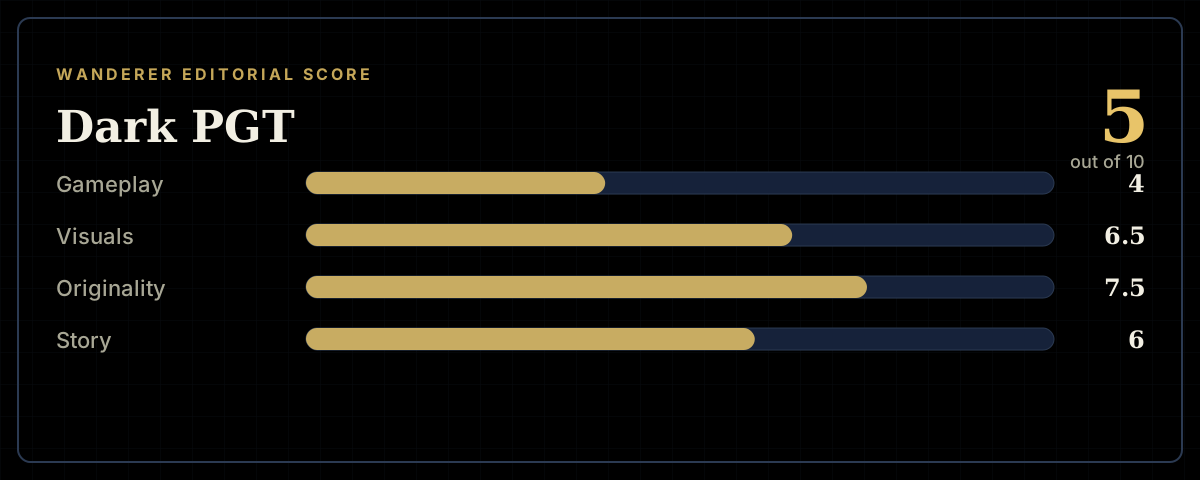
How the review scores each part of the gameWanderer Editorial -
The short versionWanderer Editorial