Game review
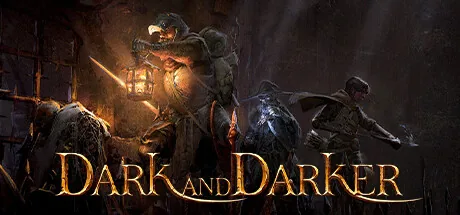
Dark and Darker
7 / 10
- Developer
- IRONMACE
- Publisher
- IRONMACE
- Released
- 7 June 2024
- Platforms
- Windows
- Genre
- First-Person Extraction Dungeon Crawler
- Monetisation
- Free to play, with a one-time real-money account upgrade (Legendary Status) that unlocks High Roller dungeons, extra character slots and full trading privileges, plus optional recurring seasonal packs that bundle premium currency, cosmetics and season-limited conveniences.
- Players
- Online PvPvE only — trios, duos and solo queues depending on dungeon and season, full-loot on death, an in-game Marketplace for player trading added in Season 10
The short version
Dark and Darker's central idea is still one of the best in multiplayer gaming right now: strip a first-person fantasy dungeon crawler down to loot, monsters and other players, then make the only way to actually keep anything you find is walking it out through a portal alive. That single rule turns every fight into a math problem about whether winning is worth the risk of losing everything you're carrying, and nothing else quite replicates the specific tension it produces.
What keeps it from scoring higher is everything built around that idea rather than the idea itself — seasonal wipes that erase weeks of progress on a schedule, a free tier that gates real content behind a paid account upgrade, persistent cheating complaints despite an anti-cheat aggressive enough to lock out older PCs and Linux entirely, and a legal history with Nexon that is not as settled as a lot of players assume.
Biggest strengths
- Full-loot extraction genuinely changes how you play every fight, since walking away is often the smarter tactical choice than winning a scrap
- Ten classes with real toolkit differences give trios actual division of labour instead of five reskins of the same warrior
- The Season 10 Marketplace finally gives gear a legitimate place to go besides a stash or a killer's inventory
Biggest weaknesses
- Seasonal wipes clear character levels, stashes and gear roughly every two to three months, so no run of good luck ever compounds into lasting progress
- High Roller dungeons, extra character slots and full trading access sit behind the one-time Legendary Status purchase, so the free tier is a taste of the game rather than the whole thing
- Cheating remains a recurring complaint in player feedback despite a kernel-level anti-cheat that requires TPM 2.0 and Secure Boot, which locks out older PCs, Linux and Steam Deck entirely
Who it's for: Players who want PvP with real stakes and don't mind losing a good run to a smarter or luckier opponent. A poor fit for anyone who wants their time investment to compound indefinitely, or who has already burned out on other extraction shooters' wipe cycles.
Our recommendation: Install it free and spend your first sessions in solo or duo queues learning class fundamentals before risking anything in a trio. Treat every wipe as the actual reset point rather than chasing a permanent stockpile, and decide on Legendary Status only after you know whether you'll still be playing next season.
7 / 10
Every extraction game asks the same question at the door: what happens if you die holding everything you came for? Most answer it with a compromise — you keep some of it, or you keep all of it minus a tax, or death only costs you the run's loot and not your stash. Dark and Darker doesn't compromise. Die in the dungeon with a full inventory and every item on your body, in your pack and in your hands becomes free loot for whoever or whatever killed you. The only way to keep anything is to physically carry it to a portal or a staircase and leave. That single, uncompromising rule is the entire design, and two years into Steam Early Access it's still the sharpest version of this idea on the market.
The loop: leaving is the actual skill
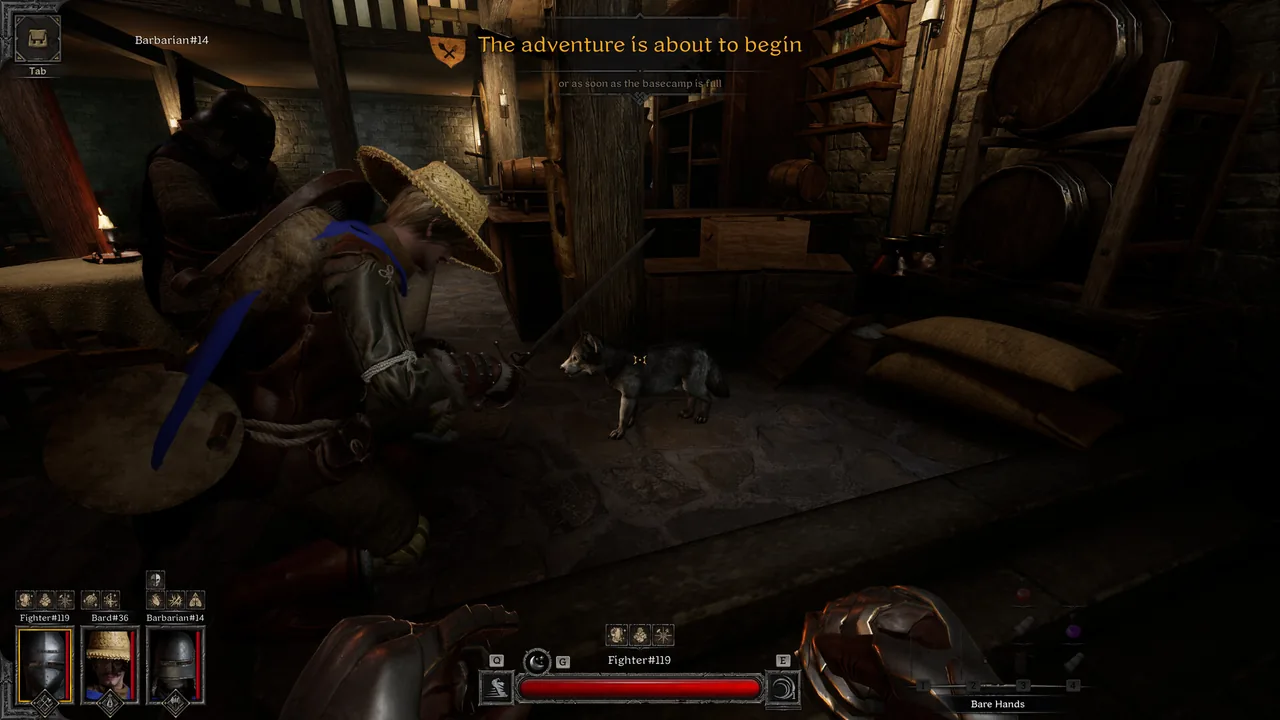
Combat in Dark and Darker is competent first-person fantasy fighting — swing timing, stamina management, positioning around chokepoints — but it isn't the game's real test. The real test is deciding when a fight isn't worth having. A trio that's cleared half a dungeon, killed a few monsters and found decent gear is constantly weighing a simple question: push deeper for better loot and risk running into a better-equipped squad, or head for the nearest exit while they still can. That tension doesn't come from any single system. It comes from the fact that everything you're carrying is genuinely, permanently at stake the moment another player finds you.
This is the same design philosophy EVE Online has run for two decades in a spaceship setting — losses have to be real for decisions to mean anything — compressed into a twenty-to-thirty-minute dungeon run instead of a years-long career. Where EVE spreads the consequence of a bad decision across a slow, deliberate pace, Dark and Darker delivers it fast enough that a single misjudged fight in the last two minutes of a run can undo everything that came before it. That immediacy is the game's best trick. It's also why so much of the community's energy goes into "should I have fought that" post-mortems rather than build theorycrafting — the interesting decisions happen in real time, not in a menu.
Classes, trios and whether solo play is a real option
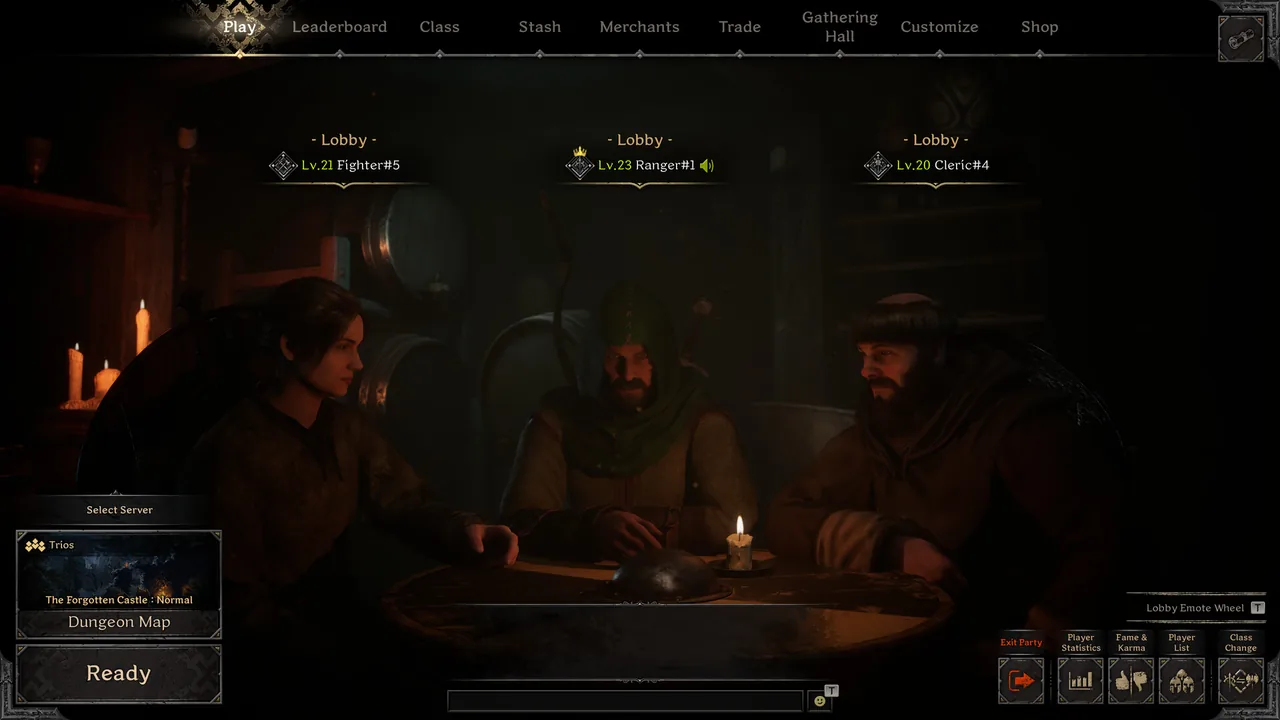
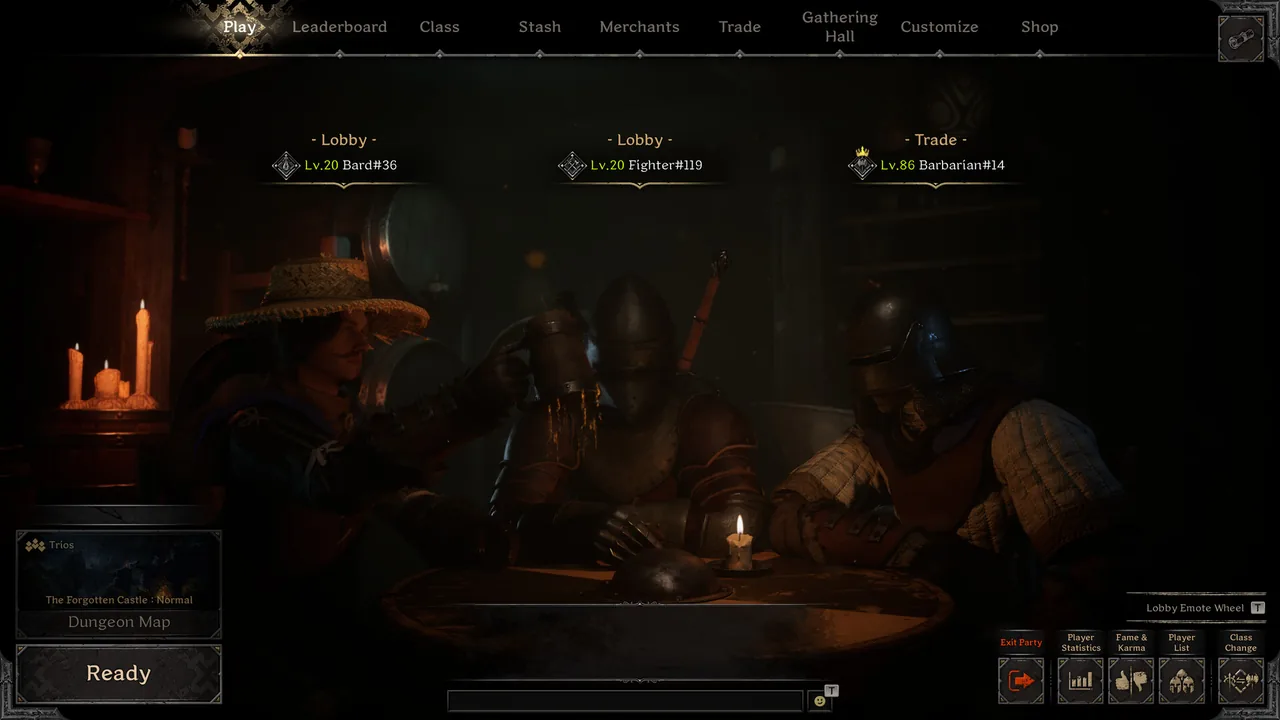
Ten classes are currently playable — fighter, barbarian, rogue, ranger, wizard, cleric, bard, warlock, druid and sorcerer — and they genuinely diverge in what they're for rather than just how they look. A cleric keeping a trio alive through a bad pull plays nothing like a rogue scouting ahead with detection tools, and a barbarian tanking a chokepoint is solving a different problem than a wizard controlling a doorway from range. Multiclassing, added in a recent season, lets a character borrow a secondary class's toolkit at reduced strength, which softens the commitment of picking one class at character creation without erasing the differences between them.
Solo and duo queues exist alongside trios and take real pressure off the "you need two friends online at the same time" problem that sinks a lot of extraction and PvPvE games. It's a genuinely useful addition, and current player feedback treats it as one of the better recent changes — but it doesn't fully solve solo viability so much as give it a fairer lane to fail in. A lone player is still one bad encounter away from a wipe that three coordinated players would have survived, and class balance complaints in recent player feedback consistently point at melee classes falling behind ranged casters, which narrows viable solo picks even further. Solo play is real here. It's also the harder, less forgiving version of the same game a trio is playing.
The gear economy, and whether veterans just win by default
Loot lives or dies as a system on what happens to it after a run, and Season 10's biggest structural change was adding an actual Marketplace for player-to-player trading, replacing a messier patchwork of direct trades and third-party sites. That's a genuine improvement — it gives gear a real destination and gives crafters and gatherers a reason to specialise rather than everyone hoarding everything they find. The catch is that trading privileges themselves, along with the High Roller dungeons where the best loot actually drops, are gated behind the paid Legendary Status account upgrade. A free "Squire" account can play the core loop, but the version of the game with the deepest economy and the highest-stakes dungeons is a purchase away.
This is the same fundamental tension Albion Online has spent nine years managing on a much larger scale — a full-loot economy needs constant destruction to stay healthy, and constant destruction disproportionately punishes whoever understands the system least. Dark and Darker's version compounds that with gear-score matchmaking meant to keep undergeared players away from stacked veterans, which helps at the margins but doesn't change the basic fact that a well-funded, well-practised trio brings a real structural advantage into every dungeon they enter. Wealth here doesn't accumulate into a permanent power fantasy the way it might in a traditional MMO, mostly because of the next problem — but while a season is live, it absolutely compounds.
Wipes: the thing that keeps this from being a persistent RPG
Here's where Dark and Darker parts ways from most of what a Wanderer reader would call an RPG. Roughly every two to three months, a new Early Access season resets character levels, stashes, inventory, reward tokens and quest progress. Season 10 landed on 18 July 2026 with exactly that kind of clean-slate reset. The stated reasoning is the usual seasonal live-service logic — keep the economy from calcifying, give everyone a fresh start, force fresh strategies around new content — and it does genuinely work as a way to stop the game from stagnating.
It also means nothing you build ever properly lasts. Compare that to Darkest Dungeon, where losing a hero is permanent and painful but your estate, your gold and your unlocked systems persist and compound across the whole campaign, or to Mortal Sin, where a roguelike run resets but the meta-progression around it doesn't. Dark and Darker resets almost everything, on a clock, regardless of how carefully you played. Recurring player feedback treats this as the single most common source of burnout — not losing a specific run, which is the game working as intended, but watching a season's worth of grinding evaporate on schedule. It's an honest design choice for a live game still finding its systems. It is not a game that respects long-term time investment the way persistent-progression games do, and anyone coming from that expectation should walk in knowing it.
Monetisation, cheating and the technical floor
The free-to-play shift in June 2024 was a real improvement over the original paid Early Access model — anyone can install the game and try the actual loop for nothing. What real money buys now is layered: Legendary Status is a one-time NZ$48 purchase unlocking High Roller access, extra character slots and trading, while seasonal packs like the EAS10 bundle (NZ$14.25) sell a permanent cosmetic alongside premium currency and season-limited conveniences — extra stash and marketplace slots — that expire when the season resets. Selling temporary conveniences in a game already built around forced resets is a genuinely awkward combination, and it's fair to read it as the game monetising the same wipe cycle that frustrates its own players.
Cheating is the other recurring complaint, and it sits oddly alongside Ironmace's anti-cheat approach: the game requires TPM 2.0 and Secure Boot to run at all, which locks out a meaningful slice of older hardware and rules out Linux and Steam Deck entirely. That's an aggressive technical bar for a free game to set, and player feedback suggests it hasn't eliminated the problem it's meant to solve — hacking complaints remain a steady presence in negative reviews. A strict anti-cheat that still lets cheaters through while turning away legitimate players on unsupported hardware is the worst version of that trade-off, and it's currently where Dark and Darker sits.
The Nexon question, briefly
Dark and Darker exists because several former Nexon developers, including Ironmace's founder, worked on an internal Nexon project before leaving to build this game — and Nexon has spent most of the game's life pursuing that connection through the courts. A US federal copyright case was dismissed in 2023. In Korea, the more consequential case actually decided something: in February 2025, a Seoul court found that Ironmace had not infringed Nexon's copyright, but had misappropriated trade secrets, and ordered Ironmace to pay roughly ₩8.5 billion (about US$5.9 million) in damages. Whether that ruling has since been appealed, upheld or resolved further isn't something we can confirm from a reachable source as of this review, so treat it as the last verified status rather than a closed case. Practically, none of this has stopped the game shipping seasons on schedule — but it's a real, unresolved thread in the studio's history, and anyone weighing a long-term investment of time or money should know it exists rather than assume the legal chapter is closed.
Where the game actually stands
Season 10 is active, hotfixes are landing roughly weekly, and total Steam review volume — 47,000-plus at time of writing, split into a "Mixed" overall rating — points to a playerbase large enough to support matchmaking without reading as abandoned. That Mixed label is doing real work, though: it's less a verdict on whether the core game is good and more a running tally of exactly the frustrations covered above — wipes, class balance, gate-kept content, cheating — recorded season after season by players who mostly keep coming back anyway.
Verdict
Dark and Darker succeeds completely at the one thing it set out to do: make every dungeon run a genuine risk-reward calculation where the smartest play is often walking away. Ten classes with real identity, a functioning player marketplace and positional audio that actually matters make the moment-to-moment experience some of the tensest PvPvE currently available. It doesn't score higher because almost everything surrounding that core idea — the wipe schedule, the paywall between the free tier and the real game, persistent cheating, and a legal history that isn't fully resolved — asks a lot of trust from a player before it pays that trust back. It's absolutely worth trying for free. Just go in knowing the ground resets under you every couple of months, and that "free" here means a real trial of a game whose best parts are still one purchase away.
Players who want the same full-loot tension without gearing up for a genre this unforgiving might find Wanderer's own risk-free progression a useful palate cleanser between seasons.
Pros and cons
Pros
- Full-loot extraction genuinely changes how you play every fight, since walking away is often the smarter tactical choice than winning a scrap
- Ten classes with real toolkit differences give trios actual division of labour instead of five reskins of the same warrior
- The Season 10 Marketplace finally gives gear a legitimate place to go besides a stash or a killer's inventory
- The free-to-play entry point is a genuine trial of the core loop rather than a stripped-down demo
- Positional audio and torch management do real mechanical work, turning footsteps and darkness into information rather than atmosphere
Cons
- Seasonal wipes clear character levels, stashes and gear roughly every two to three months, so no run of good luck ever compounds into lasting progress
- High Roller dungeons, extra character slots and full trading access sit behind the one-time Legendary Status purchase, so the free tier is a taste of the game rather than the whole thing
- Cheating remains a recurring complaint in player feedback despite a kernel-level anti-cheat that requires TPM 2.0 and Secure Boot, which locks out older PCs, Linux and Steam Deck entirely
- Current player feedback consistently reports melee classes lagging behind ranged casters, narrowing which trio compositions are actually viable
- A first-instance Korean court ruling found Ironmace liable for leaking trade secrets tied to the game's origins, and the studio's long-term legal footing is not fully resolved
Screenshots
-
Dark and DarkerImage: IRONMACE via Steam -
Dark and DarkerImage: IRONMACE via Steam -
Dark and DarkerImage: IRONMACE via Steam -
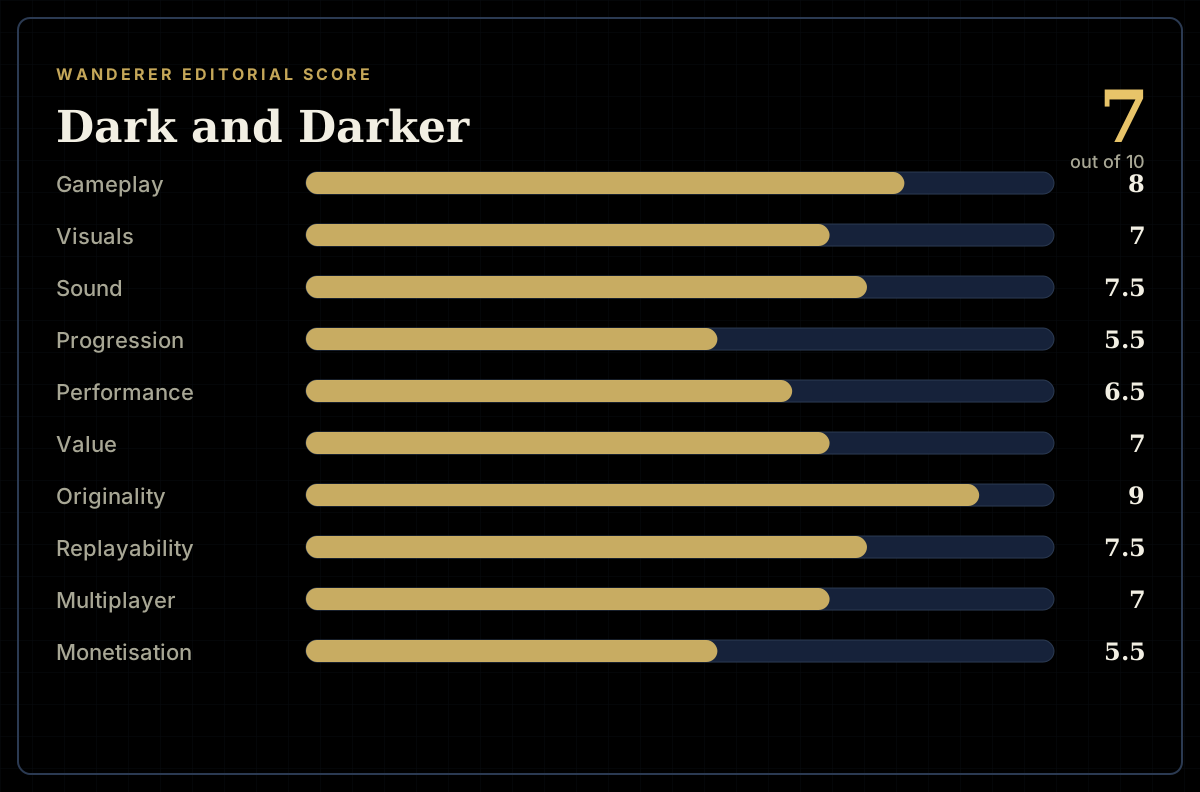
How the review scores each part of the gameWanderer Editorial -
The short versionWanderer Editorial