Game review
Crypto Miner Tycoon Simulator
5.5 / 10
- Developer
- Bigosaur
- Publisher
- Bigosaur
- Released
- 21 April 2022
- Platforms
- Windows
- Genre
- Simulation, Strategy, Tycoon
- Monetisation
- One-time purchase. A separate free "Starter Edition" exists as a standalone taste of one scenario.
- Players
- Single-player, with Steam Workshop mod support in Sandbox/Free Play mode
The short version
Crypto Miner Tycoon Simulator asks you to build a cryptocurrency mining empire from a bedroom setup in 2010 through to a multi-facility operation, buying and assembling real PC components, researching hardware, hiring and training staff, and trading against historically accurate coin prices. Released 21 April 2022 by solo developer Bigosaur, it sits Mostly Positive with English-speaking players, 77% across 162 reviews. Reviewers consistently praise its underlying systems as more detailed than they expect from the premise, and Steam Workshop support in its sandbox mode extends that further. What holds the score down is just as consistent across the sample: an interface built around single-item actions rather than bulk management, turning large-scale play into what one reviewer calls "thousands upon thousands" of individual clicks, and a deeper structural tension several reviewers identify — because the game replays real, fixed cryptocurrency history, the actual optimal strategy is often simply buying Bitcoin on day one rather than engaging with the simulation the game is built around.
Biggest strengths
- The core systems go noticeably deeper than the premise suggests: building individual PCs from real component types, researching new hardware tiers, and hiring and training staff with distinct skills that affect output
- Historically accurate coin prices root the whole experience in a real, checkable timeline, and one reviewer specifically credits the way the game's own systems — like a PR department that can influence a coin's hype — let you meaningfully diverge from that history rather than just watching it play out
- Steam Workshop integration in Sandbox and Free Play modes gives the community a real way to extend the systems, including overpowered mods some reviewers enjoy specifically because they're opt-in
Biggest weaknesses
- The interface is the single most consistent complaint across the entire sample: nearly every action must be performed one piece of equipment at a time, with reviewers describing thousands of repetitive clicks to manage racks, restart idle machines, or adjust mining settings once a facility grows past a handful of rooms
- Several reviewers identify a structural tension at the heart of the design: because the game replays real, already-known cryptocurrency history, the mathematically optimal strategy is often to simply buy coins early and hold, rather than build out the mining infrastructure the game's systems are built around — one reviewer calls building infrastructure "pointless" once you know what's coming
- More than one reviewer explicitly compares it unfavourably to genre neighbours like Software Inc. and Startup Company, arguing those games execute similar management-sim ideas with noticeably better usability
Who it's for: Management-sim fans specifically fascinated by the mechanics of crypto mining as a historical curiosity, who don't mind a demanding, click-heavy interface in exchange for real systemic depth.
Our recommendation: Try the free Starter Edition scenario first — reviewers specifically recommend it as a twenty-minute test of whether the interface bothers you before committing to the full price.
5.5 / 10
Introduction
There's a specific kind of pleasure in a management sim that takes an unglamorous real-world business and renders it in surprising mechanical detail, and Crypto Miner Tycoon Simulator delivers that pleasure more consistently than its slightly novelty-shop premise might suggest. Released 21 April 2022 by solo developer Bigosaur, it drops you into a bedroom in 2010 with a little starting cash and a father who's excited about this new "digital currency" thing, and asks you to build an actual cryptocurrency mining business from there — researching hardware, building PCs component by component, hiring and training staff, and trading against real historical coin prices. It sits Mostly Positive with English-speaking Steam reviewers, 77% across 162 reviews, and almost everyone in that sample agrees on what's good about it and what isn't.
More depth than the pitch suggests
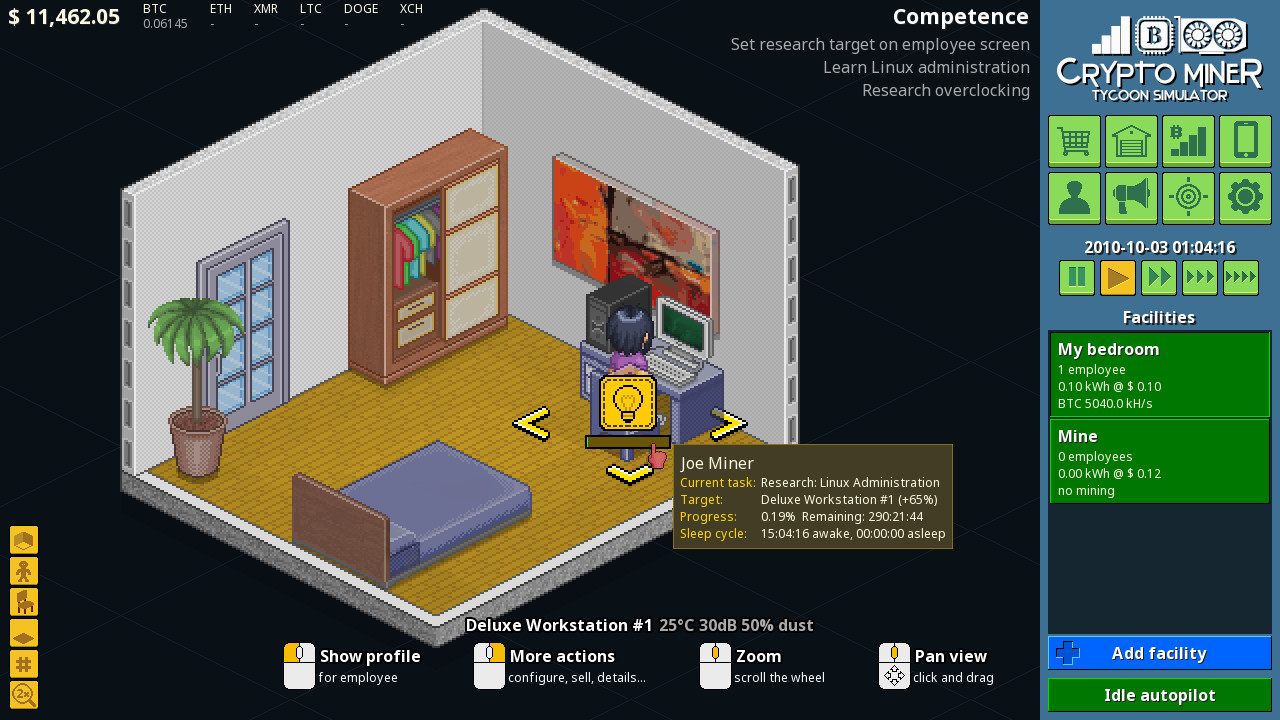
Reviewer after reviewer describes being surprised by how much is actually going on underneath the premise. One early, detailed review lays it out plainly: you buy individual computer parts and assemble them into rigs, research unlocks new hardware tiers and operating systems, machines need active cooling as facilities scale, and hired employees bring distinct skills that can be trained further to expand what your operation can do. The historical grounding adds a layer most tycoon games don't attempt — coin prices track the real market, with unlockable events and hardware tied to actual moments in crypto history — and at least one reviewer specifically credits systems like an in-game PR department, which lets you meaningfully hype or suppress a coin's price, with giving players real agency to diverge from the history everyone already knows rather than just replaying it passively. Steam Workshop support in the game's Sandbox and Free Play modes extends that further, letting the community add systems the base game doesn't offer, deliberately gated away from the main scenario so they don't undercut its historical framing.
The click tax
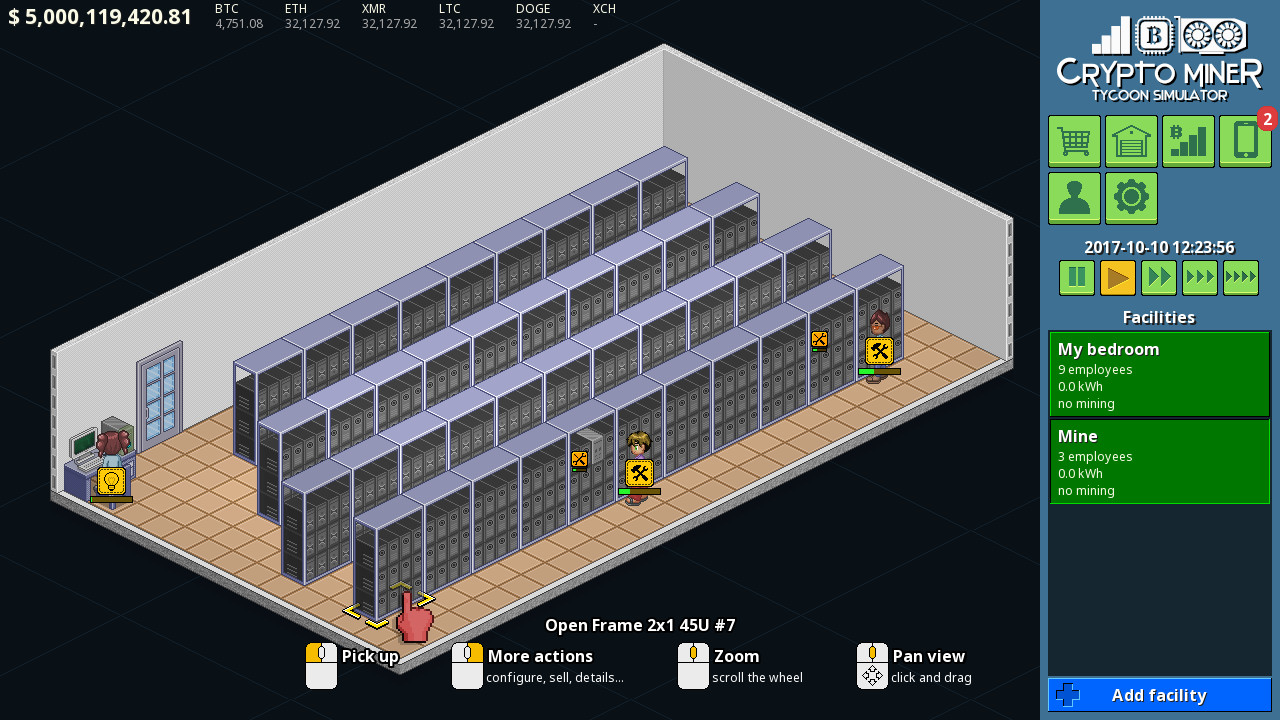
Set against that praise, one specific, structural problem recurs constantly enough to define the game's reputation as much as its depth does: nearly everything must be done one piece of equipment at a time. A detailed review from an early player lists the exact pain points — no way to mass remove dead equipment from a rack, no way to start up multiple machines at once, no way to shift- click and select several racks together — and estimates clicking "thousands upon thousands" of times by their fourth hour managing a growing facility. A much later review, years after launch, makes the identical complaint in almost the same words, suggesting this is a design choice that has persisted rather than a launch rough patch since fixed. For a game whose core loop is explicitly about scaling up a mining operation, an interface that actively punishes scale is a serious tension sitting at the centre of the experience rather than a peripheral annoyance.
A game that already knows how it ends
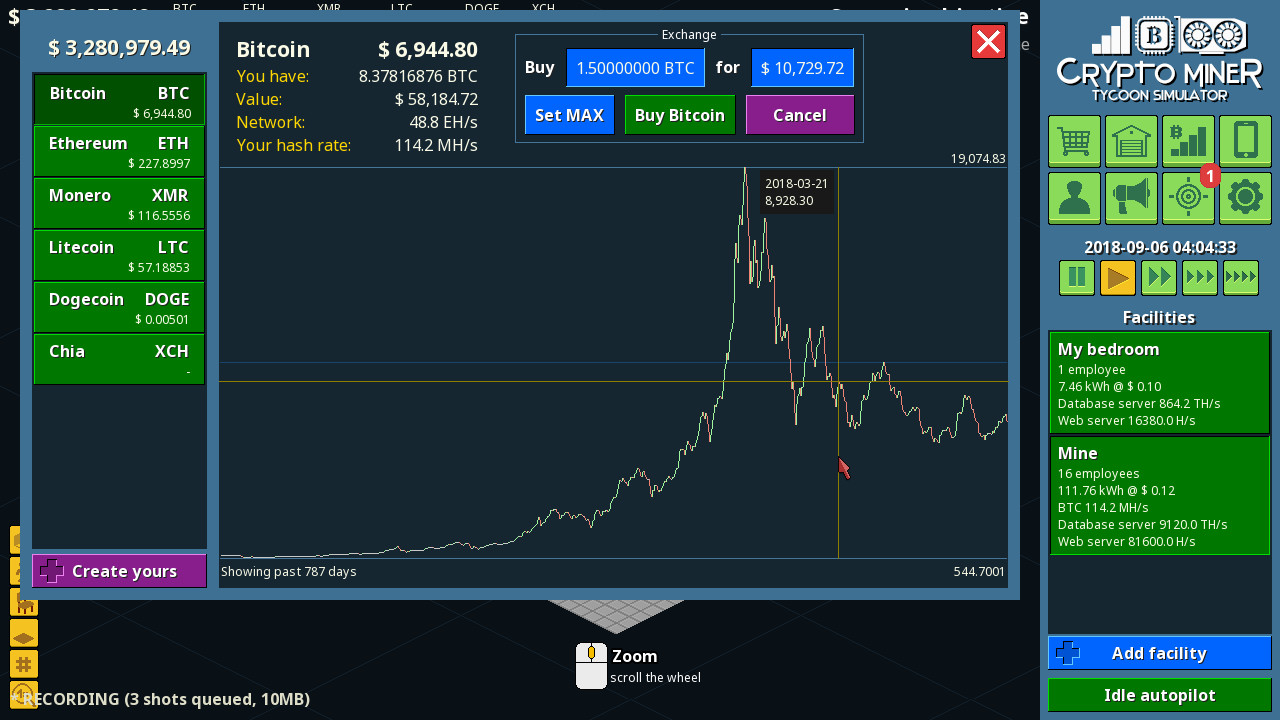
The sharpest, most interesting criticism in this review's sample isn't about clicking at all — it's about what the historical framing actually does to the strategy layer. Because the game replays real, already-public cryptocurrency history, a player who already knows Bitcoin's price trajectory holds a kind of foreknowledge no in-game system can counter: one reviewer states it directly, "the winning move is obviously to buy 30,000 BTC ASAP and then watch your account go to the moon," concluding it's "pointless to build mining infrastructure when you can just buy BTC on day one with daddy's money." That's a genuinely sharp structural observation rather than a taste complaint — the same fixed-history hook that makes the game's premise interesting also gives a knowledgeable player an escape hatch out of engaging with its central mechanic at all, and this review doesn't have a clean answer for how the design could resolve that tension without abandoning the historical grounding that makes the game distinctive in the first place.
How far the global expansion actually goes
Steam's own achievement data adds a useful check on how far players actually push the game's later systems. The earliest milestones sit reasonably healthy — 67.2% of tracked players earn the game's first mining achievement, and 44.2% reach an early wealth milestone — but the game's regional expansion achievements, tied to opening facilities across different continents, all sit in the single digits: North America leads at 14.2%, with Europe, Latin America, Asia, Africa and the Middle East all trailing behind it, several under 5%. That's broadly consistent with the interface and pacing complaints in the written reviews — a game whose core loop holds attention through its first facility and its first real wealth milestone, but where relatively few players push on into the multi-continent scale the tycoon genre usually treats as its actual endgame.
Final Verdict
Crypto Miner Tycoon Simulator is a genuinely more ambitious management sim than its premise promises, built by one developer with real attention to the mechanics of an unusual, specific business. What keeps the score modest is equally real: an interface that turns the game's own scaling fantasy into a chore, and a structural tension between its historical framing and its strategy layer that several of its own reviewers have independently identified. Try the free Starter Edition first, as more than one reviewer explicitly suggests — twenty minutes will tell you whether the depth outweighs the clicking for you personally, before you commit to the full price.
Pros and cons
Pros
- The core systems go noticeably deeper than the premise suggests: building individual PCs from real component types, researching new hardware tiers, and hiring and training staff with distinct skills that affect output
- Historically accurate coin prices root the whole experience in a real, checkable timeline, and one reviewer specifically credits the way the game's own systems — like a PR department that can influence a coin's hype — let you meaningfully diverge from that history rather than just watching it play out
- Steam Workshop integration in Sandbox and Free Play modes gives the community a real way to extend the systems, including overpowered mods some reviewers enjoy specifically because they're opt-in
- A free "Starter Edition" containing one full scenario lets you test the game's feel before paying full price, and multiple reviewers actively recommend doing exactly that
Cons
- The interface is the single most consistent complaint across the entire sample: nearly every action must be performed one piece of equipment at a time, with reviewers describing thousands of repetitive clicks to manage racks, restart idle machines, or adjust mining settings once a facility grows past a handful of rooms
- Several reviewers identify a structural tension at the heart of the design: because the game replays real, already-known cryptocurrency history, the mathematically optimal strategy is often to simply buy coins early and hold, rather than build out the mining infrastructure the game's systems are built around — one reviewer calls building infrastructure "pointless" once you know what's coming
- More than one reviewer explicitly compares it unfavourably to genre neighbours like Software Inc. and Startup Company, arguing those games execute similar management-sim ideas with noticeably better usability
- Load and save times reportedly grow noticeably longer once a mining operation scales up, according to a detailed long-term review
- A minority of reviewers describe the loop, once the novelty wears off, as fundamentally repetitive — "you mine things, then you mine more things" — with limited additional systems to break up the core grind
Screenshots
-
Crypto Miner Tycoon SimulatorImage: Bigosaur via Steam -
Crypto Miner Tycoon SimulatorImage: Bigosaur via Steam -
Crypto Miner Tycoon SimulatorImage: Bigosaur via Steam -
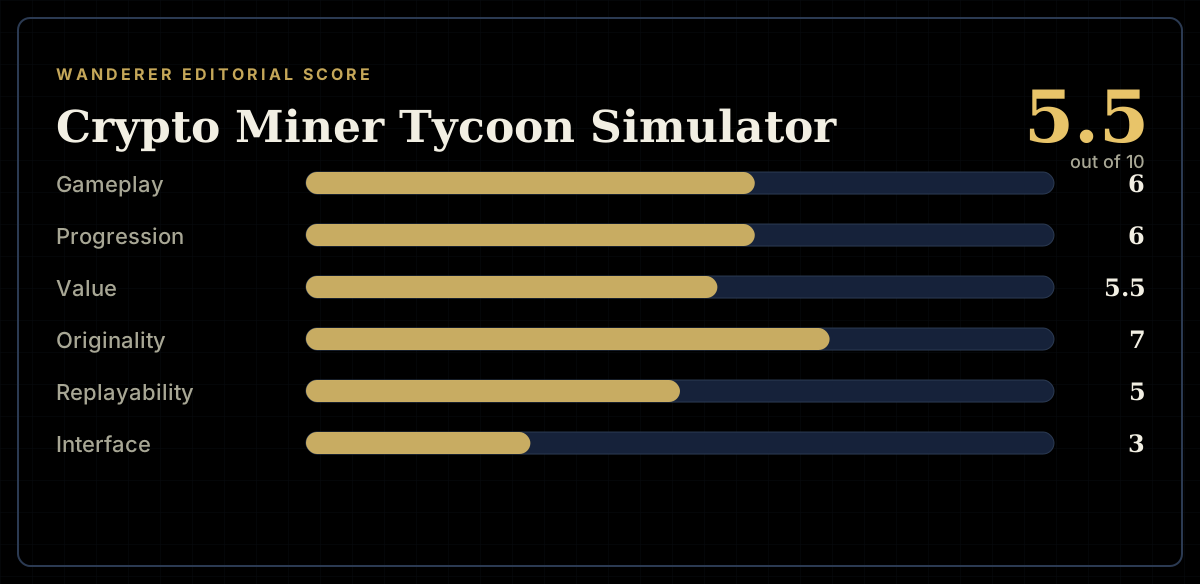
How the review scores each part of the gameWanderer Editorial -
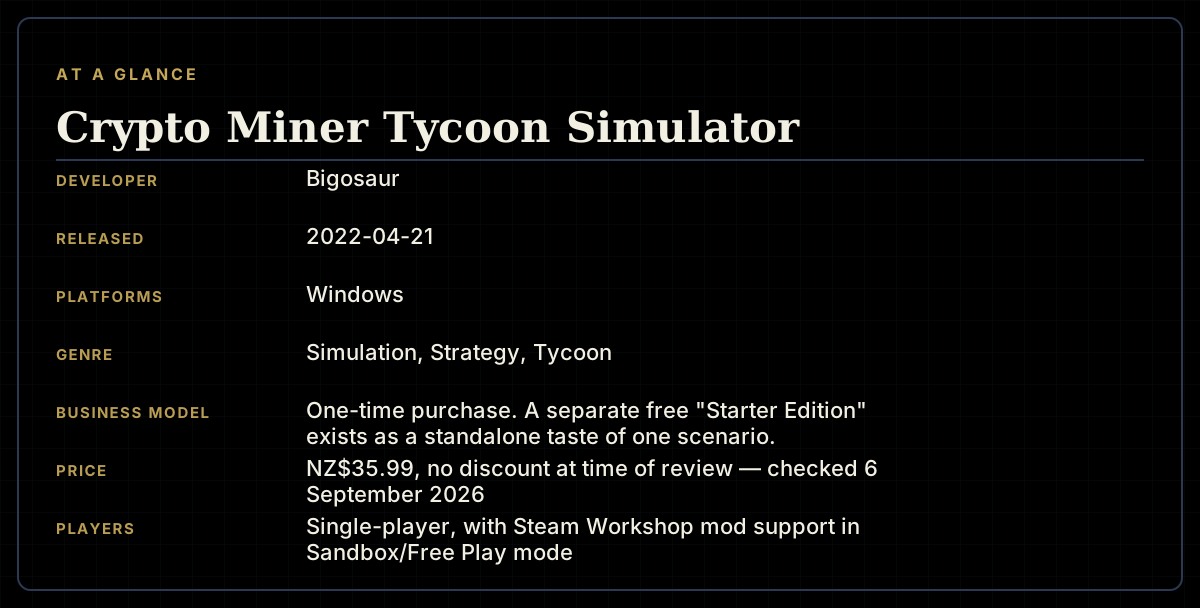
The essentials at a glanceWanderer Editorial -
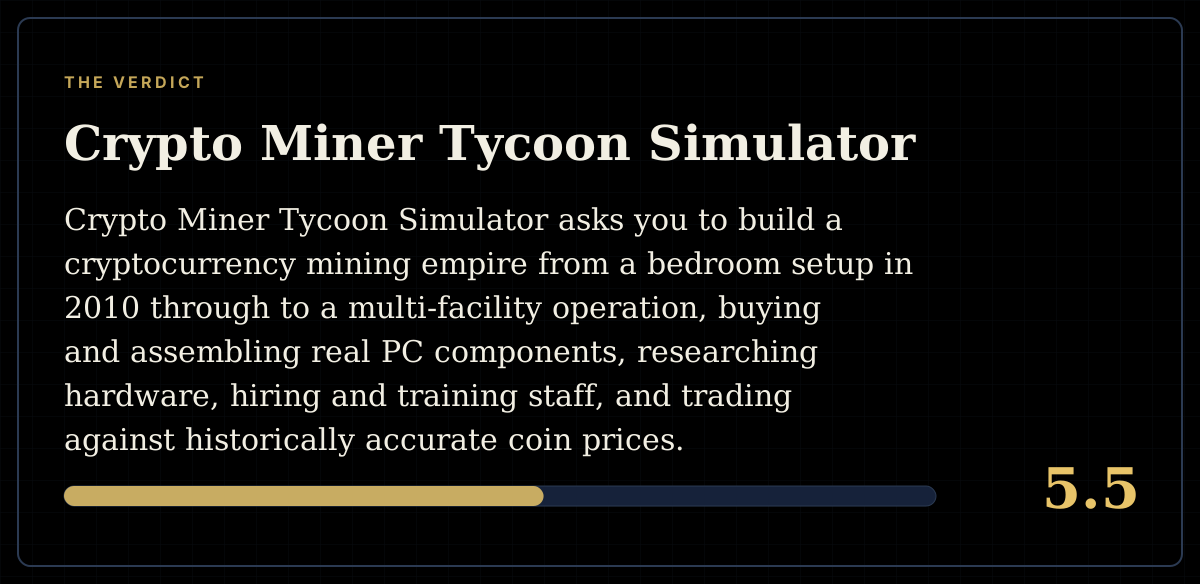
The short versionWanderer Editorial