Game review
Crownhold
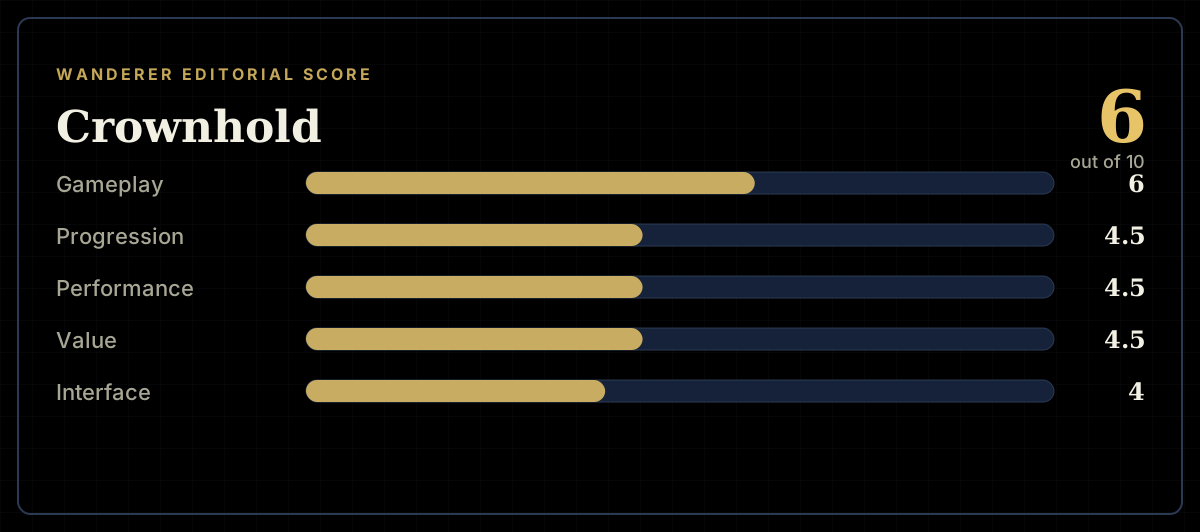
6 / 10
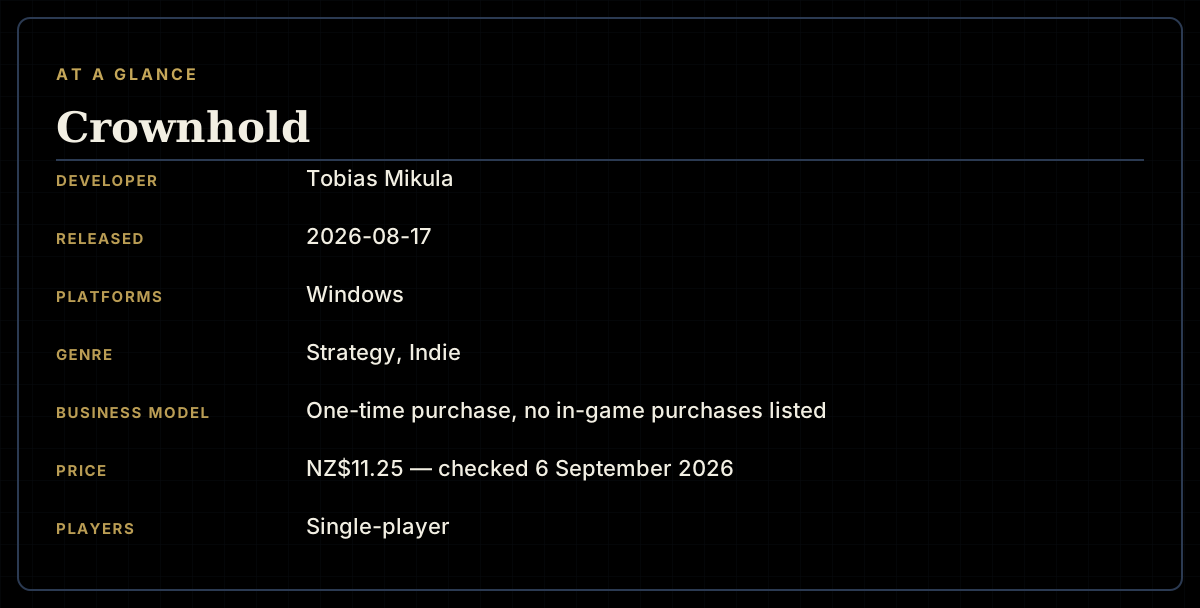
- Developer
- Tobias Mikula
- Publisher
- Tobias Mikula
- Released
- 17 August 2026
- Platforms
- Windows
- Genre
- Strategy, Indie
- Monetisation
- One-time purchase, no in-game purchases listed
- Players
- Single-player
The short version
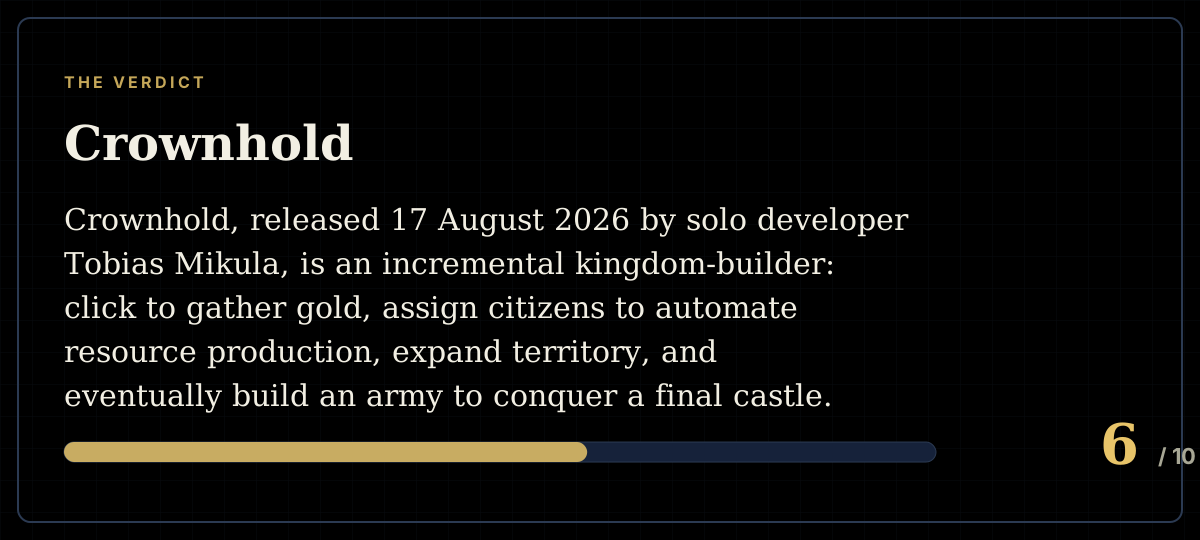
Crownhold, released 17 August 2026 by solo developer Tobias Mikula, is an incremental kingdom-builder: click to gather gold, assign citizens to automate resource production, expand territory, and eventually build an army to conquer a final castle. It sits Very Positive with English-speaking players, 83.9% across 441 reviews as of this check, and that reception splits along a specific, genuinely contested line rather than a simple quality gradient. A large number of reviewers independently report finishing 100% of the game's content in six to ten hours — some framing that as a refreshingly tight, complete arc worth recommending on its own terms, others calling the same fact poor value at this price for the genre. Separately, this review found well-corroborated, more clear-cut problems: an artificial time gate blocking the final battle even when a player's army is already strong enough to win it, severe interface bugs involving menus that get stuck open across much of the screen, and reported visual and performance regressions from the pre-release demo. Crownhold's own Steam listing also officially discloses that AI tools were used to generate placeholder art, graphics and variations of the developer's own assets — a confirmed fact rather than reviewer speculation — which a number of reviewers say they weren't expecting and are unhappy about despite the disclosure.
Biggest strengths
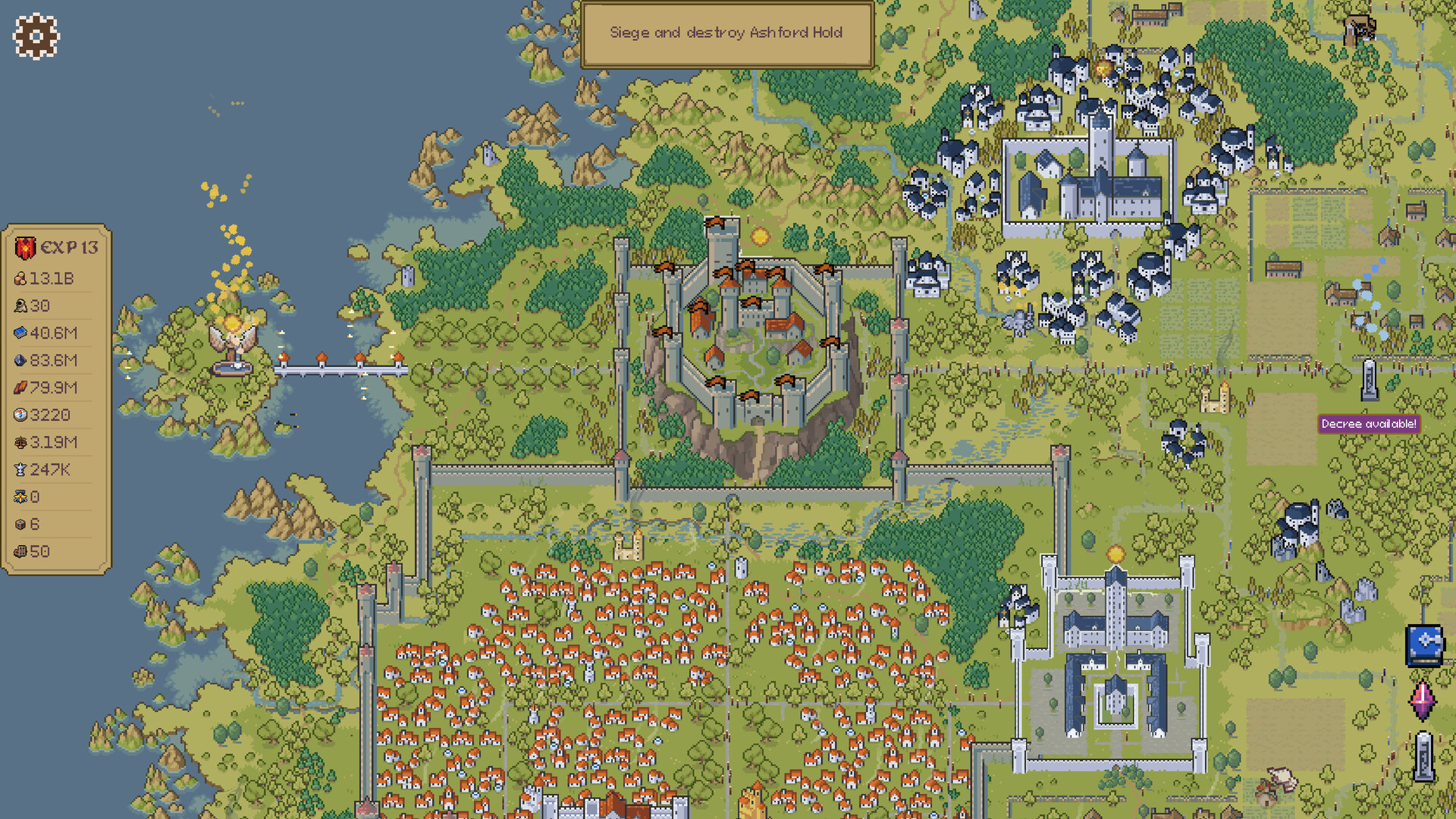
- The game's evolving visuals draw consistent, specific praise — the kingdom visibly grows, citizens walk around the map, and the presentation is repeatedly described as unusually attractive for the genre and price point
- Many reviewers specifically like the game's short, complete arc, several explicitly contrasting it favourably with incremental games that drag on for weeks, calling roughly eight hours to 100% completion a genuine strength rather than a shortfall
- The developer is credited by multiple reviewers as highly active immediately after launch, addressing reported issues quickly during the period covered by this review
Biggest weaknesses
- A large number of reviewers independently report completing 100% of the game's content in six to ten hours, and many of them — unlike the fans quoted above — specifically call this poor value at the current price relative to typical incremental-game runtimes
- Multiple reviewers report the endgame is gated behind an arbitrary time requirement rather than genuine difficulty: even once a player's army is strong enough to defeat the final castle, the game reportedly won't allow the final battle to be won until enough real time has passed
- Severe interface bugs are reported by multiple reviewers, including building-upgrade menus that remain stuck open across large portions of the screen and require inconvenient extra steps to dismiss before another menu can be opened
Who it's for: Incremental-game fans who want a short, visually pleasant, complete experience rather than a weeks-long grind, and who can tolerate real launch-week bugs in a solo-developed release.
Our recommendation: Worth its price if a tight six-to-ten-hour arc is genuinely what you want from an incremental game; skip if you expect the genre's usual much longer playtime, or if disclosed AI-generated assets are a dealbreaker for you regardless of the honesty of the disclosure.
6 / 10
Introduction
Crownhold, released 17 August 2026 by solo developer Tobias Mikula, sends players through a familiar incremental arc with a medieval kingdom-building coat of paint: click for gold, assign citizens to automate production, expand territory, and eventually raise an army to conquer a final castle. It sits Very Positive with English-speaking players — 83.9% across 441 reviews — and reading through a large slice of that sample reveals a genuinely interesting split. The single most-repeated fact in this review's research — that the game can be 100% completed in roughly six to ten hours — is agreed upon by fans and critics alike. What they disagree on, sharply and explicitly, is whether that's the game's best feature or its biggest problem.
A short runtime that divides its own fanbase
Multiple reviewers frame the game's brevity as a genuine strength rather than a limitation. One detailed review calls the length "perfect," explicitly praising a game that stays engaging without overstaying its welcome; another appreciates finishing with only two prestige resets specifically because it means the game "does not drag on" the way many incrementals do. Set directly against this, an equally substantial number of reviewers treat the identical fact as the game's central flaw, several explicitly comparing it unfavourably to the genre's expected pace — one states plainly that idle games "should take days or weeks to complete," not eight hours, and multiple reviewers frame the price as difficult to justify against that runtime specifically. Both camps are citing the same completion time; the disagreement is entirely about what a player should reasonably expect from an incremental game's length, which makes this less a flaw to score around and more a fit question prospective buyers should weigh honestly before purchasing.
A visually appealing loop, undermined by a broken finish line
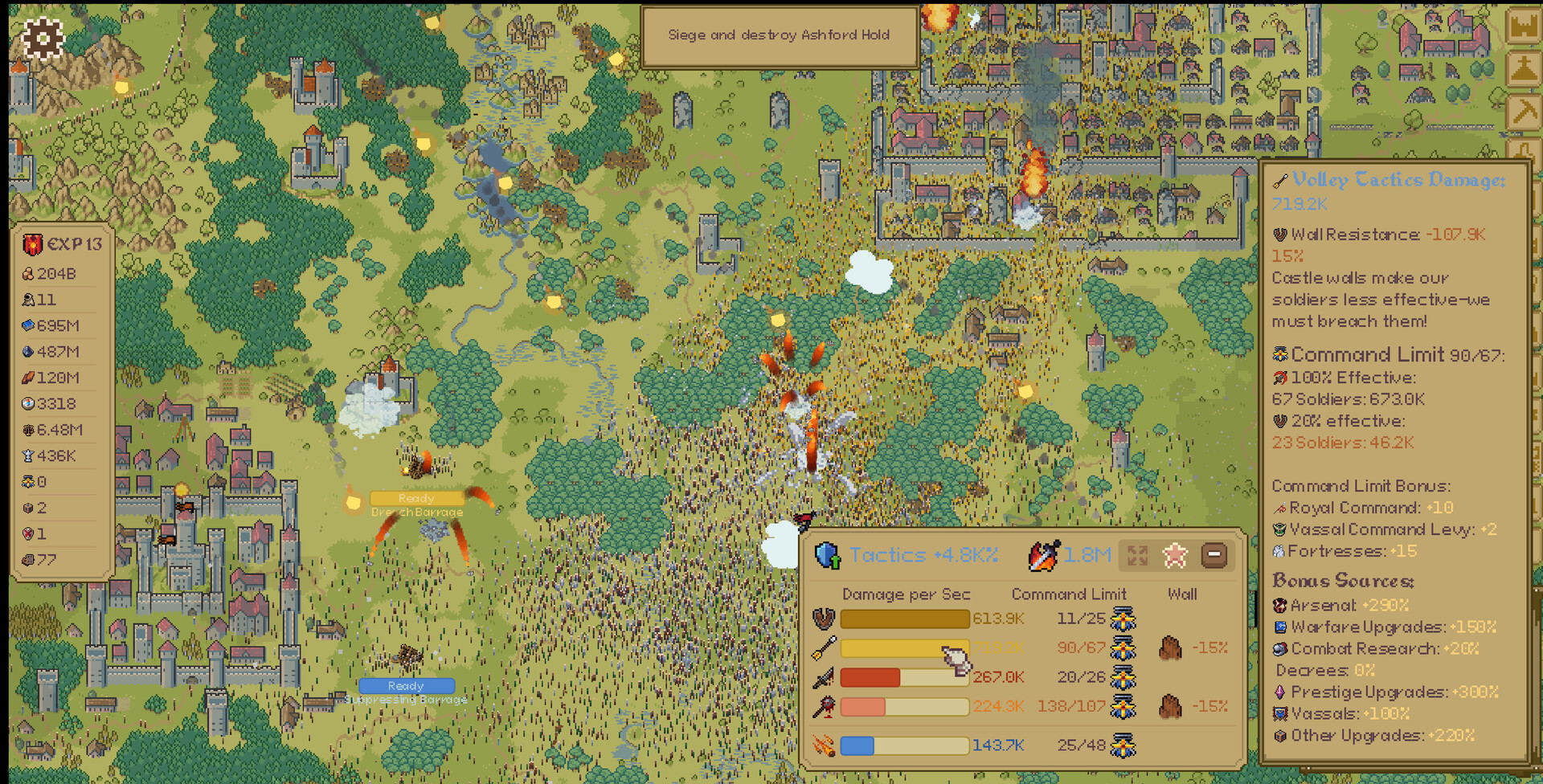
Independent of the length debate, reviewers consistently praise the game's presentation — a kingdom that visibly grows and changes, citizens animated walking through the world, and multiple interacting systems across resource production, territory and eventual warfare that keep the loop from reading as a single flat number climbing. That makes a specific, credible complaint about the endgame more disappointing by contrast: multiple reviewers report that reaching the final battle is gated behind an arbitrary time requirement rather than genuine difficulty, to the point that a player's army can already be strong enough to win and still be blocked from attempting the final castle until enough real-world time has passed. One detailed reviewer goes further, reporting the game stopped registering clicks on the enemy castle entirely, preventing completion outright. That's a meaningfully different problem than difficulty tuning — it's the game withholding its own ending from players who've already earned it.
Real interface and performance problems at launch
This review found multiple, independently reported technical problems serious enough to flag directly. Several reviewers describe building-upgrade menus that remain stuck open across large portions of the screen, requiring inconvenient workarounds to close one before a neighbouring menu can be opened — one reviewer says they'll revise their review once this specific issue is fixed. Separately, more than one reviewer reports visual regressions compared to the pre-release demo, including map elements like trees and villages failing to load and leaving the world looking noticeably emptier than advertised. At least one reviewer reports severe, specific frame-rate drops triggered simply by moving the cursor, calling the game effectively unplayable on their system at the time of writing.
A confirmed, disclosed use of AI-generated assets
One fact in this review doesn't need the usual caveats about unverified reviewer speculation: Crownhold's own Steam store listing officially states that AI tools were used during development "to generate placeholders, graphics & variation of existing developer-made assets." This is a disclosed fact from the developer, not a claim this review is reporting secondhand. Even so, multiple reviewers say they were unaware of this before buying and are specifically unhappy about it despite the disclosure being present on the store page — a reminder that a technically compliant disclosure doesn't automatically satisfy every player's expectations about how a game's art was made.
A confusing turn once warfare unlocks, and padded achievement chasing
Two smaller, more specific complaints round out the picture. Several reviewers who otherwise enjoy the early game describe a sharp jump in confusion once the warfare system unlocks partway through, with mechanics introduced faster than the game explains them — a contrast to the straightforward, well-signposted opening hours several other reviewers separately praise. Separately, reviewers chasing full achievement completion describe a specific, frustrating pattern: nearly all achievements can be earned within the first several hours of active play, but the last few require simply leaving the game running passively in the background for hours longer with no further engagement required — padding rather than rewarding the pursuit of 100% completion, and a pattern more than one reviewer explicitly asks the developer to address by adjusting the underlying costs.
Final Verdict
Crownhold is a genuinely attractive, actively supported incremental game that a large number of players specifically like for exactly the reason another large number specifically dislike it: a short, complete arc rather than the genre's usual much longer commitment. Whether that's a good fit depends entirely on what you want from an idle game, and this review can't resolve that for you. What it can score more confidently are the problems that aren't a matter of taste — an artificial endgame time-gate that can block a win a player has already earned, interface bugs serious enough that reviewers are withholding recommendations until they're patched, and specific performance and visual regressions from the pre-release demo. Worth its price if the short runtime genuinely appeals to you and you're prepared for real launch-week rough edges; skip if either concern applies.
Pros and cons
Pros
- The game's evolving visuals draw consistent, specific praise — the kingdom visibly grows, citizens walk around the map, and the presentation is repeatedly described as unusually attractive for the genre and price point
- Many reviewers specifically like the game's short, complete arc, several explicitly contrasting it favourably with incremental games that drag on for weeks, calling roughly eight hours to 100% completion a genuine strength rather than a shortfall
- The developer is credited by multiple reviewers as highly active immediately after launch, addressing reported issues quickly during the period covered by this review
- Multiple systems interacting with one another — resource production, territory expansion and eventual warfare — draw praise for keeping the loop from feeling like a single flat number climbing throughout
Cons
- A large number of reviewers independently report completing 100% of the game's content in six to ten hours, and many of them — unlike the fans quoted above — specifically call this poor value at the current price relative to typical incremental-game runtimes
- Multiple reviewers report the endgame is gated behind an arbitrary time requirement rather than genuine difficulty: even once a player's army is strong enough to defeat the final castle, the game reportedly won't allow the final battle to be won until enough real time has passed
- Severe interface bugs are reported by multiple reviewers, including building-upgrade menus that remain stuck open across large portions of the screen and require inconvenient extra steps to dismiss before another menu can be opened
- Separate reviewers report visual and performance regressions from the pre-release demo, including map elements such as trees and villages failing to load at all, and at least one reviewer reports severe frame-rate drops whenever the cursor moves, calling the game effectively unplayable for them at the time of review
- Crownhold's own Steam store listing officially discloses that AI tools were used to generate placeholder art, graphics and variations of existing developer-made assets; several reviewers say they were unaware of this before purchase and are unhappy about it despite the disclosure being present
- One detailed reviewer identifies a specific mathematical flaw in the upgrade system: additive percentage bonuses become negligible once base bonuses are already very large, while multiplicative bonuses would have preserved meaningful value throughout the late game
Screenshots
-
CrownholdImage: Tobias Mikula via Steam -
CrownholdImage: Tobias Mikula via Steam -
CrownholdImage: Tobias Mikula via Steam -
How the review scores each part of the gameWanderer Editorial -
The essentials at a glanceWanderer Editorial -
The short versionWanderer Editorial