
Game review
Croakoloco
5 / 10
- Developer
- Ryan Forrester
- Publisher
- Ryan Forrester
- Released
- 6 May 2024
- Platforms
- Windows
- Genre
- Idle/clicker creature-collector
- Monetisation
- One-time purchase, no in-game store or additional currency purchases
- Players
- Single-player only
The short version
Croakoloco asks you to collect, breed, and nurture an ever-growing tank of frogs, from common greens to rare golden variants, and the sheer charm of its creature designs and croaking sound work earns it real, sincere affection across its review sample. What dominates that same sample, though, is a specific and remarkably consistent contradiction between the game's own genre framing and what it actually delivers: reviewers overwhelmingly report that a game tagged and marketed as an idle game requires near-constant manual clicking to spawn flies and feed frogs, with no automation option and only minimal, heavily reduced offline earnings. Layered on top of that core frustration are specific complaints about steep, poorly-tuned cost scaling once breeding and prestige systems come into play, and repeated, direct comparisons to Chillquarium, a similar creature-collector idle game reviewers consistently say does the same concept better.
Biggest strengths
- The frog designs, sound work, and overall creature variety draw consistent, genuine affection from reviewers, with several describing the collecting loop as a real, sincere pleasure independent of the game's other issues
- The breeding system, letting players combine frogs to produce offspring with inherited rarity and bonuses, adds a real layer of intentional collection strategy beyond simple purchasing
- At a low price, several reviewers frame the game as a reasonable purchase purely for the charm and novelty of the concept, independent of its structural issues
Biggest weaknesses
- The single most repeated and consistent complaint across the entire review sample is that the game, despite being tagged and marketed as an idle game, requires near-constant manual clicking to spawn and collect flies, with no automation option and only a small fraction of earnings available offline
- Cost scaling for higher-tier frogs, tank upgrades, and breeding is described by multiple reviewers as poorly balanced, with costs rising much faster than the income bonuses those purchases actually provide
- The prestige mechanic, meant to give long-term players a reason to reset and progress further, is described by at least one long-session reviewer as minor and underwhelming relative to the investment required to reach it
Who it's for: Frog enthusiasts and collection-game fans specifically drawn to the creature designs who don't mind an active clicking loop rather than a genuine idle experience. A poor fit for anyone specifically shopping for a low-effort, background-running idle game, since the genre label is widely disputed by the game's own fans.
Our recommendation: Worth a look at a low price purely for the frog collecting and creature charm if you go in expecting an active clicker rather than a true idle game. Read the reviews about automation carefully first if "idle" is specifically what you're shopping for — a large share of this game's own fans say that label doesn't fit.
5 / 10
Croakoloco's premise is charming enough on its face to sell itself: buy frog packs, discover species ranging from common to epic, watch your collection hop around a tank, and occasionally take direct control of a favourite frog to hunt golden flies for extra rewards. Reviewers across the sample confirm the concept lands — the frog designs and croaking sound work earn real, specific affection. What this review's sample makes unusually clear, though, is a direct, widely shared dispute with the game's own genre identity, one specific and consistent enough to weigh heavily against the charm.
A genre label its own fans keep disputing
The single most repeated complaint in this review's sample isn't about content or balance — it's about false advertising in the loosest sense: a game tagged and marketed as an idle game that, according to an overwhelming share of its own players, isn't idle at all. "Bought it thinking it would be a cute idle frog collection game - but no, like others have mentioned: there isn't anything idle about it. To progress you must click the screen constantly," one reviewer writes. Another states it even more bluntly: "THE FACT THAT YOU CANNOT AUTOMATE THE DROPPING OF FLIES is what makes me give this game the negative review, THERE IS NOTHING IDLE about this game." What's notable is how often this exact complaint appears even in positive reviews — "I'm not positive this is actually an idle game? The only way to make any real progress is to actively play it," one recommending reviewer writes, essentially agreeing with the critics while still enjoying the collecting loop enough to recommend it anyway.
A specific, repeated balance complaint
Beyond the genre-label dispute, reviewers with genuinely enormous playtimes describe real structural balance problems. "Buying frogs, breeding, getting new tanks, and upgrading capacity gets really expensive very quickly, but the income boost that we get from these benefits/upgrades is very minimal," one reviewer with over 13,700 minutes logged writes. Another, with over 11,000 minutes invested, describes the prestige mechanic — usually a genre staple giving long-term players a fresh reason to keep going — as "miniscule and useless" once actually reached. These aren't first-impression complaints; they're coming from exactly the players who gave the game the most time to prove itself.
An unfavourable comparison that recurs independently
Multiple reviewers, without apparent coordination, reach for the exact same comparison: Chillquarium, a similarly structured creature-collector idle game. "It's basically a copy of the mechanics of Chillquarium, but worse in almost every way. Most notably the awful, clunky UI," one reviewer writes, while others frame the comparison more gently but just as directly as "kinda like Chillquarium but with frogs." This review takes that pattern seriously as a signal about interface quality specifically — when a niche genre has an obvious, well-regarded reference point, and multiple independent reviewers keep measuring a new entry against it unfavourably, that's a more concrete data point than a single reviewer's personal taste.
Specific technical and content gaps
Beyond the genre and balance disputes, individual reviewers flag concrete, specific problems. One reports the game failing to launch at all beyond a black screen with audio playing underneath. Another raises a more pointed concern: the store page specifically advertises a shop offering playstyle-tailored upgrades (active, idle, or sell-focused builds), which this reviewer states does not actually exist in the shipped game as described — a discrepancy between marketing and product this review cannot independently confirm one way or the other, but which is specific enough to flag directly for prospective buyers who found that particular feature appealing on the store page.
A developer who has kept some attention on the project
To its credit, this review can confirm the developer responded quickly at launch, shipping six separate release patches in the days immediately following the 6 May 2024 launch, and followed up with a further "Hoppy Heights" content update roughly nine months later in February 2025. Localisation fixes continued as recently as September 2025. That's a real, if modest, ongoing commitment from a solo developer, even if it hasn't addressed the core automation complaint driving most of the sample's dissatisfaction.
What the achievement data suggests about how far players get
Steam's own completion figures offer a useful independent view of the balance complaints raised above. An early milestone sits at 98.6%, meaning almost everyone who buys the game engages with the basic loop, but completion falls off steeply from there — full frog-pack discovery sits at just 6.4%, and value-based late-game achievements settle around 4.5-5.8%. That's a notably steep drop-off, and it lines up precisely with reviewers' accounts of an economy that scales costs faster than it scales rewards: a large share of buyers clearly enjoy the opening hours of frog-collecting, but comparatively few stick around long enough to see the collection through to completion, which is consistent with the specific balance complaints raised by the game's most invested players rather than a simple matter of difficulty preference.
A reasonable minority defense worth naming directly
It's fair to note that not every reviewer treats the "not actually idle" complaint as disqualifying. Several positive reviews explicitly acknowledge the genre mismatch and still recommend the game purely on the strength of the collecting and breeding loop, treating the active-clicking requirement as an acceptable trade for the frog variety on offer rather than a dealbreaker. That's a legitimate position, and this review doesn't dispute that Croakoloco can be enjoyed on those terms — but it's a meaningfully different pitch than "idle game," and buyers specifically shopping by that genre tag deserve to know the mismatch is real and widely reported before purchasing.
Final verdict
Croakoloco has a genuinely likeable creature-collecting hook at its center, and reviewers who go in expecting an active clicker rather than a genuine idle game do report real enjoyment from the frog variety and breeding systems. But the gap between what this game calls itself and what a large, consistent share of its own fans say it actually is — not idle, not automated, requiring near-constant manual input to progress — is a real, specific problem this review can't score around. Worth a look at its low price if the frogs themselves are the draw and you're prepared for active clicking; skip it if "idle game" in the genre tag is the actual reason you're considering it.
Pros and cons
Pros
- The frog designs, sound work, and overall creature variety draw consistent, genuine affection from reviewers, with several describing the collecting loop as a real, sincere pleasure independent of the game's other issues
- The breeding system, letting players combine frogs to produce offspring with inherited rarity and bonuses, adds a real layer of intentional collection strategy beyond simple purchasing
- At a low price, several reviewers frame the game as a reasonable purchase purely for the charm and novelty of the concept, independent of its structural issues
- The developer shipped a dense cluster of quality-of-life patches in the days immediately following launch, followed by a further "Hoppy Heights" content update roughly nine months later, showing continued attention to the project
- The developer is specifically praised by at least one long-session reviewer as receptive to community feedback, with changes discussed on Discord visibly implemented by the time of full release
Cons
- The single most repeated and consistent complaint across the entire review sample is that the game, despite being tagged and marketed as an idle game, requires near-constant manual clicking to spawn and collect flies, with no automation option and only a small fraction of earnings available offline
- Cost scaling for higher-tier frogs, tank upgrades, and breeding is described by multiple reviewers as poorly balanced, with costs rising much faster than the income bonuses those purchases actually provide
- The prestige mechanic, meant to give long-term players a reason to reset and progress further, is described by at least one long-session reviewer as minor and underwhelming relative to the investment required to reach it
- Several reviewers make direct, unfavourable comparisons to Chillquarium, a similar creature-collector idle game, describing Croakoloco as a weaker execution of a very similar concept, particularly around interface polish
- At least one reviewer reports the game failing to launch entirely, showing only a black screen with audio, and another notes a store-page-advertised shop with playstyle-specific upgrades does not appear to exist in the shipped game
Screenshots
-

CroakolocoImage: Ryan Forrester via Steam -

CroakolocoImage: Ryan Forrester via Steam -

CroakolocoImage: Ryan Forrester via Steam -
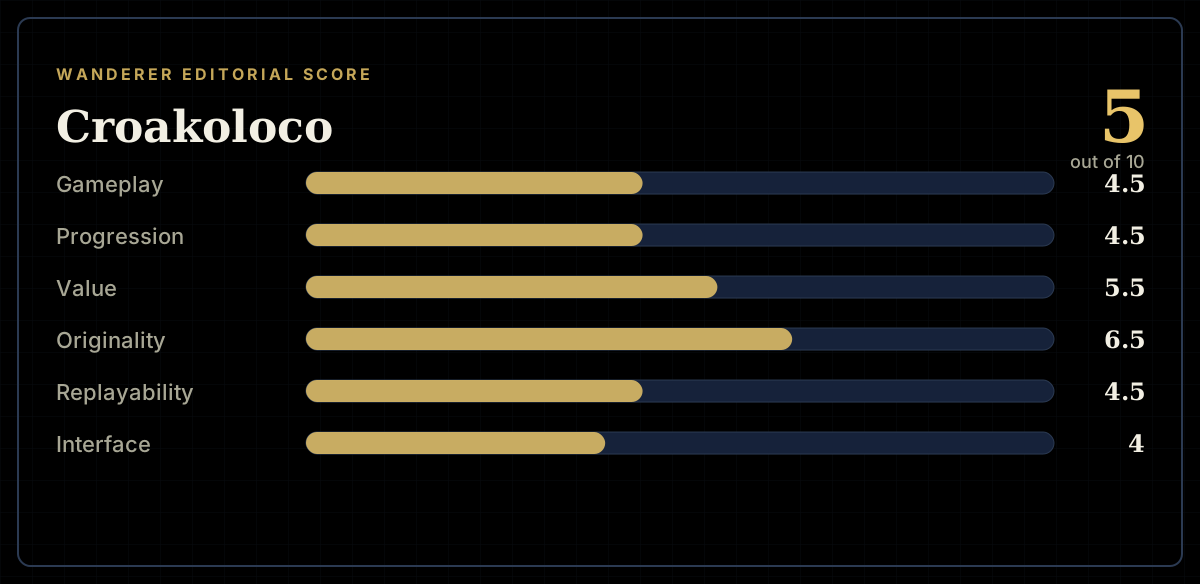
How the review scores each part of the gameWanderer Editorial -
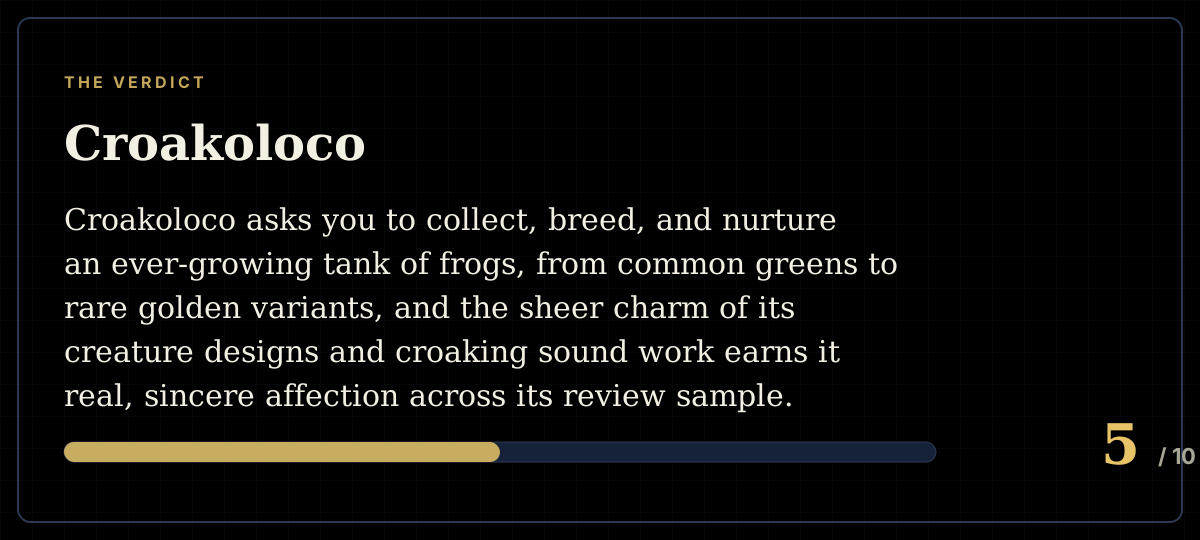
The short versionWanderer Editorial