
Game review
Creature in the Well
6 / 10
- Developer
- Flight School Studio
- Publisher
- MWM Interactive
- Released
- 6 September 2019
- Platforms
- Windows
- Genre
- Action
- Monetisation
- Paid, no in-app purchases found
- Players
- false
The short version
Creature in the Well sends a lone robot into a buried, sand-swallowed facility to restore power by launching charged energy balls at pinball-style bumpers, activating machinery and fighting off the ancient, malevolent Creature that lurks within. Flight School Studio's striking, minimalist geometric art style and desert atmosphere earn some of the most consistent visual praise this lane has documented. But a large, specific and detailed share of its own review corpus argues the pinball-combat mechanic underneath — the game's entire premise — feels simple and repetitive rather than deep, with imprecise aiming and copy-pasted boss formulas turning what should be a satisfying puzzle-action hybrid into a source of real, specific frustration.
Biggest strengths
- A genuinely striking, distinctive geometric art style and desert-facility atmosphere that draws close to unanimous praise across the entire review corpus, including from its harshest critics
- A strong, atmospheric soundtrack that several reviewers specifically praise, though some note it grows repetitive over a longer session
- A short, respectable runtime (roughly 6-8 hours to fully complete per multiple reviewers) with genuine replayability for speedrunning-minded players
Biggest weaknesses
- A dominant, detailed critical thread arguing the core combat loop is "mindless thwacking" rather than genuine pinball or puzzle-solving, with an aiming reticule multiple reviewers describe as imprecise and unreliable
- Boss battles widely described as following "one copy and pasted formula" throughout the game, undermining variety in the moments meant to be the biggest set-piece challenges
- Repeated room layouts and a real, specific difficulty spike concentrated in the game's final area, which at least one detailed reviewer says prevented them from reaching the story's intended payoff
Who it's for: Fans of distinctive visual design and unconventional genre mashups who are willing to accept shallow, sometimes frustrating combat mechanics in exchange for atmosphere and a short runtime.
Our recommendation: Worth a look at a discount purely for the art direction and atmosphere — go in with modest expectations for the actual pinball-combat depth, since a large, detailed share of this game's own fans say it doesn't hold up across a full playthrough.
6 / 10
What it is
Creature in the Well sends a lone robot, BOT-C, into a massive, sand-buried ancient facility to restore its power by navigating rooms built around pinball-style mechanics — charging energy balls and launching them at bumpers, switches and enemies — while confronting the ominous, all-seeing Creature responsible for the facility's fall. Developed by Flight School Studio and published by MWM Interactive, it released on 6 September 2019 at NZD 18.49, presenting its world through a distinctive, minimalist geometric art style set against a striking desert palette.
Its review corpus, 211 in English, sits at a genuine Mostly Positive 78.7% (166 to 45), and reading through it in depth reveals a familiar pattern for a visually striking indie: near-total agreement on presentation, and real, detailed disagreement about whether the mechanics built around that presentation actually hold up.
Visual and atmospheric craft that earns near-universal praise
Regardless of overall verdict, this corpus agrees closely on Creature in the Well's presentation. "This is the most artistically beautiful game I've seen in years," writes one otherwise critical reviewer, a sentiment echoed constantly across both positive and negative reviews. Another calls the "direction, atmosphere, visual design and attention to detail" amazing even while delivering an overall negative verdict on the gameplay built on top of it. A separate reviewer credits the game with a genuinely novel visual identity: "great art style" combined with an "interesting" premise that "combines breakout and baseball with a touch of Zelda" — a distinctive combination this corpus rarely disputes on aesthetic grounds alone.
A large, detailed case that the core mechanic doesn't hold up
Set against that visual consensus, a substantial and specific critical thread argues the pinball- combat loop at the center of the game's identity is shallow in practice. "This is not pinball — it's mindless thwacking with an aiming reticule that behaves about as well as my [frustrating] parrot," writes one detailed, highly-upvoted reviewer, who nonetheless praises the characters and music separately. Another, especially thorough negative review states the issue precisely: "the 'logic puzzles' mentioned are virtually nonexistent. The example shown in the trailer is one of perhaps four or five extremely simple 'puzzles.' Boss battles follow one copy and pasted formula" throughout the entire game. A third reviewer frames the disappointment in genre terms, directly referencing a similarly-styled action-adventure game as a point of comparison: "this is not the Yoku's Island Express of action-adventure games" — a specific, useful benchmark for readers trying to calibrate expectations.
Specific, repeated frustrations with difficulty and secrets
Beyond the core-loop debate, several detailed reviews raise more specific structural complaints. One reviewer describes a design choice they consider actively unfair: "making a game that requires you to unlock secrets to beat boss fights because they're incredibly difficult... they're prerequisites," they write, "not recommend if you don't enjoy having to jump through hoops to get 'secret' items just to beat one of the bosses." A separate reviewer reports the game's difficulty curve breaks down specifically at the very end: "the huge difficulty spike in the final area is just frustrating and prevented me from reaching the big payoff the whole game was leading up to," while explicitly wishing for more variety in the earlier levels to have better prepared them for it.
A separate, more technical thread concerns basic input reliability rather than difficulty balance. "It has a metric ton of problems, starting from 'x doesn't always work for exiting game' (tedious) to 'LMB doesn't always work while collecting balls' (deadly and infuriatingly unfair)," writes one detailed reviewer, who goes on to describe specific enemy encounters — including standing in a laser field while juggling multiple charged balls — as "imbalanced" to the point of feeling designed against the player rather than merely difficult. That's a distinct, more concrete complaint from the general "combat feels shallow" critique above: unreliable input registration in a game built entirely around precise aiming and timing is a specific, checkable technical flaw rather than a matter of taste.
A more balanced middle ground
Not every account in this corpus lands cleanly on one side. One detailed, mixed-leaning review credits the game with "great variety in useful equipment" and "fluid action and movement" while still flagging "repetitive room layouts" and "challenging ramp up in early difficulty and controls" as real costs. A separate reviewer who finished the game in under seven hours found the puzzles "fun and unique" even while acknowledging the soundtrack "gets really repetitive and lacks diversity" over a full playthrough — a fair, more measured account suggesting the game's flaws and strengths sit closer together for some players than the sharpest positive and negative reviews might suggest.
What the achievement data confirms
Creature in the Well's achievement curve shows a real, meaningful decline from a strong start: 88.8% for the first milestone, dropping through a real mid-game (65-68% for core mechanic introductions), before settling around 20-25% for story completion and most collectible-related achievements. That's consistent with a short game that a majority of buyers make solid progress into, with a real but not enormous drop-off toward full completion — a pattern that fits a game whose early hours draw people in with its presentation, even as the specific frustrations documented above cause some to stop short of finishing.
Verdict
Creature in the Well succeeds unambiguously as a visual and atmospheric achievement, and that alone makes it worth a look for players drawn to distinctive indie art direction. But a large, detailed share of its own reviewers make a specific, credible case that the pinball-combat mechanic at its core — the very thing that makes it novel on paper — doesn't deliver the depth or fairness needed to carry a full playthrough, particularly once repeated room layouts and a late difficulty spike set in. Worth trying at a discount with tempered expectations for the gameplay specifically.
Pros and cons
Pros
- A genuinely striking, distinctive geometric art style and desert-facility atmosphere that draws close to unanimous praise across the entire review corpus, including from its harshest critics
- A strong, atmospheric soundtrack that several reviewers specifically praise, though some note it grows repetitive over a longer session
- A short, respectable runtime (roughly 6-8 hours to fully complete per multiple reviewers) with genuine replayability for speedrunning-minded players
- A genuinely novel core concept — combining pinball-style ball launching with Zelda-esque dungeon exploration — that reviewers credit as creative even when they find the execution lacking
Cons
- A dominant, detailed critical thread arguing the core combat loop is "mindless thwacking" rather than genuine pinball or puzzle-solving, with an aiming reticule multiple reviewers describe as imprecise and unreliable
- Boss battles widely described as following "one copy and pasted formula" throughout the game, undermining variety in the moments meant to be the biggest set-piece challenges
- Repeated room layouts and a real, specific difficulty spike concentrated in the game's final area, which at least one detailed reviewer says prevented them from reaching the story's intended payoff
- A real, specific complaint that hidden "secret" upgrade items are functionally mandatory prerequisites for beating certain bosses rather than optional bonus content, undermining their framing as discoverable extras
- Multiple reports of control inconsistency, including unreliable input registration while collecting balls and awkward transitions between walking and aiming, with at least one reviewer noting real high-DPI display scaling issues requiring manual fixes
Screenshots
-

Creature in the WellImage: Flight School Studio via Steam -

Creature in the WellImage: Flight School Studio via Steam -

Creature in the WellImage: Flight School Studio via Steam -
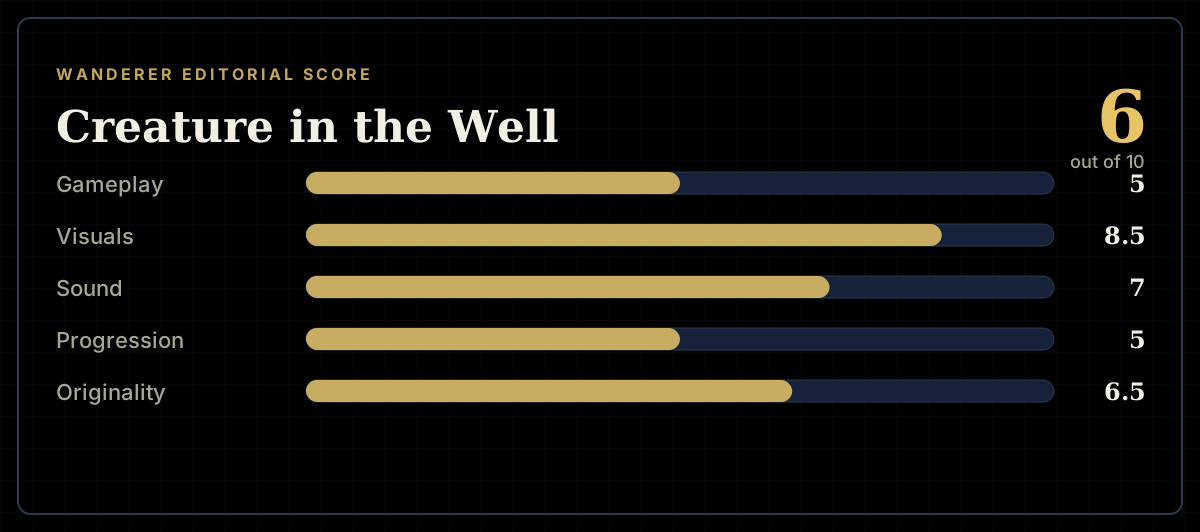
How the review scores each part of the gameWanderer Editorial -
The short versionWanderer Editorial