
Game review
Clickstellar
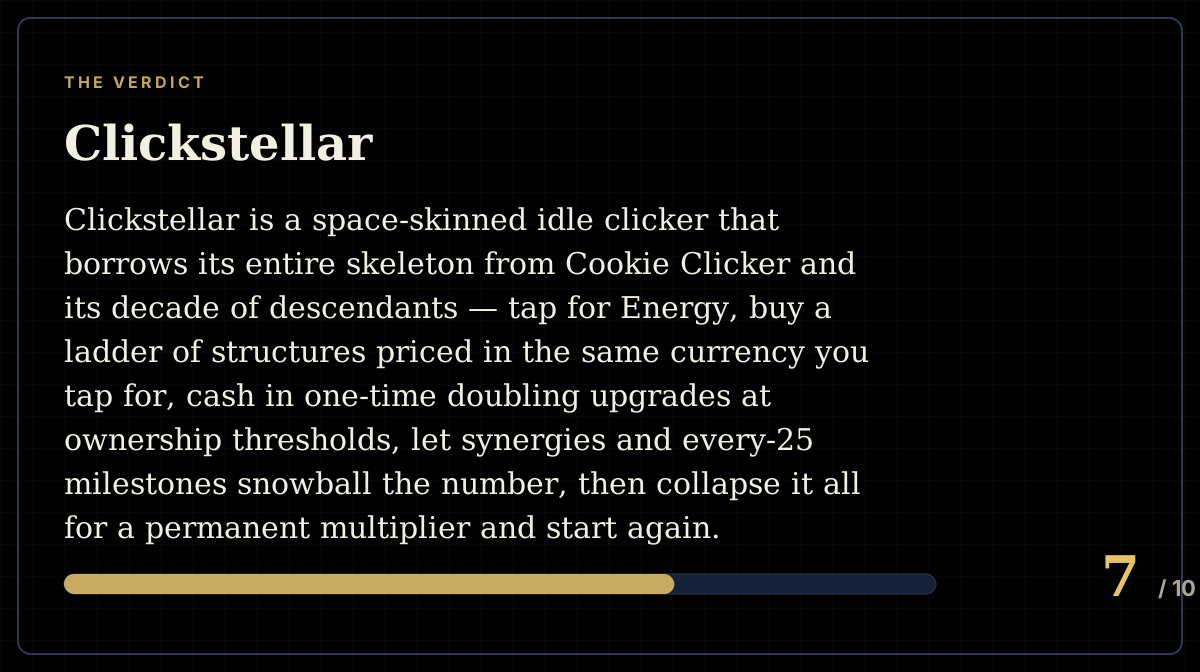
7 / 10
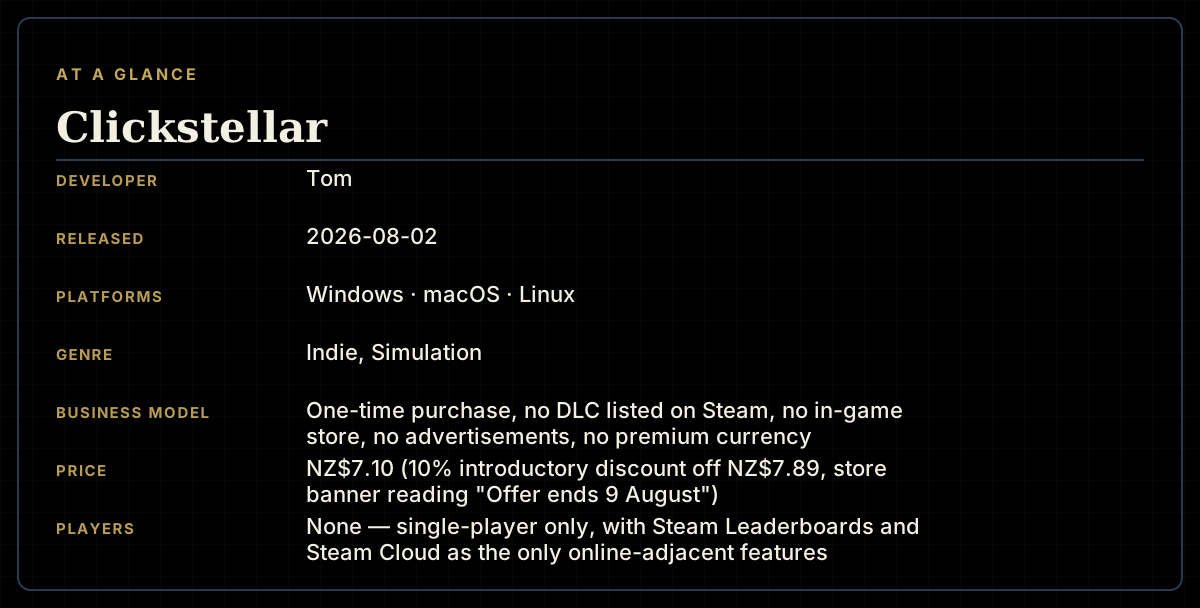
- Developer
- Tom
- Publisher
- Tom
- Released
- 2 August 2026
- Platforms
- Windows, macOS, Linux
- Genre
- Indie, Simulation
- Monetisation
- One-time purchase, no DLC listed on Steam, no in-game store, no advertisements, no premium currency
- Players
- None — single-player only, with Steam Leaderboards and Steam Cloud as the only online-adjacent features
The short version
Clickstellar is a space-skinned idle clicker that borrows its entire skeleton from Cookie Clicker and its decade of descendants — tap for Energy, buy a ladder of structures priced in the same currency you tap for, cash in one-time doubling upgrades at ownership thresholds, let synergies and every-25 milestones snowball the number, then collapse it all for a permanent multiplier and start again. What it does with that inherited shape is more careful than most: a single currency instead of a wall of competing ones, offline progress capped at a sane 12 hours, and — found only by opening the ascension screen directly — a prestige payout that ramps from 23% to full value over roughly 15 minutes specifically to stop players farming quick resets. It's a clean, thoughtful execution of a very well-worn template, sold at a price well above the genre's usual free-to-a-dollar range, five days into a launch that has drawn precisely two Steam reviews and, at the moment of checking, two people playing it.
Biggest strengths
- A single Energy currency runs the entire structure ladder, so nothing here produces the "rich in the wrong number" wall that dual-currency clickers are prone to
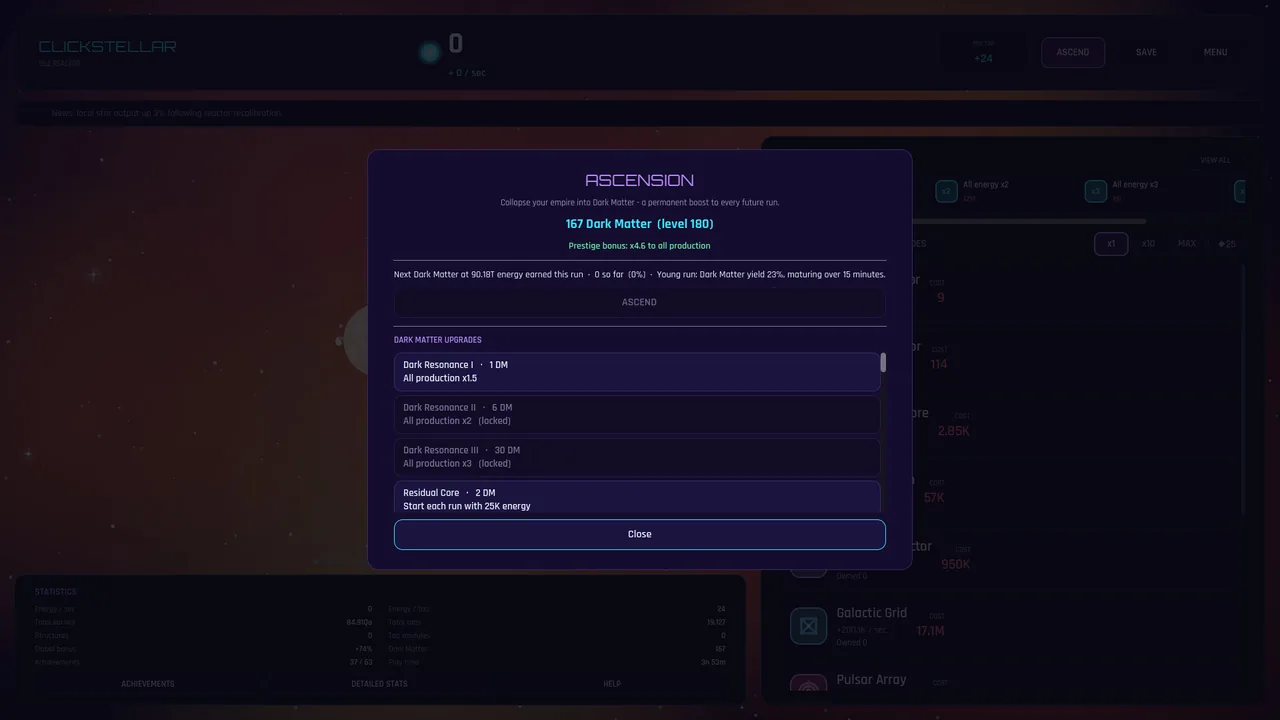
- Ascending too quickly is actively discouraged: the prestige screen states outright that a "young run" only pays out 23% of its Dark Matter, climbing to full value over roughly 15 minutes, a safeguard against reset-farming that no store text mentions and most clickers don't bother building
- Automation is a purchasable part of the ~40-node Dark Matter tree itself — an Auto-Harvester that taps for you and a Foreman that buys the best-value structure on its own — rather than an unofficial "just leave it open" workaround players have to discover for themselves
Biggest weaknesses
- The buy-1/10/max/next-milestone controls, the every-25-owned doubling, the one-time per-structure upgrades unlocked at ownership thresholds and the cross-structure synergies are close enough to Cookie Clicker's own systems, feature for feature, that little here reads as a new idea rather than a space-themed pass over an eleven-year-old template
- The store page promises "a living 3D centerpiece: a glowing planet that becomes a star with orbiting satellites and rings," but none of the five official screenshots show any rings or satellites — every one is a flat, unadorned circle, and Steam's own community tags file the game as 2D rather than 3D
- NZ$7.89 before discount sits well above where most of the incremental genre prices itself, and nothing in the available evidence yet says whether the content past the opening structures justifies asking more than the free or under-$2 clickers this genre is usually built on
Who it's for: Genre regulars who know the Cookie Clicker formula by heart and want to see a careful, unoriginal version of it done in space rather than a bakery, plus anyone who specifically wants a clicker with real controller and accessibility support built in from day one.
Our recommendation: Worth it at the NZ$7.10 introductory price if a faithfully-built version of the classic building-ladder clicker with a genuinely smart prestige-pacing safeguard is what you're after — there's real design care in the parts that don't show up in a screenshot. Wait for a price drop or a larger review corpus if you're specifically looking for a fresh idea in the genre, since almost everything visible here has a direct ancestor, and there isn't yet enough independent play time on record to say how the back half of the prestige tree holds up.
7 / 10
Clickstellar's pitch is disarmingly honest about what it is: tap a dying star, watch the number go up, build an empire of reactors and Dyson swarms that keeps earning while the game is closed, then collapse the whole thing into a permanent multiplier and start over as a new star. That is, almost feature for feature, the shape Cookie Clicker set for the genre in 2013 — a single currency, a ladder of buildings that each cost more of the thing they produce, one-time doubling upgrades unlocked at ownership thresholds, and milestones that double a building's output every time you own another 25 of it. Clickstellar doesn't hide from that lineage; it just moves it into orbit, and the question worth asking isn't whether the skeleton is new — it isn't — but whether the execution justifies a NZ$7.10 asking price in a genre where most competitors are free.
A familiar ladder, built with real care
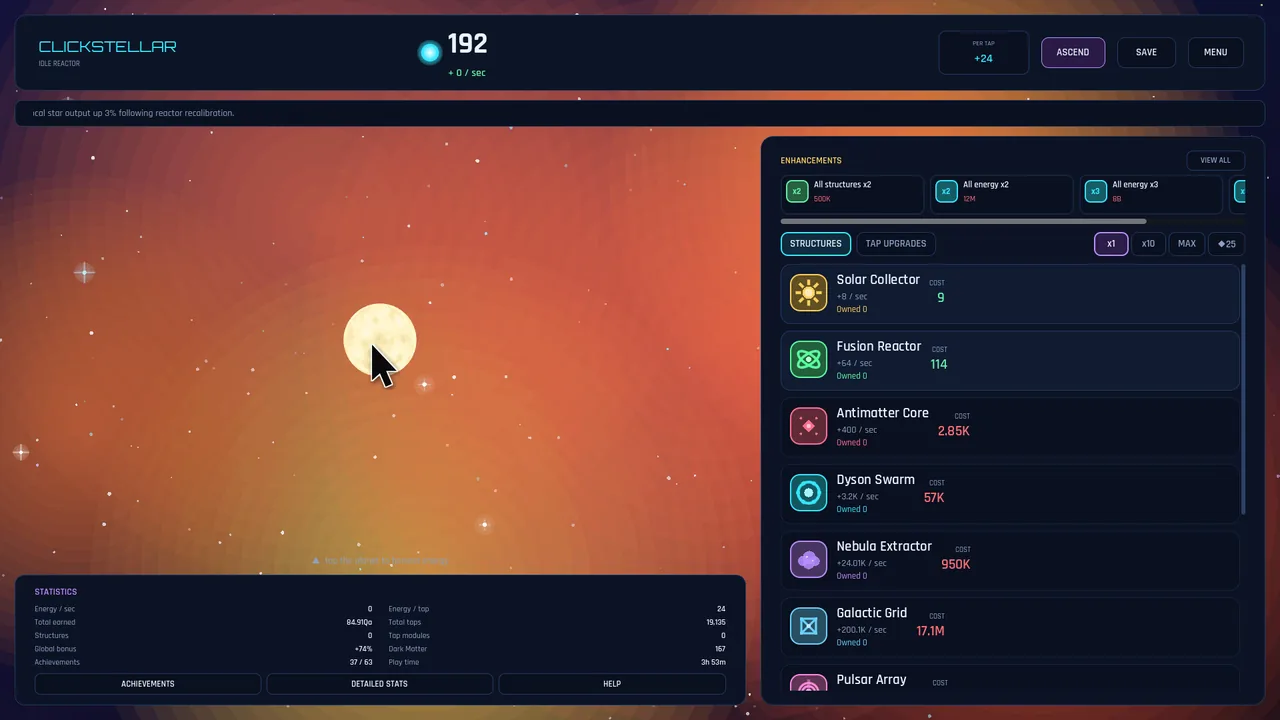
The structure list, laid out directly in the game's own promotional screenshots, runs Solar Collector, Fusion Reactor, Antimatter Core, Dyson Swarm, Nebula Extractor, Galactic Grid and Pulsar Array, with the store description promising it continues on to Quasar Engines and beyond. Every purchase is priced in the same Energy you tap for by hand, which matters more than it sounds: it means Clickstellar never produces the specific frustration of clickers that gate purchases behind two currencies that don't climb together, where a screen full of "rich" numbers still can't afford the next upgrade because the wrong number grew. Buying controls cover the standard four modes — one at a time, in tens, MAX, or straight to the next times-25 milestone — and a scrollable Enhancements row sits above the structure list offering dozens of one-time doublers, twenty-two of which are visible in a single captured screenshot alone, several gated behind owning ten of a specific building rather than a flat Energy cost.
Comets are the one system without a direct Cookie Clicker analogue on the surface, though the underlying idea — a rare timed bonus that rewards attention during otherwise idle play — will be familiar to genre veterans by another name. The store page counts seven comet event types: Frenzy multipliers, instant Windfalls, free structures and rarer effects it declines to spell out. None of the five official screenshots catch one in the act of being clicked, so how generous or how punishing they feel in practice isn't something this review can verify from the evidence available.
The one system that isn't a copy
Ascension is where Clickstellar earns its keep. Collapsing a run converts everything into Dark Matter, a currency spent on a prestige tree the store page describes as roughly forty nodes deep — Dark Resonance tiers that multiply all production, a Residual Core that seeds the next run with starting Energy, and, further in, true automation: an Auto-Harvester that taps on the player's behalf and a Foreman that buys whatever structure currently offers the best value. That last part is worth sitting with. In a lot of clickers, the "correct" endgame play — stop clicking, let the numbers tick over, check back later — is something players discover for themselves and the developer either shrugs at or never planned for. Here it's a purchasable, intended destination on the game's own progression tree, which is a more honest way to build a game whose entire pitch is that it earns while closed.
The genuinely uncommon find sits inside the ascension screen itself, in text no store page or description repeats anywhere: a freshly-started run only pays out 23% of the Dark Matter it would otherwise earn, climbing to full value as the run "matures" over roughly fifteen minutes. That's a direct, deliberate answer to a problem most incremental games never solve — the incentive to ascend the instant it's numerically profitable, over and over, farming a currency instead of playing the game the currency is supposed to reward. Building that safeguard into the prestige math itself, rather than bolting on a cooldown timer or simply hoping players don't min-max the loop, is the single most interesting design decision this review found anywhere in the package.
An interface with more thought in it than the genre usually gets
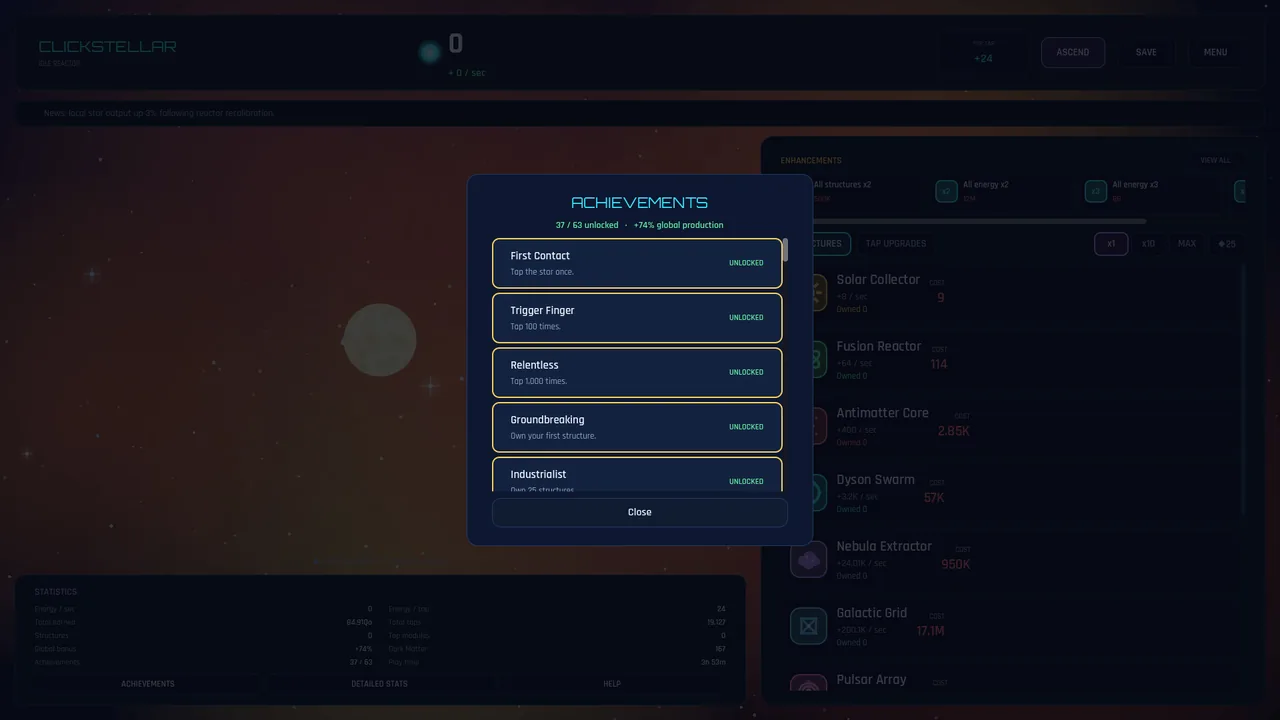
Clicker interfaces have a bad habit of becoming their own worst enemy once the numbers get large — walls of stacking floating text, ambiguous purchase buttons, currency displays that clip their own digits. Clickstellar's captured screens don't show that failure mode: the structure list states cost, current output and owned count cleanly per row, big numbers get a choice of Short, Scientific or Engineering notation for players who want precision over readability, and a persistent statistics panel tracks lifetime taps, total earned, achievement count and Dark Matter in one place rather than scattering them across menus. Full controller support goes further than most PC-first clickers bother to — on-screen prompts that match whichever input device is active, and a dedicated Steam Deck layout using the handheld's touch or trackpad rather than treating it as an afterthought. Paired with Adjustable Text Size, Camera Comfort, a Mouse Only option and Playable without Timed Input all listed as Steam store categories, this is a more accessible default configuration than the genre typically ships, clicker or otherwise.
A gap between the pitch and what's actually shown
Set against that care, one piece of the store description doesn't hold up against the store's own evidence. The features list promises "a living 3D centerpiece: a glowing planet that becomes a star with orbiting satellites and rings," but across all five official screenshots the planet is a flat, softly-glowing circle with no visible ring system or satellites in any of them. Steam's own community tags file Clickstellar under 2D rather than 3D. It's possible later stellar stages (the game cycles through nine star types across repeated ascensions) look more elaborate than the early ones captured for marketing, but nothing in the available evidence shows that, and a features list is a promise a shopper is entitled to hold the game to.
Five days old, almost nothing to measure it against
This review lands close enough to launch that the usual tools for reading a game through its audience mostly come up empty. Clickstellar has exactly two Steam reviews, both positive, both worth taking at face value rather than as a trend: one player logged 53.8 hours in total after writing theirs at the 142-minute mark, specifically praising the ability to leave it running in the background between other tasks, which is the idle genre's core promise working as intended. The other praised active, responsive development. Neither is a large enough sample to represent anything beyond two individual opinions, and at the moment of checking the game had two concurrent players. The achievement curve tells a similar story at a slightly larger but still tiny scale: tapping the star and catching a first comet sit at a near-universal 97.8%, a first ascension is reached by roughly seven in ten players who tried, and the numbers fall off a cliff by the 25th and 50th ascension. That shape is consistent with a normal difficulty curve rather than a design failure, but the population behind it is small enough that it should be read as a sketch, not a verdict — there simply hasn't been time for one to form yet.
Final verdict
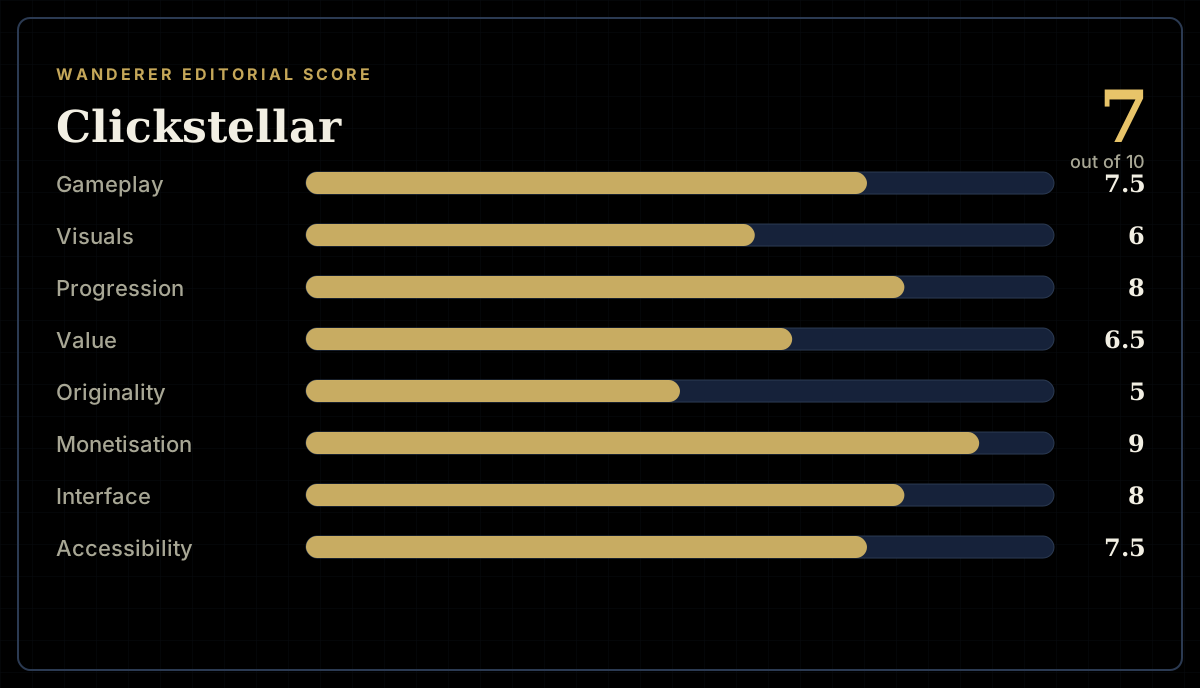
Clickstellar earns a 7.0 for doing something unglamorous well: taking a genre template that's over a decade old and building it with more internal consistency than most of its imitators manage, particularly in a prestige system that actively discourages the exploit most clickers quietly tolerate, and in an accessibility and control setup well ahead of the genre's usual baseline. It loses ground for asking a real-world price in a market its own competitors mostly give away, for a features list that oversells what its own screenshots demonstrate, and for simply not yet having enough independent play behind it to say how well the second half of its prestige tree holds up. None of that makes it a bad clicker — the parts a screenshot can't show, like the ascension pacing safeguard, suggest a developer who thought carefully about the loop rather than assembling one from a checklist. It just isn't yet a proven one.
Pros and cons
Pros
- A single Energy currency runs the entire structure ladder, so nothing here produces the "rich in the wrong number" wall that dual-currency clickers are prone to
- Ascending too quickly is actively discouraged: the prestige screen states outright that a "young run" only pays out 23% of its Dark Matter, climbing to full value over roughly 15 minutes, a safeguard against reset-farming that no store text mentions and most clickers don't bother building
- Automation is a purchasable part of the ~40-node Dark Matter tree itself — an Auto-Harvester that taps for you and a Foreman that buys the best-value structure on its own — rather than an unofficial "just leave it open" workaround players have to discover for themselves
- Full controller support with input-matched on-screen prompts, plus Adjustable Text Size, Camera Comfort, a Mouse Only option and Playable without Timed Input all listed as Steam categories, which is more accessibility groundwork than most clickers of any budget bother shipping
- A one-time NZ$7.10 purchase (NZ$7.89 once the introductory discount lapses) with no DLC, no in-game store and no premium currency of any kind on Steam's own listing
Cons
- The buy-1/10/max/next-milestone controls, the every-25-owned doubling, the one-time per-structure upgrades unlocked at ownership thresholds and the cross-structure synergies are close enough to Cookie Clicker's own systems, feature for feature, that little here reads as a new idea rather than a space-themed pass over an eleven-year-old template
- The store page promises "a living 3D centerpiece: a glowing planet that becomes a star with orbiting satellites and rings," but none of the five official screenshots show any rings or satellites — every one is a flat, unadorned circle, and Steam's own community tags file the game as 2D rather than 3D
- NZ$7.89 before discount sits well above where most of the incremental genre prices itself, and nothing in the available evidence yet says whether the content past the opening structures justifies asking more than the free or under-$2 clickers this genre is usually built on
- Five days after launch the game has exactly two Steam reviews and a current player count of two at the time of checking, so there is effectively no independent record yet of how the back half of the Dark Matter tree, the higher ascension tiers or the later comet events actually play
- Structures named only inside a locked upgrade requirement, such as "Plasma Drill," never appear in the visible structure list across any of the five promotional screenshots, so the fuller roster beyond Pulsar Array is undocumented outside the developer's own marketing copy
Screenshots
-
ClickstellarImage: Tom via Steam -
ClickstellarImage: Tom via Steam -
ClickstellarImage: Tom via Steam -
How the review scores each part of the gameWanderer Editorial -
The game at a glanceWanderer Editorial -
The short versionWanderer Editorial