Game review
Capivara Clicker
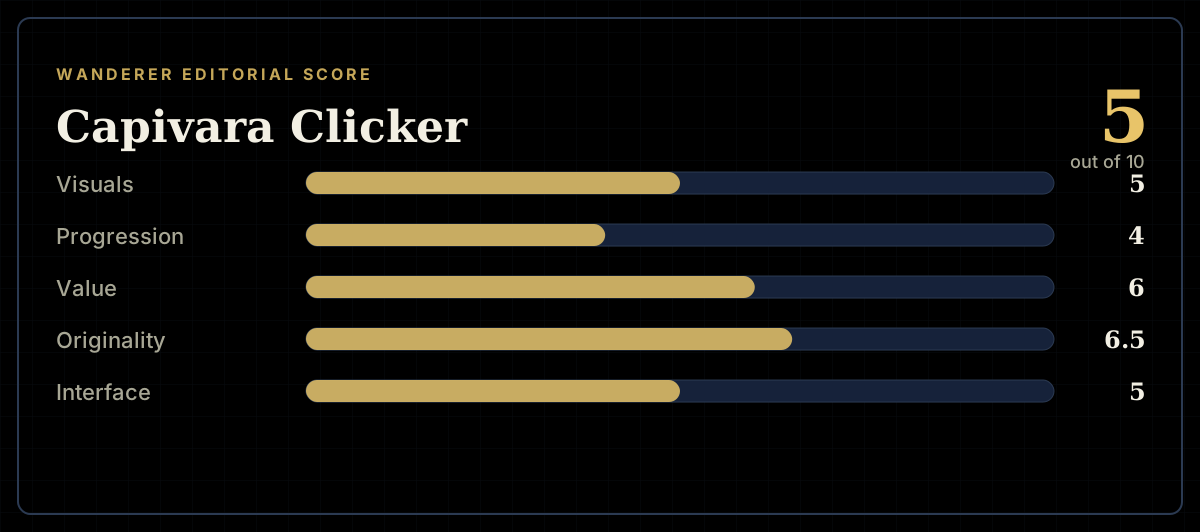
5 / 10
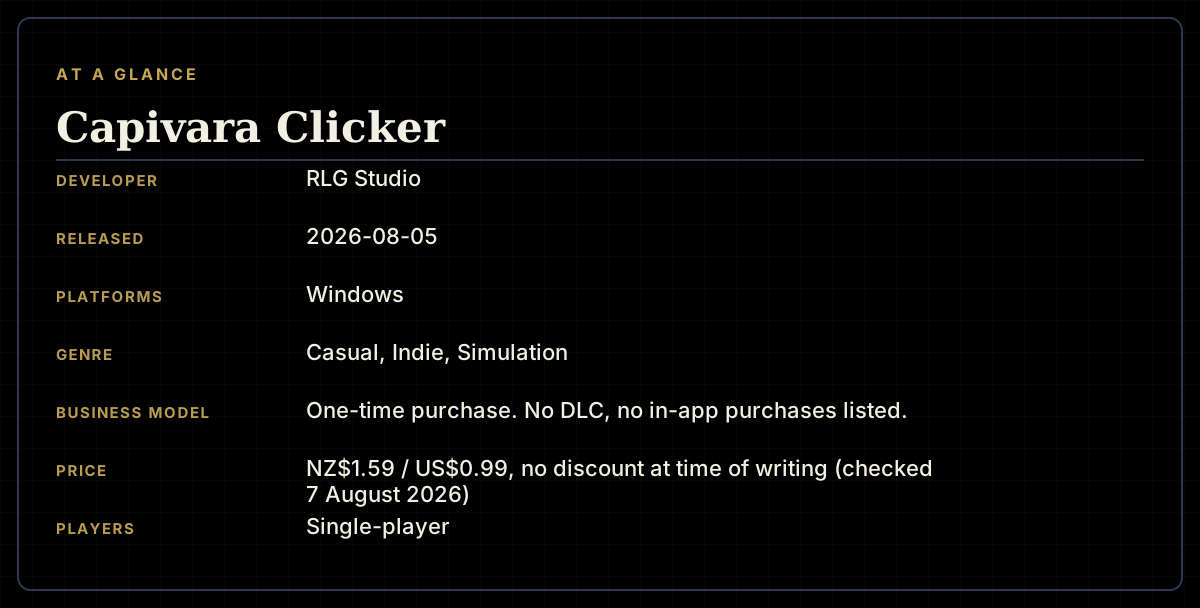
- Developer
- RLG Studio
- Publisher
- RLG Studio
- Released
- 5 August 2026
- Platforms
- Windows
- Genre
- Casual, Indie, Simulation
- Monetisation
- One-time purchase. No DLC, no in-app purchases listed.
- Players
- Single-player
The short version
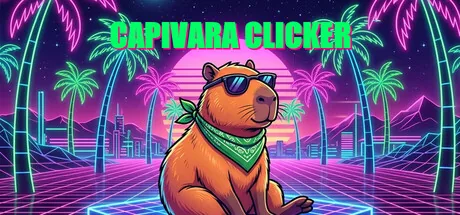
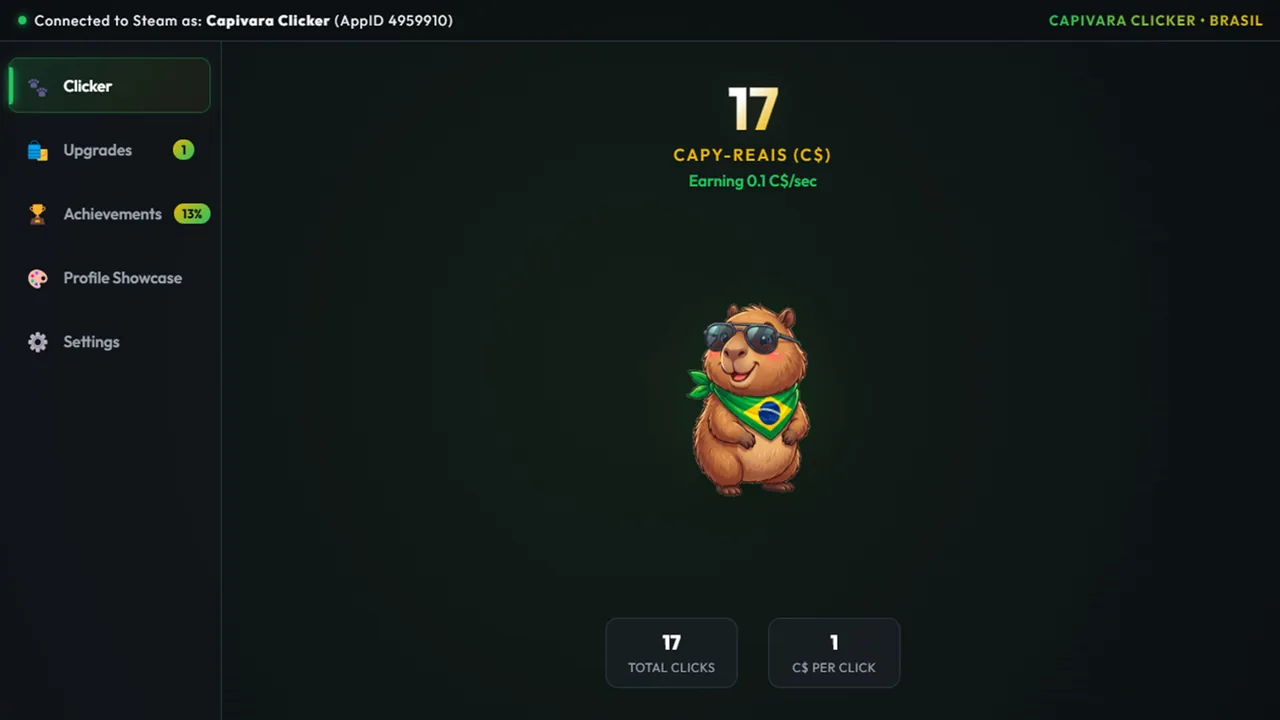
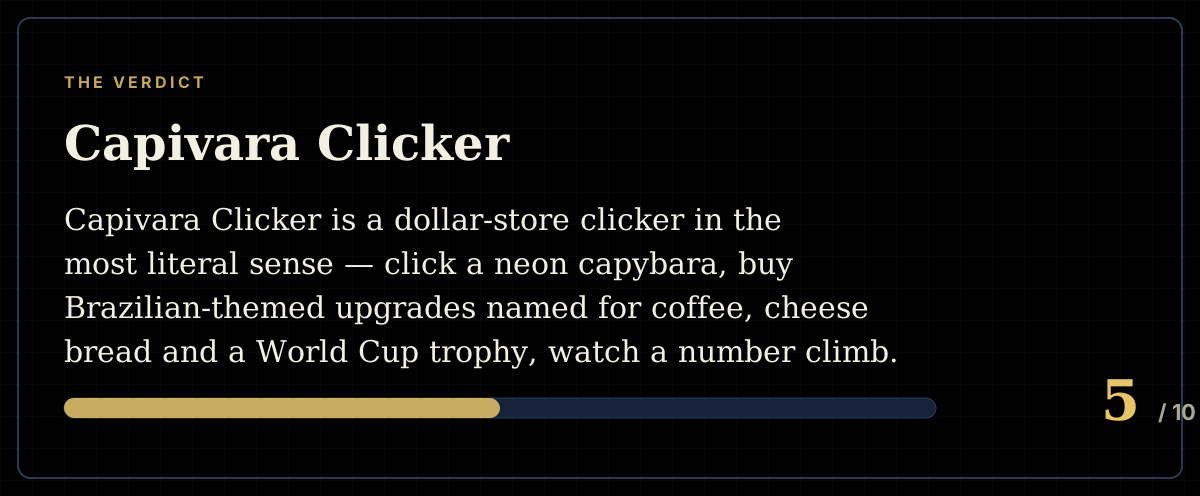
Capivara Clicker is a dollar-store clicker in the most literal sense — click a neon capybara, buy Brazilian-themed upgrades named for coffee, cheese bread and a World Cup trophy, watch a number climb. What makes it worth a second look is buried in its own achievement list: 60 of its 80 achievements are letters, numbers, symbols and national flags that exist purely to decorate a Steam profile showcase, spelling out words rather than marking anything you did in the game. It's a genuinely fun gimmick for a genre that mostly reuses the same milestone badges.
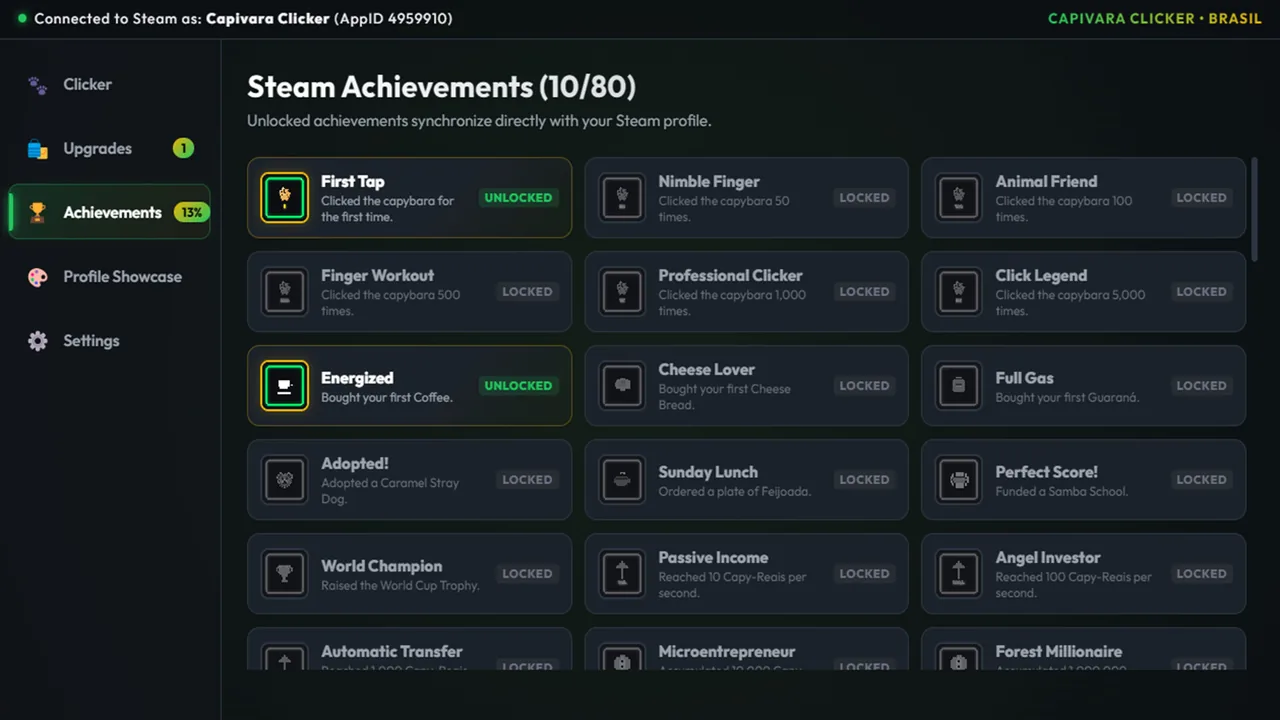
The other 20 achievements are the actual game, and they sketch a short ladder: click counts up to 5,000, an automated income rate up to 1,000 per second, a currency total up to a million, and seven named upgrades culminating in a trophy. Nothing in that list references a prestige, reset or ascension mechanic, which is the single most-copied structural idea in the genre and appears to be missing here.
Biggest strengths
- 60 of 80 achievements are pure profile decoration — the full alphabet, digits, punctuation and thirteen national flags, meant to be worn on a Steam showcase rather than earned as milestones
- A clear, low-risk price point with no in-app purchases, battle pass or premium currency of any kind
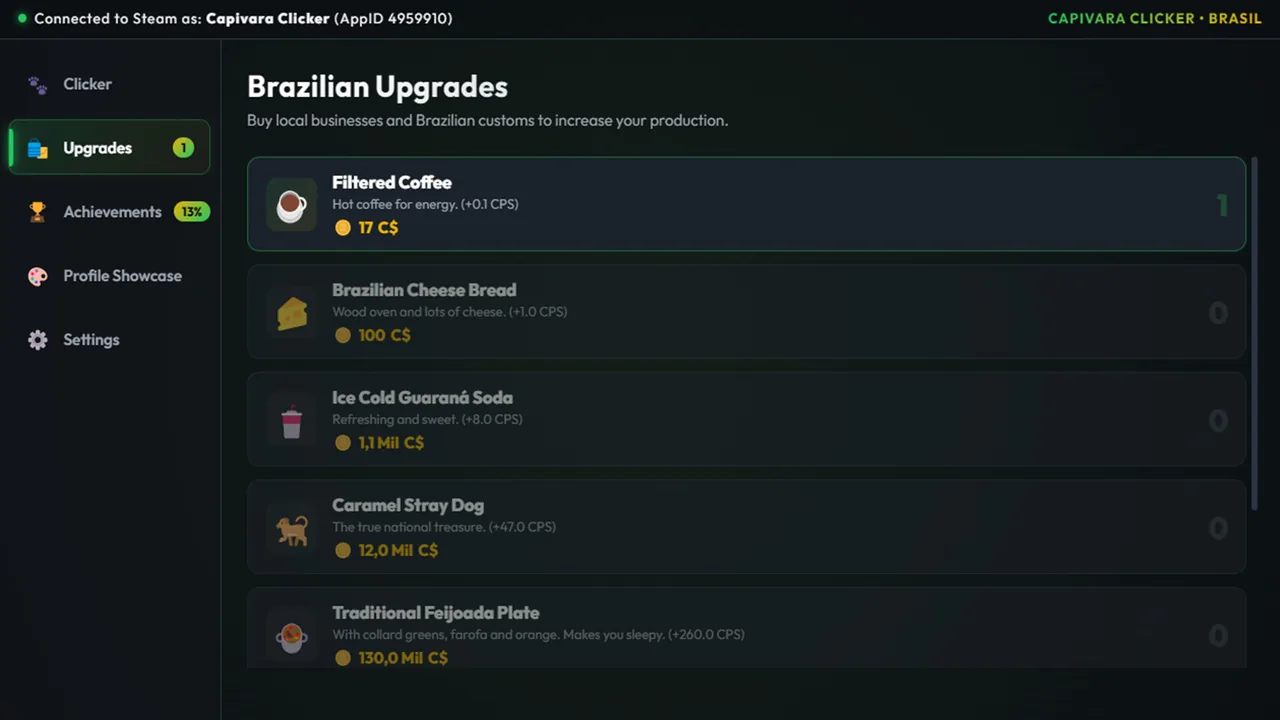
- Seven named Brazilian-themed upgrades (coffee, cheese bread, guaraná, a stray dog, samba, feijoada, a World Cup trophy) give the buy-menu a specific, cheerful identity instead of generic tier names
Biggest weaknesses
- No achievement, store-page line or patch note references a prestige, ascension or reset loop, and there's no way to confirm one exists without playing
- The store page never states whether progress accrues while the game is closed, a detail idle-game buyers usually check first
- The tracked progression ladder is short — a currency total achievement at one million is the top rung named anywhere, well short of the exponential curves the genre is built around
Who it's for: Anyone who wants a pocket-change clicker to run in a background window and doesn't need the genre's usual reset-and-multiply endgame; profile-achievement collectors specifically.
Our recommendation: At a dollar, the risk is low and the achievement-decoration idea is worth seeing. Don't expect a deep incremental — the visible ladder tops out well short of where Cookie Clicker or Melvor Idle's midgame even begins, and there's no confirmed offline-progression or prestige system to extend it.
5 / 10
Capivara Clicker costs a dollar, came out two days ago, and asks almost nothing of you beyond tapping a neon capybara until a number gets bigger. That description fits several hundred other Steam clickers. What makes this one worth writing about is buried in a place most players never look closely at: the achievement list. Read all 80 of them in order and they tell you exactly what kind of game this is — and exactly where it stops being one.
The buy-menu: coffee, cheese bread, a stray dog, a trophy
The store page frames the whole thing around a "rich Brazilian twist," and the achievement names back that up more specifically than the marketing copy does. The purchasable upgrades named in Steam's own achievement schema are, in order of how rare their unlock is: Cafezinho Coado (brewed coffee, to speed up clicks) and Pão de Queijo (cheese bread, to automate income) come easily; Guaraná and a Vira-lata Caramelo — the "legendary Brazilian Caramel Dog," a real stray-dog breed that's become an affectionate national symbol — sit a rung higher; and Samba, Feijoada and finally a Taça do Hexa, the World Cup trophy, sit at the top as the achievements almost nobody has reached. That's a coherent little ladder of specifically Brazilian touchstones rather than the tier-1-tier-2-tier-3 naming most budget clickers default to, and it's the game's clearest piece of actual design identity.
Behind those named purchases, the schema also tracks a broader "bought 50 upgrades" milestone, plus a plain currency-total ladder (10,000, then a jump straight to one million) and an automated-income ladder measured in production per second (10, then 100, then 1,000). None of that is unusual for the genre — it's the standard shape of a clicker's economy, currency climbing, automation climbing faster — but it is short. The highest named rung, a million units of currency, is where a game like Cookie Clicker or Melvor Idle is just getting started rather than approaching a ceiling. Whether Capivara Clicker has more depth than its achievement list admits to isn't something the achievement API can answer, and nothing else about the page fills the gap.
Three-quarters of the achievements aren't about playing at all
Here's the part worth genuinely crediting. Of the 80 achievements Steam's schema lists for this game, 60 have nothing to do with clicking, buying upgrades or hitting a score threshold. They are the 26 letters of the alphabet, the ten digits, roughly a dozen punctuation and symbol tiles, and thirteen national flags — unlocked, per the store description, so a player can "spell out words" and "decorate your profile showcase with numbers, symbols, and Circular 3D Glassy flags." It's a sticker album disguised as an achievement list, and it's a genuinely clever use of a system every idle game already has to build anyway. Most clickers spend their achievement budget on the same handful of milestone badges — first purchase, first hundred clicks, first prestige. Capivara Clicker spends three-quarters of its budget on something a player actually gets to keep looking at afterward, on their own profile, arranged however they like.
One detail stands out enough to be worth naming: of the thirteen flags in that set — Italy, Chile, Portugal, the United States, Spain, Germany, Argentina, Japan, China, Russia, Thailand, the United Kingdom, France — none of them is Brazil's own flag. A game built entirely around Brazilian coffee, cheese bread, a Brazilian stray dog and Brazil's own World Cup trophy count never gives you Brazil's flag as a collectible, only a generic capybara emblem in its place. It's a small, likely unintended gap in an otherwise well-themed design, and the kind of thing a Portuguese-speaking player is more likely to notice than an English-speaking reviewer would be inclined to invent.
That leaves 20 achievements that actually gate progress: click counts from 1 up through 5,000, production-rate milestones at 10, 100 and 1,000 per second, currency totals at 10,000 and a million, the seven named upgrade purchases above, a 50-upgrades milestone, and a completionist award for clearing everything else. Reading the full list makes the game's shape legible without needing to guess at it: this is a small, single-currency, single-resource clicker with one visible economy, not a multi-currency layering game like NGU Idle or a multi-business empire like Adventure Capitalist.
What isn't confirmed, and probably should have been on the store page
Two things a genre-savvy buyer checks before spending even a dollar on an idle game are whether progress keeps accruing while the game is closed, and whether there's a reset-for-a-permanent-bonus loop waiting once the early numbers stop feeling interesting — the mechanic Cookie Clicker's Legacy button popularised and that Melvor Idle, NGU Idle and Adventure Capitalist all build their own version of. Neither is mentioned anywhere on Capivara Clicker's store page, and neither shows up in its achievement list: there's no achievement with a name resembling "prestige," "reset" or "ascend," and nothing describing an offline-earnings rate the way "idle clicker" marketing usually does elsewhere. That's not proof either system is absent — achievement lists don't have to cover every mechanic, and a small studio may simply not have built achievements around them — but it's a real gap in what a prospective buyer can verify up front, and worth flagging rather than assuming either way.
The store page's own numbers don't quite agree with each other either: the description promises "77 beautifully crafted Steam achievements," while Steam's schema for the game lists 80. It's a minor inconsistency, the kind of thing a one-person or very small studio's launch-week copy often carries, but on a page this new it's one more small sign of a release that hasn't had much time to settle.
Presentation and price
The visuals are described on the store page as "procedural" — neon colours and scanline grid effects rather than hand-drawn art — and the audio as "synthesized," clean sound effects generated rather than composed. That's an honest, low-budget presentation choice rather than a hidden one; the game isn't pretending to be more than a small, generated-asset production, and at a dollar that's a reasonable trade. It's Windows-only, with no Steam Cloud category listed among its store tags, so cross-device saves aren't a given the way they are on bigger releases. Support is a single email address rather than a community hub, which is standard for a studio this size and not a mark against it on its own.
At NZ$1.59, the price removes almost all of the risk a genre built on monetisation traps usually carries. There's no premium currency, no battle pass, no energy system, nothing to unlock beyond what a one-time purchase already bought. Whatever else is true of the game, it isn't trying to nickel-and-dime anyone.
Verdict
Capivara Clicker earns a 5.0. The achievement-as-profile-decoration idea is a genuinely good piece of design that this review is happy to single out — it's more original than most of what a dollar clicker usually offers, and it's the reason originality scores above the rest of the card here. But the game's own documentation stops well short of the genre's usual promises: no confirmed offline progression, no visible prestige loop, and a progression ladder that — going only by what Steam's own achievement schema and store page confirm — tops out at a scale most incrementals treat as an early waypoint rather than an endgame.
It's two days old, has no user reviews yet to check against, and a dollar is a small enough bet that curiosity is a reasonable reason to try it. Just go in knowing what's actually documented: a short, clearly-themed clicker with an unusually good collectible gimmick bolted onto a progression system this review can't yet confirm has real legs.
Price and store details checked 7 August 2026.
Pros and cons
Pros
- 60 of 80 achievements are pure profile decoration — the full alphabet, digits, punctuation and thirteen national flags, meant to be worn on a Steam showcase rather than earned as milestones
- A clear, low-risk price point with no in-app purchases, battle pass or premium currency of any kind
- Seven named Brazilian-themed upgrades (coffee, cheese bread, guaraná, a stray dog, samba, feijoada, a World Cup trophy) give the buy-menu a specific, cheerful identity instead of generic tier names
- Bilingual out of the box in English and Portuguese, which most budget clickers this size don't bother with
Cons
- No achievement, store-page line or patch note references a prestige, ascension or reset loop, and there's no way to confirm one exists without playing
- The store page never states whether progress accrues while the game is closed, a detail idle-game buyers usually check first
- The tracked progression ladder is short — a currency total achievement at one million is the top rung named anywhere, well short of the exponential curves the genre is built around
- Windows only, no listed Steam Cloud support, so cross-device saves aren't guaranteed
- The store description claims 77 achievements; Steam's own achievement schema for the game lists 80, a small inconsistency for a page this new
Screenshots
-
Capivara ClickerImage: RLG Studio via Steam -
Capivara ClickerImage: RLG Studio via Steam -
Capivara ClickerImage: RLG Studio via Steam -
How the review scores each part of the gameWanderer Editorial -
The game at a glanceWanderer Editorial -
The short versionWanderer Editorial