
Game review
Incremental Birds
4.5 / 10
- Developer
- IncBirdsGames
- Publisher
- IncBirdsGames
- Released
- 5 August 2026
- Platforms
- Windows
- Genre
- Action, Casual, Indie, Simulation
- Monetisation
- One-time purchase, no DLC listed on Steam, no in-game store, no advertisements, no content descriptors of any kind
- Players
- None — single-player only, no online features beyond Steam Achievements and Steam Cloud
The short version
Incremental Birds asks you to click migrating birds out of the sky with a physics twist worth noticing — hit the right "keystone" bird in a falling cluster and the whole group drops at once — then spends the rest of its runtime asking you to do that thousands more times against a 16-upgrade tree gated by two separate currencies that rarely arrive together. There's no prestige layer, no reset, no second act: waves escalate forever, and the honest way to clear the upgrade list is to leave the window open and stop actively playing, which two of its first three Steam reviewers reached independently, one of them a curator who specialises in exactly this genre. At NZ$0.95 for the next twelve days it's a low-risk curiosity with a genuinely pretty hook buried in it; at its regular NZ$1.59 it's a much harder recommendation once the discount lapses.
Biggest strengths
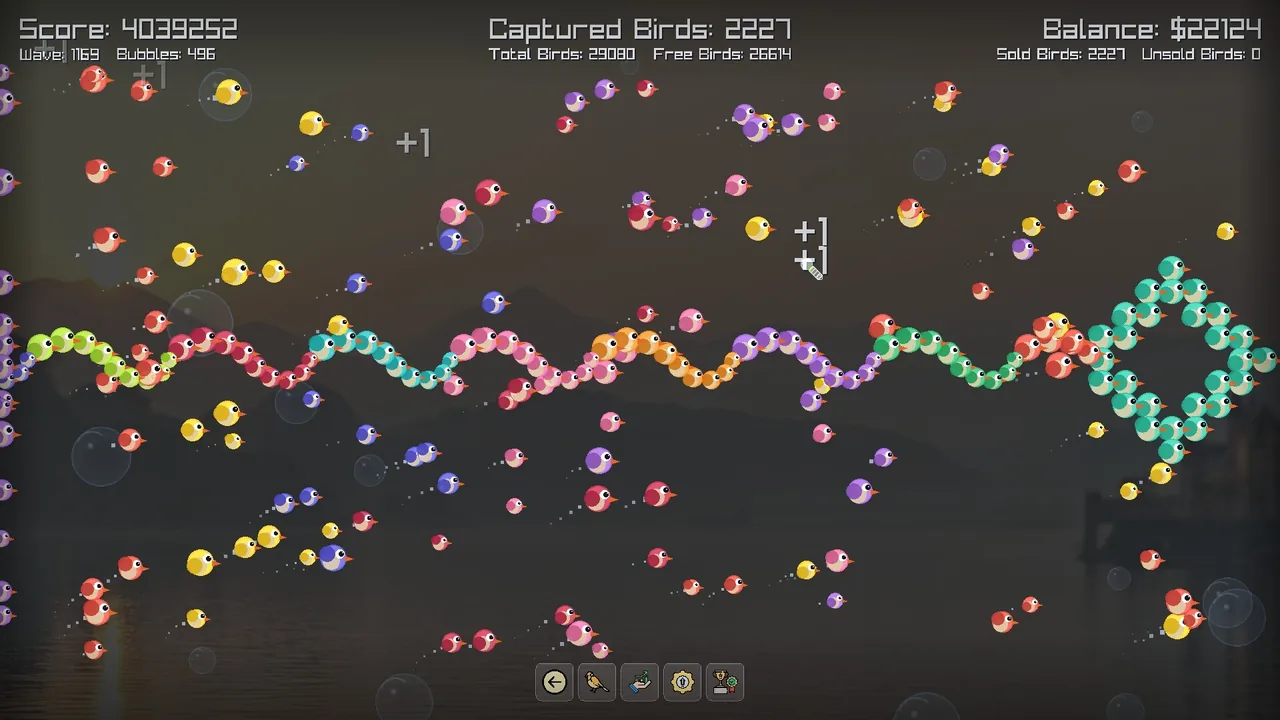
- The core capture mechanic has a real idea in it — birds fall in clusters, and clicking the right "keystone" bird takes the whole group down in a chain reaction, which the store's own screenshots and both critical reviews single out as the one moment of genuine delight
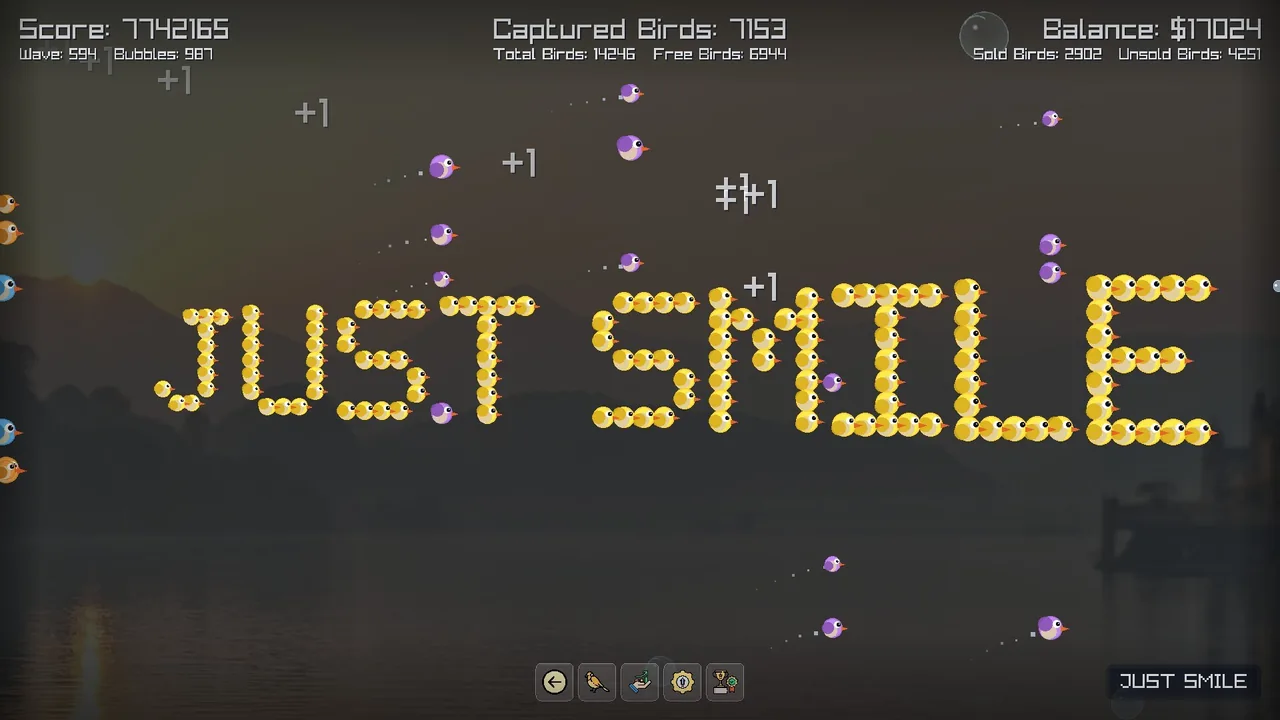
- Wave-formation birds occasionally spell short messages ("Just Smile", "Be Grateful") or fly in shapes, confirmed directly in the promotional screenshots, which is a small, distinctive art touch a plain clicker wouldn't bother with
- Three separate gameplay modes — Cozy (no fail state), Difficult (game over on too many missed birds, screenshotted directly: "Too many free birds!"), and Passive (missed birds reward you) — save independently, giving the same core loop three genuinely different postures toward failure
Biggest weaknesses
- There is no prestige system, reset layer or second act of any kind — waves and the upgrade tree simply climb forever, so once the achievement curve flattens out there is nothing new to chase, only bigger numbers at the same pace
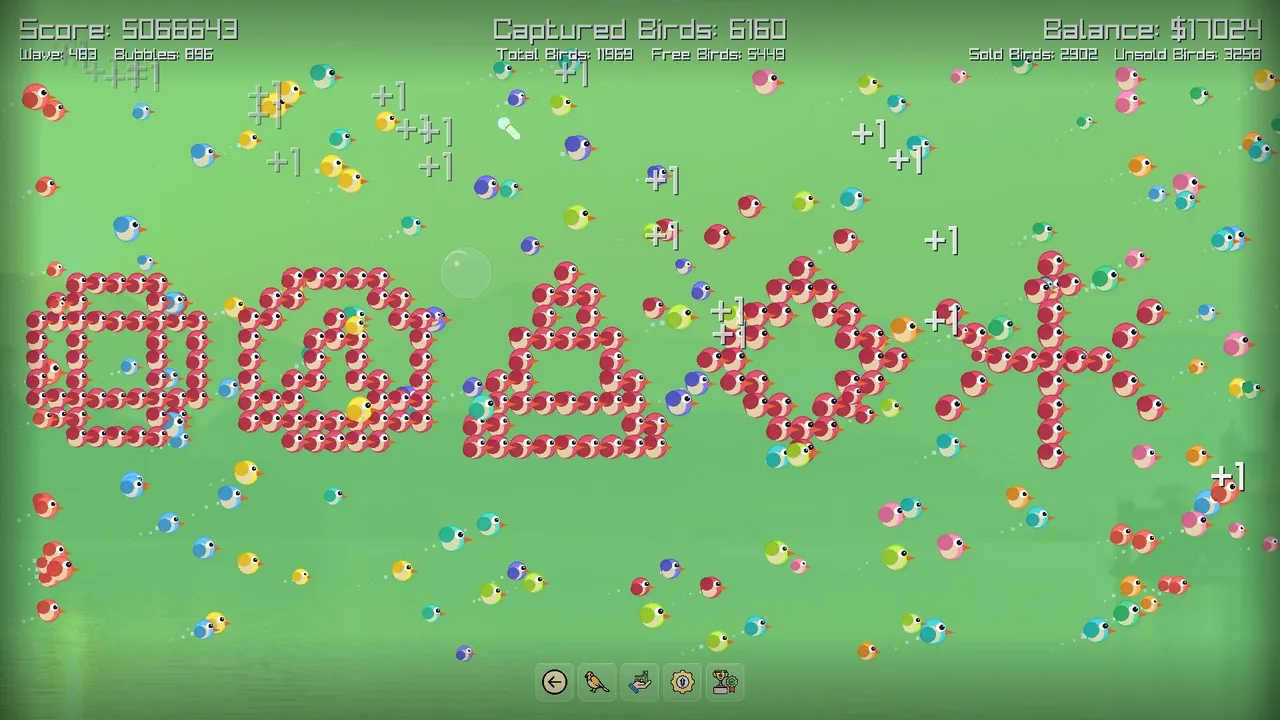
- The 16 general upgrades are gated by both a money threshold and a separate score threshold that don't scale together — a captured store screenshot shows a player with a 6.3-million score (comfortably past the 1-million score gate for the first upgrade) sitting on a $17,024 balance against a $100,000 price tag, which matches both critical reviewers' complaint that you can be "rich" in one currency and still locked out
- Two of the game's first three Steam reviews, including one from a curator who runs an idle-and-incremental recommendation page, independently conclude the optimal strategy is to unlock auto-capture and auto-sell and then stop actively playing — a genre where the store page never claims the reward keeps growing while the app itself is closed, only while it's left open and idle
Who it's for: Incremental-game completionists who enjoy picking apart a small, cheap system for an hour, and anyone charmed by the idea of birds falling into formation to spell out "Just Smile" while your balance ticks up in the background.
Our recommendation: Buy it during the introductory window if the physics-capture hook and the wave-formation art appeal on their own terms — NZ$0.95 is a fair price for what's here, and the monetisation is as clean as this library ever scores. Don't expect it to hold up as an active clicking game past the first few waves; both of its early critical reviews reach the same conclusion independently, that the actual optimal play is to unlock auto-capture and auto-sell as fast as possible and then stop touching it.
4.5 / 10
Incremental Birds opens with a genuinely nice idea: birds cross the screen in waves, sometimes alone and sometimes clustered, and clicking the right bird in a cluster — the one holding the rest of the formation up — sends the whole group falling at once. It's a small piece of physics choreography that the store's own screenshots lean on hard, including waves of birds arranged to spell out phrases like "Just Smile" before you scatter them. IncBirdsGames' debut title, released 5 August 2026 for NZ$0.95 (down from a regular NZ$1.59 until the introductory discount lapses on 19 August), spends its first two minutes selling that idea well. What it does with the other several hours is where its first Steam reviewers start to disagree with each other, and with the store page.
A dual-currency wall dressed up as an upgrade tree
The upgrade menu, visible directly in IncBirdsGames' own promotional screenshots, lays out 16 general upgrades across a 4x4 grid: a single stand-alone One-Click Kill ability, then three parallel tracks — Sales Bonus, three tiers of Auto-Sell, and Auto-Capture — each duplicated across Common, Uncommon and Rare bird rarities. Every single one of those 16 upgrades costs both a dollar amount and a separate score threshold, and the two don't climb together. A mid-game screenshot shows a player sitting on a score of roughly 6.3 million — comfortably clear of the 1-million score gate on the very first upgrade — while their balance sits at $17,024 against that upgrade's $100,000 price tag. Score comes easily from simply watching birds cross the screen; money only comes from clicking through captured birds one at a time to sell them, or holding the mouse and dragging across a sell menu to bulk it. The result, exactly as both of the game's negative Steam reviews describe it independently, is that you can be "rich" in the currency that doesn't matter and locked out by the one that does, for a stretch of play that has nothing else to offer while you wait.
Past that 16-item general tree there's a second, much larger structure the game itself seems ambivalent about: 108 individual bird variants, sorted by colour and size, each with its own sell-price upgrade purchasable up to ten times, at climbing point costs. The one positive Steam review — 322 minutes in, written by a reviewer with nearly 2,800 Steam reviews to their name — describes this system in detail and then recommends ignoring it outright, because the payoff never catches up to the grind of upgrading each of the 108 individually. That's an unusual thing for a positive review to say about a third of a game's advertised content, and nothing in the store description contradicts it.
No prestige, no reset, no second act
What's conspicuously absent from Incremental Birds, for a NZ$0.95 game carrying the word "Incremental" in its own title, is any kind of prestige layer. There's no point at which score, balance or upgrades reset in exchange for a permanent multiplier — the store page's own pitch is "chase an infinite balance and score," and that's meant literally. Waves climb forever, the 16-upgrade ladder is finite, and once it's cleared the entire remaining game is watching the same numbers get bigger at the same rate. Steam's own achievement data backs this up precisely: capturing a single bird sits at 97.7% of the tracked population, but owning all 16 general upgrades sits at 20.4% — the exact same floor shared by the highest wave-count, score and bird-count achievements in the game, which strongly suggests those are the same small group of committed players clearing everything there is to clear, with nowhere further to go once they do. The population behind that percentage is tiny — this is a two-day-old release with three Steam reviews and a player count that read zero at the moment of checking — so treat the exact number as a curiosity rather than a settled statistic, but the shape of the curve (one gentle slope down to a single flat floor, rather than a long tail) is the signature of a game with an ending built into its upgrade list, not an open-ended one.
The genre's own curator called the UI "clunky as hell"
Of Incremental Birds' first three Steam reviews, two are negative, and the more detailed of them comes from a curator who runs a dedicated Idle & Incremental Lovers recommendation page — about as on-the-nose an audience match as this library ever finds for a game. Their verdict, in full: "First two minutes are fun. Then you realize the UI is clunky as hell, the few upgrades are boring and don't change the gameplay, and you better idle the whole thing cause waiting is the best strategy." They put in 936 minutes — over fifteen hours — before writing that, which rules out a drive-by complaint. The captured mid-game screenshots corroborate the UI half of it directly: at wave counts in the 400s and 500s, the play area fills with dozens of stacked floating "+1" pop-ups layered directly over the birds and over each other, actively working against reading your own score at exactly the point the game expects you to still be watching it capture things. The third review, at 129 minutes, is shorter but lands on the same note: "It's fine, but the upgrade progression isn't very interesting."
There is a real interface effort underneath the clutter — the options menu, also captured directly, offers four colour themes, separate sound and music toggles, wave-message and gradient-border toggles and a fullscreen switch, more consideration than a lot of much bigger idle games give their settings screen. It just doesn't extend to the one screen that matters most, which is the one you're meant to be staring at for hours.
Cozy, Difficult and Passive aren't just difficulty sliders
The one structural idea that holds up well under scrutiny is the three gameplay modes, each of which saves its progress separately rather than just changing a multiplier. Cozy mode, described directly in its own in-game text, removes any downside to a slow or imprecise click and has no fail state at all. Difficult mode ends the run outright if too many birds escape uncaptured — a captured Game Over screen reads "Too many free birds!" after 13 waves and 9 free birds, banking a bonus score of 33,459 on exit. Passive mode inverts the premise entirely, rewarding you for letting birds go rather than catching them, which is the closest thing in the package to an actual answer for players who'd rather watch than click. Running three separate save files for the same core loop under three different failure philosophies is more structural thought than the flat upgrade list around it gets credit for.
Final verdict
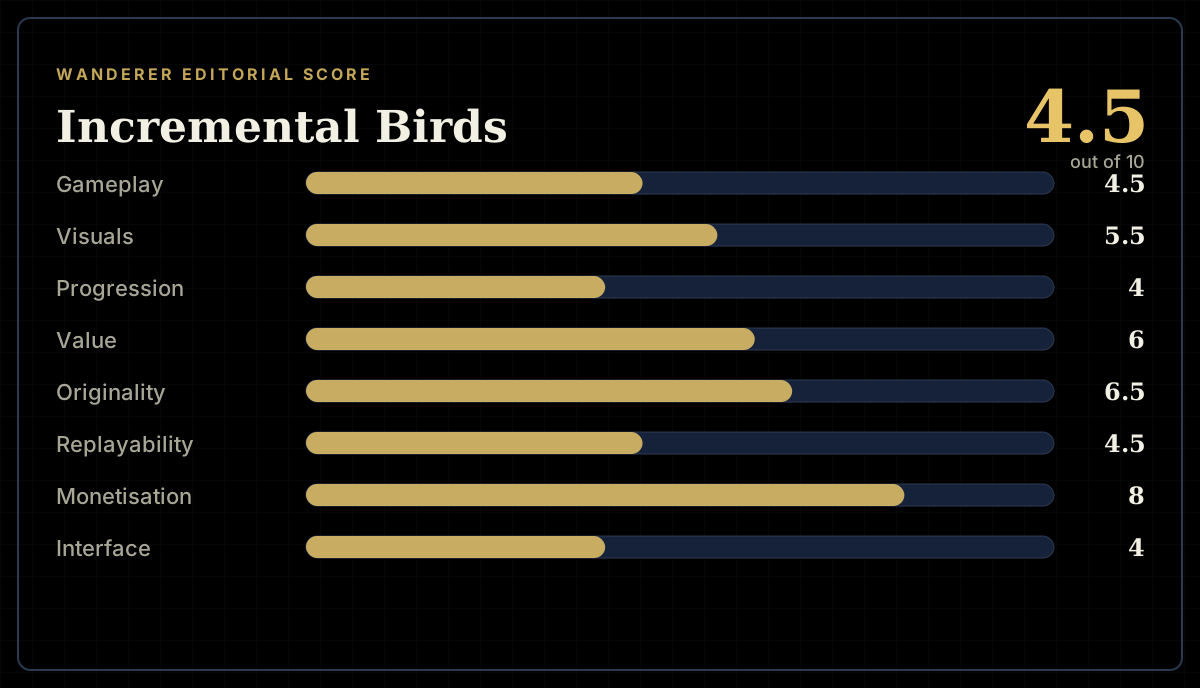
Incremental Birds earns a 4.5 for a genuinely charming capture mechanic and an unusually clean one-time-purchase monetisation model, undercut by an upgrade tree that gates every purchase behind two currencies that don't arrive together, a total absence of any prestige or reset layer to give the climbing numbers a reason to keep matter past the first sitting, and an interface that its own most qualified reviewer — a curator whose entire page is built around this exact genre — calls clunky after fifteen-plus hours with it. The physics-capture hook and the wave-formation art are worth the NZ$0.95 asking price on their own, especially while the introductory discount holds through 19 August. What this isn't, on the evidence of its first three Steam reviews and its own achievement curve, is a game built to reward active play for very long — the honest strategy, according to the people who've actually put the hours in, is to unlock the automation upgrades as fast as the dual-currency wall allows and then stop touching it.
Pros and cons
Pros
- The core capture mechanic has a real idea in it — birds fall in clusters, and clicking the right "keystone" bird takes the whole group down in a chain reaction, which the store's own screenshots and both critical reviews single out as the one moment of genuine delight
- Wave-formation birds occasionally spell short messages ("Just Smile", "Be Grateful") or fly in shapes, confirmed directly in the promotional screenshots, which is a small, distinctive art touch a plain clicker wouldn't bother with
- Three separate gameplay modes — Cozy (no fail state), Difficult (game over on too many missed birds, screenshotted directly: "Too many free birds!"), and Passive (missed birds reward you) — save independently, giving the same core loop three genuinely different postures toward failure
- A one-time NZ$0.95 (currently discounted from NZ$1.59) purchase with no DLC, in-game store or ads is about as low-risk a monetisation model as this library scores
- The options menu is more thorough than a game this size needs to offer — four colour themes, separate music and sound toggles, wave-message and gradient-border toggles, and a fullscreen switch, all visible directly in the captured menu screenshot
Cons
- There is no prestige system, reset layer or second act of any kind — waves and the upgrade tree simply climb forever, so once the achievement curve flattens out there is nothing new to chase, only bigger numbers at the same pace
- The 16 general upgrades are gated by both a money threshold and a separate score threshold that don't scale together — a captured store screenshot shows a player with a 6.3-million score (comfortably past the 1-million score gate for the first upgrade) sitting on a $17,024 balance against a $100,000 price tag, which matches both critical reviewers' complaint that you can be "rich" in one currency and still locked out
- Two of the game's first three Steam reviews, including one from a curator who runs an idle-and-incremental recommendation page, independently conclude the optimal strategy is to unlock auto-capture and auto-sell and then stop actively playing — a genre where the store page never claims the reward keeps growing while the app itself is closed, only while it's left open and idle
- Beyond the 16 general upgrades there are 108 individual bird colour-and-size variants, each requiring its own price upgrade purchased up to 10 times apiece with escalating point costs, which the positive reviewer explicitly recommends ignoring outright — a large chunk of the advertised content the game itself doesn't think is worth engaging with
- On-screen clutter is real at scale: the captured mid-game screenshots show dozens of overlapping "+1" floating text pop-ups stacked on top of the birds and each other, actively working against reading your own progress at exactly the wave counts (400-plus) where the game expects you to still be watching
Screenshots
-
Incremental BirdsImage: IncBirdsGames via Steam -
Incremental BirdsImage: IncBirdsGames via Steam -
Incremental BirdsImage: IncBirdsGames via Steam -
How the review scores each part of the gameWanderer Editorial -

The game at a glanceWanderer Editorial -
The short versionWanderer Editorial