Game review
Cats & Cups
6 / 10
- Developer
- Rogue Duck Interactive
- Publisher
- Rogue Duck Interactive, Gamersky Games
- Released
- 1 November 2025
- Platforms
- [Windows, macOS, Linux]
- Genre
- Simulation
- Monetisation
- Paid
- Players
- Single-player only
The short version
Cats & Cups launched into a genuinely chaotic economy — thieves, breakdowns and a rent collector all fighting for the same thin margins — but Rogue Duck Interactive has spent the months since chasing patch after patch, and the reviews from later in its life read a lot calmer than the ones from launch week. It's a cute, short cafe sim best enjoyed slowly.
Biggest strengths
- Charming, distinctly feline art direction that stands out in a crowded genre
- Genuine drink-prep mechanics that reward careful, unhurried play
- A developer that visibly reads and responds to feedback, with a track record of quick patches
Biggest weaknesses
- Launch-week economy swamped players with thieves, breakdowns and rent demands at once
- Tutorial leaves several recipes and mechanics unexplained
- Achievement descriptions don't match their actual unlock thresholds
Who it's for: Cozy-game fans who don't mind an early-access-shaped bumpy patch and want a short, cat-themed management loop rather than a long-haul tycoon game.
Our recommendation: Worth a look on sale, especially now that several of the worst launch-week frustrations have been patched, but go in expecting a game that still needs a light touch to enjoy.
6 / 10
A Cafe Concept Built on Cats and Careful Hands
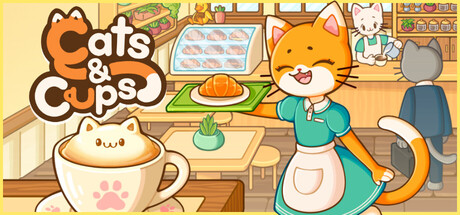
Cats & Cups puts players behind the counter of a cat-staffed coffee shop, steaming milk, pulling espresso, baking croissants and handing drinks to customers who queue up and wait — or don't. The core loop sits close to genre touchstones like Cook, Serve, Delicious! and Good Coffee, Great Coffee, and reviewers who have played those games recognise the family resemblance immediately: read an order, assemble the right combination of coffee, milk, syrup and toppings, then hand it over before the customer's patience runs out. What Rogue Duck Interactive adds on top is presentation. The cats are the reason most players picked this up in the first place, and the drink-prep animations — pouring, steaming, stirring — feel more tactile than the genre's usual click-and-wait interactions. One reviewer, comparing it to a previous Rogue Duck release, called the drink prep "surprisingly realistic," and it's the strongest part of the package: players can refuse orders they don't want to make, set their own pace for calling up customers, and actually feel the difference between a rushed drink and a careful one.
That control over pacing matters more than it sounds, because the rest of the shop does not always cooperate. Customers arrive with orders drawn from a growing recipe list, and once new drinks are unlocked there is no way to un-see them — players have to actually manage the ingredients, timing and preparation steps for everything they've bought into, whether or not they're ready for it.
When Cozy Turns Into Crisis Management
The single biggest theme across the review sample, especially from the first six weeks after launch, is that Cats & Cups shipped an economy that fought against its own cozy branding. Thieves spawn on a large share of customer visits and have to be stopped by calling the police, who then expect a free croissant for their trouble. A separate "rent dog" character shows up regularly to collect a cut of the day's earnings. Coffee machines break down constantly and each repair costs a day or more of productive time. Several reviewers described a genuine death-spiral: low early profits mean machines can't be repaired, which slows service, which produces less money, which means still more broken machines. One detailed write-up called it "micro-management hell," noting that a mid-November patch aimed at making the shop "safer" from thieves actually raised the spawn rate in two different ways at once, prompting a wave of frustrated comments before a further round of fixes calmed things down.
It's a rough first impression for a game marketed on cats and coziness, and it clearly cost Cats & Cups some early goodwill — several of the harshest write-ups in the sample come from the opening days, when players were still discovering just how aggressively the thief and breakdown systems could stack against them. Ingredient restocking adds its own friction: buying more of an unlocked ingredient costs the same as unlocking it in the first place, croissants can't be baked after a restock, and ingredient quantities on offer are wildly uneven — twenty of one item, five of another, with no obvious logic connecting the numbers to how often they're actually used.
A Developer Who Keeps Showing Up
What separates Cats & Cups from a game that simply launched broken and stayed that way is how visibly present Rogue Duck Interactive has been in the aftermath. Developer replies appear directly under critical reviews in the sample, and one long, itemised critique — eighteen separate numbered complaints about tutorials, UI blocking, achievement pop-ups, animation clipping and more — was edited over time by its own author to mark off items as "Fixed" as patches landed, eventually raising their score from a 4/10 to a 6/10 without changing the underlying review. That kind of update-in-place is rare and it tells a clear story: this is a team still patching a game most players consider basically finished on the surface.
The later dated reviews in the sample, from spring and into September, read differently from the November launch cluster. They're shorter, more positive, and mostly untroubled by the thief-and-breakdown spiral that dominated the earlier feedback — "adorable and a lot of fun," "pawsome," "just straight up relaxing if at times frustrating fun." That's not universal; a handful of players as recently as September were still reporting unstable machine-breakdown rates and one reported the game simply wouldn't launch on an otherwise trouble-free Windows 11 machine. But the balance of complaints has clearly shifted from "this economy is unplayable" toward smaller, genre-typical gripes.
Small Frictions the Patches Haven't Reached
Even setting the economy aside, Cats & Cups carries a handful of rough edges that patches haven't fully sanded down. The tutorial is consistently singled out as inadequate — several reviewers describe having to figure out entire recipe categories, like the matcha and tea stations, entirely through trial and error, with no in-game prompt pointing them toward stations that exist off in a corner of the shop. Achievement descriptions don't match their real unlock conditions in at least two documented cases: one achievement described as requiring ten mechanic calls actually needs twenty-five, and another described as twenty scratch-card plays actually needs fifty. The scratch-card minigame itself draws its own complaints — one player reported scratching it more than a hundred times without ever hitting the advertised jackpot. A stirring minigame and a straw-placement minigame both come in for criticism as fiddly rather than fun, and the oven's beep timer is loud enough that multiple reviewers asked for a volume option or a gentler cue, noting that the game's existing accessibility filter doesn't mute it. None of these are fatal on their own, but they stack on top of an already demanding day-to-day loop.
Where the game clicks, it clicks because of restraint rather than completeness. The reviewer who put it best described spending their first five hours in "pure bliss" before unlocking everything at once and watching the same systems that felt satisfying become overwhelming — sixty drink combinations to remember, ingredients running dry, orders piling up faster than they could be cleared. The advice repeated across multiple reviews is the same: don't rush the unlocks, serve at your own pace, and treat the achievement grind as optional rather than a race.
Verdict
Cats & Cups arrived with a punishing gap between its marketing — cute, cozy, cat-themed — and its launch-week reality of thieves, breakdowns and rent demands stacking up faster than a new player could learn to manage them. Rogue Duck Interactive has spent the months since chasing that gap down, patching thief spawn rates, fixing achievement triggers, and responding directly to specific player complaints rather than letting them sit. The later reviews in the sample suggest that work has paid off, even if the tutorial still leaves players to discover several mechanics on their own and a few frictions — the scratch-card odds, the loud oven timer, the fiddly minigames — remain unaddressed. Played slowly and without chasing every unlock at once, it's a short, charming cafe sim with real feline appeal; players who go in expecting a flawless cozy experience on day one are the ones most likely to bounce off it.
Pros and cons
Pros
- Charming, distinctly feline art direction that stands out in a crowded genre
- Genuine drink-prep mechanics that reward careful, unhurried play
- A developer that visibly reads and responds to feedback, with a track record of quick patches
- Short enough to finish without the genre's usual bloat
Cons
- Launch-week economy swamped players with thieves, breakdowns and rent demands at once
- Tutorial leaves several recipes and mechanics unexplained
- Achievement descriptions don't match their actual unlock thresholds
- Unlocking the full menu too quickly turns a relaxing loop into a stressful one
Screenshots
-
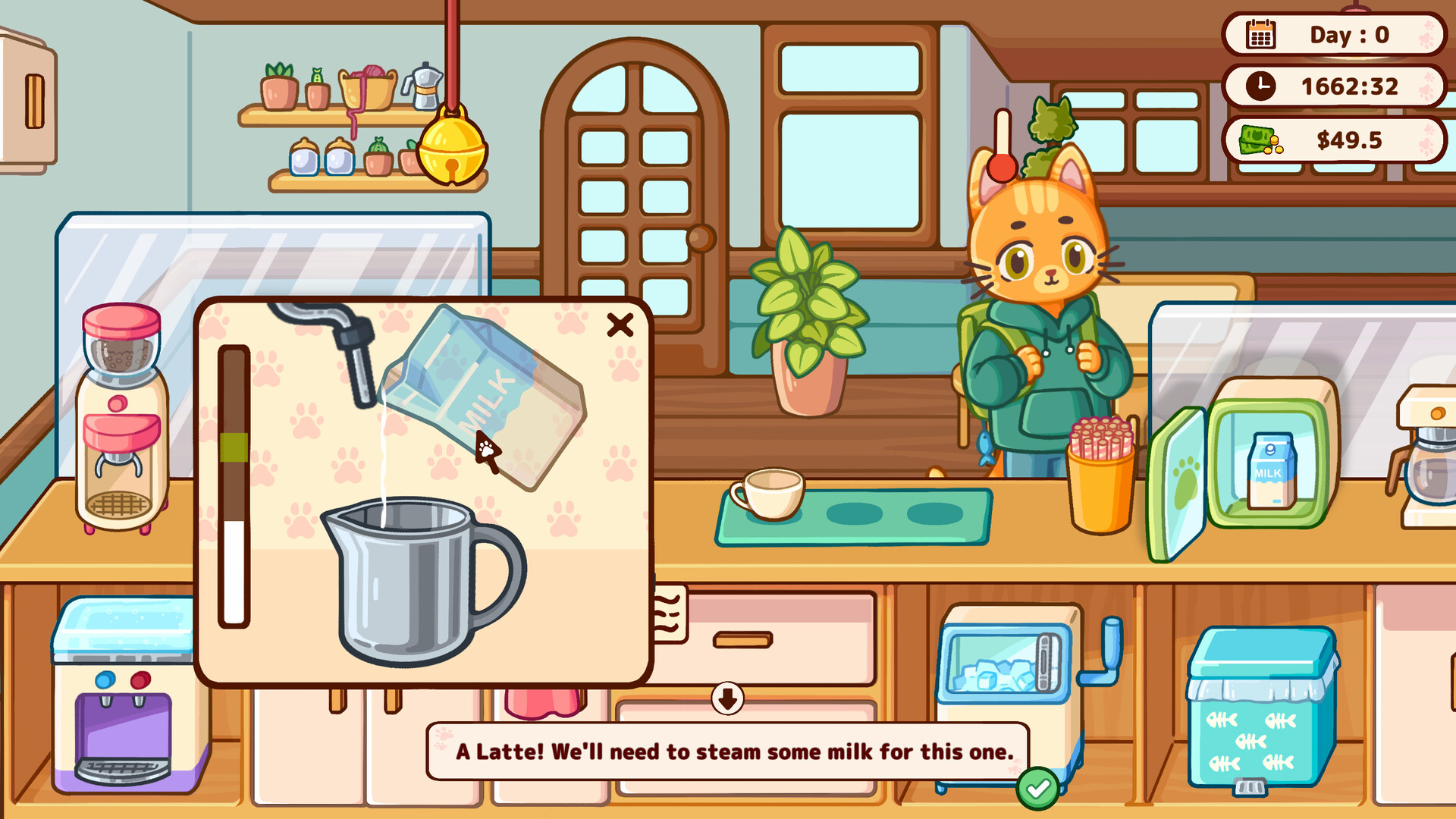
Drink prep is the game's strongest hook, with a tactile pour-and-steam sequence for every orderRogue Duck Interactive -
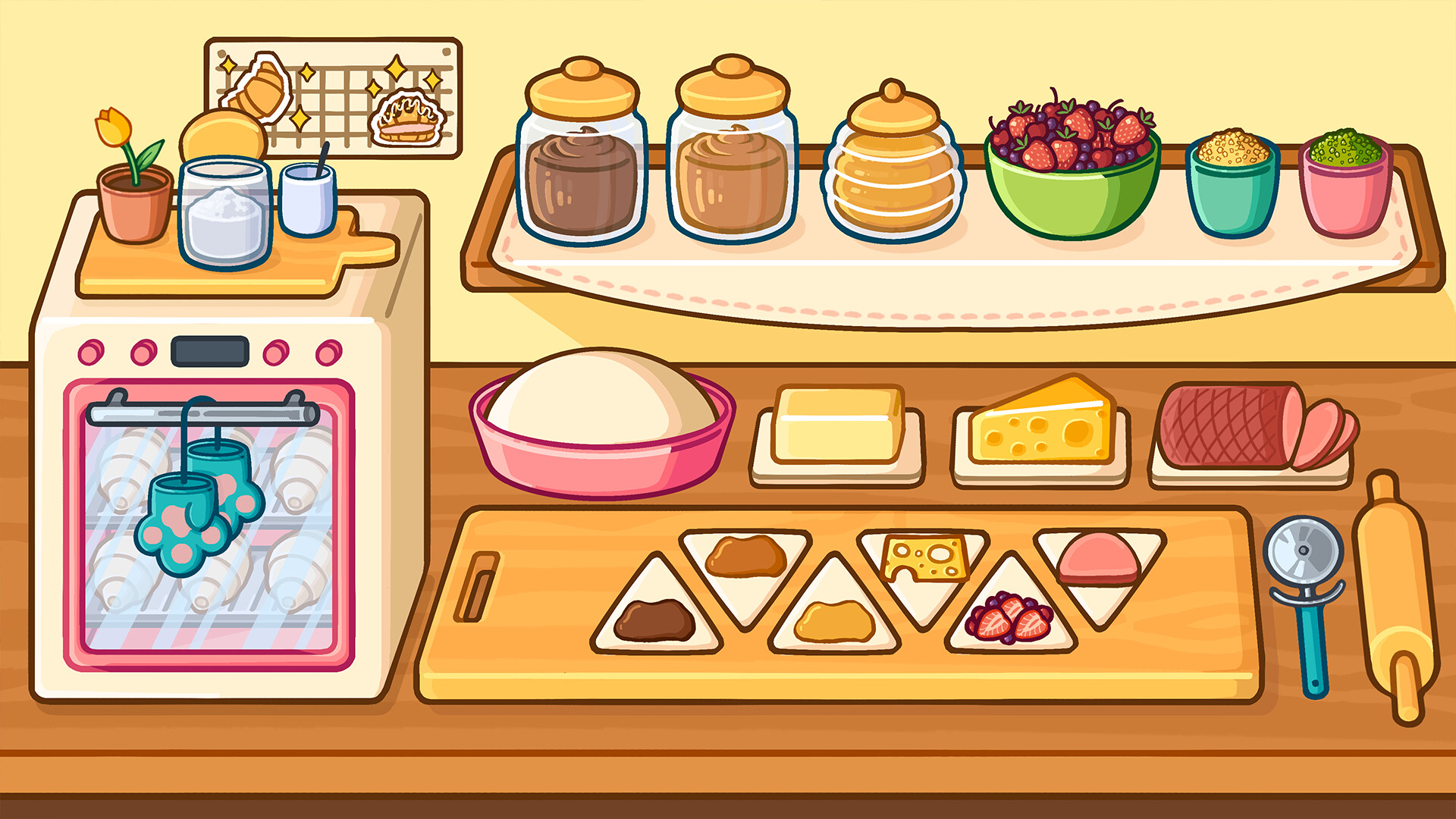
The bakery side of the shop adds its own ingredient and recipe management on top of the drinks counterRogue Duck Interactive -
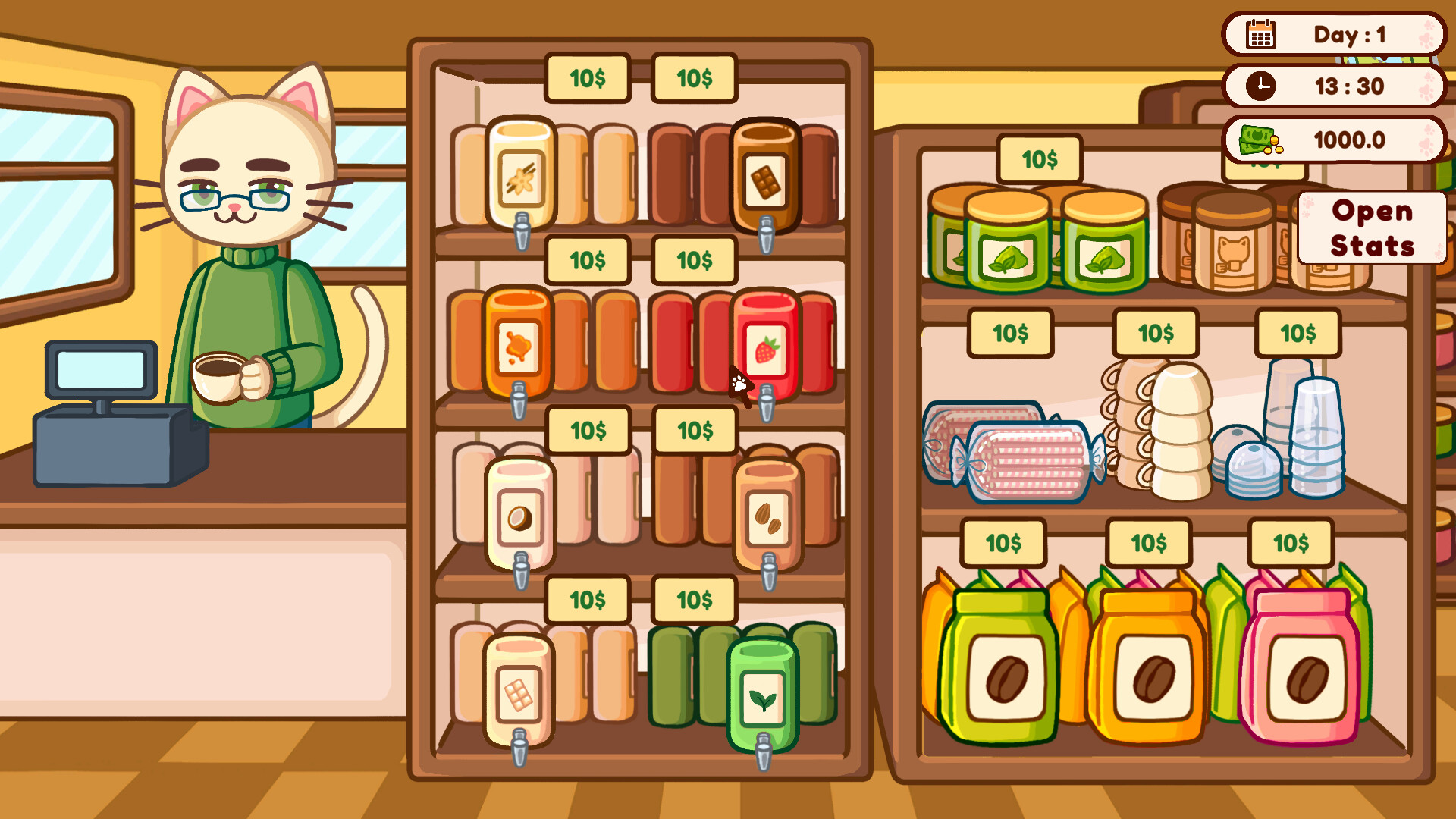
The shop's restocking shelves, where ingredient prices stay tied to their original unlock costRogue Duck Interactive -
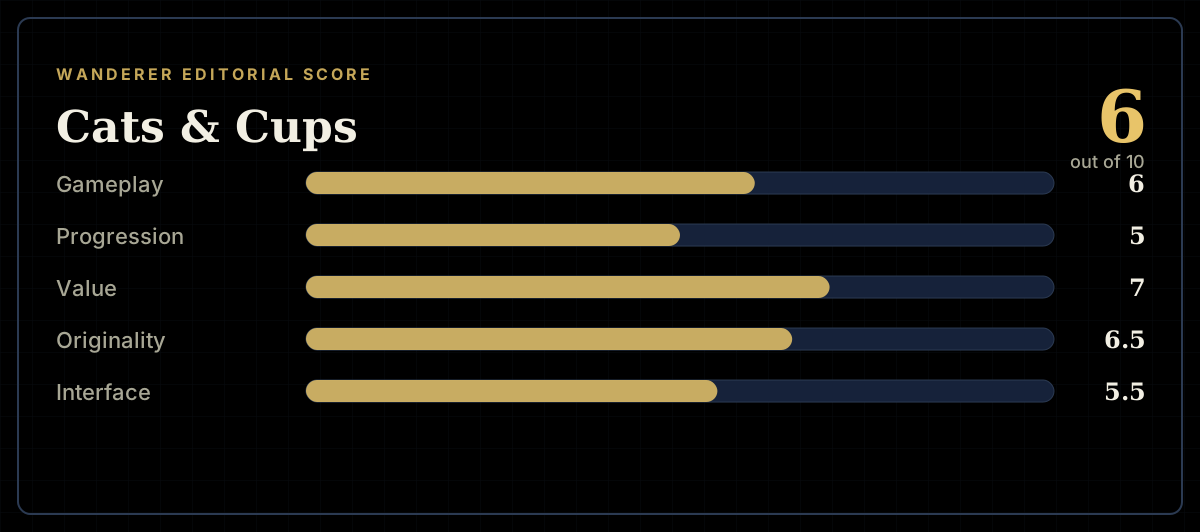
How the review scores each part of the gameWanderer Editorial -
The short versionWanderer Editorial