
Game review
Bounty Trail Review
5.4 / 10
- Developer
- September Games
- Publisher
- September Games
- Released
- 1 September 2026
- Platforms
- ["Windows"]
- Genre
- RPG
A Minimalist Western Where Every Hunt Is a Balancing Act
Bounty Trail casts players as a debt-ridden drifter turned bounty hunter, sending them into randomized Wild West maps to track down a single target within a fixed number of in-game days. The loop is simple but has real texture to it: players ride out to explore unmarked terrain, visit farmsteads for intel on their target's habits, search abandoned wagons for loot, and use vantage points to scout ahead, all while managing a stamina resource that governs how much can be done before rest becomes mandatory. One reviewer who helped test the game before release describes the appeal precisely: "the systems aren't deep, but there's more there than is apparent at first, making the bounty hunts surprisingly moreish." Another frames it as "kind of a rogue-lite-lite," since players carry lessons — and a handful of unlockable tools — from one bounty run into the next.
Reviewers consistently praise the atmosphere the pixel-art presentation creates, describing the game as unusually chill and immersive for something built around manhunts. Several specifically highlight small, unscripted moments — a horse spooked by cacti, an unexpectedly tense final standoff — as the kind of texture that elevates a mechanically simple game into something more memorable.
Two Paths to Every Bounty: Persuade or Draw
The game's central decision point, repeated with every target, is whether to bring a bounty in alive through persuasion or end the hunt with a gunfight. Reviewers describe a real tension between the two: choosing to capture rather than kill pays out better rewards but demands patience and information-gathering, while a more aggressive playstyle is faster but riskier and less lucrative. One reviewer notes the game "seems to favor bringing in the bounties alive vs dead," pointing out that going for a kill-focused approach effectively handicaps the run's economic upside even though it's the more straightforward option.
The English-language review pool treats this dual-path system almost entirely as a strength, with several reviewers specifically praising perks and skill choices that nudge each hunt toward a different strategy — favoring negotiation-focused builds, or leaning into direct confrontation. One reviewer playing largely on Steam Deck reports the system working smoothly there as well, suggesting the game's modest scope carries over well to handheld play.
A Sharply Divided Reception Once the Whole Review Pool Is Counted
Here's the twist that a review focused only on English-language feedback would miss entirely: Bounty Trail's aggregate Steam rating sits at Mixed, not because of any split within its English-speaking audience — every English review pulled for this piece recommends the game, several enthusiastically — but because a larger pool of Simplified Chinese-language reviews is nearly evenly split, and that language group makes up the majority of the game's total review volume. Digging into that pool surfaces specific, recurring complaints that don't show up in the English feedback at all.
The most consistent frustration in the Chinese-language reviews centers on the persuasion system's opacity: players report gathering intelligence about a target across an entire map, only to have the game reject their accumulated total as insufficient with no way to have known the required threshold in advance, forcing a costly, time-wasting restart of that information-gathering loop. A related, repeated complaint targets the gunfight system's randomness — several reviewers describe firing at near-maximum accuracy stats and still missing repeatedly, arguing the game deliberately suppresses hit rates below what its own displayed numbers suggest in order to artificially extend playtime, rather than genuine difficulty. Multiple reviewers in this pool also describe the overall content as thin once its systems are understood, noting that different randomized maps vary mainly in size and weather events rather than offering meaningfully new scenarios, and one specifically reports a lock-on/aiming bug with the game's rifle weapon that left them surrounded and unable to cancel an aim state properly.
Runtime and Replay Value Split Along Similar Lines
Length is where the two review pools land closer together, though they draw different conclusions from similar numbers. English-language reviewers generally clock a full playthrough at four to five hours and treat that as appropriately scaled to the low asking price, with one writing simply that it's "worth the buy" despite wishing for more post-completion content to purchase. A few English reviewers who finished the story note they experienced the bulk of what the game offers in a single run and aren't strongly motivated to replay it, though none frame that as a serious complaint given the price point.
Several Chinese-language reviewers report a similar completion time — one specifically citing five and a half hours for a first ending — but describe the back half of that runtime as noticeably more repetitive than the opening hours, with one noting that after the first randomized bounty, later hunts felt like variations on an already-understood formula rather than new challenges. More than one reviewer in this pool also flags that finishing the main story locks the save file rather than allowing continued free exploration, which reads as a design choice at odds with the roguelite-adjacent framing some English reviewers apply to the game.
Verdict
Bounty Trail is a small, atmospheric Western bounty-hunting game whose reception depends heavily on which side of its review pool you're looking at. English-language reviewers overwhelmingly praise its chill pacing, its meaningful persuade-or-fight decision at the heart of every hunt, and its price-to-content ratio, landing consistently on recommendations despite acknowledging the systems aren't especially deep. A larger, more critical Simplified Chinese-language pool tells a more pointed story, with specific, repeated complaints about an opaque persuasion-threshold system, gunfight accuracy that feels artificially suppressed, and content that grows repetitive once its randomized-map formula is understood. Both accounts are grounded in specific, credible detail rather than vague dissatisfaction, and the resulting Mixed aggregate score is a genuinely accurate reflection of a game that different audiences are experiencing in meaningfully different ways. At $6.99 for four to five hours, it's a reasonable, low-risk pick for players drawn to a minimalist Western vibe who go in with modest expectations about depth and randomness.
Pros:
- A distinctive, atmospheric Western setting with well-regarded pixel art and small, memorable emergent moments
- A meaningful persuade-versus-confront decision that shapes each bounty hunt differently
- Low $6.99 price matched reasonably to a four-to-five-hour completion time
- Works well on Steam Deck according to reviewers who tried it there
- Unanimous praise from the game's English-language review pool
Cons:
- A large, more critical Simplified Chinese-language review pool reports an opaque persuasion-threshold system that can waste significant playtime
- Repeated complaints of gunfight hit chances feeling artificially suppressed below displayed accuracy stats
- Content and randomized maps reported as increasingly repetitive after the first bounty hunt
- Finishing the story locks the save file rather than allowing continued free exploration
- Aggregate Mixed rating reflects a genuine, well-documented split rather than a universally embraced release
Screenshots
-
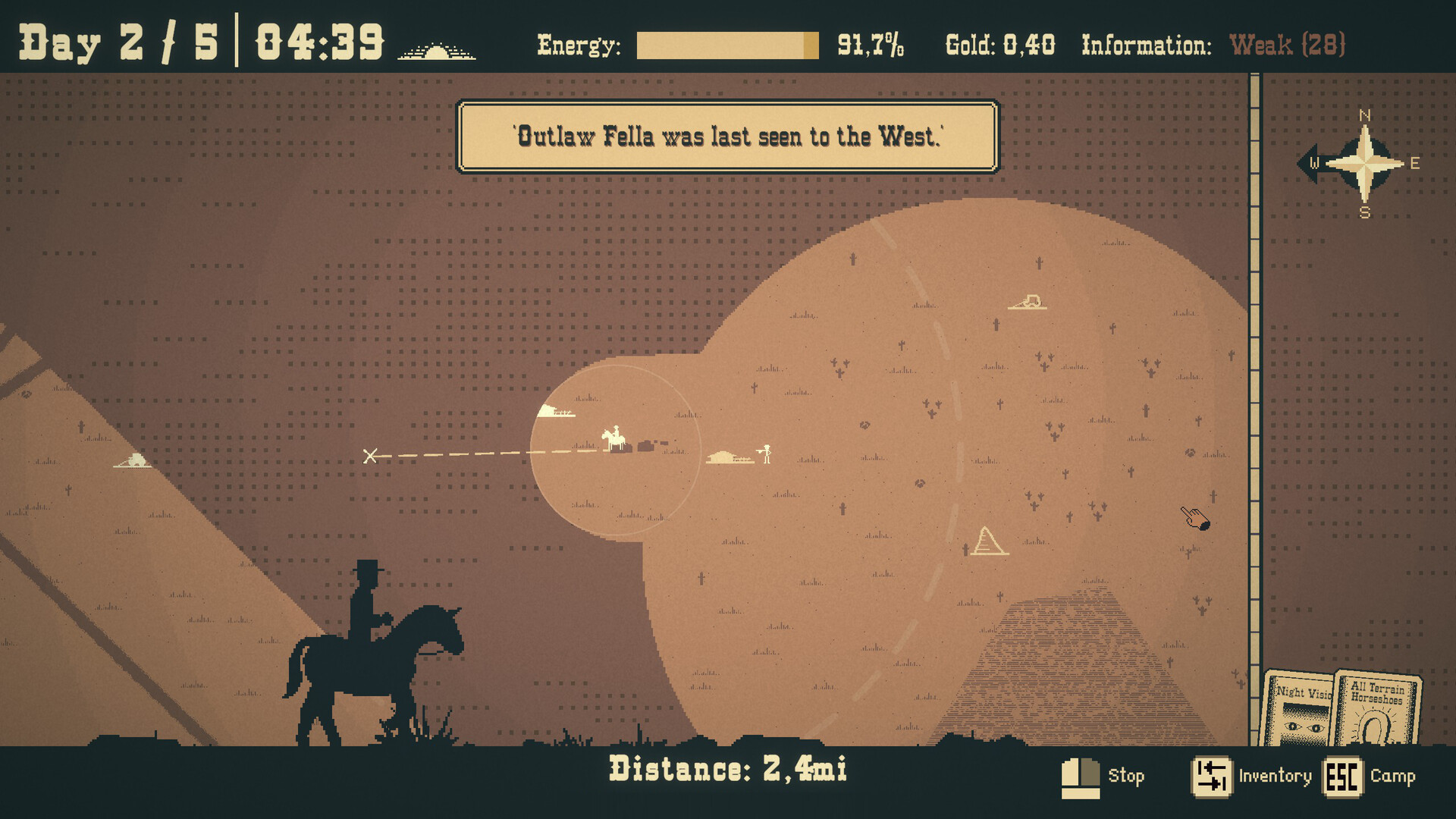
Riding out to gather intel on a target's whereabouts, tracked by the Information stat in the top barImage: September Games via Steam -
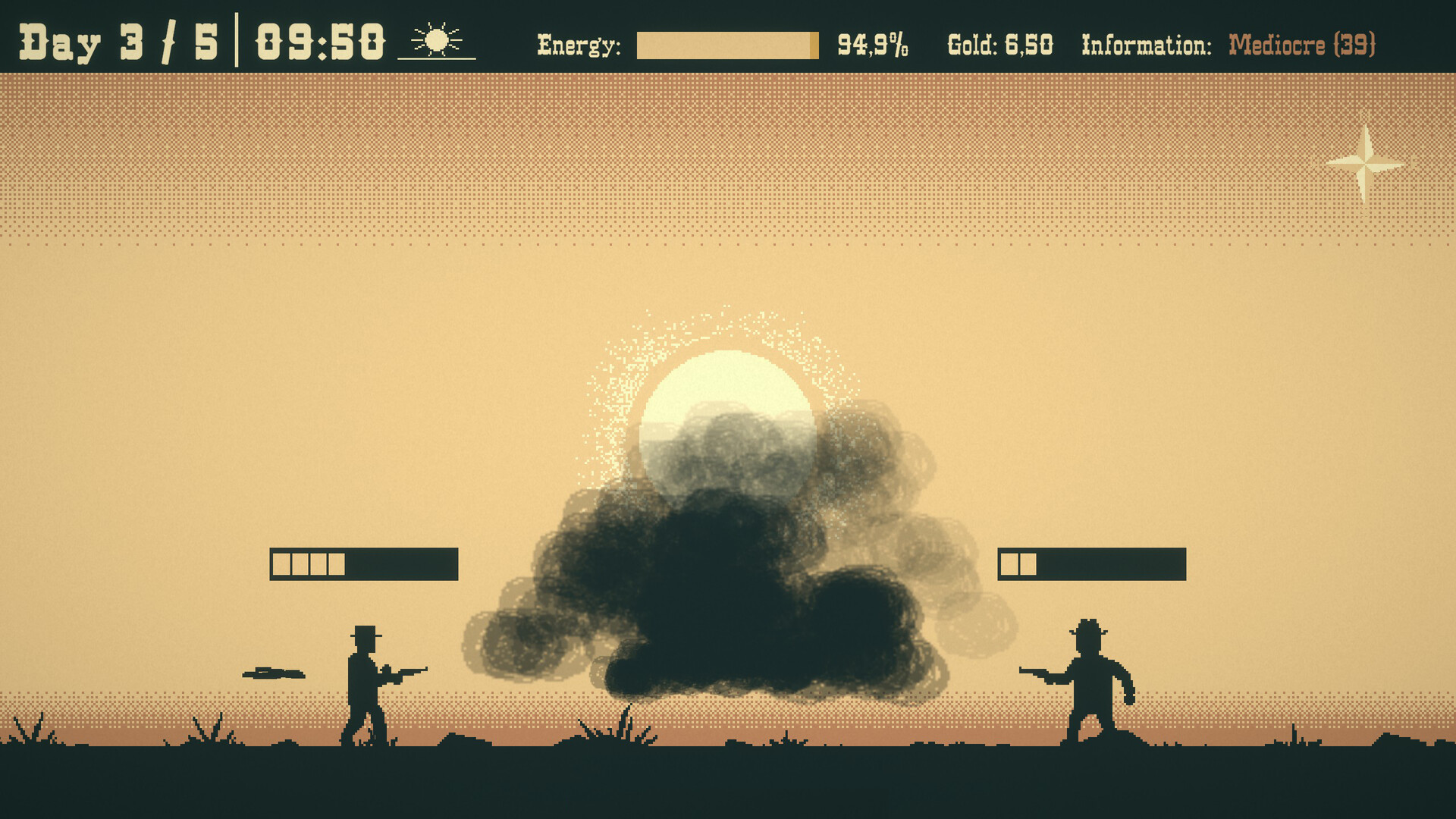
A final standoff plays out as a tense duel once persuasion or pursuit runs its courseImage: September Games via Steam -
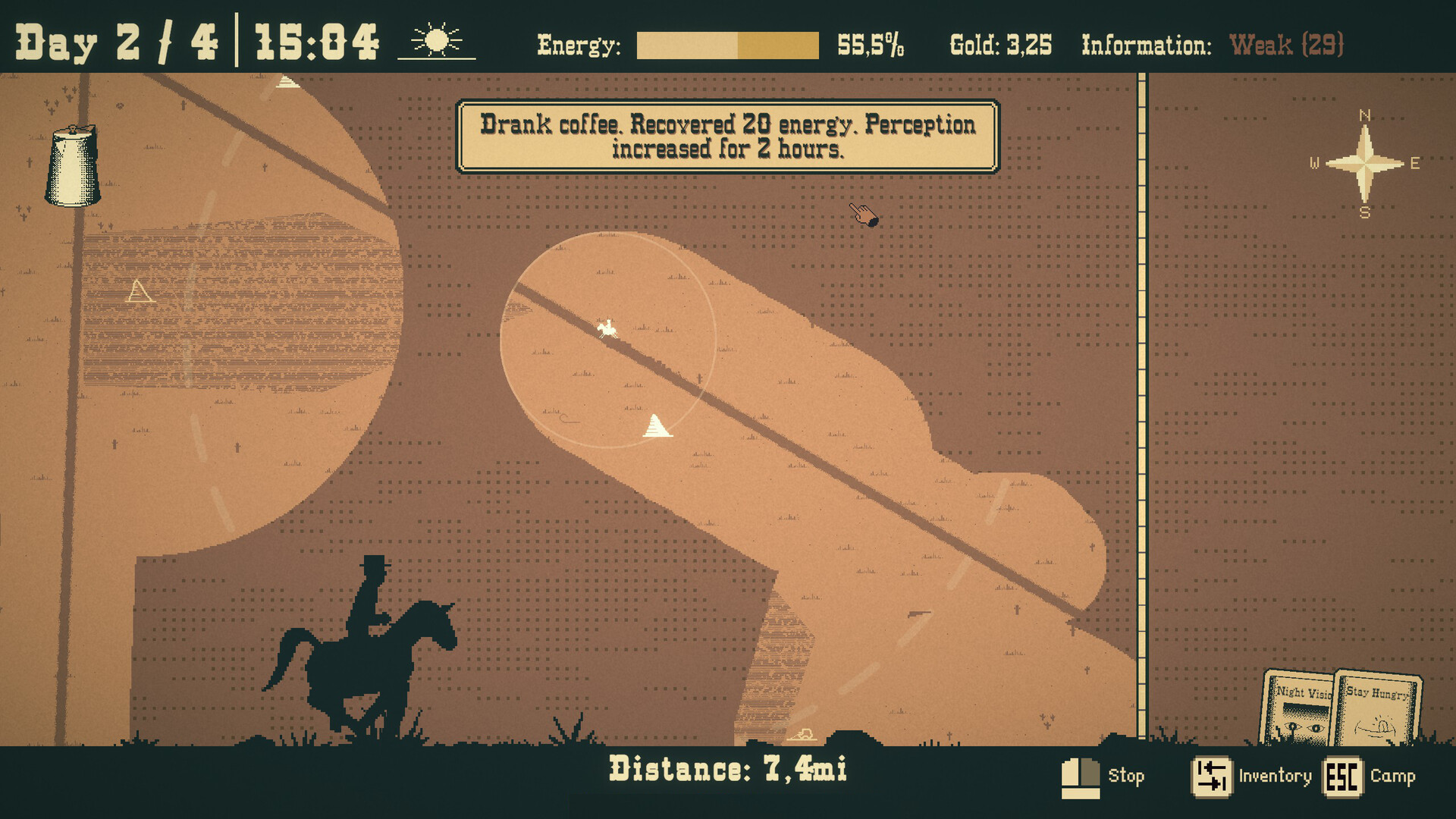
Resource management sits at the core of the loop, balancing energy, gold, and information against a ticking day counterImage: September Games via Steam -
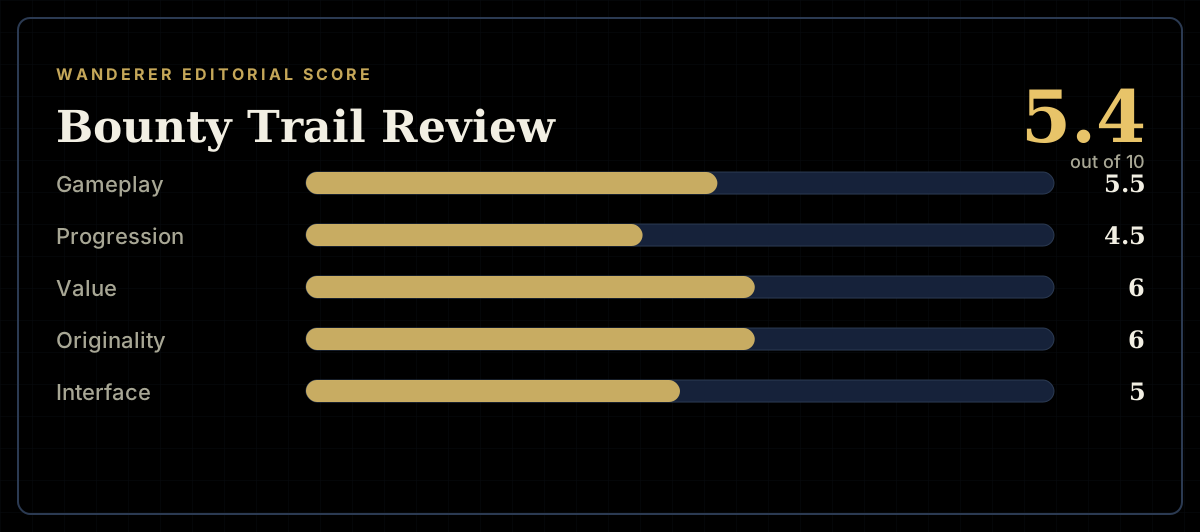
How the review scores each part of the gameWanderer Editorial -
The short versionWanderer Editorial