
Game review
Bō: Path of the Teal Lotus
6.5 / 10
- Developer
- Squid Shock Studios
- Publisher
- Balor Games
- Released
- 17 July 2024
- Platforms
- Windows
- Genre
- Metroidvania action platformer
- Monetisation
- One-time purchase, no DLC or microtransactions
- Players
- Single-player only
The short version
Bō: Path of the Teal Lotus is a striking, Japanese-folklore-inspired metroidvania built almost entirely around an aerial pogo-combat system, and this review's sample confirms the art, music, and movement genuinely stand out even in a genre thick with Hollow Knight comparisons. But a consistent, specific complaint about punishing checkpoint resets and bloated boss encounters runs through a substantial share of this review's sample, and this review's own achievement-data check shows a steep completion drop-off consistent with that frustration driving real player attrition.
Biggest strengths
- The hand-drawn 2.5D art direction and Japanese-folklore theming earn consistent, specific praise across nearly every review, with several reviewers calling it some of the best presentation in the genre
- The aerial pogo-combat system, which underpins both platforming and combat simultaneously, is repeatedly singled out as a genuinely fresh mechanical hook distinct from its Hollow Knight and Ori influences, with multiple reviewers coining the term "pogovania" to describe it
- Multiple reviewers specifically credit the developers with strong, responsive post-launch support, and this review's own check of Steam's partner-events feed confirms a substantial free content update years after launch alongside more than a dozen numbered patches
Biggest weaknesses
- A consistent, specific complaint describes unusually harsh checkpoint placement in platforming challenge sequences, with multiple reviewers reporting that a single hit can send a player back through several screens of already-completed platforming rather than a short, local reset
- Multiple reviewers separately describe boss fights as overly long due to excessive health pools, with at least one reviewer specifically noting the final boss can take roughly 15 minutes and forces a full restart from the beginning of the fight on death
- This review's own achievement-data check corroborates a steep completion drop-off: the earliest boss defeat sits at 87.5% but full game completion sits at just 12.9%, consistent with reviewer reports that a substantial share of players stop before the end due to escalating frustration rather than escalating fun
Who it's for: Metroidvania veterans specifically drawn to challenging aerial-combat systems and Japanese folklore aesthetics, comfortable with punishing difficulty; not a fit for players who want forgiving checkpointing or a gentler difficulty curve toward the back half of the game.
Our recommendation: Worth playing for genre veterans who want something visually and mechanically distinct from the Hollow Knight formula, with the clear caveat that the back half of the game asks considerably more patience for checkpoint resets and lengthy boss fights than the front half suggests.
6.5 / 10
Bō: Path of the Teal Lotus is a hand-drawn 2.5D metroidvania built around an aerial pogo-combat system, wearing its Hollow Knight and Ori influences openly while carving out a genuinely distinct identity through Japanese folklore theming and constant airborne movement. This review's sample confirms the presentation and core mechanic are widely loved, alongside a consistent, specific complaint about how the game handles failure.
A genuinely striking presentation and a fresh mechanical hook
Reviewers repeatedly single out the art and music as some of the best in the genre. "The art is absolutely gorgeous," one reviewer with over 500 minutes logged writes, a sentiment echoed almost universally even among reviewers who otherwise struggled with the game. The core pogo-combat system, where striking enemies or objects mid-air refreshes jumps and dashes, draws specific praise for how it unifies platforming and combat into a single continuous system. "The combat, since it's focused on aerial combos, felt fresh and original," one reviewer writes, coining a term that recurs across the sample: "that's why I called this game a 'pogovania.'" Another reviewer draws a more specific lineage: "the game teaches you... that aerial hits on objects and enemies refresh your jump and air dash, similar to cloudstepping in The Messenger... The WHOLE GAME revolves around this system."
A consistent complaint about punishing checkpoints
Set against that praise, the most repeated specific criticism in this review's sample concerns checkpoint placement during platforming challenges. "The biggest issue is the platforming challenges that warp you back to a ridiculous spot if you get hit," one reviewer writes, describing sequences where "you progress through three screens only to get sent back to the beginning." Another reviewer, who logged nearly 1,500 minutes before writing a negative review, describes an almost identical frustration: "You're telling me I have to start over the elevator part with the balls and lasers even when I died in a totally different puzzle? All other places you're put back at the start of that puzzle but there you have to start all over." A positive-leaning reviewer independently confirms the same structural issue: "You have to platform through every room again if you want to revisit an area... taking a single point of damage will teleport you ba[ck]."
Boss length and the late-game difficulty spike
A second consistent complaint concerns boss encounters specifically. "Bosses have seemingly unending health. The final boss in particular takes 15 minutes or so, and requires restarting from the very beginning if you die," one reviewer writes. Several reviewers separately describe the game's final act as a marked step up in tedium rather than difficulty: "The last 1/3 of this game just felt like they swapped gears and said what if we made the game tedious instead of fun to pad out some numbers." This review's own check of Steam's achievement data supports that pattern directly: the earliest tracked boss-defeat achievement sits at 87.5% completion, but full game completion sits at just 12.9% — a steep drop consistent with a meaningful share of the player base stopping before the end.
Grapple imprecision
Beyond checkpoints and boss length, several reviewers separately flag the grapple ability as unreliable. "Even if the grapple arrow appears, a lot of times it won't actually let you grapple - the boundaries are very unclear. Sometimes my character latches onto a thing further away than the one I was trying to grapple," one reviewer who fully cleared the game writes. That's a specific, mechanical complaint distinct from the game's intentional difficulty, describing the tool behaving unpredictably rather than simply being hard to use well.
A genre comparison the sample makes unprompted, repeatedly
Reviewers across both the positive and negative samples independently reach for the same handful of comparison points, which is worth noting as a pattern in itself. Hollow Knight and Nine Sols are cited constantly, but so is a specific claim that this game sits at a harder difficulty tier than either. "This game is like a puzzle game where the puzzle is resolved as platforming," one reviewer coming from Nine Sols and Doomblade writes, describing the transition as jarring. Another reviewer with over 3,500 minutes logged, who completed the game twice including a full 100% clear, frames the difficulty directly: "i am not complaining btw THIS GAME IS PEAK... this game is very brutal in the beginning. i struggled with aerial combat in hollow knight already and this skill issue became very clear when playing this game." That reviewer's ultimate takeaway — that the mechanics eventually click with enough practice — appears repeatedly among players who stuck with the game past its roughest early hours, though this review's own achievement data confirms a large share of players do not.
A handful of reviewers also raise a smaller, specific request: an option to disable the game's grain filter, which at least two reviewers describe as visually intrusive, particularly at lower resolutions. It's a minor complaint next to the difficulty-curve concerns above, but its repetition across otherwise-positive reviews suggests it's a real, easily fixable point of friction rather than a one-off preference.
What the patch record confirms — and what it doesn't yet resolve
Steam's own partner-events feed documents real, sustained responsiveness from the developers: a "1.0.7 - Cloud Saves and Balance Changes" update directly answers a complaint present in this review's sample about the lack of cloud saves at launch, and more than a dozen further numbered patches followed, culminating in a "Major Free Content Update: The Tanuki Kabuki!" roughly two years after release. One reviewer's own account matches this pattern of active fixes: returning to the game after time away, they confirmed "the boss battles aren't annoying anymore and don't take ages to deal with" and that "pogo stick jumping is finally fixed," but reported hitting a comparably frustrating new obstacle later in the game regardless. That firsthand account suggests the developers have made real progress on some of this review's core complaints without yet fully resolving the underlying difficulty-curve concerns end-to-end.
Final verdict
Bō: Path of the Teal Lotus succeeds at carving out a genuinely distinct identity within a crowded metroidvania field, and this review's sample confirms real, specific admiration for its art, music, and aerial-combat hook. But a consistent complaint about punishing checkpoints and bloated boss encounters — corroborated directly by a steep completion drop-off in Steam's own achievement data — describes a real barrier between the game's considerable strengths and a smooth, satisfying difficulty curve all the way to the credits. Genre veterans looking for something visually and mechanically fresh should find real value here; players seeking a gentler, more forgiving experience should look elsewhere.
Pros and cons
Pros
- The hand-drawn 2.5D art direction and Japanese-folklore theming earn consistent, specific praise across nearly every review, with several reviewers calling it some of the best presentation in the genre
- The aerial pogo-combat system, which underpins both platforming and combat simultaneously, is repeatedly singled out as a genuinely fresh mechanical hook distinct from its Hollow Knight and Ori influences, with multiple reviewers coining the term "pogovania" to describe it
- Multiple reviewers specifically credit the developers with strong, responsive post-launch support, and this review's own check of Steam's partner-events feed confirms a substantial free content update years after launch alongside more than a dozen numbered patches
- A specific 1.0.7 update is documented as having added Steam Cloud save support and balance changes, directly answering complaints present in this review's sample about the lack of cloud saves at launch
- Several reviewers who struggled significantly with the game's difficulty in early sections report the mechanics eventually "click," describing a satisfying sense of mastery once the aerial combat system is fully learned
Cons
- A consistent, specific complaint describes unusually harsh checkpoint placement in platforming challenge sequences, with multiple reviewers reporting that a single hit can send a player back through several screens of already-completed platforming rather than a short, local reset
- Multiple reviewers separately describe boss fights as overly long due to excessive health pools, with at least one reviewer specifically noting the final boss can take roughly 15 minutes and forces a full restart from the beginning of the fight on death
- This review's own achievement-data check corroborates a steep completion drop-off: the earliest boss defeat sits at 87.5% but full game completion sits at just 12.9%, consistent with reviewer reports that a substantial share of players stop before the end due to escalating frustration rather than escalating fun
- Several reviewers describe the grapple ability specifically as imprecise and unreliable, reporting the character sometimes latches onto unintended targets or fails to trigger despite a visible prompt
- A reviewer who returned to the game after a significant gap to check on patches confirmed several early-game issues (boss length, pogo precision) had been fixed, but reported encountering a comparably frustrating new obstacle later in the game, suggesting the difficulty-balance concerns in this review's sample are not yet fully resolved end-to-end
Screenshots
-

Bō: Path of the Teal LotusImage: Balor Games via Steam -

Bō: Path of the Teal LotusImage: Balor Games via Steam -

Bō: Path of the Teal LotusImage: Balor Games via Steam -
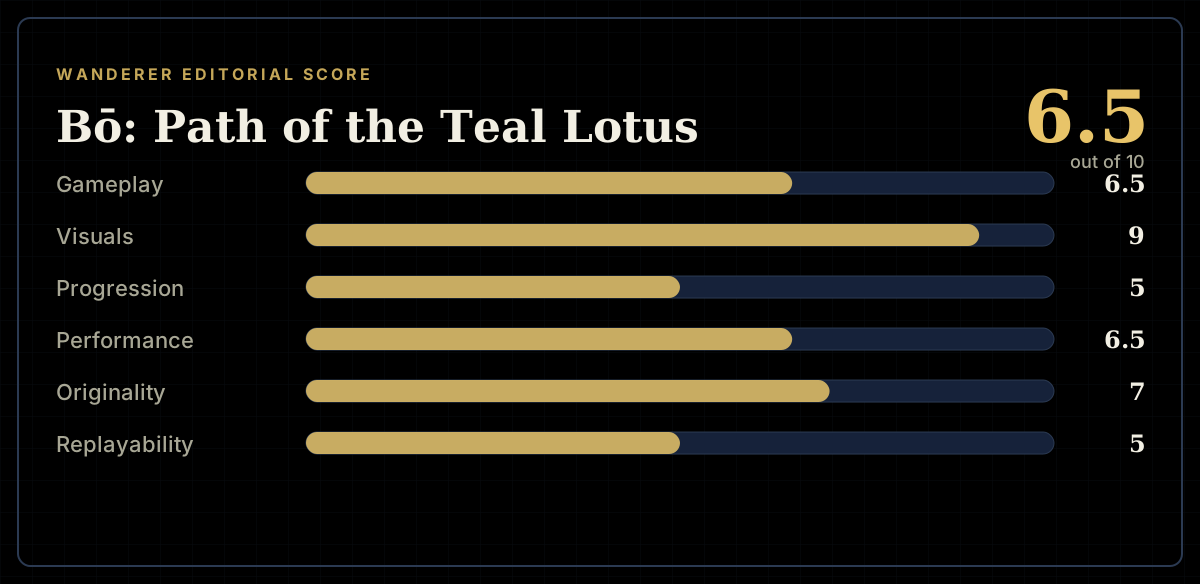
How the review scores each part of the gameWanderer Editorial -
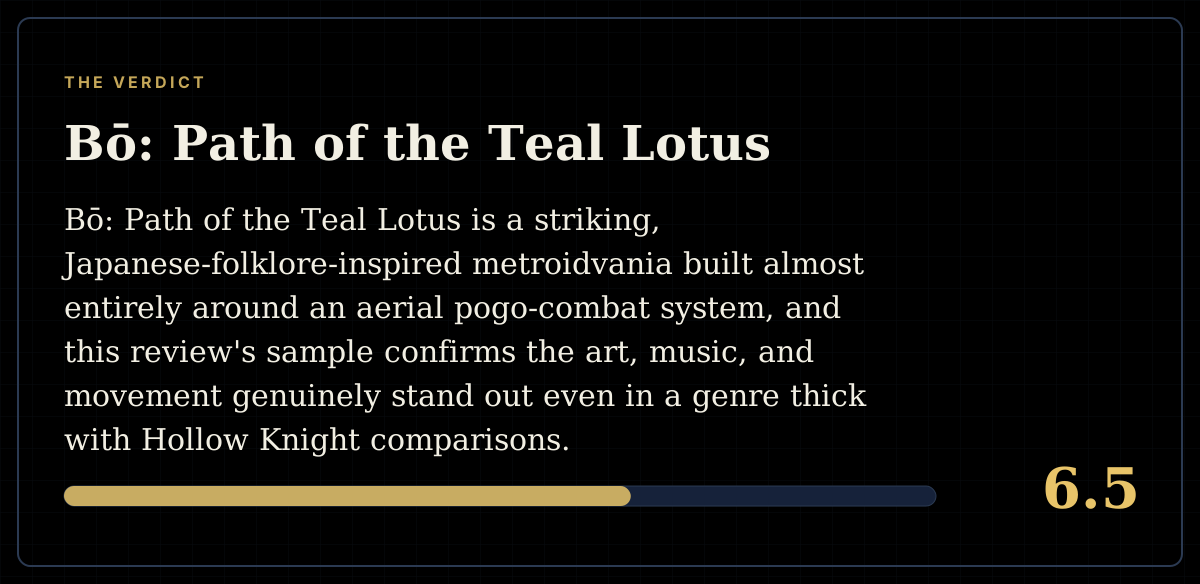
The short versionWanderer Editorial