
Game review
Ambidextro
7.5 / 10
- Developer
- Majorariatto
- Publisher
- Majorariatto
- Released
- 28 March 2025
- Platforms
- Windows
- Genre
- Action, Indie
- Players
- Single-player
The short version
Biggest strengths
- A genuinely rare, fully original core concept — simultaneously controlling two separate characters, one per hand, to rescue both a prince and a princess together — that reviewers consistently call fresh and hard to find anywhere else
- An impressively gradual, carefully engineered difficulty ramp across 100 levels, moving from fully symmetrical challenges to genuinely asymmetric, coordination-testing puzzles by the endgame
- A strong, widely praised soundtrack and tight, responsive controls that reviewers credit even when frustrated by the difficulty itself
Biggest weaknesses
- Several thoughtful, detailed reviewers argue the game is less about developing genuine bilateral coordination and more about memorizing a fixed, specific input sequence per level, a meaningfully different (and for some, less satisfying) kind of challenge than the marketing implies
- Tight timers on individual levels compound frustration for players who find themselves repeating short sequences many times before success
- A short overall campaign, with several reviewers specifically requesting a level editor or Steam Workshop support to meaningfully extend replay value
7.5 / 10
A multiplayer game for exactly one player
Ambidextro's pitch is as simple to describe as it is genuinely rare in execution: control two separate characters at once, one with each hand, and guide both a prince and a princess simultaneously through 100 increasingly demanding platforming levels. The store page's own tagline, "a multiplayer game for a single player," captures the concept precisely, and based on the available English-language review sample of 276 reviews — 269 positive, 7 negative, landing at an overall Very Positive rating — that concept has generated exactly the kind of genuinely surprised, delighted reaction novel game ideas rarely manage anymore. "Learning how to use both hands is such a great feeling. Quite a pleasant and original experience. The game is also good," one reviewer writes with disarming simplicity, while a separate reviewer frames the experience in more exasperated, comedic terms: "I thought it would be an easy and very entertaining game, but my surprise was when I discovered that I am just an Ambimbecile, 10/10!!!"
The specific joke of the game's premise — literally rewiring how your hands cooperate — produces some of the more creative, extended bits in this review sample. "Thanks for this masterpiece. My right and left hand are completely independent now, so much that they developed their own lives. My right hand got married and is expecting his third kid while my left hand is running for president in the North Pole. 10/10 Would never play it again," one reviewer writes, a joke echoed and expanded by other reviewers in the sample, suggesting the specific "my hands have become separate people" bit became something of a running theme in how fans chose to express their appreciation.
Genuinely careful level design, not just a gimmick
What elevates Ambidextro above a one-note novelty, according to reviewers, is how deliberately and gradually the difficulty curve is constructed. "This game is great at what it does! Handling two characters at once is overwhelming at first, but the game introduces things very gradually; starting with completely symmetrical levels, then adding slight differences between the two sides, and so on. It ramps up continuously across the 100 levels, and by the time you get to the last 10, it feels like you're playing a coop platformer where you are both players," one reviewer writes, describing exactly the kind of thoughtful onboarding that separates a well-designed difficult game from an arbitrarily punishing one. A separate reviewer frames the same structural strength more concisely: "Instead of just throwing difficult levels at you that could be easily completed, each level is carefully designed with a clear idea behind it."
One especially detailed reviewer offers a genuinely useful account of what a full completion actually demands: "3 hours, 22 minutes, and 2754 deaths later, I beat the game! What a ride. I'm usually hesitant to buy short games, but these levels really made 3 hours feel much longer. Controlling two characters at once is really challenging, but the difficulty progression was impressively balanced." That specific death count is a genuinely useful, concrete data point for anyone trying to gauge just how demanding the game's difficulty actually gets, distinct from vaguer "it's hard" framing.
Memorization, not motor skill, according to a thoughtful minority
Set against the broad praise, a small but articulate group of critical reviewers raises a specific, considered objection to what the game is actually asking of players. "Rather than developing ambidexterity, I'd say it's about memorizing the order of actions to perform with each hand," one detailed reviewer writes, directly challenging the premise implied by the game's own title and marketing. A separate reviewer reaches the identical conclusion independently: "I do not recommend it, it's less about developing ambidexterity, and more about memorizing the level." That's a meaningfully different critique than simple difficulty complaints — it's an argument about what kind of skill the game is actually training, and whether repeated trial-and-error memorization delivers the same satisfaction as the genuine coordination-building the title promises.
One reviewer pushes back directly and pointedly against a perceived pile-on of complaints about the game's difficulty, worth including as a genuinely spirited defense of the game's design philosophy: arguing that the difficulty here resembles old-school 80s-style challenge built on careful play and repetition rather than the reflexive, twitch-based difficulty of something like Dark Souls, and suggesting some critics simply aren't used to that older style of demanding, patient game design. That's a useful frame for prospective buyers trying to gauge whether this particular flavour of difficulty suits their taste.
Short, and wanting more
A separate, more practical complaint concerns overall length and replayability. "Needs a level editor or more content. The game is way too short. Probably worthwhile to get it if discounted. Had a lot of fun playing it overall," one reviewer writes, a sentiment echoed by another who specifically wants community-made content: "I think it would be good adding steam workshop support with maps made by the community, I'm sure it would increase the game's lifespan by a lot." That's a reasonable, constructive request rather than a fundamental complaint about the existing content, and it points to real enthusiasm for more of a format reviewers already enjoy rather than dissatisfaction with what's there.
The achievement data offers a strong, corroborating picture of just how steep the game's difficulty curve becomes for dedicated players. Across 25 total achievements, the earliest symmetrical-level milestone sits at 97.9%, but completion falls off steeply from there, bottoming out at 2.1-2.3% for speedrun, randomizer, and high-retry-count challenges. That's an exceptionally wide spread, confirming both that the core 100-level campaign is broadly approachable and completable, and that genuinely serious post-campaign challenge content exists for the small minority of players chasing full mastery.
Where this leaves it
Ambidextro delivers a genuinely rare, fully original core mechanic backed by careful, deliberate level design that earns its difficulty rather than simply imposing it arbitrarily, and the overwhelming positive reception reflects real, specific delight at a concept this fresh actually working as well as it does. A thoughtful minority's critique that the game rewards memorization over genuine bilateral coordination is worth taking seriously as a real philosophical disagreement about what the game is actually teaching, rather than dismissing it as ordinary difficulty complaining. Strongly recommended for precision-platformer fans looking for something genuinely different from the genre's usual offerings, with realistic expectations about a short but demanding campaign that rewards patience and repetition over raw reflexes.
Pros and cons
Pros
- A genuinely rare, fully original core concept — simultaneously controlling two separate characters, one per hand, to rescue both a prince and a princess together — that reviewers consistently call fresh and hard to find anywhere else
- An impressively gradual, carefully engineered difficulty ramp across 100 levels, moving from fully symmetrical challenges to genuinely asymmetric, coordination-testing puzzles by the endgame
- A strong, widely praised soundtrack and tight, responsive controls that reviewers credit even when frustrated by the difficulty itself
- A very wide, 25-achievement structure (97.9 percent down to 2.1 percent) that supports serious post-campaign challenge content, including dedicated speedrun and randomizer modes
Cons
- Several thoughtful, detailed reviewers argue the game is less about developing genuine bilateral coordination and more about memorizing a fixed, specific input sequence per level, a meaningfully different (and for some, less satisfying) kind of challenge than the marketing implies
- Tight timers on individual levels compound frustration for players who find themselves repeating short sequences many times before success
- A short overall campaign, with several reviewers specifically requesting a level editor or Steam Workshop support to meaningfully extend replay value
- Not accessible to everyone: at least one reviewer reports genuine motion-sickness-like discomfort from the visual demands of tracking two independently moving characters
Screenshots
-

AmbidextroImage: Majorariatto via Steam -

AmbidextroImage: Majorariatto via Steam -

AmbidextroImage: Majorariatto via Steam -
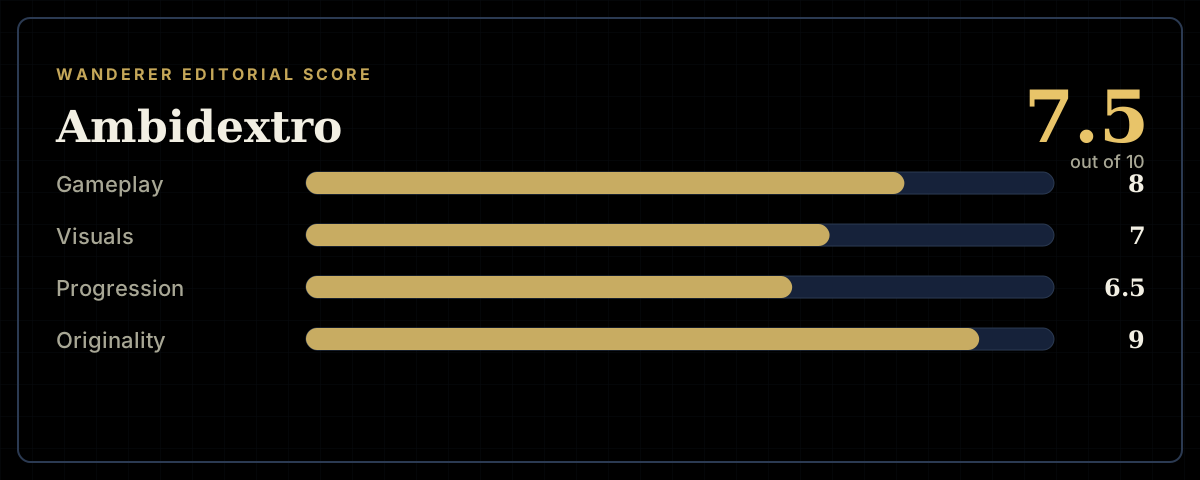
How the review scores each part of the gameWanderer Editorial -
The short versionWanderer Editorial