Game review
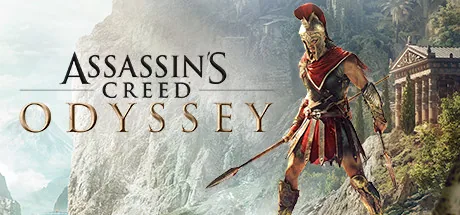
Assassin's Creed Odyssey
7.5 / 10
- Developer
- Ubisoft Quebec
- Publisher
- Ubisoft
- Released
- 5 October 2018
- Platforms
- Windows
- Genre
- Open-world Action RPG
- Monetisation
- Premium purchase at NZ$19.99, discounted heavily from its launch price, plus three DLC. Steam also flags in-app purchases — the in-game store sells XP and resource boosters, cosmetics and, at launch, a map-reveal item. Checked 4 August 2026.
- Players
- Single-player only
The short version
Ancient Greece here is one of the great video game places — islands you can sail between, cities that feel inhabited, light that makes you stop and look. Underneath it is a competent, generous action RPG with a genuinely good protagonist and two expansions better than most full games. The problem is the middle. Somewhere around level 25 the story starts asking for levels you don't have, the side content stops being optional, and the in-game shop happens to sell exactly the thing that would fix it. At twenty dollars in 2026 the value argument is overwhelming. The design compromise is still in the box.
Biggest strengths
- One of the most beautiful and coherent open worlds ever built, with sailing that ties the islands together instead of fragmenting them
- Enormous — the median recent reviewer has 64 hours logged and many describe months of play
- Kassandra is one of Ubisoft's genuinely great protagonists, well written and superbly performed
Biggest weaknesses
- Progression is gated so that main-story missions outpace your level around the mid-game, converting optional content into obligation
- The in-game store sells XP and resource boosters that solve exactly the friction the game creates, in a full-price single-player title
- Players report that later patches raised the level cap while reducing XP, currency and material gain, deepening the same gap
Who it's for: Players who want an enormous, gorgeous open world to disappear into for a hundred hours, and who don't mind that "Assassin's Creed" here means Greek mercenary adventure rather than stealth. Not for players who want the older series' focus, and not for anyone allergic to padding.
Our recommendation: Buy it on sale — at this price it's one of the best hours-per-dollar deals on Steam, and the Ultimate or Gold editions with both expansions are worth the extra if discounted. Play it on a slightly lower difficulty than you think you need, which defuses most of the level-gap problem without touching the shop. Ignore the boosters entirely; the pacing they exist to fix is the pacing you can also fix by simply doing the side content you enjoy and skipping the rest.
7.5 / 10
Read the most-upvoted negative reviews of Assassin's Creed Odyssey and you notice something unusual: almost none of them say the game is bad.
They say it's beautiful. They say it's massive. They say it improved on Origins in nearly every way. And then they explain, at length and with more than two thousand people agreeing, that they're downvoting it anyway because of the shop.
That's a rare thing to find in a review corpus, and it makes Odyssey the clearest case study I've come across of monetisation reaching backwards into design.
Greece
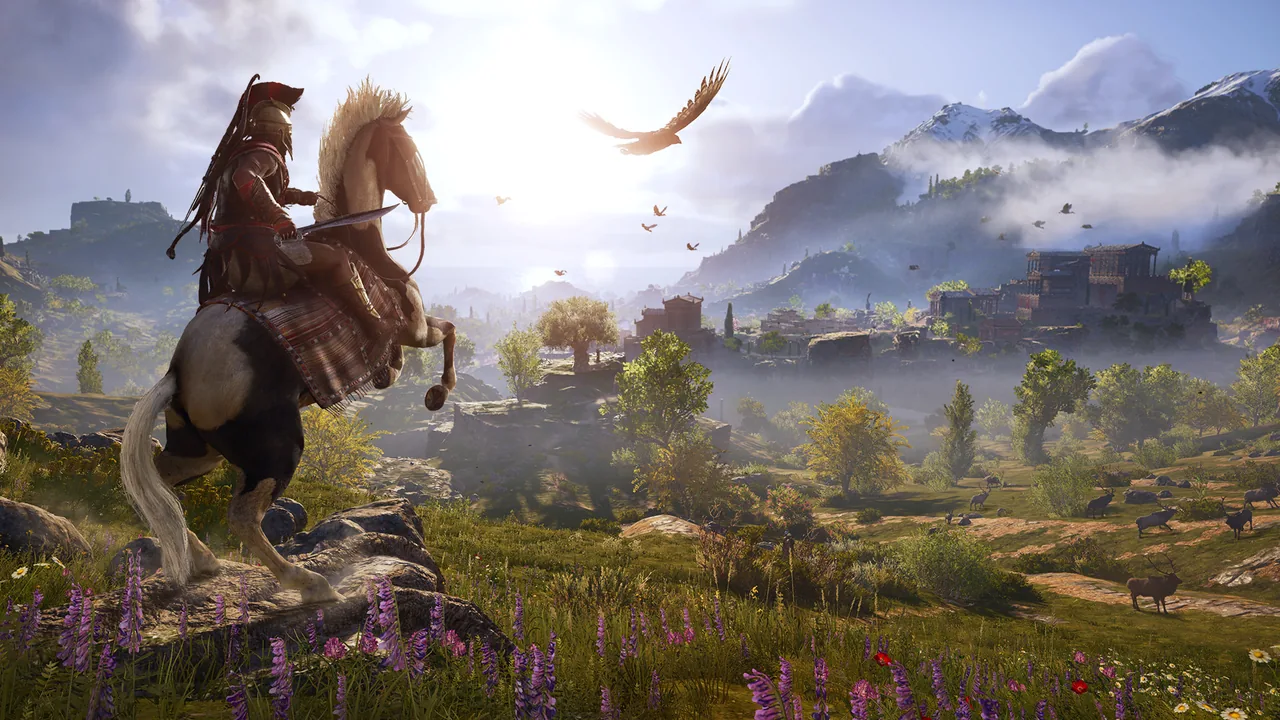
Start with what's unarguable. This is one of the great video game places.
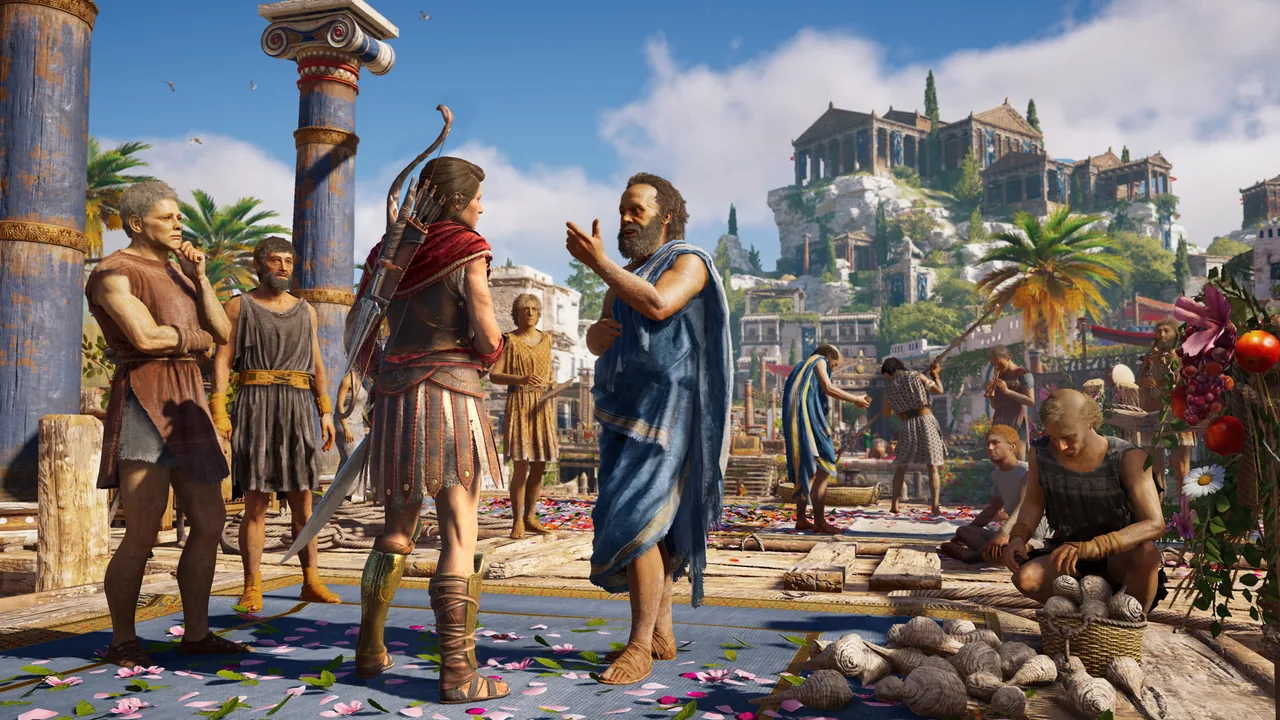
The Aegean is rendered as a genuine archipelago — you sail between islands, and the sailing is good enough to be a pastime rather than a loading screen. Athens is busy in a way that feels populated rather than dressed. The light does things that make people stop and take screenshots eight years later; recent reviews still open with paragraphs about how it looks.
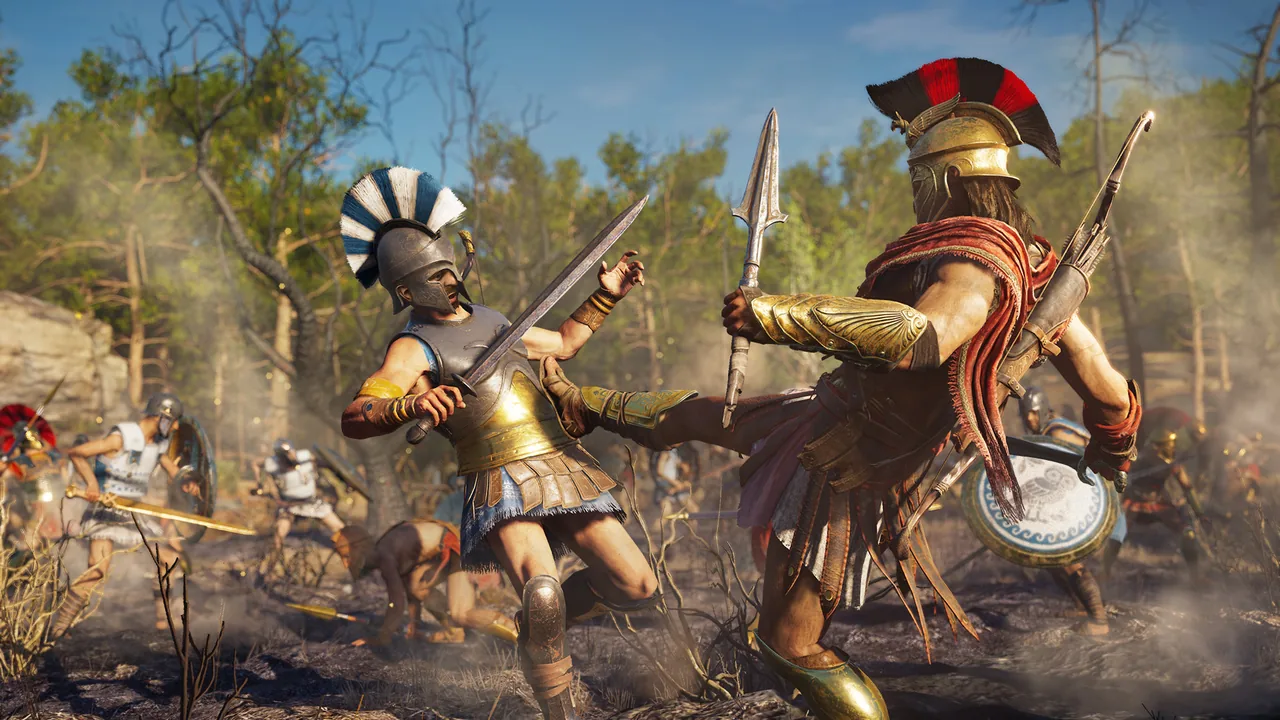
The RPG layer is generous. Skill trees that meaningfully change your approach, a gear system with engravings, naval combat that expands into fleet management, and a mercenary system that puts named hunters on your trail when you misbehave — which is the best emergent-pressure system Ubisoft has built. Kassandra, if you choose her, is genuinely well written and superbly performed, and the two expansions are better than the base game's final act.
Median recent playtime is 64 hours, and reviewers routinely describe months. For NZ$19.99 that is an enormous amount of game.
The middle
Now the part everyone writes about.
The complaint is specific and it recurs for eight years with almost identical wording. Somewhere around level 25, main story missions start appearing several levels above your character. The game doesn't stop you — it simply makes progress punishing until you close the gap, and the way to close the gap is hours of side content built from a small number of templates. Go to fort, clear fort, open chest. Deliver item. Kill captain.
And in the menu, available at any time, are XP boosters for real money.
I want to be careful about what can be asserted here. That the game has level gates is a fact. That the store sells permanent XP boosters is a fact. That one caused the other is an inference — a widely-held one, made by thousands of players including many with a hundred-plus hours who otherwise love the game, but an inference. Ubisoft would presumably say the pacing is a pacing decision and the boosters are a convenience for people short on time.
What tilts it, for me, is the pattern people describe afterwards. Reviewers report that later patches raised the level cap substantially while reducing XP, currency and material gain across the board. I can't independently verify the specifics of those patch changes, and I'd treat the numbers in any individual review as approximate. But a game that widens the gap between where you are and where you need to be, while selling the ladder, is going to attract that reading whether or not it deserves it.
The map-reveal item sold at launch didn't help. Paying to remove exploration from an exploration game is the kind of thing that ends up in every retrospective.
Is it an Assassin's Creed game?
The other theme running through the reviews, and one worth settling before you buy, is that a lot of people arrived expecting a different series.
A recent reviewer put it neatly: this isn't Assassin's Creed so much as the adventures of a Greek mercenary who helps people. The hidden blade is gone. Stealth exists but is one option among several, and rarely the strongest. Social blending, the crowd systems, the architectural assassination puzzles that defined the early games — mostly absent or vestigial. What replaced them is a levelled RPG where you can hit an enemy for insufficient damage, which is the single most un-Assassin's-Creed sentence imaginable.
Whether that's a loss depends entirely on what you wanted. As an action RPG it's good: the ability loadout is flexible, the assassin, warrior and hunter trees genuinely support different builds, and the mercenary system creates pressure the older games never managed. As a stealth game it's mediocre, and as a continuation of the series' original design language it's essentially unrelated.
I'd argue the honest framing is that Ubisoft built a decent open-world RPG and attached a brand to it, and the brand is why a chunk of the audience feels misled rather than merely uninterested. If you came for Black Flag Resynced's version of the series, this is not that. If you have no attachment to the franchise at all, you'll likely enjoy it more than the people who do — which is exactly what the review split shows, with newcomers praising it and long-term fans writing the careful, disappointed paragraphs.
Worth knowing, too: the ending most players consider the good one requires specific choices earlier in the story, and the game does not signal this. Look it up before your final act if that matters to you.
Does it still matter at twenty dollars?
This is the genuinely interesting question in 2026, and I think the answer is: less than it did, but not none.
Most of the anger in that review corpus came from people who had paid full price, sometimes NZ$120 for an ultimate edition, and then met a shop. That specific injury doesn't apply to you now. At NZ$19.99 for a hundred-hour game, the value proposition is overwhelming and the boosters are trivially ignorable.
But the friction they were built around is still in the game. You will still hit the level wall around the mid-game. You will still find the side content thinning out into templates. The pacing was shaped by a commercial decision, and the discount doesn't unshape it — it just makes it cheaper to put up with.
The practical workaround costs nothing: drop the difficulty a notch when the gap opens. It defuses most of the problem, and it's what I'd tell anyone starting today.
7.5 out of 10. Rated 7.5 out of 10.
Odyssey is a very good open-world RPG in a magnificent setting, with more content than almost anyone will finish and two expansions worth the price on their own. If you want to spend a hundred hours in ancient Greece, buy it — the 89% score is honestly earned and the recent reviews are still 85% positive eight years on.
It doesn't score higher because a game's progression is part of its design, and this one's was visibly bent toward a storefront. The Witcher 3 is the comparison that hurts: a similarly enormous open-world RPG from a similar era whose side content respects you throughout, and which never once asks whether you'd like to buy your way past the part it made tedious on purpose.
Pros and cons
Pros
- One of the most beautiful and coherent open worlds ever built, with sailing that ties the islands together instead of fragmenting them
- Enormous — the median recent reviewer has 64 hours logged and many describe months of play
- Kassandra is one of Ubisoft's genuinely great protagonists, well written and superbly performed
- Both story expansions are substantial and better regarded than the base campaign's later acts
- Excellent accessibility footing, with captions, adjustable difficulty, camera comfort options and a keyboard-only control scheme
- At NZ$19.99 with everything discounted, the value is close to unarguable
Cons
- Progression is gated so that main-story missions outpace your level around the mid-game, converting optional content into obligation
- The in-game store sells XP and resource boosters that solve exactly the friction the game creates, in a full-price single-player title
- Players report that later patches raised the level cap while reducing XP, currency and material gain, deepening the same gap
- A map-reveal item was sold rather than earned, which drew particular anger at launch
- Side content leans heavily on fetch-and-clear templates that repeat across a very large map
- It is only nominally an Assassin's Creed game, which disappointed a substantial part of the series' audience
Screenshots
-
Assassin's Creed® OdysseyImage: Ubisoft via Steam -
Assassin's Creed® OdysseyImage: Ubisoft via Steam -
Assassin's Creed® OdysseyImage: Ubisoft via Steam -
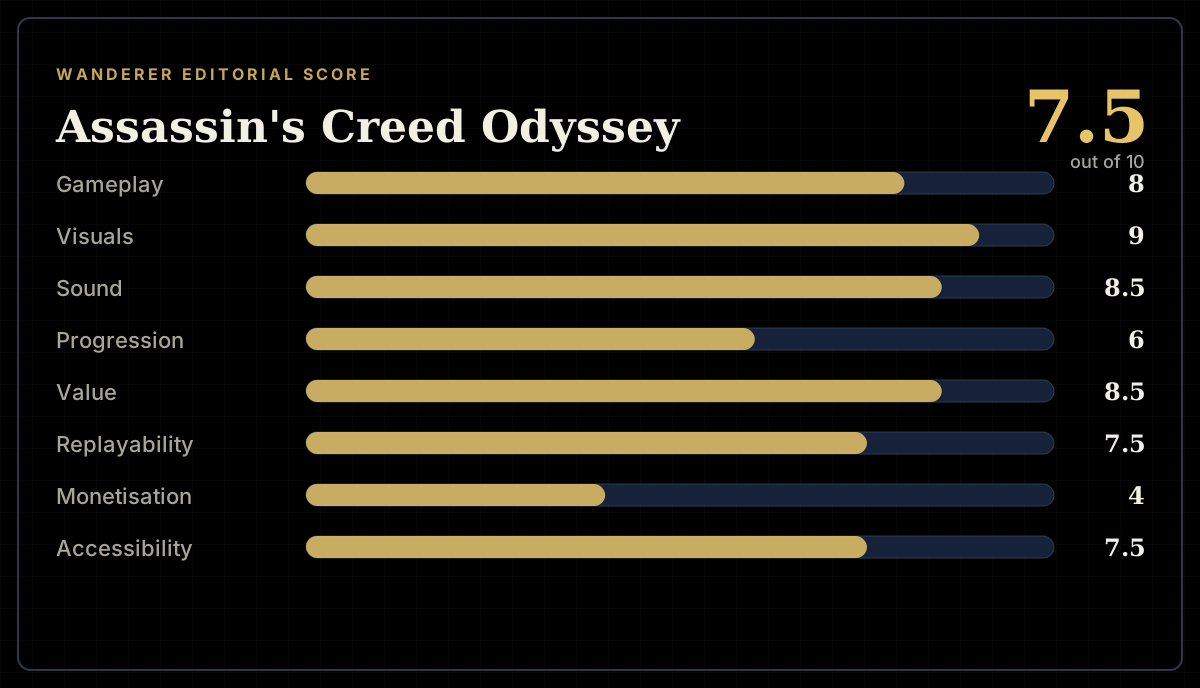
How the review scores each part of the gameWanderer Editorial -
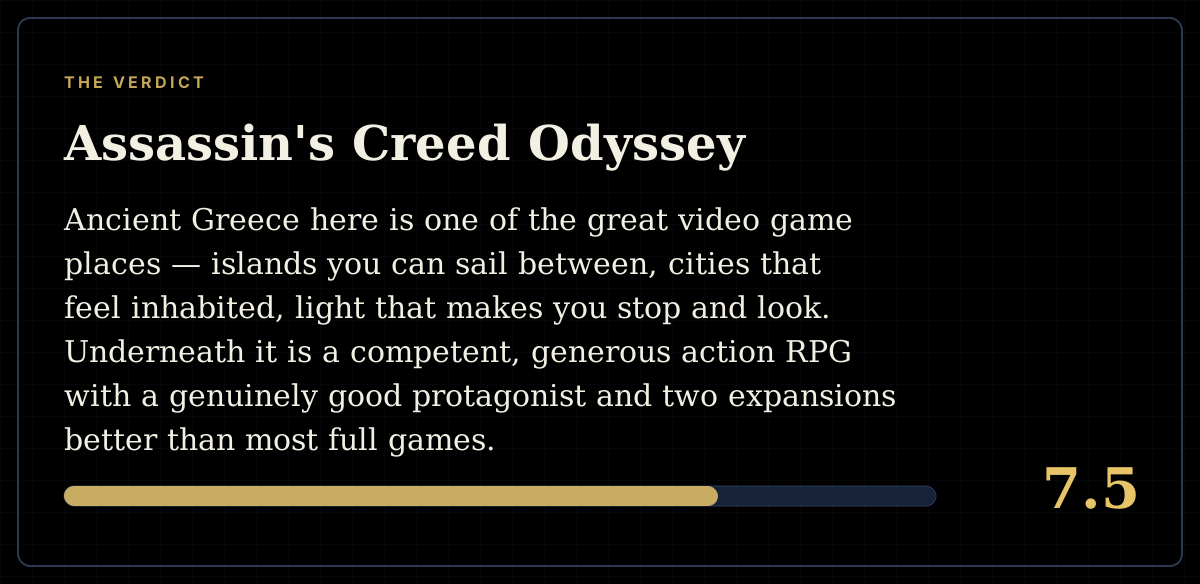
The short versionWanderer Editorial