Game review
AFK Three Kingdoms
3.2 / 10
- Developer
- Three Kingdoms Games Limited
- Publisher
- Three Kingdoms Games Limited
- Released
- 4 September 2026
- Platforms
- Windows
- Genre
- RPG
Every Official Screenshot Is a Marketing Graphic, Not Gameplay
AFK Three Kingdoms launched free-to-play on 4 September 2026 from developer and publisher Three Kingdoms Games Limited, and as of this writing it sits at a "Mixed" rating from 12 Steam reviews — 7 positive, 5 negative. That split, and a genuinely unusual detail about its own store page, shape most of what follows. All five of the game's own Steam screenshots (this outlet selected three) are the same style of split-panel marketing graphic — a frustrated, hand-drawn character grinding manually on one side, a smug, gold-draped winner idling on the other, with captions doing the arguing for it ("idling automatically makes you stronger," "time equals combat power") — and not one of them shows an actual menu, battle screen, or piece of real interface. A Russian-language reviewer flagged exactly this, quoting Steam's own screenshot guidelines back at the store listing and noting that concept art and promotional graphics aren't supposed to stand in for real gameplay captures. That reviewer is right that it's a real, checkable oddity, and it means this review has no genuine screenshot of the game itself to describe — everything below about what actually happens on screen comes secondhand, from the store page's own text and from what actual reviewers report having played.
A Description Stuffed With Other Games' Names
The store page's detailed description is worth noting on its own terms: alongside genuine feature claims, it's dense with bracketed references to dozens of unrelated, well-known titles — Call of Duty, Modern Warfare, Anno, RimWorld, Apex Legends, Diablo, Warhammer, Pokémon, Sword and Fairy, Ranch Story, Girls' Frontline-style "Sword and Expedition," and more — dropped into sentences in ways that don't meaningfully describe this game's own design, reading much more like search-term stuffing aimed at Steam's discovery algorithm than honest developer commentary. The same description also embeds three redemption codes directly in the sales copy. Neither of those is a gameplay flaw exactly, but both are the kind of low-effort listing hygiene that tends to travel with the games least likely to reward a player's time, and it's worth naming plainly rather than skipping past.
What the Store Page Claims Underneath the Noise
Setting the keyword-stuffing aside, the description does lay out a real feature list: an auto-battle system where generals fight, level up, and collect loot without input; a roster built around dozens of familiar Three Kingdoms figures (Guan Yu, Zhang Fei, Zhao Yun, Lu Bu, Zhuge Liang) rendered in a cute, stylised art direction; a troop-type counter system (cavalry beats archers, archers beat shieldmen, shieldmen beat spearmen); formation switching; terrain and weather effects on combat; cross-server "hegemony" tournaments running through a bracket from qualifiers to finals; alliance-based city sieges with night raids and siege-and-starve tactics; and a Roguelike-styled exploration mode for random tomb and ruin events. Taken at face value it's a reasonably full feature set for a free strategy-RPG. None of it is independently verifiable from anything this outlet has access to, and given the description's demonstrated willingness to pad itself with irrelevant content, these claims are reported here as exactly that — claims — rather than confirmed design.
What Actual Reviewers Say Once They're Inside
The 12 real reviews tell a more grounded and more useful story than the store page does. The most detailed negative review, in Simplified Chinese, describes a familiar mobile free-to-play shape: without spending money, the reviewer says, you can't beat even basic roaming NPCs, the game opens with a wave of purchase pop-ups, a server-wide power leaderboard is used to visibly shame non-paying players, and a constant stream of time-limited bundles is designed to manufacture urgency and anxiety around spending. A second negative review calls it bluntly "a garbage cash-grab mobile game ported to Steam," and a third, in Traditional Chinese, is a two-word "Bad Game." A fourth negative review raises a specific, concrete interface complaint: the game's sound cannot be turned off, which the reviewer says makes it impossible to do anything else while it's running — a strange limitation for a game explicitly marketed around being left alone in the background. On the other side, the positive reviews are shorter and less detailed, mostly praising fast early experience gains, generous starter gifts, and a "hundred free pulls" promotion for new players, with one player specifically recommending it "because it's a domestic Chinese game" rather than on the game's individual merits. Read together, the reviews describe a functioning gacha-idle strategy game that a meaningful share of its own early players experienced as an aggressively monetised, pay-gated grind rather than the relaxed, hands-off pitch its marketing sells.
Verdict: The Marketing Is the Loudest Thing About It
AFK Three Kingdoms is difficult to evaluate charitably when its own store page won't show a single real screenshot of the game it's selling, pads its description with dozens of unrelated franchise names, and drew multiple detailed, independent complaints about aggressive monetisation and pay-gated progression from the small number of people who've actually reviewed it. The underlying feature list — troop counters, formations, terrain and weather effects, cross-server tournaments, alliance sieges — reads like it could be a competent enough free Three Kingdoms strategy game if all of it is real and functions as described, and a genuine minority of reviewers do report a good time with it. But between the screenshot-guideline violation, the keyword-stuffed listing, and specific, credible complaints that non-paying players are locked out of basic competitiveness, there's more evidence here of a low-effort mobile port chasing Steam's storefront traffic than of a game built with its PC audience's time or wallet in mind. Free to try costs nothing but attention, but go in with expectations calibrated by the reviews above rather than by the store page's own pitch.
Screenshots
-
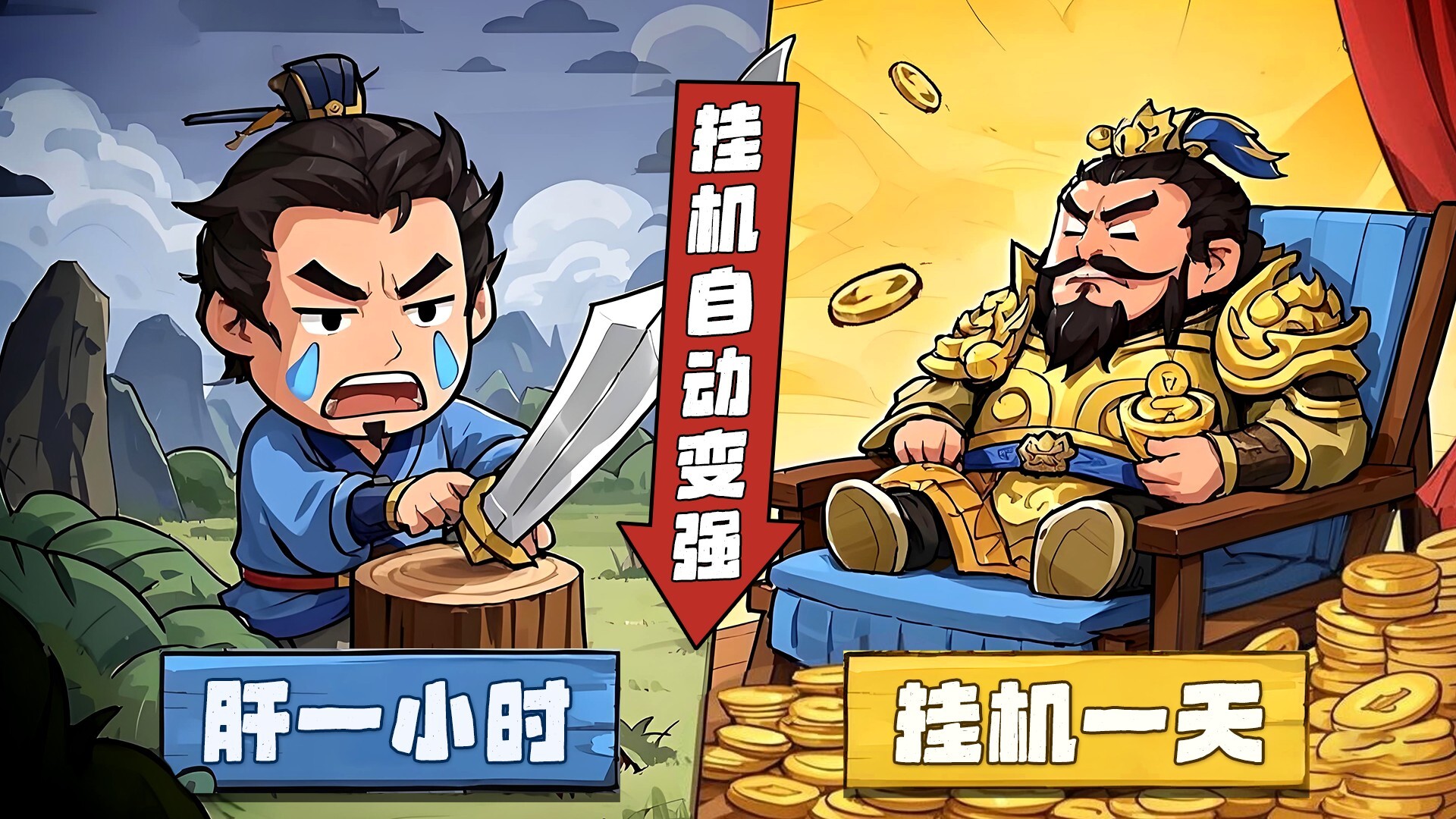
None of this outlet's three official screenshots show real gameplay — all three are marketing comparison graphics, like this one contrasting manual grinding with idling.Steam store page -
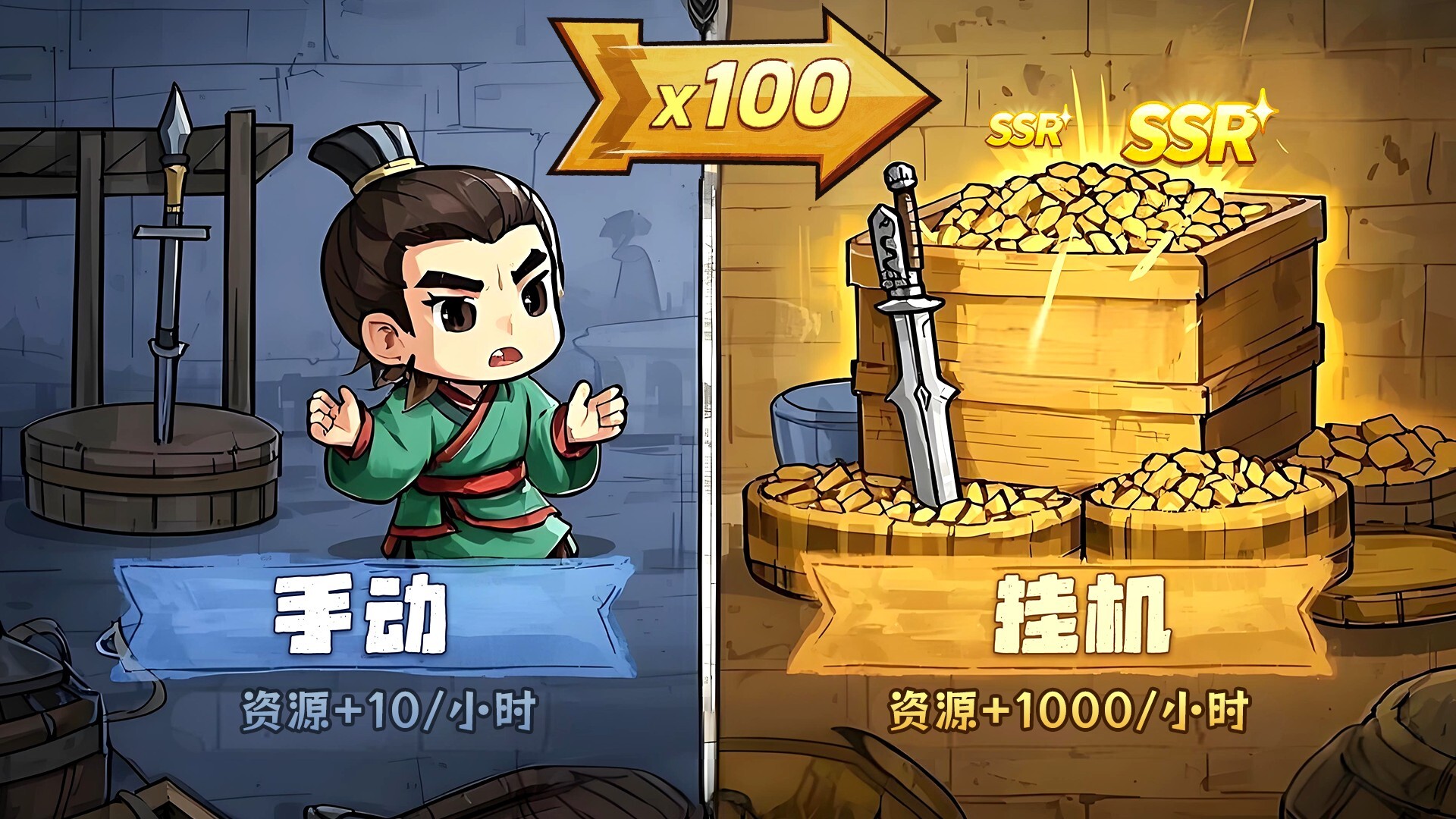
A second marketing graphic makes the same pitch even more bluntly: manual play nets ten resources an hour, idling nets a thousand.Steam store page -
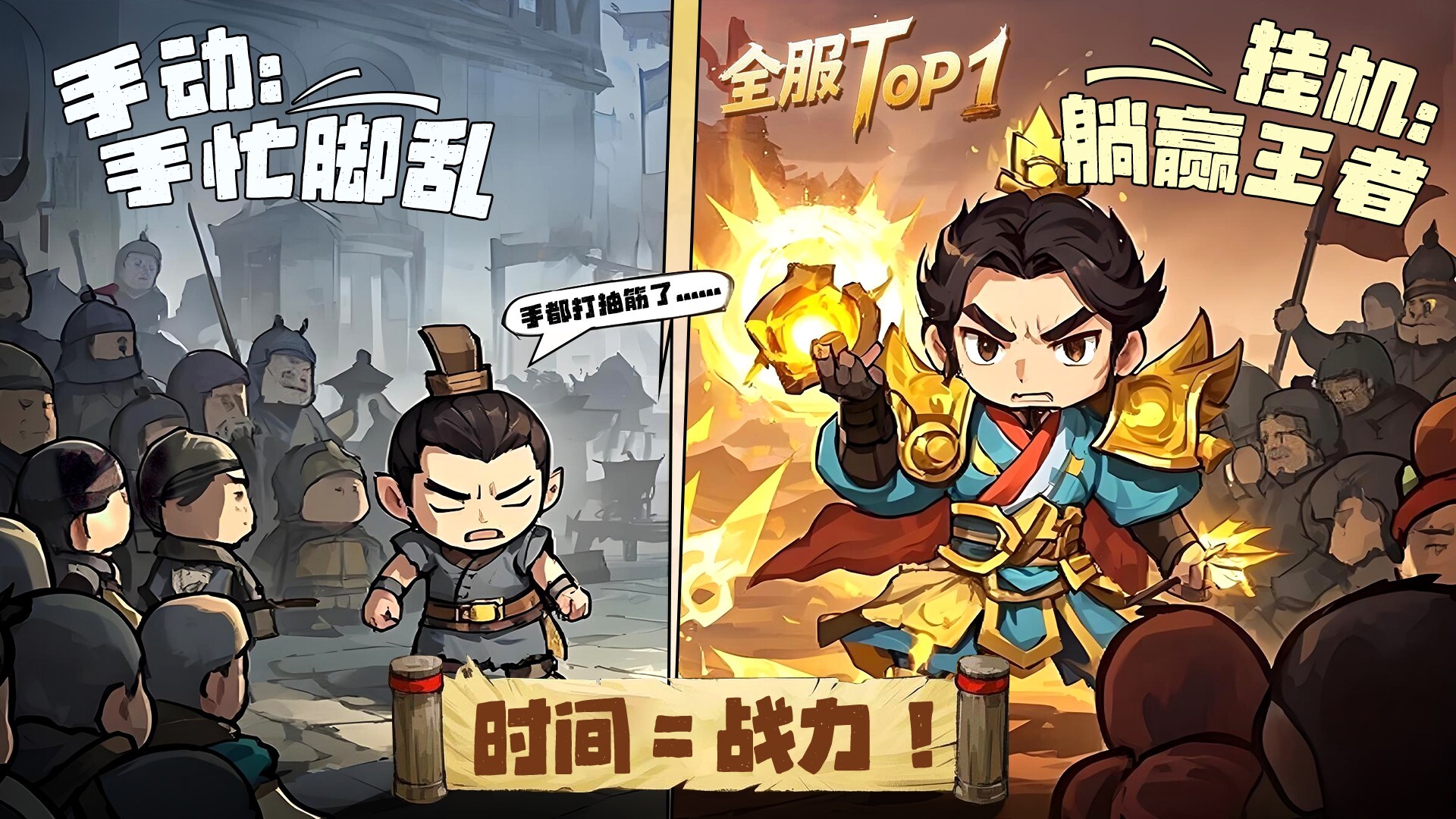
The third and final official screenshot repeats the same message once more: time spent, not skill, is what the game says determines rank.Steam store page