
Game review
Zone Sweeper Review
5.5 / 10
- Developer
- Missroot
- Publisher
- Missroot
- Released
- 26 August 2026
- Platforms
- ["Windows", "Mac"]
- Genre
- RPG
Short Runs, Automated Fights, and a Grid That Never Repeats
Zone Sweeper bills itself as "a fast RPG of short runs, hand-picked stats, and levels that explode in a single fight." The moment-to-moment loop is simple: walk a colour-coded risk grid where blue tiles are safe and red tiles are deadly, and let combat resolve itself. Fights are fully automated, with crits, combos, and agility-driven extra attacks calculated the instant a monster is engaged — no scene change, no loading, no manual input beyond choosing where to walk. Players hand-allocate points across five stats (HP, ATK, DEF, AGI, LUK), or hit an auto-balance option and skip the decision entirely, then gear up across 11 equipment slots that, along with the shop and bag, carry over between runs. A late-August patch overhauled the core structure entirely: the old Standard/Hard/Expert/Hell difficulty menu is gone, replaced by a single endless "Normal" mode where difficulty climbs by a flat ×1.225 multiplier per map with no ceiling, across freshly-rolled 96×40 maps spanning ten named biomes — Abyssal Moor, Obsidian Emberfield, Bone Ossuary, Sunken Depths, Crystal Vein, Fungal Bloom, Void Terrace, Iron Foundry, Frozen Abyss, and Crimson Moor.
An Idle Layer Hiding Behind the Run Structure
What separates Zone Sweeper from a pure roguelite is a Lab research system that "ticks in real time — even while the app is closed," giving the run-based structure a genuine idle backbone alongside its session-based combat. That idle identity shows up elsewhere too: a subsequent patch raised the level cap from 1e24 to a flatly incremental-genre 1e100, the kind of number that only makes sense in a game where numbers are meant to keep climbing indefinitely rather than cap out at a designed ceiling. The same patch also introduced auto-sell and auto-salvage filters that dispose of matching gear the instant it drops — by rarity tier and equip-level cap — so that inventory management doesn't have to compete with the moment-to-moment pace of walking the grid. Quest and boss reward claims now surface a receipt banner confirming what was earned, translated across all 16 supported languages, a small but telling sign of a developer sanding down UI friction release over release rather than treating the interface as finished.
Realms Carved Into Ten Reaches Apiece
Beyond the biome-to-biome climb, the world is structured into realms, each cut into ten distinct "Reaches" with their own monster roster, layout, and a Warden boss waiting at the end — killed once per run for a Battle Points payout. Two navigation tools help players find where to go next: a "Milestone Compass" that cycles between Best Prey, Unbeaten, and Off, routing players through the realm's layout rather than pointing in a straight line through obstacles, and a "Field Chart" fog map that fills in as the player explores, with a zoomable hero-centred minimap. Elites and bosses stay dead for the remainder of a run once killed, and monsters that roam the field will actively hunt the player down rather than waiting to be approached — though none of them can outrun a fleeing hero, according to the patch notes. It's a surprisingly deep navigational layer for a game built, by its own description, "for quick sessions."
What Players Are Actually Saying
The review sample is thin — nine total reviews, six positive — and only two are in English, but both are substantive and point in useful directions. One reviewer with 42 minutes logged captures the game's core tension directly: "the gameplay feels a lot like a mobile game where almost everything is automated," describing watching combat resolve itself to the point of literally falling asleep at the keyboard, and asking the developer to "consider making the gameplay more interactive and balanced, so players don't get bored too quickly." That's a fair characterisation of an auto-battler where the player's real decisions are stat allocation and gear choices rather than combat inputs — the systems described above (biome variety, the Reach/Warden structure, the navigation tools) exist specifically to give that idle loop somewhere to go, but they don't change the fact that fights themselves are hands-off. A second reviewer, with a considerably larger 181 hours logged, takes a longer view: "Developer is responsive to feedback and patching the game almost everyday. Worth giving it a try" — a claim the frequency of the patch notes above (three separate updates covering 1.0.765 through 1.0.1136 inside about a month) independently backs up.
Monetisation Unclear From the Available Evidence
Zone Sweeper is free to play and lists in-app purchases among its Steam categories, but the store page doesn't specify what's actually for sale, and neither English-language review mentions spending money, encountering a paywall, or being pushed toward a shop. Wanderer can't independently verify from the available player feedback whether the in-app purchases are cosmetic, convenience-based, or something more aggressive — that's a real gap in a review of a free game, and worth flagging plainly rather than guessing at what a monetisation screen might contain.
Verdict
Zone Sweeper pairs a genuinely idle backbone — real-time offline Lab research, a level cap that stretches into 1e100 territory, auto-sell filters clearing out inventory clutter — with a run-based roguelite shell of biome-hopping, Warden bosses, and an increasingly elaborate navigation layer. The developer's patch cadence is a clear strength: three substantial updates landed in barely a month, addressing UI friction and expanding content at a pace the one long-session reviewer explicitly credits. But the core combat is fully automated, and the only detailed player account of actually playing it describes losing engagement to the point of falling asleep — a legitimate concern for anyone hoping for more hands-on RPG combat rather than a system to watch. With monetisation details unclear and the review sample too small to draw firm conclusions, this is a free download worth a short trial run to see whether the biome variety and idle Lab layer hold your attention where the combat itself won't.
Screenshots
-
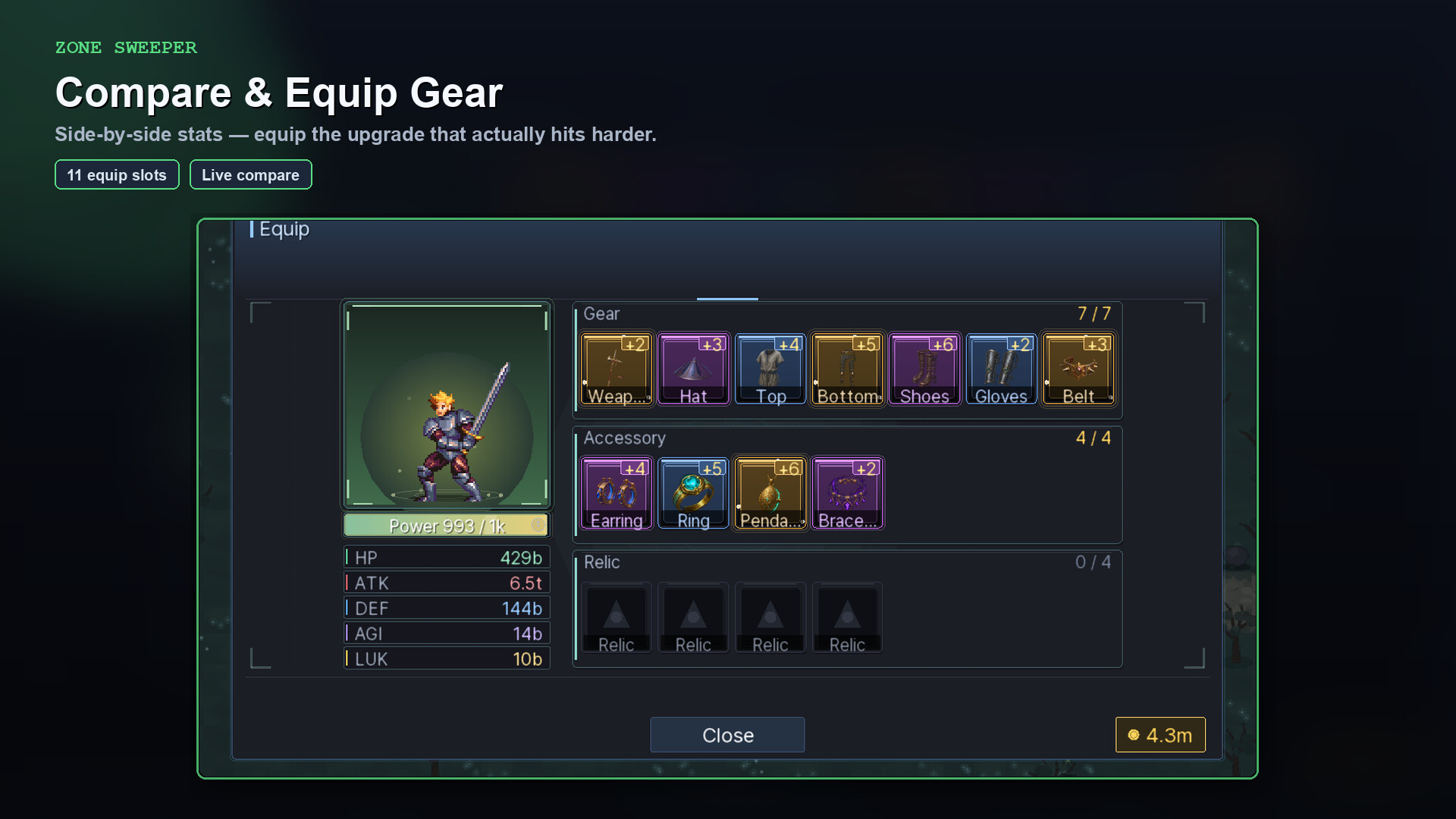
Gear across 11 equip slots and 4 accessory slots carries between runs, with side-by-side stat comparisons before equipping.Image: Missroot via Steam -
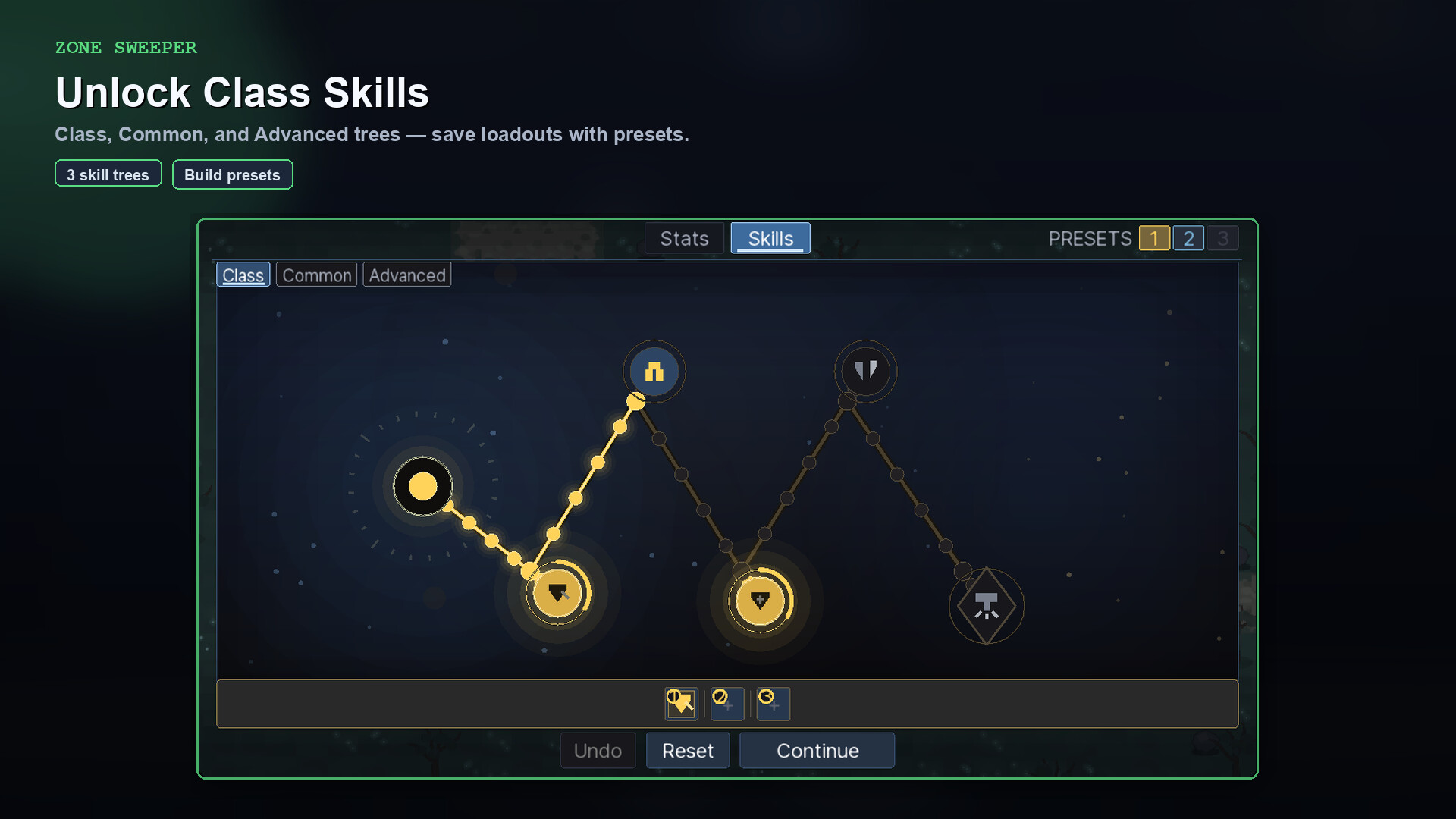
Three separate skill trees — Class, Common, and Advanced — support saved build presets.Image: Missroot via Steam -
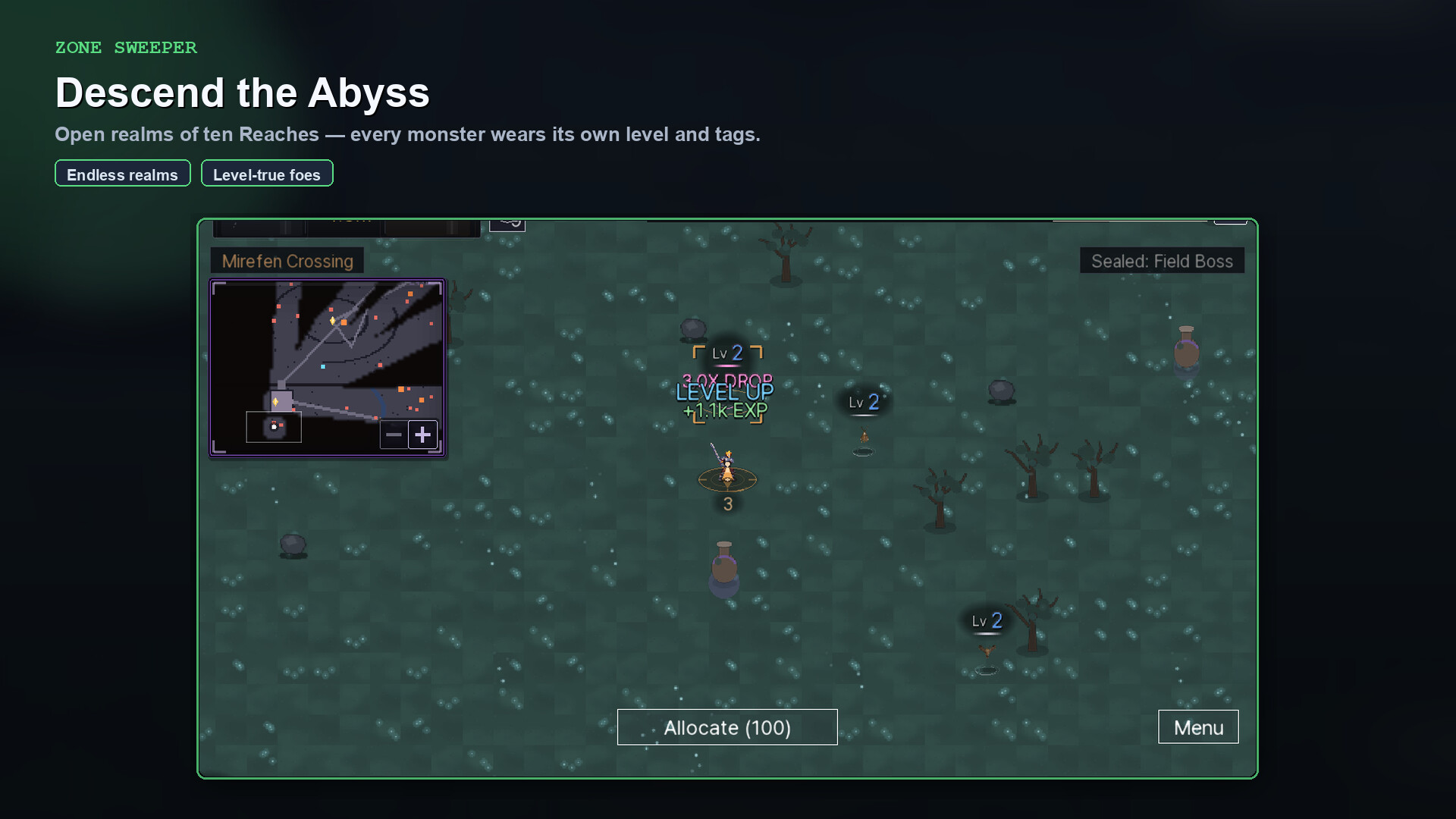
Walking a Reach in real time — enemies carry their own level, and kills pop level-up and EXP notifications instantly.Image: Missroot via Steam