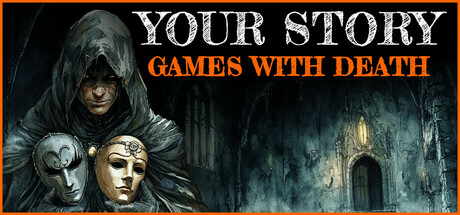
Game review
Your Story: Games with Death Review
3.9 / 10
- Developer
- BoldBox
- Publisher
- BoldBox
- Released
- 11 September 2026
- Platforms
- ["Windows"]
- Genre
- Adventure
A Medieval Wanderer, Two Thousand Events, and Two Hundred Ways to Die
Your Story: Games with Death is a text-based "Choose Your Own Adventure" game set during the Middle Ages, casting the player as a young adventurer fleeing a dull hometown in search of fortune in unknown lands. The pitch, per the developer, is scale: more than 2,000 written events branching across jungles, ruins, taverns, and open seas, roughly 200 of which end in the protagonist's death. Every screen presents a short passage of prose followed by a choice, and the structural hook is that death is always one wrong pick away — the game wants you to feel the weight of a decision the way a tabletop game's dice would deliver it, except here fate is scripted rather than rolled.
There's no combat system, no inventory to manage, no stat sheet to build — this is prose and branching alone, closer in spirit to the old paperback gamebooks than to a modern interactive-fiction engine like those built in Twine or Ink. The scope is genuinely large on paper: thousands of individually written passages is a lot of text for a $6.99 release, and the developer frames finding every one of the game's endings as the actual long-term goal rather than a single playthrough.
A Tiny Launch, Split Almost Evenly, With One Recurring Complaint
Your Story: Games with Death launched on September 11, 2026 after a playtest and a public demo the previous year, and its English-language review pool at review time was small — seven reviews, split four negative to three positive, sitting at roughly Mixed on Steam's aggregate. Small samples cut both ways: there isn't a broad consensus to lean on, but the reviews that exist are unusually detailed for a pool this size, several running to multiple paragraphs of specific complaint or specific praise rather than one-line verdicts.
The recurring negative thread is structural rather than a bug report: several reviewers independently describe choices that aren't really choices, saying the "correct" option is usually the obvious one and picking anything else ends the story outright, with one comparing it unfavorably to the branching complexity of children's gamebooks from decades ago. A second, separate thread of complaint concerns the writing itself — more than one reviewer describes the game's artwork as looking like it wasn't drawn by a human artist, and a couple of others compare the plot's structure and tone to being run by an "AI dungeon master," language they use to describe a story that jumps abruptly between scenes without earning the transitions. These are reviewer accusations and impressions rather than developer-confirmed facts about how the game's text or art were produced, but they're a consistent enough thread across independent reviews to be worth reporting as part of the reception. On the positive side, reviewers who enjoyed it describe a "meditative" reading pace worth a few quiet hours, smooth prose, and a fair price for the amount of content on offer.
The Scale Is Real, and So Is the Prose, When the Choices Aren't Forced
Credit where it's earned: the sheer volume of written material here is not an exaggeration. Two thousand distinct events is enough text that even a determined player won't see everything in one sitting, and the endings-as-collectibles structure gives the "outsmart death" premise something concrete to chase after a first death-by-storm or death-by-ambush ends a run early. The positive reviews specifically single out the prose quality on its own terms — smooth, readable, appropriately grim for a medieval survival-adventure premise — and note that the price tag feels proportionate to a game built almost entirely from text rather than art or systems. One reviewer, writing in Ukrainian, describes the loop plainly: you sit, you read, you die, you reread, you die a little further along, and over enough attempts your own particular story takes shape — which is, at its best, exactly what a game called Your Story is supposed to deliver.
Binary Choices, Unclear Translation, and an Unfinished Widescreen Mode
The core complaint that shows up across multiple negative reviews is that the branching promised by the genre rarely materializes in practice: choices are consistently limited to two options, one of which frequently ends the run, which several reviewers say collapses the "choose your own adventure" premise into a guess-the-right-answer format rather than a meaningful decision tree. One reviewer adds that option text itself sometimes reads as unclear or apparently translated awkwardly, muddying which of the two choices is actually the safer one before you've committed to it — a problem specific to a genre where the wording of a choice is the entire interface. A separate, more conventional complaint flags that ultrawide 21:9 display support isn't fully dialed in at launch, a rough edge one reviewer was willing to forgive as a common early-release oversight rather than a dealbreaker.
Taken together, the negative-review cluster describes a game whose central promise — meaningful choice under threat of death — is undercut by choices that are frequently binary and frequently punishing in a way that removes agency rather than heightening tension, alongside presentation elements (art, prose transitions) that multiple independent reviewers read as machine-assisted rather than handcrafted, whether or not that impression reflects the actual production process.
Verdict
Your Story: Games with Death has real scale and, at its better moments, readable prose behind a fair price tag, and the handful of positive reviews describe a genuinely relaxing way to burn a few hours rereading toward a different ending. But the small, closely split English review pool converges on a structural problem that's hard to write around: a "choose your own adventure" format where the choices are mostly binary and mostly punishing, several reviewers independently reading its art and pacing as artificial rather than authored, and rough edges like unfinished ultrawide support that a launch this small can't easily absorb. There's a real game's worth of text here, but not yet a game's worth of choice.
Screenshots
-
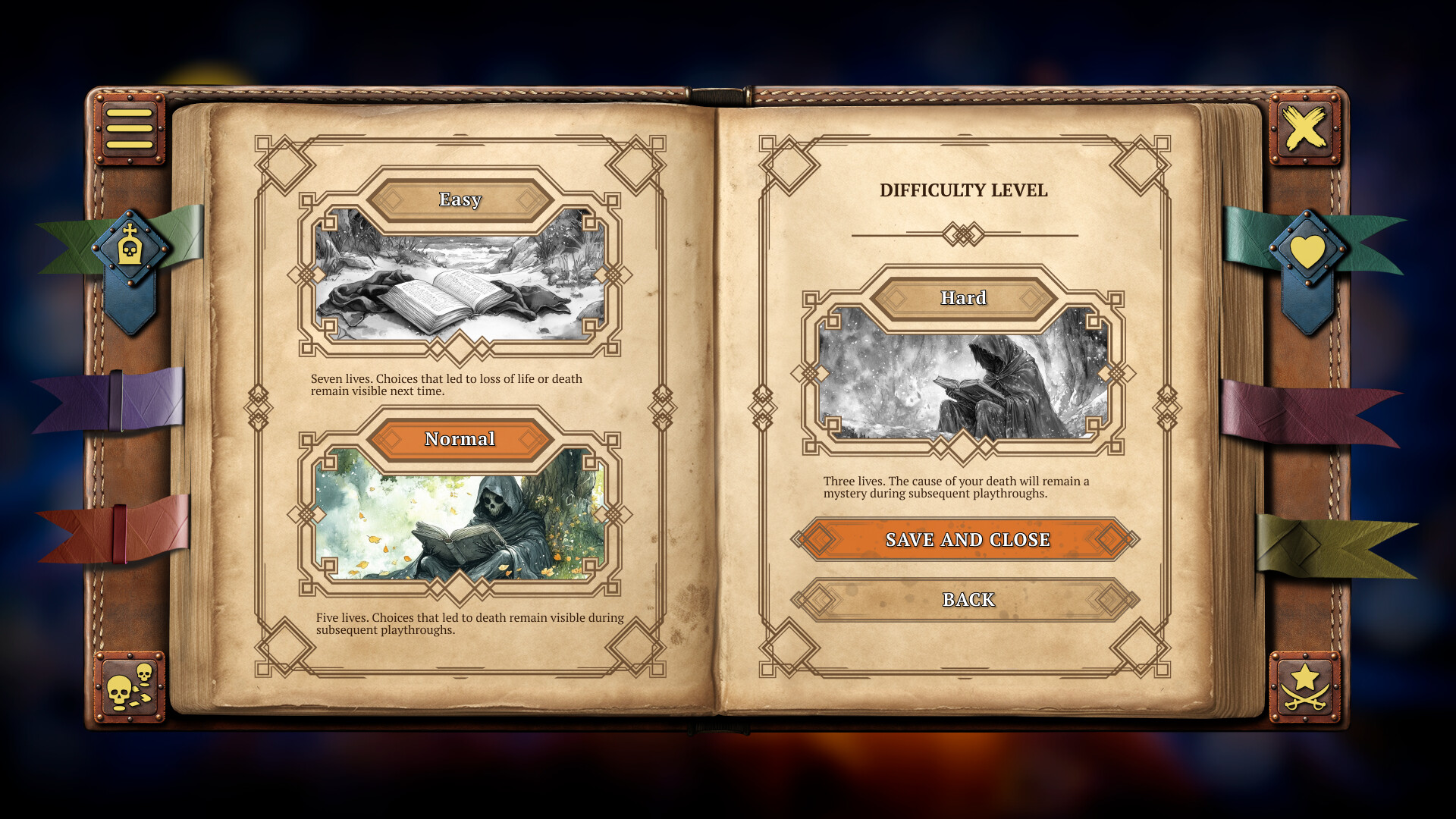
Difficulty is framed entirely in lives and memory: Hard gives you three lives and erases the cause of each death on future playthroughs.Image: BoldBox via Steam -
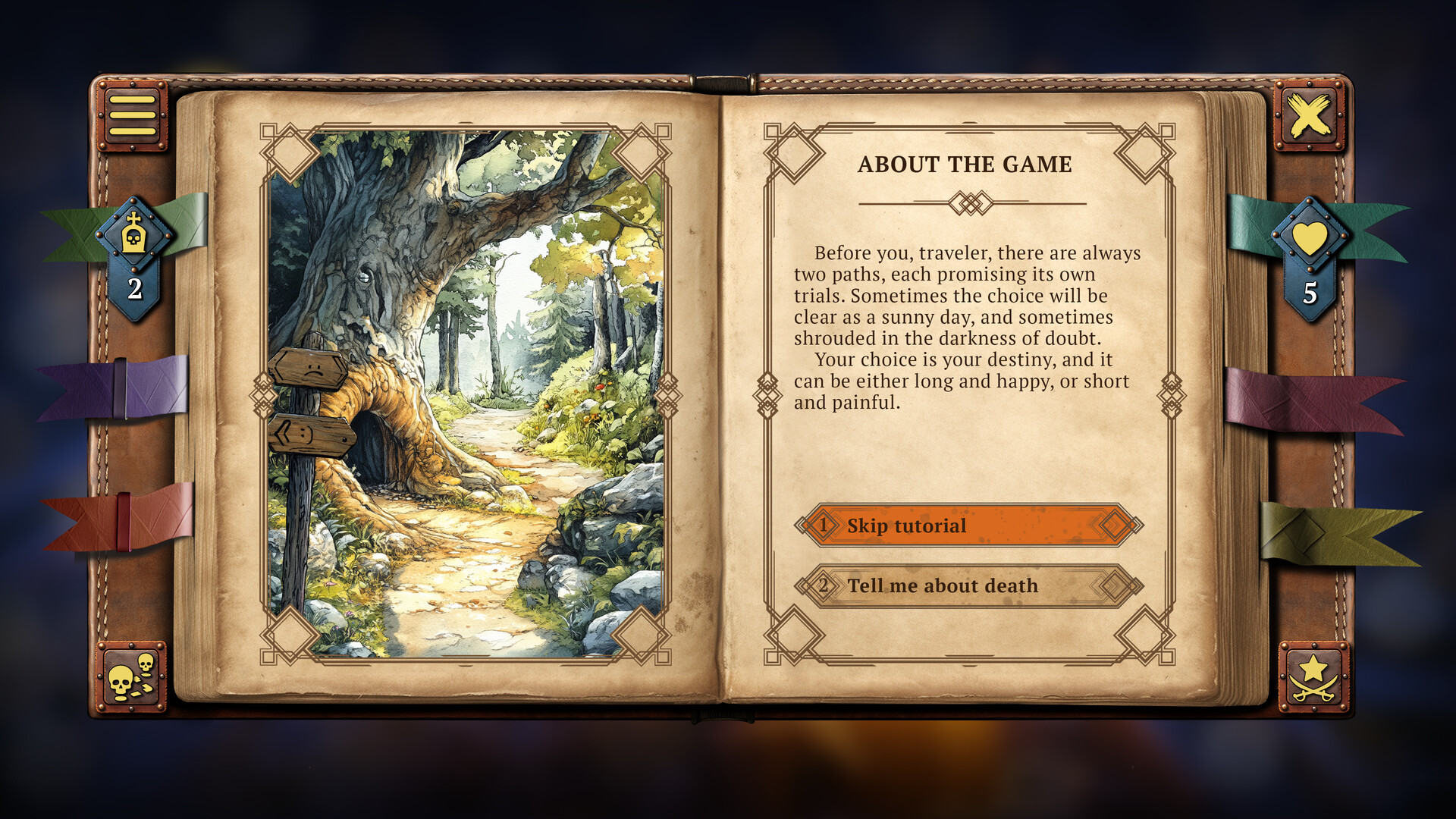
The book-page presentation is handsome, but the interaction underneath is almost always exactly two choices at a time, just as reviewers describe.Image: BoldBox via Steam -
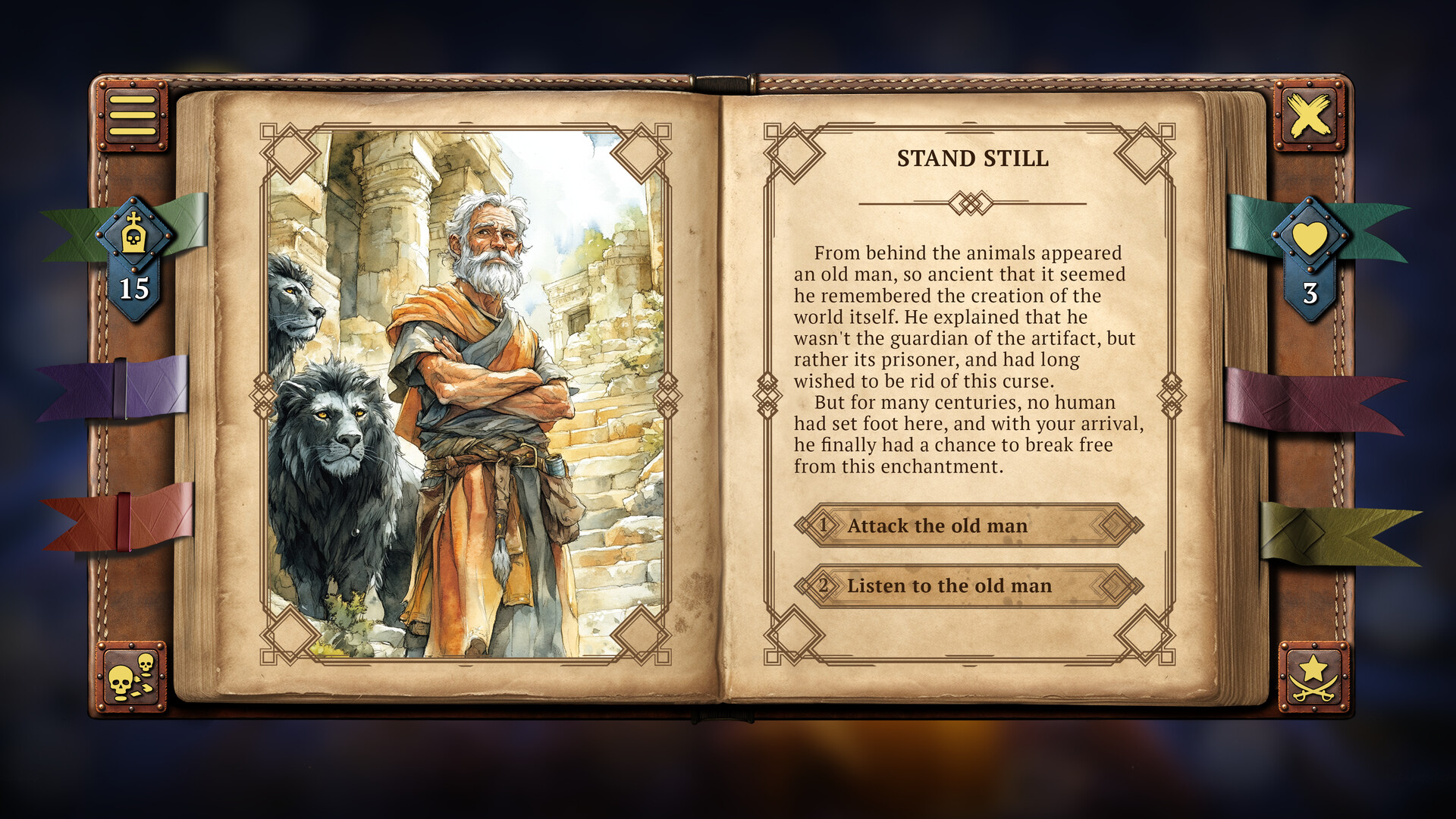
A typical fork: attack or listen, with no visible middle ground and no indication which path is the one that keeps you alive.Image: BoldBox via Steam