
Game review
Vampire Crawlers: The Turbo Wildcard from Vampire Survivors
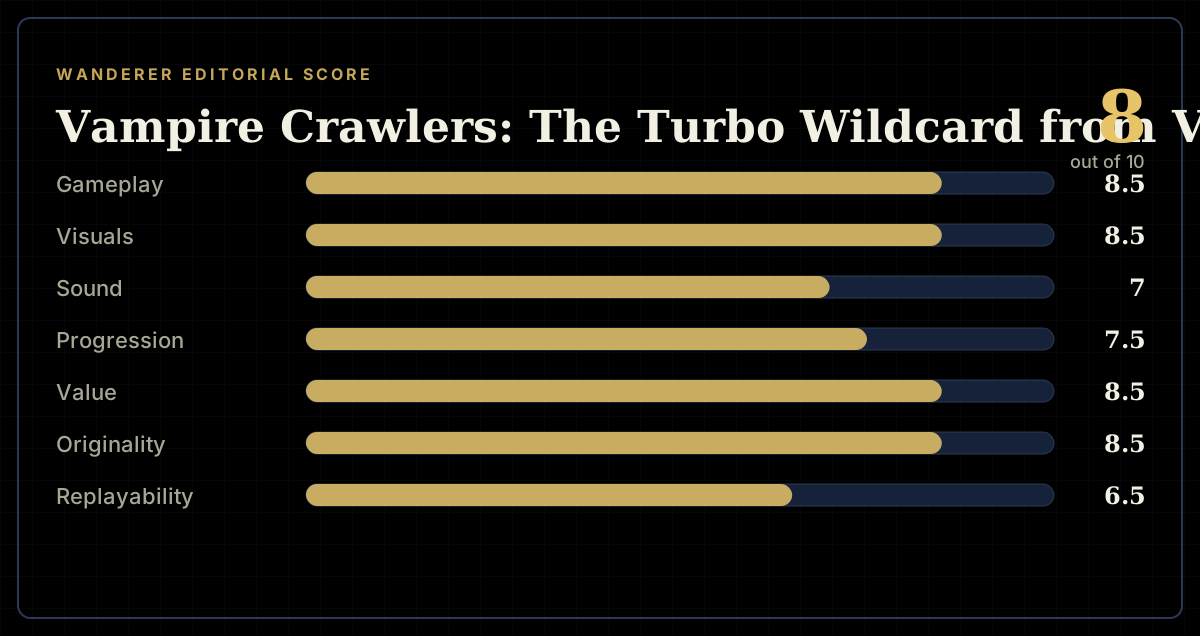
8 / 10
- Developer
- poncle, Nosebleed Interactive
- Publisher
- poncle
- Released
- 21 April 2026
- Platforms
- Windows, macOS, Xbox Series X/S, PlayStation 5, Nintendo Switch, Nintendo Switch 2
- Genre
- Turn-Based Roguelite Deckbuilder
- Monetisation
- One-time purchase, no in-game purchases found on the storefront listing; a separate paid soundtrack and a free demo are also available
- Players
- Single-player only
The short version
Vampire Crawlers takes the one thing everybody assumed was load-bearing in Vampire Survivors — the auto-attacking chaos — and throws it out entirely in favour of turn-based cards. What's left standing is the part that actually mattered: picking a build, watching it snowball, and chasing the next evolution. The Turboturn and Mana Chain systems make card combat feel as frantic as the original's bullet storm, but the game leans so hard on stacking combos that a good run stops being a decision-making exercise well before the credits.
Biggest strengths
- The Mana Chain turns "play cards in ascending cost order" into a genuinely tense math puzzle, and Wilds for extending it feel like a real skill expression rather than a gimmick
- The Turboturn removes animation lock entirely, so a full hand resolves in seconds instead of the usual deckbuilder stop-start rhythm
- Evolution Statues and boss-drop Evolution Gems give every floor a concrete short-term goal beyond "reach the exit"
Biggest weaknesses
- Gems that undercut a card's mana cost let a handful of stacking strategies spam the same one or two cards indefinitely, and once a player finds one the rest of the deck stops mattering
- The floor-to-floor structure recycles the same handful of enemy types far more than a run-based game this combo-obsessed can really afford
- The soundtrack leans on a small pool of remixed Vampire Survivors themes that loop noticeably across a longer session, even with strong individual tracks from Yoko Shimomura and the returning composer team
Who it's for: Deckbuilder fans who want something faster and looser than Slay the Spire, Vampire Survivors players curious what the systems look like with the reflexes removed, and anyone who likes watching a build go from fragile to absurd inside a single dungeon floor.
Our recommendation: Worth the roughly $10 asking price without hesitation, and there is a free demo if the concept still sounds unlikely on paper. Go in expecting a fantastic first ten hours that cools off once you've found the combo that breaks each Crawler.
8 / 10
What kind of game is this, actually
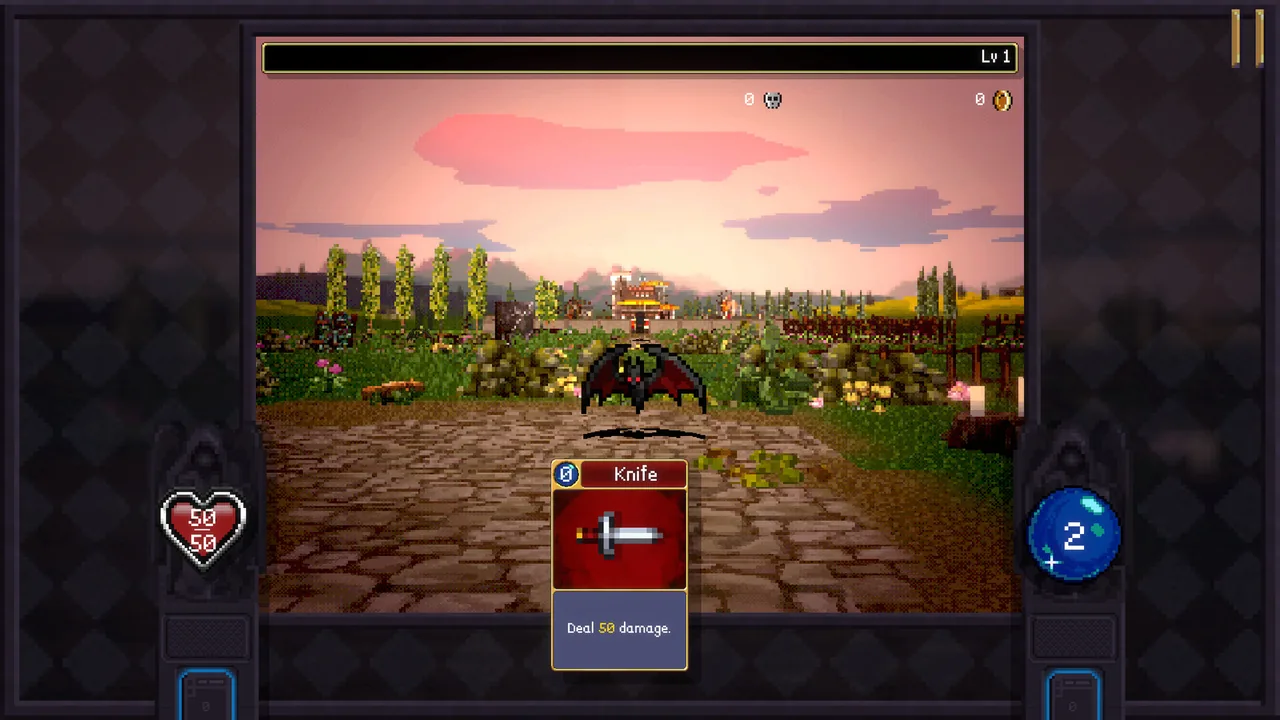
Calling Vampire Crawlers a Vampire Survivors game is technically true and almost entirely unhelpful. The original is an auto-battling bullet-heaven where the player's only real inputs are movement and build decisions made between waves. Vampire Crawlers keeps the build decisions and throws away everything else: there's no aiming, no dodging, and no real-time anything. Instead you walk a first-person dungeon corridor between rooms, and every fight is a turn-based card battle against the same cast of familiar Vampire Survivors enemies, now standing still and waiting for you to play a hand.
That's a big swing for a spin-off of one of the decade's most recognisable indie hits, and it's also the right one. The auto-attacking chaos of the original was never really the appeal on its own — it was the delivery mechanism for watching a build compound. Vampire Crawlers isolates that feeling and builds an entire card game around it.
The Turboturn and the Mana Chain
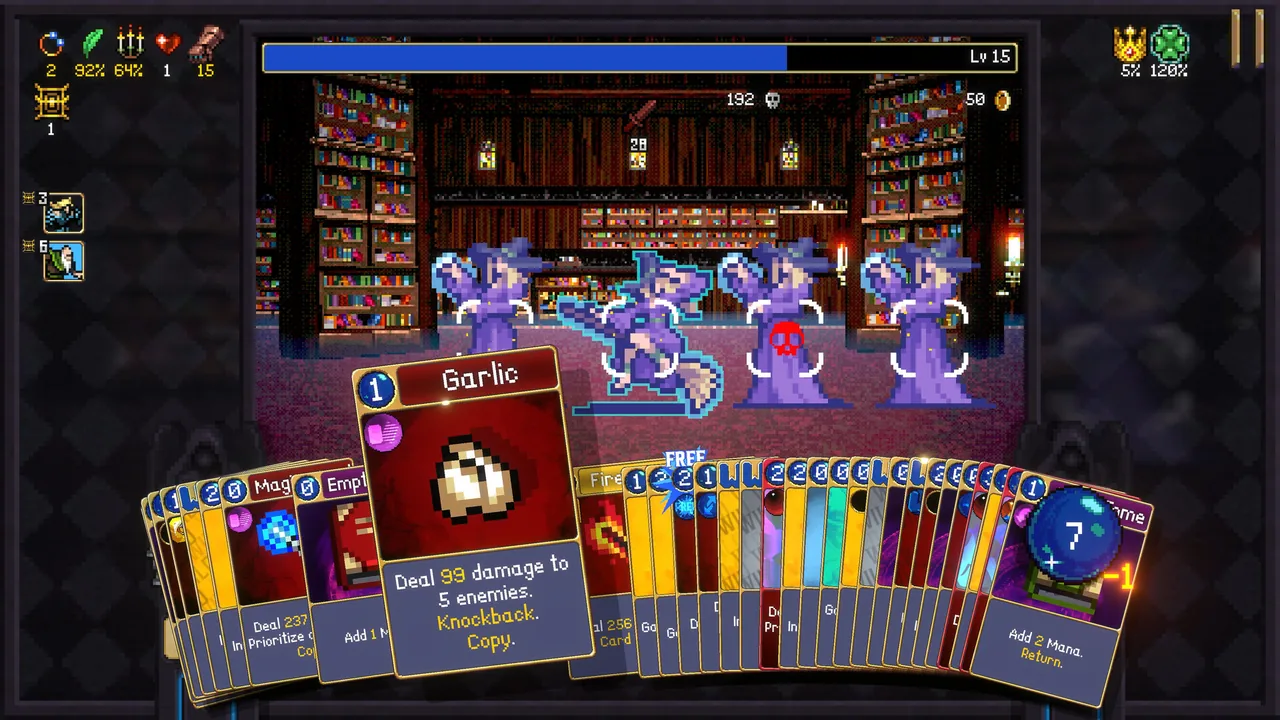
The signature system here is the Turboturn, and it's a smarter piece of design than "turn-based deckbuilder starring vampire survivors" makes it sound. Cards don't wait for animations to resolve before the next one can be played, so a full hand fires off in a rapid burst rather than the usual stop-start rhythm of Slay the Spire or its many imitators. It keeps the pacing closer to the original game's constant motion than anything else about the structure would suggest.
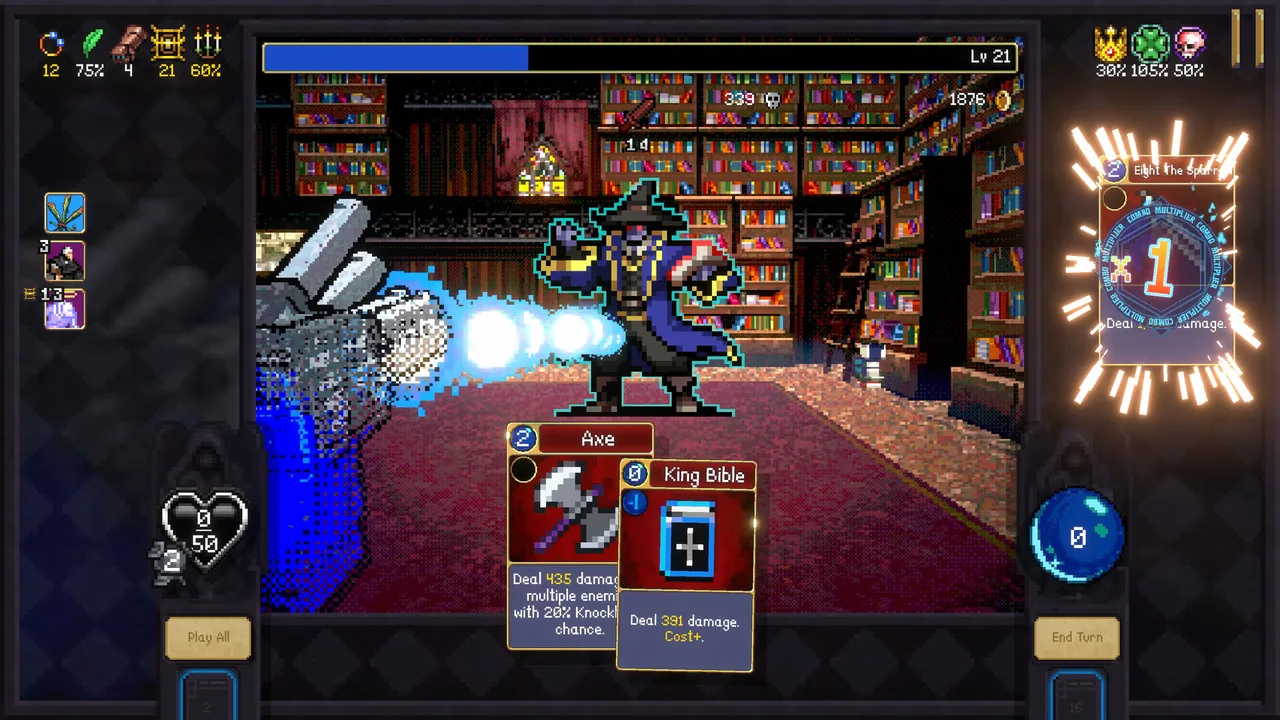
Layered on top is the Mana Chain: play cards in ascending mana-cost order — a 0-cost card, then a 1-cost, then a 2-cost, and so on — and each card in the sequence multiplies the damage of the one that follows it. Wilds extend the chain past its normal limit, letting a well-built hand stack ten, twenty, or even thirty cards into a single cascading combo. When it comes together, a full chain is a genuine spectacle: the same kind of screen-filling payoff the original game built its identity around, just earned through sequencing instead of positioning.
It's a smart hook, and for the first several hours it does exactly what a deckbuilder needs to do — it makes every card pickup a real decision about whether it fits the chain you're building, not just a bigger number to slot in.
Evolutions, gems, and where the wheels come off
Progression inside a run comes from headbutting chests for gems and power-ups, then slotting those gems into existing cards to cut their mana cost or boost their output. Evolution Gems — found in chests, dropped by bosses, or claimed at dark Evolution Statues scattered through each floor — turn a base card into one of the legendary weapon evolutions the Vampire Survivors series is known for, often pulling in an iconic survivor as a summoned effect. Chasing an evolution gives every floor a concrete short-term goal that sits nicely on top of the longer climb to the exit.
The trouble is that the same gem system that makes chain-building satisfying is also what breaks it. Gems that reduce a card's mana cost below its normal floor let certain strategies spam the same one or two cards indefinitely, and once a run finds that combination, the rest of the deck — and a meaningful share of the deck-building decisions that got you there — stops mattering. Reviewers across multiple outlets flagged this independently: a great early run can snowball into something that trivialises the back half of a dungeon, and the middle hours, while still experimenting with different builds, tend to be the strongest part of the experience specifically because nothing has been solved yet. For a genre-savvy audience that's not automatically a dealbreaker — roguelites running away from their own balance is a known and often-forgiven feature of the format — but it does mean the back half of a strong run asks less of the player than the front half did.
Four Crawlers, and a repetition problem underneath them
Two Crawlers, Antonio Belpaese and Imelda Belpaese, are available from the start, each with a distinct starting deck and card synergy. Poe Ratcho and Arca Ladonna unlock later by clearing specific floors — Mad Forest and the Inlaid Library respectively — which is a reasonable pacing lever for a first run but does mean the game holds back some of its best build variety until you've already spent a few hours with the two starting kits.
That variety matters because the dungeons themselves lean hard on a limited enemy roster. The cast is instantly recognisable to anyone who's played the source game, but a turn-based card battle asks a lot more of an enemy encounter than a five-second brush with an auto-attacking swarm does, and facing the same handful of monster types floor after floor wears thin faster here than it ever did in the original. It's the review's most consistent complaint across the outlets that covered it at launch, and it's a fair one — the combat system is inventive enough that it deserved a wider bench of things to fight.
Presentation
The pixel art translates into a first-person dungeon crawler better than it has any right to, leaning into a deliberately chunky, late-80s faux-3D look where flat 2D sprites populate a projected corridor. It reads as a knowing homage rather than a technical limitation, and it gives the game a distinct identity instead of just being "Vampire Survivors, but you can't see the swarm." The real payoff is in the card-cast effects: they don't reach the eye-searching density of the original's screen-filling projectile storms, but they scale visibly with combo length, so a maxed-out Mana Chain still delivers a real "look what I built" moment.
The soundtrack pulls in composer Yoko Shimomura for the main theme alongside the series' returning team, remixing a handful of popular Vampire Survivors tracks and adding a few new ones. Individual tracks land well, but the overall pool is small enough that longer sessions start looping the same handful of cues, which undercuts what is otherwise a genuinely strong soundtrack on a track-by-track basis.
Value and where it sits
At roughly ten dollars, with a free demo available for anyone still unsure the concept works, this is an easy purchase to justify regardless of how the mid-game balance shakes out — there's no season pass, no premium currency, and nothing beyond an optional separate soundtrack release sitting behind the base price. Critical reception backs that up: an aggregate in the low-to-mid 80s across dozens of reviews and a Very Positive Steam tag from thousands of players, with the occasional harsher outlier calling out the same repetition and pacing concerns raised here. That split is honest — this is a genre pivot that mostly works, executed by people who clearly understood what made the source material tick, but it hasn't fully solved the problems that come with asking turn-based cards to deliver the same rush as a real-time swarm.
Players who like watching a build compound from fragile to absurd, and who don't mind a run's second half getting easier once that build clicks, will get a lot out of this. Anyone hoping for the tighter, more punishing balance of a Slay the Spire — where a broken run is the exception rather than an expected outcome — will find Vampire Crawlers looser than that comparison suggests.
Players who like a build that keeps compounding on its own timetable, on the other hand, might also want to look at Wanderer's own progression systems, where the payoff for planning ahead keeps paying out even after you've logged off.
Pros and cons
Pros
- The Mana Chain turns "play cards in ascending cost order" into a genuinely tense math puzzle, and Wilds for extending it feel like a real skill expression rather than a gimmick
- The Turboturn removes animation lock entirely, so a full hand resolves in seconds instead of the usual deckbuilder stop-start rhythm
- Evolution Statues and boss-drop Evolution Gems give every floor a concrete short-term goal beyond "reach the exit"
- Weapon-effect flair scales with combo length, so a maxed-out chain is a legitimate visual payoff rather than just a bigger number
- Four Crawlers with distinct starting decks give the opening hours real build variety before anything about the meta settles
Cons
- Gems that undercut a card's mana cost let a handful of stacking strategies spam the same one or two cards indefinitely, and once a player finds one the rest of the deck stops mattering
- The floor-to-floor structure recycles the same handful of enemy types far more than a run-based game this combo-obsessed can really afford
- The soundtrack leans on a small pool of remixed Vampire Survivors themes that loop noticeably across a longer session, even with strong individual tracks from Yoko Shimomura and the returning composer team
- Unlocking Poe Ratcho and Arca Ladonna behind specific floor clears on the starting Crawlers delays exactly the build variety the game is best at showing off
Screenshots
-
吸血鬼爬行者: 屠戮地牢的吸血鬼幸存者Image: poncle via Steam -
吸血鬼爬行者: 屠戮地牢的吸血鬼幸存者Image: poncle via Steam -
吸血鬼爬行者: 屠戮地牢的吸血鬼幸存者Image: poncle via Steam -
How the review scores each part of the gameWanderer Editorial -
The short versionWanderer Editorial