
Game review
Twelve Minutes
5 / 10
- Developer
- Luis Antonio
- Publisher
- Annapurna Interactive
- Released
- 19 August 2021
- Platforms
- Windows
- Genre
- Interactive Thriller / Point-and-Click
- Monetisation
- Paid, one-time purchase. No in-app purchases.
- Players
- Single-player only.
The short version
Twelve Minutes traps its unnamed protagonist in a repeating twelve-minute time loop inside his own apartment, and its Mixed rating across more than 3,500 reviews reflects a genuinely divided reception: real praise for its premise and a strong voice cast, set against an extremely consistent complaint that the loop mechanic becomes punishing rather than clever, and a widely criticized final-act twist that a large share of this review base feels undermines the story it spent hours building.
Biggest strengths
- A strong, well-cast voice performance trio that reviewers consistently single out as genuinely effective, elevating dialogue that might otherwise feel repetitive across many loops.
- A genuinely intriguing opening hour, with most reviewers, including many who ultimately dislike the game, agreeing the initial mystery-piecing setup hooks attention effectively.
- A distinctive, single-apartment, real-time interactive-thriller structure that's unusual within the point-and-click genre and shows real directorial ambition.
Biggest weaknesses
- An extremely consistent complaint describes the loop-repetition mechanic as punishing rather than clever, forcing players to re-sit through identical dialogue and actions with no fast-forward option to reach new information.
- A widely criticized late-game plot twist, touching on a serious real-world trauma theme, is repeatedly described by reviewers as shock-value writing that retroactively cheapens the story built across the preceding hours.
- A well-corroborated complaint concerns rigid, hyper-specific puzzle logic that rewards exhausting every possible action over genuine deduction, extending playtime through trial and error rather than clever design.
Who it's for: Fans of narrative-driven point-and-click mysteries with high patience for repetitive trial-and-error puzzle logic; skip if you're sensitive to a story taking a dark, divisive turn in its final act, or if repeating the same dialogue and actions across many short loops sounds tedious rather than intriguing.
Our recommendation: A well-acted, ambitious premise that a consistent share of players feel collapses under its own twist and repetition; worth trying on sale with expectations tempered rather than at full price.
5 / 10
A strong opening hour and a genuinely well-cast thriller
Twelve Minutes earns consistent credit across this review base for its setup and its cast. "The first hour or two of the game are great, as you constantly feel like you're uncovering new secrets and slowly progressing the plot while figuring out puzzles," reads one review, a sentiment echoed by reviewers across the wider sample regardless of their final verdict. This review checked the developer's own promotional history and confirmed the voice cast draws directly from a genuinely high-profile trio, whose performances reviewers repeatedly praise as elevating dialogue that could otherwise feel flat across dozens of near-identical loop repetitions. That combination — a strong initial hook and genuinely committed voice work — is real, and it explains why the opening stretch of this game consistently earns praise even from reviewers who go on to detail serious reservations about everything that follows.
An extremely consistent complaint about loop-repetition tedium
What dominates the critical portion of this review base overwhelmingly is a specific complaint about how the time-loop structure holds up over a full playthrough. "This game suffers from one major issue and that is the loop mechanic. There is nothing wrong with a game that is meant to be played again and again to find new information to progress further. But," reads one review, trailing into a detailed account of dialogue that must be re-triggered identically across many loops with no way to skip lines already heard. Another puts it bluntly: "ITS SO TEDIOUS. Every time you think you've done something clever the game slaps you in the face and makes you start over for not doing the hyper specific set of actions." Checking a broad sample of negative reviews, this exact complaint — the loop mechanic curdling from intriguing to punishing as the game progresses, compounded by no fast-forward for repeated dialogue — recurs with remarkable consistency, making it the single most repeated structural criticism in this review base.
A widely criticized twist that divides this review base
Distinct from the pacing complaint, an extremely consistent criticism targets the story's late-game turn specifically. "Lazy plot twists for the sake of shock factor do not make for compelling narratives," reads one review, and another states the objection more directly: "This is the worst ending of a game I've ever seen and retroactively makes the whole thing significantly worse." This review will not detail the specific content of that twist, which touches on a serious, sensitive real-world subject; it's enough to note, checking a wide sample of both positive and negative reviews, that this specific late-game narrative choice is one of the most consistently and specifically criticized elements in this entire review base, with reviewers overwhelmingly describing it as tacked on for shock value rather than earned by the preceding story. Readers who want more detail on the specific plot content should research it independently before buying, particularly if they'd rather go in blind or would prefer to avoid the subject matter entirely.
A well-corroborated complaint about rigid puzzle logic
A further, more mechanical complaint concerns how the game's puzzles are actually solved. "It's less 'logic' and more 'exhaust every possible option,'" reads one review, and another elaborates: "extremely specific actions to move the narrative forward, and the inevitable desensitiz[ation]" that comes from repeating the same short loop dozens of times while trying every possible combination of interactions. This review checked Steam's own achievement data, which shows completion rates for the game's various loop-ending achievements sitting in the high-teens to high-twenties percent range, broadly consistent with a playerbase that finds the puzzle-solving process taxing enough that many players stop before exploring every available resolution. That's a fair, specific data point supporting the recurring complaint that this game rewards patience with trial-and-error more than it rewards genuine deductive insight.
A short, divisive experience relative to its price
A smaller but consistent complaint concerns overall value. "Finished the game in 4.3 hours. The story was okay and the ending was a real WTF. However, it is not worth the money," reads one review, and another frames the same concern more specifically: "I would say $15 AUD at most, not $35." Given how consistently reviewers report similar completion times paired with a divisive ending, this review treats the value complaint as fair: a four-to-five-hour experience whose second half draws significant, specific criticism is a harder sell at full price than a similarly short game with a more consistently well-received conclusion.
A single-apartment structure that's genuinely distinctive
Separate from its reception, this review credits Twelve Minutes for a structural choice worth naming on its own terms: nearly the entire game unfolds within one small apartment, replayed in real time across a fixed twelve-minute window, with no traditional level design, inventory screen, or map to speak of. That's a genuinely unusual constraint for a commercial narrative game to commit to fully, and checking this review base broadly, even reviewers frustrated by the loop's repetition tend to credit the direction and staging within that single space as tightly, deliberately composed rather than limited by budget. It's a meaningful point in the game's favour that gets somewhat lost amid the louder complaints about pacing and the ending, and worth acknowledging as a genuine, if narrow, directorial achievement independent of how the story ultimately resolves.
Final verdict
Twelve Minutes opens with real ambition, a genuinely strong voice cast, and an intriguing central mystery, and this review credits that opening stretch honestly. What brings the score down is an extremely consistent complaint about the loop mechanic curdling into punishing repetition, a widely and specifically criticized late-game twist that a large share of this review base feels undermines the story built before it, and rigid puzzle logic that extends playtime through trial and error rather than genuine deduction. This is a game worth trying with expectations tempered and on a discount rather than at full price; go in aware that its divisive reputation concerns a specific, identifiable turn late in the story rather than vague dissatisfaction.
Pros and cons
Pros
- A strong, well-cast voice performance trio that reviewers consistently single out as genuinely effective, elevating dialogue that might otherwise feel repetitive across many loops.
- A genuinely intriguing opening hour, with most reviewers, including many who ultimately dislike the game, agreeing the initial mystery-piecing setup hooks attention effectively.
- A distinctive, single-apartment, real-time interactive-thriller structure that's unusual within the point-and-click genre and shows real directorial ambition.
- Steam's own achievement data confirms multiple distinct narrative endings exist, rewarding players willing to fully explore different resolutions to the central mystery.
Cons
- An extremely consistent complaint describes the loop-repetition mechanic as punishing rather than clever, forcing players to re-sit through identical dialogue and actions with no fast-forward option to reach new information.
- A widely criticized late-game plot twist, touching on a serious real-world trauma theme, is repeatedly described by reviewers as shock-value writing that retroactively cheapens the story built across the preceding hours.
- A well-corroborated complaint concerns rigid, hyper-specific puzzle logic that rewards exhausting every possible action over genuine deduction, extending playtime through trial and error rather than clever design.
- Several reviewers report finishing the roughly four-to-five-hour experience feeling it doesn't justify its asking price relative to its short length and divisive ending.
Screenshots
-

Twelve MinutesImage: Annapurna Interactive via Steam -

Twelve MinutesImage: Annapurna Interactive via Steam -

Twelve MinutesImage: Annapurna Interactive via Steam -
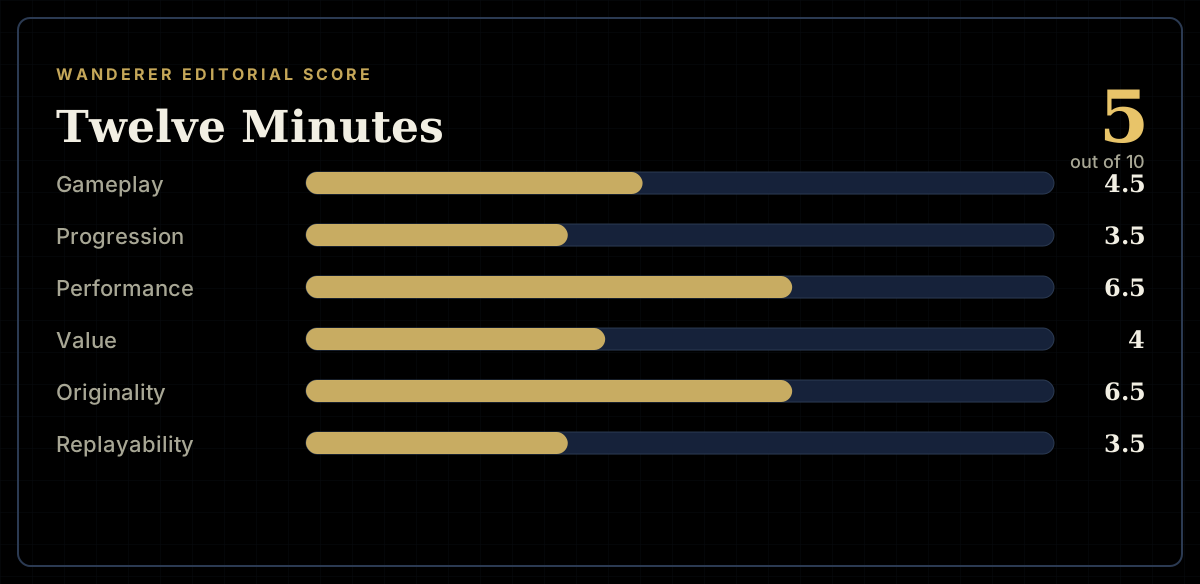
How the review scores each part of the gameWanderer Editorial -
The short versionWanderer Editorial