
Game review
Treasure Clicker
6.6 / 10
- Developer
- Marrimarr games
- Publisher
- Marrimarr games
- Released
- 13 April 2026
- Platforms
- Windows, Linux
- Genre
- RPG
One Early Review, Positive, From a Player Who Wanted the Record Set Straight
Treasure Clicker entered Steam Early Access on 13 April 2026 from developer Marrimarr games, and at the time of writing it has exactly one user review — a positive one, from a player with 1,272 minutes (over 21 hours) logged who explicitly says they're "reviewing this early as there seemed to be no other reviews," a small but telling sign of a title trying to build word-of-mouth from a near-standing start. That reviewer's account is detailed enough to be genuinely useful despite being the only data point available: they note that the first 30 minutes felt worryingly fast-paced before the game settled into a more sustainable rhythm, that the game offers "no tutorial but it is all pretty much self explainatory," and they flag one specific, concrete trap worth taking at face value — prestiging for the first time with only the initial five points on offer is described as "a trap and a nasty one at that," with the advice to wait until six points are available instead. With only one review to go on, everything else about how Treasure Clicker plays over a longer haul comes from the store page's own description and from what's visible directly in its screenshots, rather than from a broader player consensus that simply doesn't exist yet.
Tap, Upgrade, Prestige: A Familiar Incremental Spine With Real Structural Variety
The core loop follows the well-established incremental-game shape — tap a treasure chest, buy upgrades that push tap damage or passive gold generation, and watch the numbers spiral into "absurd" territory, in the store page's own words — but layers a genuinely broader structure on top than the bare tap-and-buy loop alone would suggest. Heroes can be hired across what the store page describes as "classic roles," each contributing to passive treasure generation so that progress continues even while the player is deciding on the next big purchase, giving the moment-to-moment loop an idle dimension alongside its active-clicking one. A screenshot of the Heroes tab confirms this is a much larger cast than "classic roles" alone suggests: named characters like Bramm Ironjaw the Warrior, Fenn Trickwalker the Rogue, and Veivei the blackmage the Mage each carry a one-line flavour description, a distinct signature weapon with its own level cap and multiplier, and passive income figures that scale from the low millions per second up to a maxed-out Mage generating 1.548 quintillion gold per second — a concrete, screenshot-verified example of the "spirals into absurd numbers" pitch holding up well past the game's opening hours. Above that sits a Guilds and Alchemy layer, where funding guild research amplifies hired classes and a separate Essence currency feeds an alchemy system for crafting elixirs, and above that again sits a prestige system that trades accumulated progress for permanent Essence and unlocks on a skill tree the store page specifically describes as having "real prerequisites and variety" rather than a single flat multiplier line. A screenshot of the Guild tab shows this class-amplification system is built around four distinct research buildings — Warriors' Hall, Rogues' Den, Arcane Annex, and Sanctuary — each maxed out at a 60-tier research ladder and each tied to four named heroes of that class, confirming a 16-hero roster across the four classes rather than a small handful of generic hires. The same screenshot reveals a mechanic the store page doesn't mention at all: Sanctuary, the Cleric-focused guild building, lets the player pick a single active "prayer" buff from a dropdown — the example shown grants a flat 60% boost to passive gold — layering a rotating, choice-driven buff on top of the guild system's otherwise passive bonuses. The one available review's prestige-timing warning suggests that skill tree's structure is meaningful enough to punish an uninformed first reset, which — while a rough note for new players to hit blind — is at least evidence the system has real stakes rather than being a purely cosmetic reset button.
Speed Challenges and a Boss-Gauntlet Abyss Give the Loop Somewhere to Point
Beyond the core hoard-building loop, Treasure Clicker offers two structured side activities that give an otherwise open-ended incremental game concrete goals to chase. Speed Challenges are timed runs on a temporary, separate hoard, with first clears granting permanent bonuses back on the main save and replay support for players chasing a better time — a structure that borrows a speedrunning framing rare in the incremental genre, where the loop is usually about patience rather than pace. The Abyss, meanwhile, is framed as a boss gauntlet built around relics and tap-driven combat that specifically ties back into "the crit and build choices you've invested in on the surface," meaning a player's upgrade and prestige decisions in the main hoard-building loop should carry real weight once they descend into it rather than resetting to a clean baseline. The 21-achievement list backs up the Abyss's structure as a real, multi-stage system rather than a single one-off event, with named milestones including "Into the abyss," "Abyss explorer," "Abyss delver," "Abyss master," and a capstone "Dark Lord down," alongside separate relic-collection achievements ("Relic collector," "Master relic") and prestige-specific ones ("First prestige," "Prestige veteran") that map cleanly onto the systems the store page describes. An early-game screenshot of the main navigation bar shows The Abyss tab still locked behind a plain "???" label before enough progress has been made to reveal it, a small but effective bit of mystery-box design that gives new players something concrete to look forward to unlocking rather than seeing the full menu spelled out from the very first session.
Early Access Caveats and an Interface That's Reportedly a Little Rough Right Now
Being in Early Access, Treasure Clicker comes with the standard caveats attached: the developer's own store page explicitly warns to "expect balance passes, UI polish, and new content as updates ship," and promises to flag anything that could affect existing save files directly in patch notes going forward — a reasonably transparent approach to communicating with players about a game still very much in motion. The one available review's specific complaint about the Speed Challenge popup not automatically switching the player into the chest-clicking screen once accepted is a small but concrete example of exactly the kind of UI friction that early-access label is meant to set expectations around, and worth taking as an accurate, current snapshot rather than a permanent flaw given the developer's stated commitment to UI polish going forward. With only one review and a brand-new launch to go on, it's not possible to say how consistently that friction shows up elsewhere in the interface, or how quickly it's likely to be addressed.
Price, Platform Support, and a Consumer-Friendly Structure So Far
At NZ$5.99, Treasure Clicker is priced in line with other premium (non-free-to-play) incremental games, and supports both Windows and Linux along with a reasonably broad language list for a solo-scale Early Access release — English, French, Spanish, Dutch, Polish, and Simplified Chinese. There's no DLC listed on the store page, and nothing in the available description or the single player review suggests any secondary monetisation layered on top of the upfront purchase price, which for a genre that frequently leans on energy timers or gacha-style purchases is worth crediting directly as a consumer-friendly starting position, assuming that structure holds as the game moves through Early Access. It also ships with accessibility-minded categories including Camera Comfort, custom volume controls, playable at the player's own pace, and playable without timed input — sensible inclusions for an incremental game that isn't built around reflexes.
Verdict
Treasure Clicker is a structurally ambitious incremental game arriving with almost no player track record to lean on: a familiar tap-and-upgrade core wrapped in a genuinely broad set of systems — hero classes, guild research, alchemy, a prestige skill tree with real stakes, timed Speed Challenges, and a boss-gauntlet Abyss that ties back into build choices made on the surface. The sole available review is a useful, detailed, and positive one, flagging a specific early-prestige trap and a Speed Challenge UI hiccup worth knowing about going in, but a single 21-hour account can't establish how the game's pacing, balance, or promised content updates hold up over the long run an incremental game is built to reward. At NZ$5.99 with no signs of secondary monetisation so far, it's a reasonable low-risk pickup for incremental fans willing to be among the first wave of players and to accept the real uncertainty that comes with reviewing a brand-new Early Access launch on the strength of one player's word.
Screenshots
-
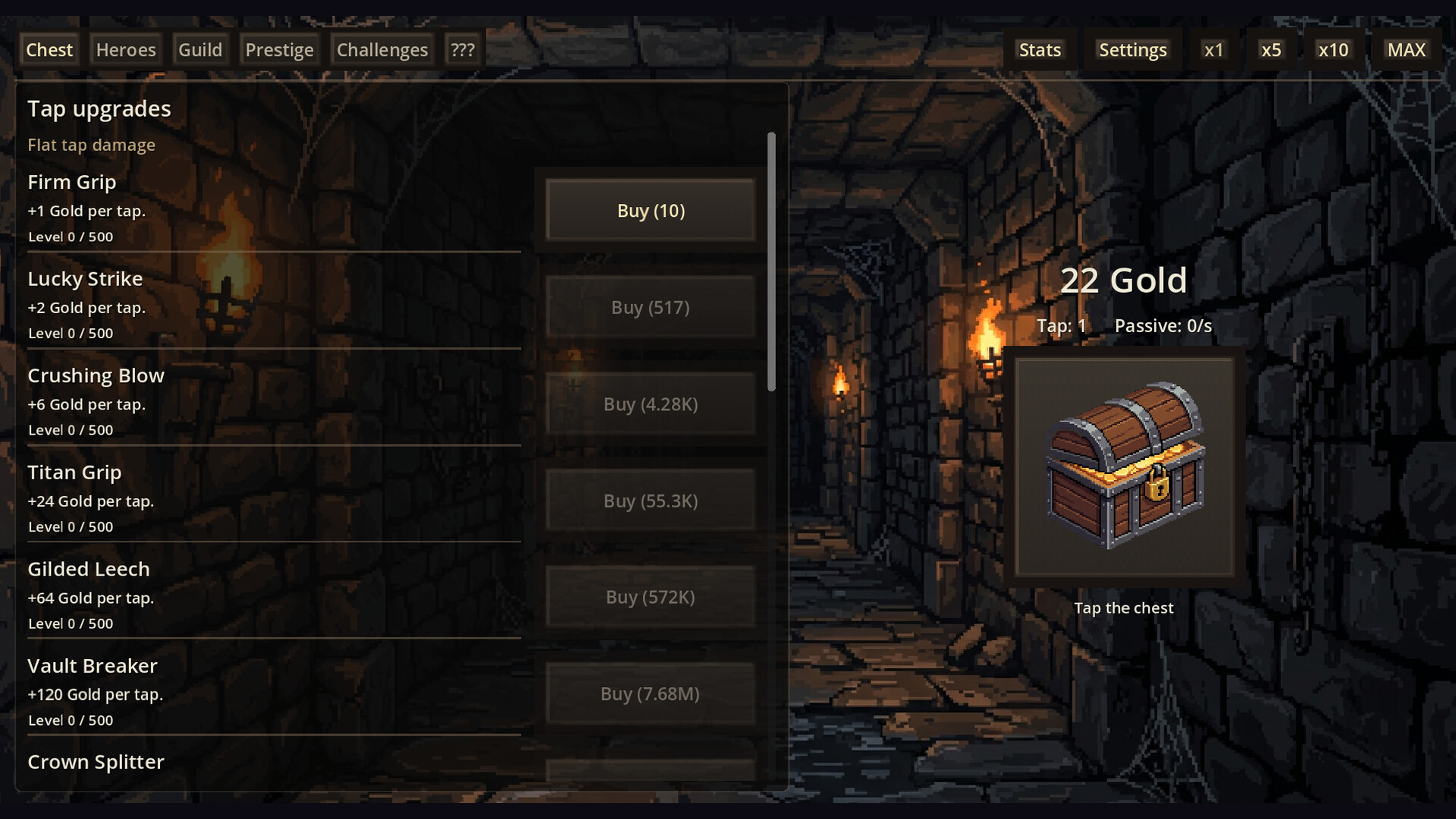
The core tap screen, with named upgrade tiers already scaling into the millions of gold before a single purchase is made, plus a locked, unlabelled tab hinting at hidden late-game content.Steam store page -
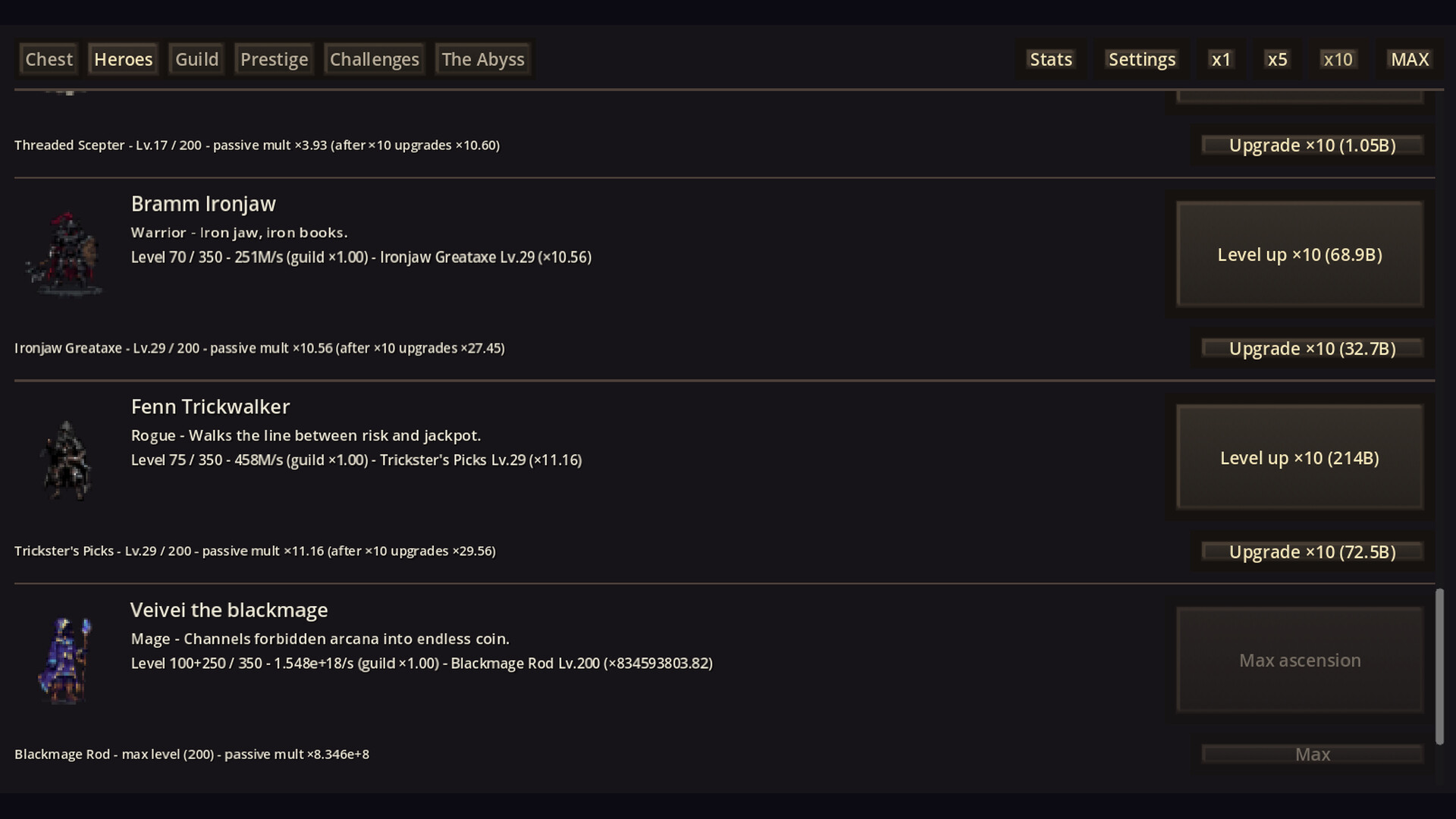
The Heroes roster mid-game, with named characters, weapon-specific multipliers, and one Mage already at a maxed passive rate of 1.548e+18 gold per second.Steam store page -

The Guild research screen, confirming a 16-hero roster across four classes and a Sanctuary-specific selectable prayer buff system not mentioned on the store page.Steam store page