
Game review
Toy Shop Simulator
5.5 / 10
- Developer
- PaperPixel Games
- Publisher
- PaperPixel Games
- Released
- 13 January 2025
- Platforms
- Windows
- Genre
- Casual, Indie, Simulation, Strategy
- Players
- Single-player
The short version
Biggest strengths
- A genuinely fun, self-aware narrative framing for the tutorial (fired, homeless, then inheriting a struggling toy shop) that reviewers consistently enjoy more than they expect from the genre
- A visibly active, responsive developer who reviewers repeatedly credit for shipping frequent updates and directly fixing bugs players reported
- A wide, 27-achievement completion spread (91.3% down to 2.1%) that confirms real structural depth for players who push into late-game content
Biggest weaknesses
- Extensive, specific, and recurring bug reports — customers and held items getting permanently stuck, the tutorial breaking outright for some players, online orders malfunctioning
- Multiple reviewers report the core loop becoming repetitive and grindy after roughly ten hours, well before the achievement list is close to finished
- At least one reviewer reports discovering AI-generated toy textures in the shipped 1.0 release without prior disclosure, a transparency complaint distinct from ordinary bug reports
5.5 / 10
From homeless to toy tycoon, with a wink
Toy Shop Simulator follows the well-worn management-sim template — arrange shelves, price stock, process customers, hire staff, expand the store — but wraps it in a small, self-aware narrative hook that a surprising number of reviewers single out as a genuine highlight. One reviewer's summary of the opening is worth quoting in full for how well it captures the tone: "Five minutes into the game, I was fired from a toy shop as the only functioning employee, went homeless, slept on a bench in the park, and was then gifted an old toy shop by my grandfather. With a small loan of sixty dollars, I turned it into a toy empire to-be. There's an underlying story, which is something, for sure. You get to sabotage the competitor who fired you in the tutorial of the game." A separate reviewer echoes the same enjoyment more concisely: "The tutorial has a fun storyline (I hate you Toyverse), and I believe they'll be adding more to the story in future updates." For a genre that often skips narrative framing entirely, that kind of specific, positive reaction to the setup is a real point in the game's favour.
Based on the available English-language review sample of 85 reviews — 67 positive, 18 negative, landing at an overall Mostly Positive rating — that light narrative charm sits alongside a genre-standard management loop of restocking shelves, running the register, fulfilling online orders, and slowly expanding the shop's footprint and inventory. Physical comedy gets specific credit too: "Throwing boxes to customers and even mopping them is absolutely hilarious," one reviewer writes, and a separate reviewer specifically enjoys a bug-fixing tool built directly into the game's own systems: "Hitting stuck customers with bug hammer is fun" — a detail that speaks to both a genuine moment of dev-side self-awareness and, less charitably, to how frequently that tool ends up necessary.
Bugs that are specific, recurring, and sometimes hard-blocking
The negative review sample is dominated overwhelmingly by one category of complaint: bugs, described in unusually specific, reproducible detail rather than vague dissatisfaction. "Had a box in my hand and ran to check someone out. I accidentally took the item into the box instead of activating the register. Game is now stuck as I can't put the item back on the register table, and I can't put it on the shelf and take it back to the register. No cancel," one detailed reviewer writes, describing a genuine soft-lock with no way to back out of the broken state rather than a cosmetic glitch. A separate reviewer reports a near-identical class of problem from an earlier stage of the game: "Tutorial breaks constantly so I ended up having to skip it after 3 times of trying different methods and restarting. Online orders get broken as well... Lastly, I got stuck at the cash register and couldn't get up."
A third reviewer, writing after the tutorial itself ran smoothly, describes a similar late-onset pattern: "after completing the tutorial, I encountered numerous bugs and glitches that forced me to restart the game multiple times. Ultimately, I found it unplayable in its current state. The game has a lot of potential, so I'll revisit it once it's out of Early Access and (hopefully) more polished." That reviewer's plan to wait for full release is worth flagging directly, because a separate reviewer's account of what happened after that full release complicates the "wait it out" strategy considerably.
A transparency complaint that outlived Early Access
One specific, more serious complaint distinct from the general bug reports concerns undisclosed AI-generated art assets, discovered by at least one reviewer only after the game left Early Access: "When I got this game initially I had a lot of fun and praised it. But now that it is fully released, the game has been stopped being updated and has several unenjoyable bugs. Not to mention when I bought it in early access there was no disclosure of AI being used as toy textures. I'm deeply disappointed." That's a specific, dateable claim worth reporting plainly and attributively rather than either amplifying or dismissing: it's one reviewer's account, not independently verified by this review, but it's specific enough (toy textures, discovered post-1.0, framed as an undisclosed change from the Early Access version they originally bought) that it reads as a genuine, considered complaint rather than a vague grievance, and it sits alongside real, corroborating reports elsewhere in the sample about updates slowing after the full release.
What's actually working underneath the bugs
Despite the volume of bug reports, the developer's responsiveness draws consistent, specific praise across much of the positive sample. "The DEV team is incredibly quick to respond and keeps the game updated," one reviewer notes, while a separate reviewer directly credits a personal bug report being addressed: "thanks for fixing some bugs that I reported." A third reviewer frames the overall value proposition in terms of adjacent, better-established genre entries: "If you like TCG Card Shop Simulator, you'll enjoy this. It scratches an adjacent itch... It's not as polished as TCGCSS, to be sure, but it's not churned out simulator slop either. It's a solid little game with a lot of heart." One especially thorough reviewer reports playing to full completion, offering a useful data point on scope: "It took me around 120 in-game days to complete all achievements. Tip: Legendary items has special abilities" — corroborated directly by the achievement data itself, which spans 27 total achievements running from 91.3% for an early milestone down to 2.1% for the hardest late-game goal, a real spread that argues for genuine structural depth beyond the grindy mid-game several reviewers describe.
That grind is worth naming directly as its own complaint, separate from the bugs: "Very repetitive and the online ordering aspect wasn't fun at all. Just feels like a long grind after about 10 hours into it," one reviewer states, and a separate reviewer frames the same fatigue more measuredly while still recommending the game overall: "Not bad but also not great. Get it on sale."
Where this leaves it
Toy Shop Simulator pairs a genuinely charming, self-aware narrative hook with a management loop that's solid in concept but undermined in practice by a consistent stream of specific, sometimes hard-blocking bugs, a repetitive mid-to-late game, and at least one credible, specific complaint about undisclosed AI-generated art assets surfacing after the game's full release. The developer's demonstrated responsiveness during Early Access is a genuine point in its favour, though that momentum reportedly cooled for at least some players once 1.0 shipped. Worth considering on sale for management-sim fans who enjoy the genre's basic loop and can tolerate real rough edges; a harder recommendation at full price given how consistently specific and reproducible the bug reports remain.
Pros and cons
Pros
- A genuinely fun, self-aware narrative framing for the tutorial (fired, homeless, then inheriting a struggling toy shop) that reviewers consistently enjoy more than they expect from the genre
- A visibly active, responsive developer who reviewers repeatedly credit for shipping frequent updates and directly fixing bugs players reported
- A wide, 27-achievement completion spread (91.3% down to 2.1%) that confirms real structural depth for players who push into late-game content
- Charming small touches, like a "bug hammer" tool for freeing customers or items stuck by glitches, that reviewers find funny rather than purely frustrating
Cons
- Extensive, specific, and recurring bug reports — customers and held items getting permanently stuck, the tutorial breaking outright for some players, online orders malfunctioning
- Multiple reviewers report the core loop becoming repetitive and grindy after roughly ten hours, well before the achievement list is close to finished
- At least one reviewer reports discovering AI-generated toy textures in the shipped 1.0 release without prior disclosure, a transparency complaint distinct from ordinary bug reports
- A cluster of reviewers who enjoyed the Early Access period report development slowing or updates stopping around the full 1.0 release, alongside lingering unresolved bugs
Screenshots
-

Toy Shop SimulatorImage: PaperPixel Games via Steam -

Toy Shop SimulatorImage: PaperPixel Games via Steam -

Toy Shop SimulatorImage: PaperPixel Games via Steam -
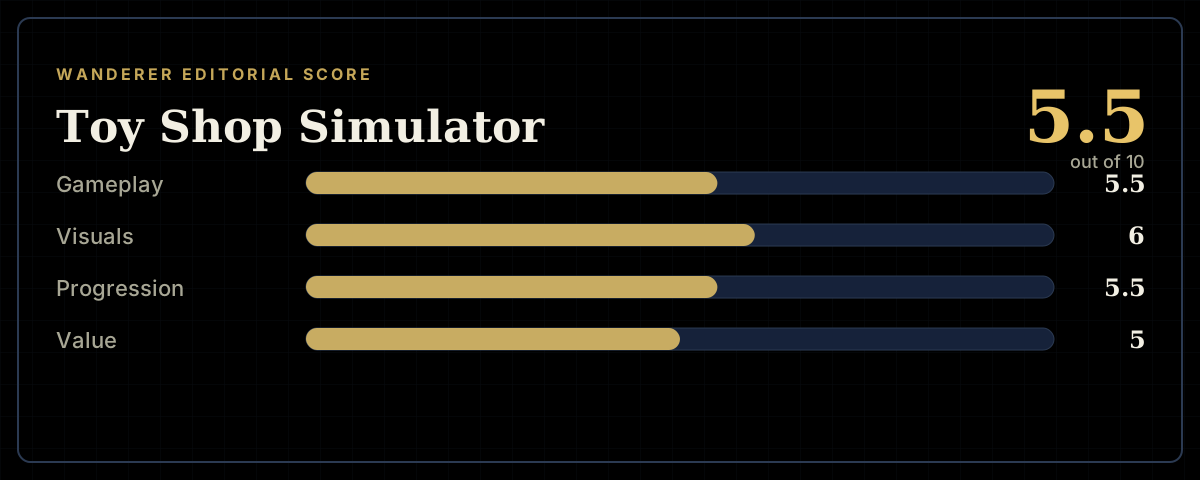
How the review scores each part of the gameWanderer Editorial -
The short versionWanderer Editorial