
Game review
Townscaper
6.5 / 10
- Developer
- Oskar Stålberg
- Publisher
- Raw Fury
- Released
- 26 August 2021
- Platforms
- Windows, macOS
- Genre
- Building Toy / Sandbox
- Monetisation
- Paid, one-time purchase. No in-app purchases.
- Players
- Single-player only.
The short version
Townscaper lets players click to grow charming, procedurally generated coastal towns across floating islands, and its Overwhelmingly Positive rating from more than 10,600 reviews reflects a real, near-universal delight in watching its algorithm turn simple clicks into cohesive architecture. What holds this review back is an extremely consistent complaint that the experience is thin: there's no click-and-drag placement, no control over terrain or grid shape, a single overall building style, and most reviewers report exhausting its novelty within thirty minutes to a few hours. Development has also been effectively dormant since a mid-2023 patch.
Biggest strengths
- A genuinely magical core algorithm that turns simple single clicks into cohesive, varied architecture, consistently described by reviewers as satisfying to watch unfold.
- A distinctive, calming low-poly art style with excellent lighting and colour, widely praised as some of the most purely beautiful procedural generation in any indie game.
- A low price point that most reviewers feel is fair for what is explicitly a toy rather than a full game.
Biggest weaknesses
- An extremely consistent complaint describes the placement system as tediously slow, since every tile must be placed with an individual click with no drag-to-build, multi-select, or undo beyond a single step.
- A well-corroborated complaint reports the game offers no control over terrain shape, grid layout, or building style, forcing every town into water-locked islands with one visual language regardless of player intent.
- Most reviewers, positive and negative alike, report exhausting the game's novelty within thirty minutes to a few hours, with nothing resembling objectives, progression, or long-term goals to sustain further play.
Who it's for: Anyone wanting a beautiful, low-stakes digital toy for short relaxing sessions or screenshot fodder; not for anyone expecting a genuine building game with objectives, variety, or ongoing content.
Our recommendation: A gorgeous, inexpensive toy worth its low price for a handful of relaxing sessions; go in expecting a short-lived novelty, not a game with lasting depth.
6.5 / 10
A genuinely magical core mechanic
Townscaper's central trick — turning a grid of single clicks into cohesive, self-assembling little towns — earns consistent, often rapturous praise across this review base, including from many reviewers who ultimately vote it down. "Okay, I'm gonna be honest. love this game, but I just can't recommend it. This game is really good, well for what it is," reads one review, a pattern repeated throughout this sample: genuine affection for the moment-to-moment act of watching a click become a roof, a staircase, a bridge between clusters of buildings, all generated procedurally with no two towns looking alike. A separate review frames the appeal specifically through a professional lens: "I like how relaxing and colorful this thing is. Simply just making buildings or looking at buildings make me happy, hence why I studied architecture." That combination of a genuinely inventive generative algorithm and a distinctive, calming low-poly aesthetic is real, and it's the reason the game's Overwhelmingly Positive score is well earned rather than inflated by low expectations.
An extremely consistent complaint about placement tedium
What dominates the critical portion of this review base overwhelmingly is a specific, mechanical complaint about how tiles are actually placed. "The dealbreaker - you can only build tiles by single clicking. Becomes chore real fast if you want to build a big city," reads one review, a frustration echoed with striking consistency across this sample. Another puts it more bluntly: "we NEED a way to place and remove more than one block at a time, and there just ISN'T. Imagine a paint program where you have to click. every. pixel. one. at. a. time." This isn't a stray complaint from a handful of dissatisfied players — checking a broad sample of negative reviews, the absence of drag-to-build or multi-tile placement is raised so often, in nearly identical language, that it reads as the single most avoidable design gap in an otherwise elegant toy. For a game whose whole appeal is watching towns grow at scale, forcing every individual tile through its own click is a real friction point that this review treats as a fair, well-corroborated criticism rather than mere impatience.
A well-corroborated complaint about lack of player control
A second, closely related complaint concerns how little control players actually have over what gets built. "You get no say in the grid shape that you can place things on, no say in the terrain," reads one review, and another lists the gap plainly: "you can't control where the doors are... you can't build proper bridges. you can't add greenery." A further review requests, reasonably given how long the game has been available, basics like "a Free camera mode" or a first-person view to actually walk through the towns being built. Every generated town uses the same visual language — Mediterranean-coastal, water-locked, one building style — and reviewers consistently note that the promotional material's apparent variety doesn't reflect the actual range available in play. This review treats the complaint as fair: a toy built entirely around one procedural template, with no player-facing knobs to meaningfully alter that template, has real ceiling.
Content runs out fast, and reviewers agree on roughly how fast
Distinct from the above, a widely repeated pattern in this review base concerns straightforward runtime. "Fun for like a hour," reads one review; another: "There is enough content to last about 30 minutes." A more detailed account states, "This game is fun for the first quarter or so. Perhaps an hour if you are dedicated to it," describing a daughter who lost interest quickly despite initial enthusiasm. Checking this review base broadly, estimates cluster consistently in the thirty-minutes- to-a-few-hours range, which this review treats as a genuine, well-corroborated data point about the game's actual longevity rather than an outlier complaint. Given the price point, several reviewers still consider that a fair trade, but it's a meaningfully shorter experience than the "sandbox you'll return to" framing some marketing implies.
Development has gone quiet since mid-2023
This review checked Oskar Stålberg and Raw Fury's own update history directly rather than relying on player assumption. The most recent substantive patch, v.1.20, shipped in July 2023; since then, the only newsworthy items are storewide sales and an August 2025 Steam Deck Verified badge, with no further gameplay content. That confirms, rather than merely repeats, a recurring player complaint: "the game is basically abandoned at this point and there aren't any more updates coming it seems," as one review puts it, and another lists specific asks — "A workshop - New type" of building set, mod support — that have gone unaddressed for years. For a toy this openly built around a single, finite generative template, the absence of any expansion in content variety since 2023 is a legitimate, verifiable strike against its long-term value, distinct from the shorter-session criticism above.
Final verdict
Townscaper is a genuinely lovely piece of generative design: its core click-to-build algorithm and low-poly aesthetic remain distinctive and satisfying, and its Overwhelmingly Positive score reflects real, earned affection rather than hype. What keeps this review's score moderate is an extremely consistent complaint about tedious, click-by-click placement with no faster alternative, a well-corroborated lack of control over terrain, layout, or building variety, short overall runtime by most reviewers' own accounts, and a development history that's been effectively dormant since mid-2023. This is a worthwhile, inexpensive pickup for a handful of relaxing sessions or a striking screenshot backdrop — not a game to expect ongoing engagement or growth from.
Pros and cons
Pros
- A genuinely magical core algorithm that turns simple single clicks into cohesive, varied architecture, consistently described by reviewers as satisfying to watch unfold.
- A distinctive, calming low-poly art style with excellent lighting and colour, widely praised as some of the most purely beautiful procedural generation in any indie game.
- A low price point that most reviewers feel is fair for what is explicitly a toy rather than a full game.
- Steam Deck Verified as of August 2025, giving it a genuinely comfortable handheld, couch-relaxation use case.
Cons
- An extremely consistent complaint describes the placement system as tediously slow, since every tile must be placed with an individual click with no drag-to-build, multi-select, or undo beyond a single step.
- A well-corroborated complaint reports the game offers no control over terrain shape, grid layout, or building style, forcing every town into water-locked islands with one visual language regardless of player intent.
- Most reviewers, positive and negative alike, report exhausting the game's novelty within thirty minutes to a few hours, with nothing resembling objectives, progression, or long-term goals to sustain further play.
- Development has been effectively dormant since a July 2023 patch, with reviewers repeatedly requesting features — a workshop, free camera, additional building sets, terrain variety — that have gone unaddressed for years.
Screenshots
-

TownscaperImage: Raw Fury via Steam -

TownscaperImage: Raw Fury via Steam -

TownscaperImage: Raw Fury via Steam -
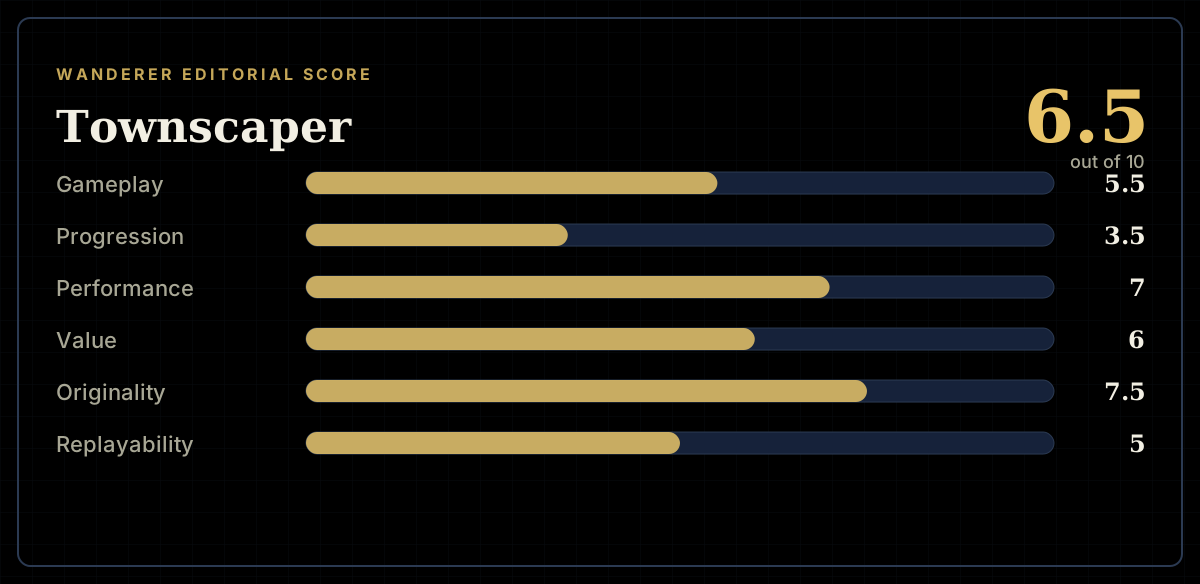
How the review scores each part of the gameWanderer Editorial -
The short versionWanderer Editorial