
Game review
Leafy Corner
7 / 10
- Developer
- Fireline Games
- Publisher
- Fireline Games
- Released
- 30 July 2026
- Platforms
- Windows, macOS
- Genre
- Cozy Management Sim
- Monetisation
- One-time purchase. No in-app purchases, no DLC, no premium currency. Listed at NZ$11.19, with launch-week discounting seen around US$7.99 — checked 4 August 2026.
- Players
- Single-player only
The short version
Grow plants, pot them, arrange a shop, sell to customers who wander in with specific requests. Leafy Corner does the cozy thing properly — the art is warm and readable, the loop is frictionless, it runs beautifully on a Deck, and the requests give you just enough direction to stop it becoming a screensaver. It's also over quickly. Players are reporting full completion in three to four hours, money stops mattering well before that, and the back half turns into watering hundreds of plants by hand because nothing in the game will do it for you. At eleven dollars that's a fair trade for a couple of very pleasant evenings, but go in knowing the shape of it.
Biggest strengths
- Genuinely lovely to look at, with a clean minimalist style that has won over players who normally dislike minimalism
- Customer requests give the sandbox a clear sense of direction without ever applying pressure
- Real breadth of plants, pots and decorations, and the variegation discovery system is a charming hook for anyone who likes the subject
Biggest weaknesses
- [object Object]
- No automation of any kind, so late-game play means hand-watering hundreds of plants and clicking every individual customer through checkout
- Money loses all meaning well before the end — players finish with five figures and nothing to spend it on
Who it's for: Cozy-game players who want something warm, short and undemanding, and anyone who actually likes houseplants — the plant variety is the point. Not for players who want a management sim with economic pressure, and not for anyone looking for a game to sink weeks into.
Our recommendation: Buy it if you want a relaxing four-hour game and the price is right; it's polished, charming and does exactly what it says. Don't buy it expecting a deep shop sim — there's no staffing, no automation, no pest or care systems, and once you've unlocked the expensive plants and pots there's nothing left to work towards. It's an excellent evening, not a hobby.
7 / 10
Leafy Corner has three negative reviews in English. Three, out of nearly five hundred. That is not a typo, and it isn't a fluke either — this is a small, warm, competently made game that does precisely what it promises and costs about eleven dollars.
So the interesting question isn't whether it's good. It's why so many of the people recommending it spend their review explaining what they wish it also had.
The loop
You run a plant shop. Seeds become plants, plants go into pots, pots go on shelves you've arranged, and customers wander in either to browse or with a specific request — something pet-friendly, something trailing, something in a particular pot. Fill the request, gain reputation, unlock more species and more furniture, expand the floorspace, repeat.
It's frictionless in the way cozy games need to be, and the requests are the smartest thing in it. A pure decoration sandbox gets boring because nothing is asked of you; a management sim gets stressful because too much is. Requests thread that needle — they give you a goal each time someone walks in, and there's no penalty worth worrying about if you can't meet it.
The subject matter carries a lot too. There are a lot of plants, they're recognisably real ones, and the variegation discovery system taps into exactly the thing that makes people collect houseplants in the first place. If you own more than four pot plants, this game knows what it's doing to you.
It's also technically tidy in a way small releases often aren't. Well optimised, sensible in windowed mode, and Steam Deck Verified on launch day — which for a game you'd play in the evening on a sofa is more relevant than it sounds.
Where it stops
Here's the pattern in the reviews, and it's remarkably consistent. Someone writes four paragraphs of praise and then adds a list. Please let me hire someone to water the plants. Please let me duplicate an arrangement. Please add a filter to the catalogue. Please let me expand further. And underneath almost all of them: I finished everything in about four hours.
Two separate reviewers report 100% completion in three to four hours. The achievement data agrees — 96.5% of players made their first sale, 12.1% have hit maximum base reputation, and the drop-off between those numbers isn't difficulty, it's people running out of things to unlock.
The specific failure is that the game builds a shop but never builds an economy. By the end players are sitting on five figures with nothing to buy. There's no upkeep, no rent, no wages, no risk, no reason to prefer one strategy over another. Once you've unlocked the expensive plants and the expensive pots, the only remaining verb is more, and the game hasn't given you anything to do with more.
The automation gap
The tedium complaint deserves separating out, because it's the one that turns a short game into a slightly wearing one.
Nothing in Leafy Corner automates. You water each plant. You click each customer through checkout. That's fine when you have a dozen plants and a handful of customers a day — it is the game. It stops being fine at the point where you own hundreds of plants, which the game actively encourages, because the exact same clicking now takes ten times as long and produces money you don't need.
This is the design problem every management game eventually meets, and the standard solution is staff: you hire someone to do the thing you've stopped enjoying, pay them out of the money that had become meaningless, and the currency gets a purpose again. It would fix two of this game's three biggest problems at once. Its own players keep proposing it, unprompted, in five-star reviews.
For comparison, Stardew Valley hands you sprinklers precisely when watering by hand stops being charming. That's not a deep insight, it's just the lesson of the genre — and it's the main thing standing between this game and a much higher score.
Four hours is a fair length. It's the price tag that decides.
It's worth resisting the reflex that short equals bad, because the cozy genre has quietly become one of the worst offenders for the opposite problem — sixteen-dollar shop sims padded with a hundred hours of repetition nobody enjoys, where the "content" is the same transaction repeated until an unlock bar fills.
Leafy Corner doesn't do that. It gives you four genuinely pleasant hours and then it's honest enough to be finished. Priced around eleven dollars, that's a better deal than a lot of its competitors offer at twice the money, and the reviews reflect it — the players calling it short are overwhelmingly still recommending it.
Where that logic breaks is on the tedium. A four-hour game that stays enjoyable for four hours is good value. A four-hour game whose final ninety minutes are spent hand-watering a collection you were encouraged to build is selling you an afternoon and then filling part of it with admin. That's the distinction worth holding onto when you weigh the price: you're not buying too little game, you're buying a game whose last act is its weakest.
So the sale price matters more here than it usually does. Around eight dollars this is an easy yes. At full price it's still fine, and you should simply plan to stop when the clicking starts to feel like a chore rather than a hobby — the game won't tell you when that moment arrives, but you'll know.
What it's worth
7.0 out of 10. Rated 7.0 out of 10.
Judged as what it actually is — a polished, generous-hearted, eleven-dollar cozy game that gives you a very pleasant afternoon and evening — Leafy Corner is a straightforward recommendation, and the 98% is honestly earned. Nobody is going to feel cheated at this price, and the craft on display is real.
Judged as a management sim, it's incomplete. There's no economic pressure, no care systems with teeth, no automation, and no endgame beyond decorating a shop you've already finished stocking. The things its fans keep asking for are not exotic requests — pests, light and humidity needs, repotting as plants grow, hiring staff — they're the systems that would turn four good hours into forty.
The developers patched within three days of launch, so there's every sign they're still working. If a content update lands with staff and plant-care depth, this becomes an easy 8. Right now, buy it for what it is: a small, kind game about plants that respects your evening and doesn't pretend to want your month.
Pros and cons
Pros
- Genuinely lovely to look at, with a clean minimalist style that has won over players who normally dislike minimalism
- Customer requests give the sandbox a clear sense of direction without ever applying pressure
- Real breadth of plants, pots and decorations, and the variegation discovery system is a charming hook for anyone who likes the subject
- Technically excellent for a small release — well optimised, good windowed-mode behaviour, and Steam Deck Verified on day one
- Priced honestly at around eleven dollars rather than the fifteen-to-twenty the genre often asks
- Almost universally liked — 98% positive, with only three English-language negative reviews in the entire corpus
Cons
- [object Object]
- No automation of any kind, so late-game play means hand-watering hundreds of plants and clicking every individual customer through checkout
- Money loses all meaning well before the end — players finish with five figures and nothing to spend it on
- Plant care has no depth: no light or humidity needs, no pests, no pruning, no repotting as plants grow
- Shop expansion runs out while you still have things you want to place
- Interface gaps add friction — no catalogue filter, limited camera rotation that makes one wall awkward to reach, and no scroll-wheel furniture rotation
Screenshots
-
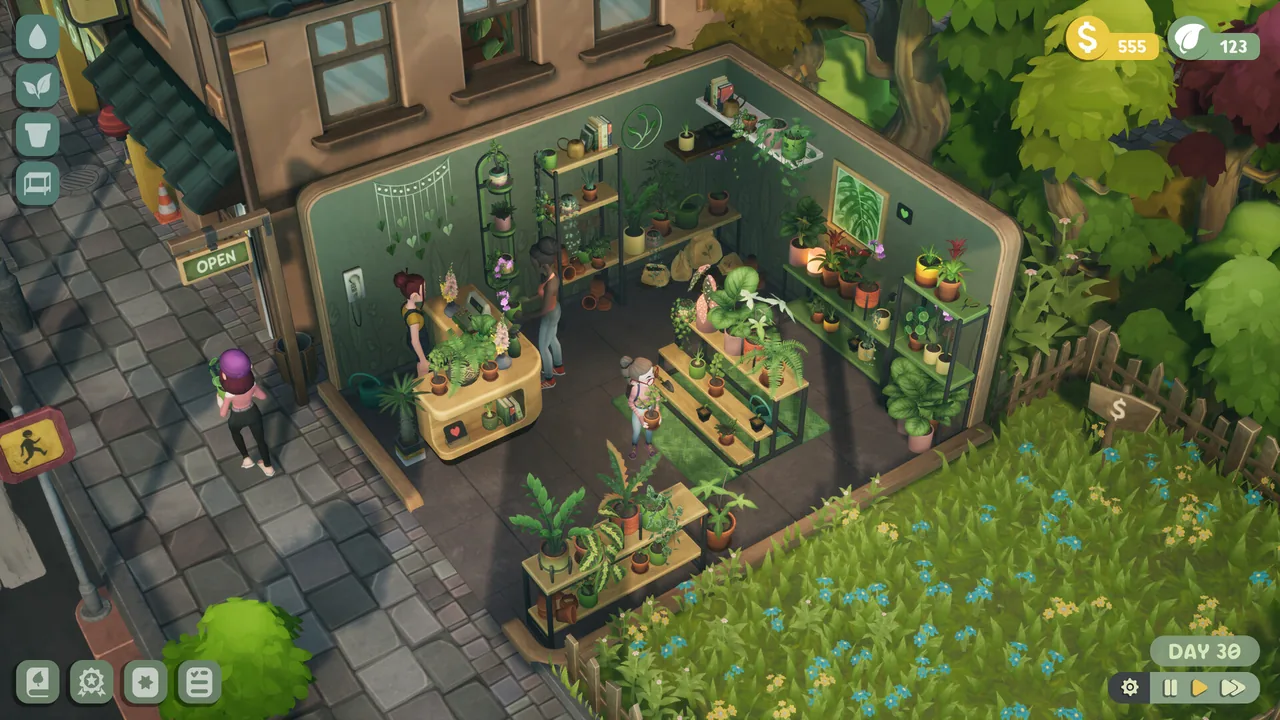
Leafy CornerImage: Fireline Games via Steam -
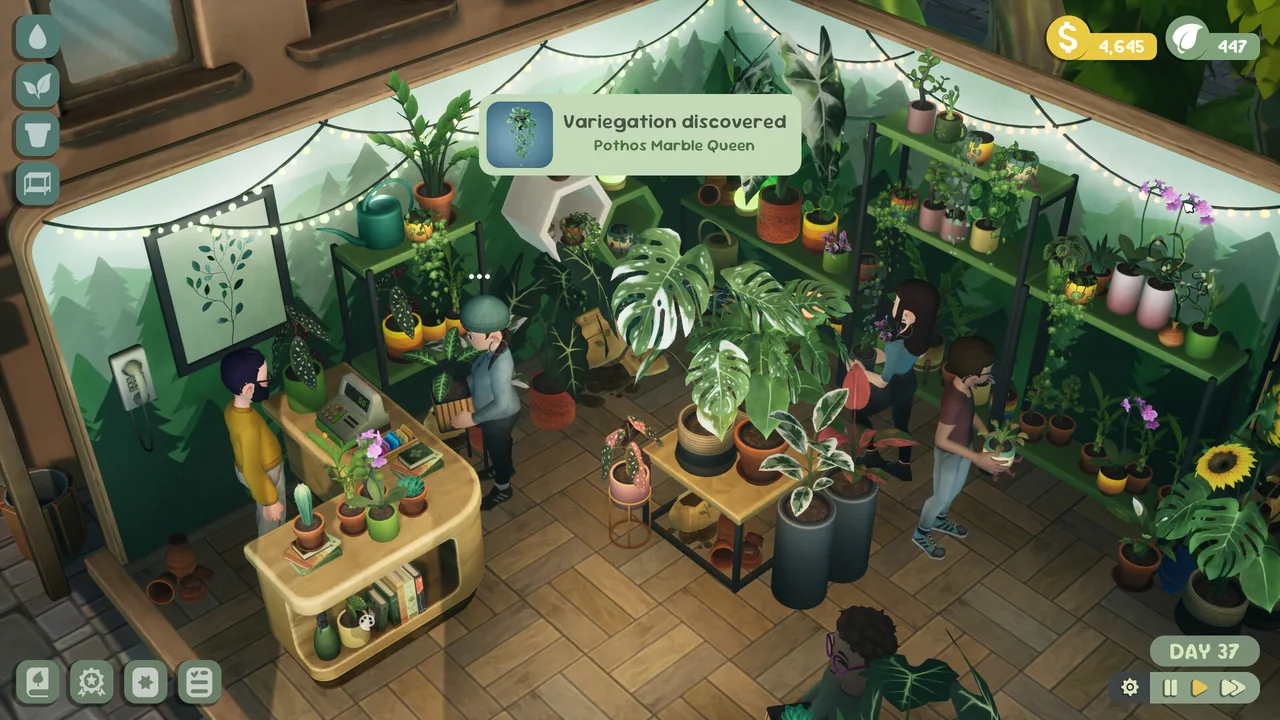
Leafy CornerImage: Fireline Games via Steam -
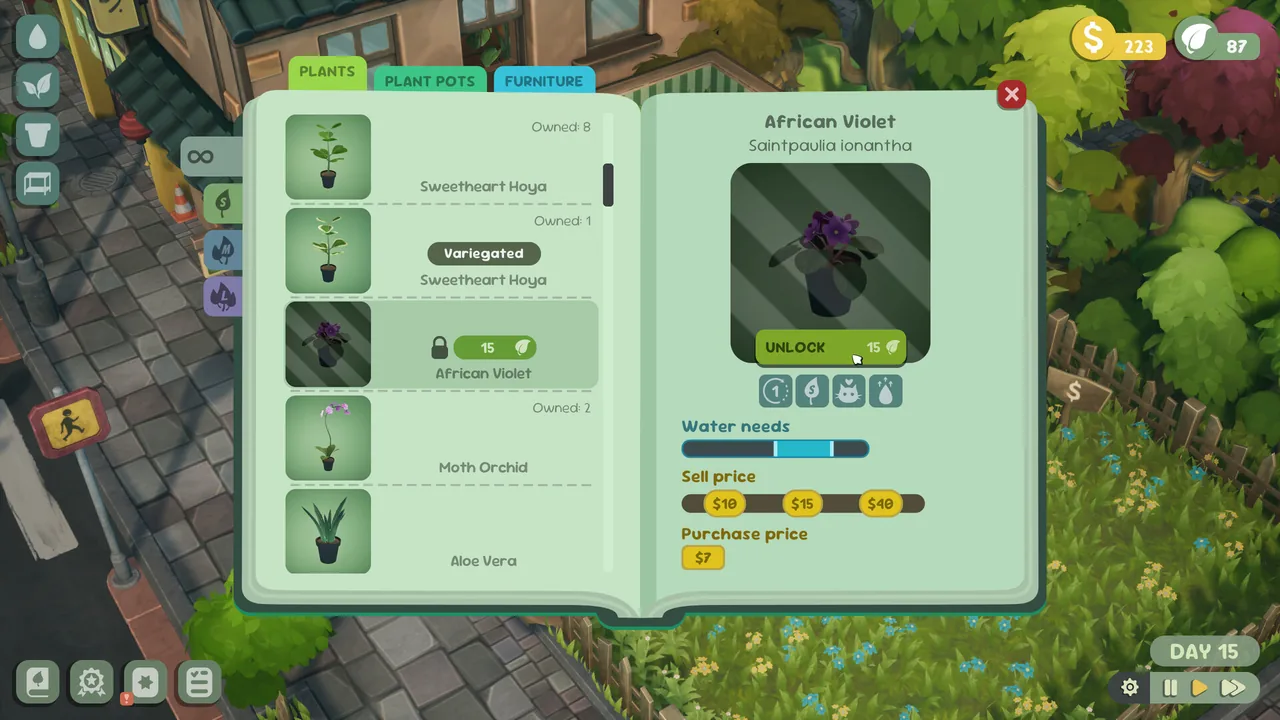
Leafy CornerImage: Fireline Games via Steam -
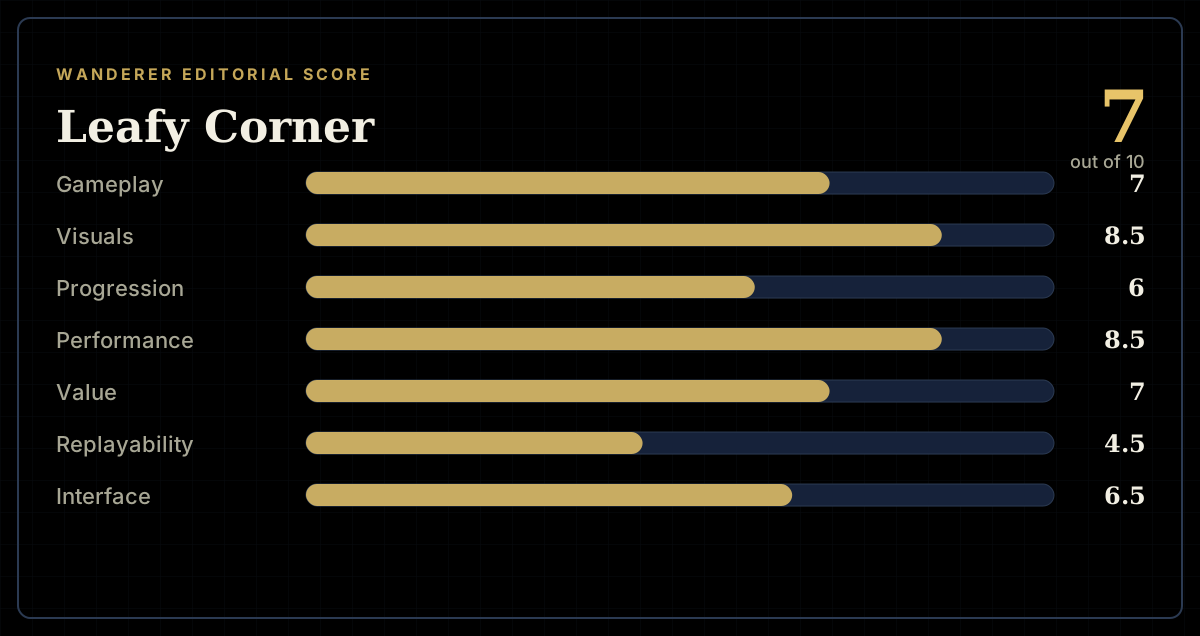
How the review scores each part of the gameWanderer Editorial -

The short versionWanderer Editorial