
Game review
Touhou Luna Nights
7.5 / 10
- Developer
- Team Ladybug
- Publisher
- WSS playground, Alliance Arts
- Released
- 25 February 2019
- Platforms
- Windows
- Genre
- Action
- Monetisation
- Paid, no in-app purchases found
- Players
- false
The short version
Touhou Luna Nights casts players as Sakuya Izayoi, the knife-wielding, time-manipulating maid of the Scarlet Devil Mansion, investigating a mystery through a Castlevania-inspired Metroidvania built by fan studio Team Ladybug. Its combat, time-stop mechanics, pixel art and Touhou-track remix soundtrack draw some of the most enthusiastic, specific praise this lane has documented, explicitly winning over players with zero prior knowledge of the source material. A detailed, structurally precise minority pushes back hard on the genre label itself, arguing the linear map, minimal backtracking and forgiving difficulty don't actually deliver what 'Metroidvania' promises.
Biggest strengths
- Fast, precise combat built around time-slow and time-stop mechanics that reviewers across the board call some of the best-feeling action in the genre, frequently compared to Castlevania: Symphony of the Night and Metroid: Aria of Sorrow
- A widely and specifically praised soundtrack of Touhou Project track remixes, described by multiple reviewers as deserving recognition well beyond the fangame space
- Genuinely accessible to complete newcomers to the Touhou franchise, with many reviewers explicitly confirming no prior knowledge is needed to enjoy the combat and world
Biggest weaknesses
- A detailed, structurally specific critical contingent argues the game barely qualifies as a Metroidvania at all — a small, linear map, minimal meaningful backtracking, and traversal abilities that mostly just unlock the next area rather than opening genuine exploration
- A real, specific difficulty complaint: bosses are widely described as too easy, undermined further by generous health regeneration, a very small player hitbox, and the complete absence of a difficulty option
- At least one detailed reviewer argues the time-stop mechanic, praised elsewhere as the game's signature feature, actually breaks its own challenge by functioning as something close to temporary invincibility
Who it's for: Metroidvania and Castlevania: Symphony of the Night fans drawn to fast, precise combat, whether or not they know anything about the wider Touhou Project franchise.
Our recommendation: An easy recommendation for the combat and presentation alone — just don't go in expecting deep exploration or a serious challenge, since a detailed contingent argues neither is really here.
7.5 / 10
What it is
Touhou Luna Nights is a fan-made Metroidvania set within the world of the Touhou Project bullet-hell shooter series, developed by Team Ladybug and centered on Sakuya Izayoi, the time-manipulating head maid of the Scarlet Devil Mansion. Rather than the vertical-scrolling bullet-hell format the source material is known for, Luna Nights reimagines that world as a side-scrolling action-exploration game built around Sakuya's signature knife-throwing combat and her ability to slow or briefly stop time entirely, both in and out of combat. It released on 25 February 2019 at NZD 22.79.
Its review corpus — 4,757 English-language reviews sitting at an exceptional 97.8% positive — is among the most lopsided this lane has documented, and reading through it reveals a genuinely distinctive quality: enthusiasm this specific and consistent, from players with no prior connection to the source franchise, isn't easily dismissed as pure fan bias. That said, a smaller, unusually detailed critical minority raises structural questions worth taking seriously on their own terms.
Combat and presentation that win over skeptics
The corpus's praise is remarkably specific rather than generic. "No idea who the hell all these characters are and why they all know each other, but even non-weebs can enjoy it, very solid metroidvania with great controls and mechanics," writes one of the most-upvoted reviews, a framing echoed independently across dozens of others explicitly confirming no Touhou knowledge is required. Comparisons to genre benchmarks recur constantly and specifically: "the game feels and controls almost like Aria of Sorrow," writes one detailed reviewer, while another calls it "the most original Metroidvania game I have ever played since Symphony of the Night." The soundtrack draws its own distinct, repeated praise — "the soundtrack should be put in a museum," writes one reviewer, a sentiment echoed by several others independent of their feelings on the gameplay itself. One reviewer's account is a small but telling data point about the goodwill this game generates: "I pirated this game about a year ago and decided to buy it to give the devs the money they deserved," they write, addressing the small studio directly by name.
A detailed, precise case that it isn't really a Metroidvania
Set against that enthusiasm, a smaller but unusually rigorous critical contingent raises a specific, structural objection rather than a matter of taste. "It's hardly Metroidvania. There's no equipment," writes one reviewer, elaborating that the game feels more like "a chore than addicting" once its core hook wears thin. A separate, more detailed review — explicitly framed as a critique for buyers "looking for critiques before buying" rather than a hostile takedown — makes the case precisely: "it gets the feel of traversal right, but it's a tiny map, very linear, and almost no backtracking," with unlocked abilities serving mainly to reach "the next section" rather than opening meaningful new paths through previously visited areas. That's a specific, checkable structural claim about genre conventions rather than a vague complaint, and it's echoed independently by a third reviewer who calls the game "completely devoid of any actual 'Metroidvania' mechanics beyond the most basic of colored door needs colored key."
A difficulty complaint aimed at the game's own signature mechanic
A separate, equally specific critical thread concerns difficulty balance. "The game blew it with far too easy boss fights," writes one detailed reviewer, citing "an extremely small hitbox" for the player character and "super generous" health regeneration, compounded by the complete absence of a difficulty option for players wanting more challenge. Strikingly, at least one reviewer directs this complaint specifically at the time-stop mechanic other reviews praise as the game's best feature, arguing its combat-difficulty "gets undermined by its own mechanics that basically just give you infinite health" when used liberally — a specific, mechanically literate critique of exactly the system most positive reviews single out as the highlight.
A pointed claim about the score itself
Worth flagging directly: at least one detailed reviewer makes an explicit argument about the review corpus rather than just the game, stating "if this game didn't have the Touhou license attached to it there is no way it would have 'Overwhelmingly Positive' reviews," while still describing genuine affection for the franchise and moment-to-moment combat feel. That's a claim about aggregate review scores specifically worth naming rather than ignoring — a reminder that a licensed fangame's rating can reflect enthusiasm for its source material as much as its own standalone design, even when, as here, many individual reviews explicitly confirm enjoying the game without prior franchise knowledge.
What the achievement data adds to the length and structure debate
The completion curve across Touhou Luna Nights's 22 achievements offers a useful data point for the "is this really a Metroidvania" debate. Early achievements sit high — 86.8% and 81.6% — descending through a real mid-game (68.1%, 54.8%, 49.5%) before falling to a 5-8% range for the hardest, optional-boss-tied achievements. That's a notably compact spread compared to longer Metroidvanias this lane has covered, with the bulk of players clearing a large majority of the game's content rather than a steep, late cliff separating casual players from committed ones. That shape is consistent with both the "short" complaint (there simply isn't as much late-game content to create a long tail) and, indirectly, the "too easy" complaint — a game whose hardest achievements still sit at 5% rather than closer to 1% suggests its ceiling of difficulty, even at the very top, remains comparatively reachable for a meaningful share of its audience.
Reconciling enthusiasm with a fair structural critique
It's worth being clear that the detailed critical reviewers quoted above aren't arguing the game is bad — several explicitly praise the combat feel, art and music in the same reviews raising their structural concerns. Their argument is narrower and more specific: that "Metroidvania" as a genre label implies a particular kind of interconnected, backtracking-driven exploration that this game, despite borrowing the format's surface conventions (a connected map, unlockable traversal abilities, colour-coded gates), doesn't actually deliver in practice. That's a genre-definition argument worth taking on its own terms rather than folding into a simple thumbs-up-or-down quality judgment — a player who specifically wants deep exploration and backtracking may come away disappointed even while enjoying every individual combat encounter, and that's a real, useful distinction for anyone deciding whether this particular game matches what they're looking for.
Verdict
Touhou Luna Nights delivers combat, presentation and music polished enough to win over players with zero investment in its source material, and that crossover appeal is real and well-documented rather than an illusion of fan enthusiasm alone. But a detailed, specific minority makes a fair case that its Metroidvania structure is thinner than advertised and its difficulty undercut by its own central mechanic — worth knowing before buying, even for an experience most players are likely to come away from smiling regardless.
Pros and cons
Pros
- Fast, precise combat built around time-slow and time-stop mechanics that reviewers across the board call some of the best-feeling action in the genre, frequently compared to Castlevania: Symphony of the Night and Metroid: Aria of Sorrow
- A widely and specifically praised soundtrack of Touhou Project track remixes, described by multiple reviewers as deserving recognition well beyond the fangame space
- Genuinely accessible to complete newcomers to the Touhou franchise, with many reviewers explicitly confirming no prior knowledge is needed to enjoy the combat and world
- Distinctive, polished pixel art and animation that reviewers consistently praise as a highlight independent of the gameplay debate
Cons
- A detailed, structurally specific critical contingent argues the game barely qualifies as a Metroidvania at all — a small, linear map, minimal meaningful backtracking, and traversal abilities that mostly just unlock the next area rather than opening genuine exploration
- A real, specific difficulty complaint: bosses are widely described as too easy, undermined further by generous health regeneration, a very small player hitbox, and the complete absence of a difficulty option
- At least one detailed reviewer argues the time-stop mechanic, praised elsewhere as the game's signature feature, actually breaks its own challenge by functioning as something close to temporary invincibility
- Multiple reviewers independently and directly argue the game's Overwhelmingly Positive score reflects Touhou fan enthusiasm more than the game's standalone design merit, a specific claim about the review corpus itself worth weighing before treating the aggregate score as a pure quality signal
- A short overall runtime that even enthusiastic reviewers acknowledge, with several wishing for meaningfully more content once the credits roll
Screenshots
-

Touhou Luna NightsImage: WSS playground via Steam -

Touhou Luna NightsImage: WSS playground via Steam -

Touhou Luna NightsImage: WSS playground via Steam -
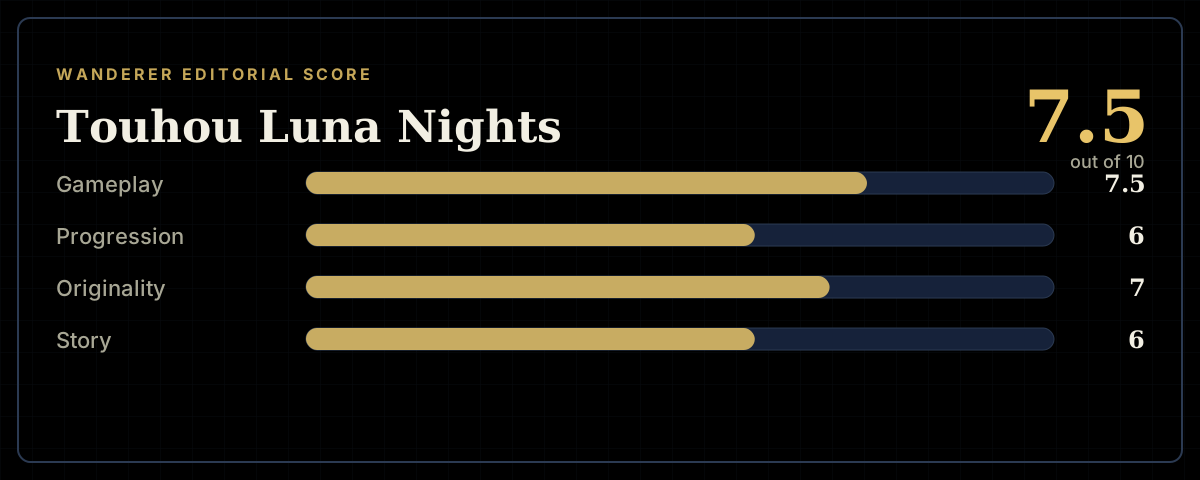
How the review scores each part of the gameWanderer Editorial -
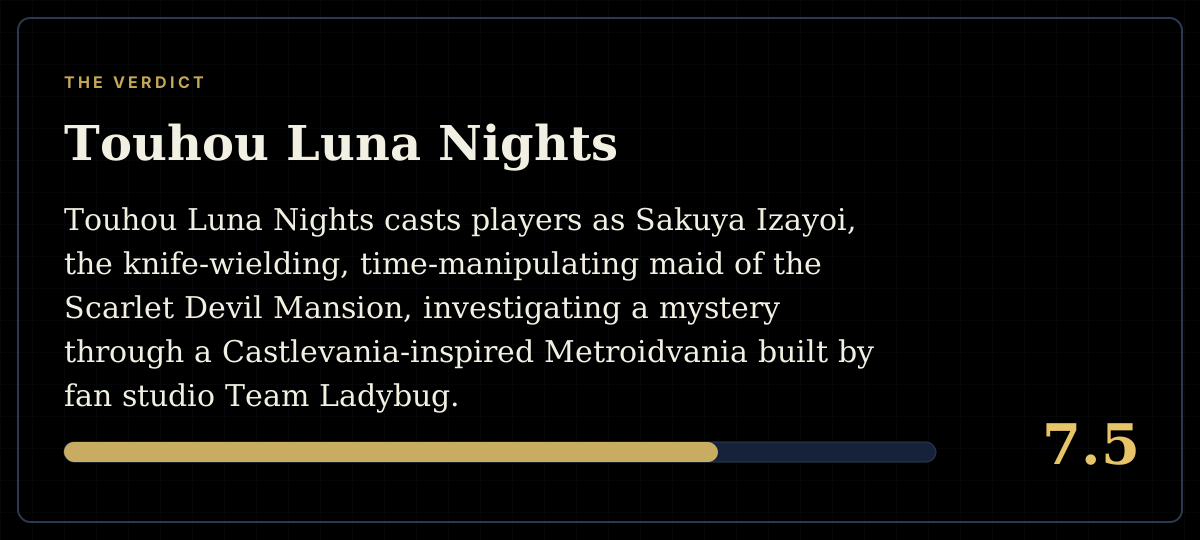
The short versionWanderer Editorial