
Game review
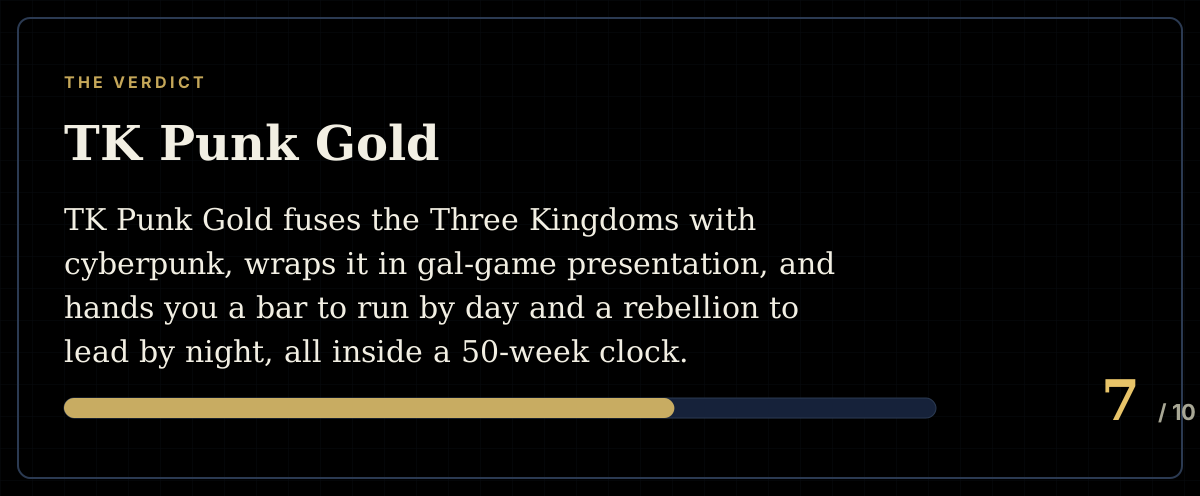
TK Punk Gold
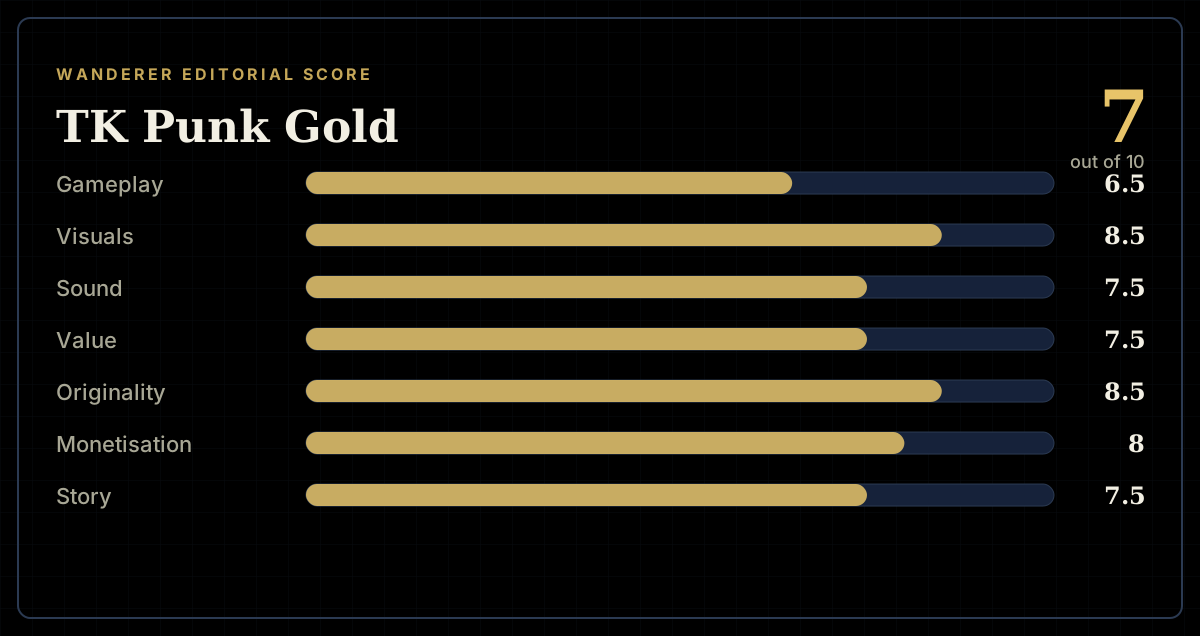
7 / 10
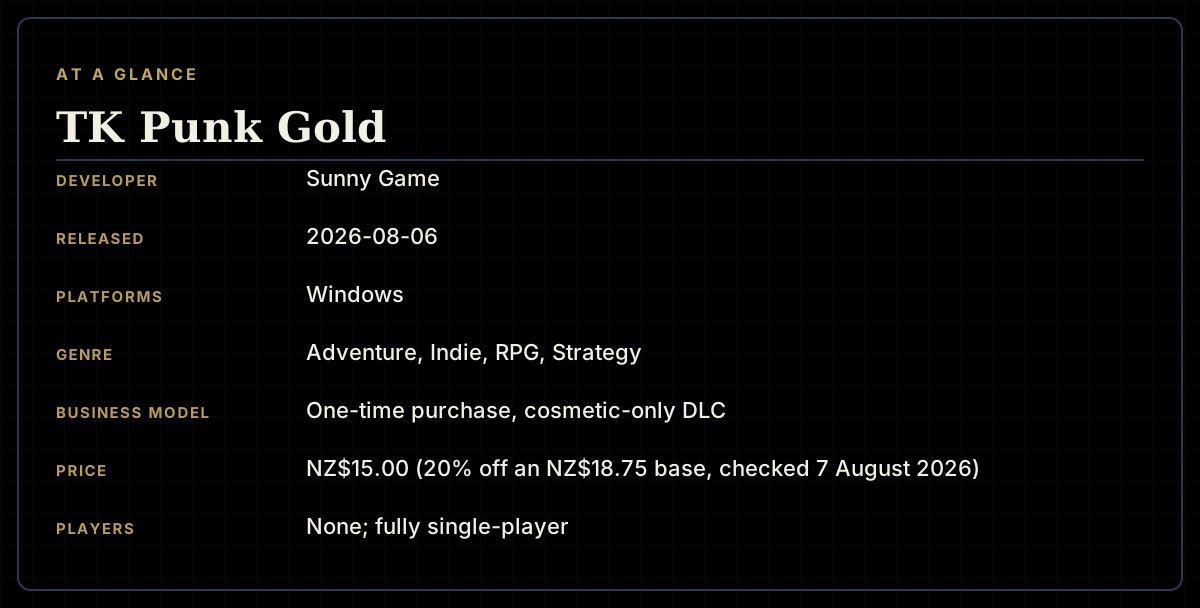
- Developer
- Sunny Game
- Publisher
- Moyu Youxi
- Released
- 6 August 2026
- Platforms
- Windows
- Genre
- Adventure, Indie, RPG, Strategy
- Monetisation
- One-time purchase, cosmetic-only DLC
- Players
- None; fully single-player
The short version
TK Punk Gold fuses the Three Kingdoms with cyberpunk, wraps it in gal-game presentation, and hands you a bar to run by day and a rebellion to lead by night, all inside a 50-week clock. This review read all 29 of the game's reviews in full, small enough to cover completely a single day after launch, in Simplified Chinese, Traditional Chinese and Japanese — there are no English reviews yet.
The praise is specific rather than vague: character art and Live2D presentation, a genuinely distinctive genre mashup, a full voice cast, and a near-death "outfit damage" system reviewers say is executed with more care than a cheap gimmick. Set against that, a detailed longform review argues the turn-based combat buries real strategy under stacks of buffs and RNG, and two Japanese reviewers — both with meaningful vote counts in this small sample — report that despite Japanese appearing as a supported language, the tutorial and item text remain in Chinese or read as machine translation.
Biggest strengths
- A genuinely distinctive premise — Three Kingdoms warlords reimagined as cyberpunk bishoujo, running a bar by day and a rebellion by night on a 50-week clock — that reviewers repeatedly single out as the reason they bought in
- Character art and Live2D presentation draw specific, repeated praise, including idle breathing and blinking on portraits and distinct designs for each reimagined Three Kingdoms figure
- A full voice cast credited across the roster, which multiple reviewers call out by name as elevating scenes beyond static gal-game dialogue boxes
Biggest weaknesses
- A detailed, highly-voted review argues combat skills stack so many simultaneous buffs and debuffs that fights stop feeling strategic and start turning on stat totals and hit/crit RNG, to the point the reviewer switched to Easy mode and saw no meaningful difference
- Two Japanese-language reviews, together carrying the most votes of any reviews in this small sample, report that despite Japanese being listed as a supported language, tutorial text and item descriptions remain in Chinese or read as raw machine translation; one reviewer says they refunded over it
- A refund-flagged review describes a small backpack with no warning when full, causing loot to go uncollected mid-mission, alongside new-character unlocks gated entirely behind fixed story beats rather than player choice
Who it's for: Fans of Three Kingdoms bishoujo games, turn-based gal games with management-sim layers, and character-collection RPGs with a heavy fan-service lean — less so players who want combat depth to be the main event, or Japanese-language players relying on the store's language listing.
Our recommendation: Worth a look for genre fans who know what they're signing up for, with two clear caveats going in — the combat draws real criticism for RNG and buff clutter, and Japanese-language support is currently reported as unreliable despite being listed on the store page.
7 / 10
Three Kingdoms fiction has been remixed into countless bishoujo franchises before, and cyberpunk has swallowed just about every genre it's touched, but TK Punk Gold's specific combination is still a genuine surprise: Zhang Jiao, Liu Bei, Cao Cao and a roster of reimagined Three Kingdoms figures rebuilt as a cyberpunk resistance cell, run through a turn-based RPG, a bar-management sim and a gal game all at once, on a 50-week countdown clock. This review read all 29 of the game's reviews in full — a small enough sample to cover completely, one day after its 6 August 2026 launch — split across Simplified Chinese, Traditional Chinese and Japanese, with no English reviews yet on record.
A three-genre collision that mostly lands
The premise, as Steam's own store copy lays it out: Hanport City is run by the corrupt Eastern Han Group, whose digital-immortality "continuation" scheme has provoked a resistance movement called GOLD, led by Zhang Jiao. You play a humanoid AI rescued from a Han Group research lab, installed as acting manager of a bar called the Gold Bar, and quietly running rebel commissions on the side while thirteen reimagined Three Kingdoms women join your squad over the course of fifty in-game weeks. Reviewers describe the loop in consistent terms: split your limited weekly action points between combat missions, character bonding, equipment crafting and business upkeep, then watch four different main-story endings and a set of character-specific endings branch off your choices.
That mashup draws the most consistent praise in the sample, and it's specific rather than generic. One reviewer calls out the neon-and-chrome aesthetic layered onto Three Kingdoms iconography directly — "neon tubes plus mechanical prosthetics plus Three Kingdoms figures" — and notes every major historical character has been given a one-to-one cyberpunk analogue, each with their own voice actor. Another, more experienced with the genre, places it against a specific lineage of Chinese-developed Three Kingdoms bishoujo titles and gacha-adjacent "warship girl" frameworks, concluding the execution earns a recommendation for anyone who already likes that particular corner of the hobby. A Traditional Chinese review — one of the more detailed and highly-voted in the sample — separately praises how well the Three Kingdoms narrative has been folded into the cyberpunk setting specifically, distinct from just borrowing the character names.
The fan-service hook, and what it actually is
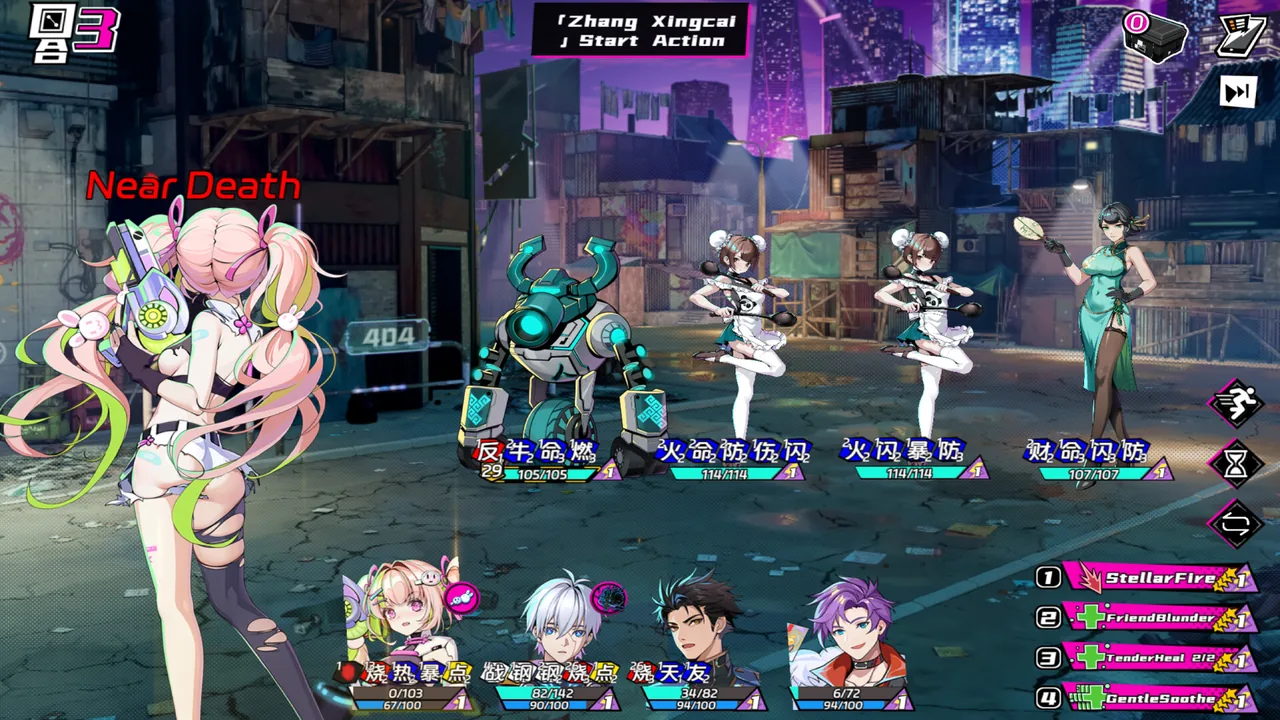
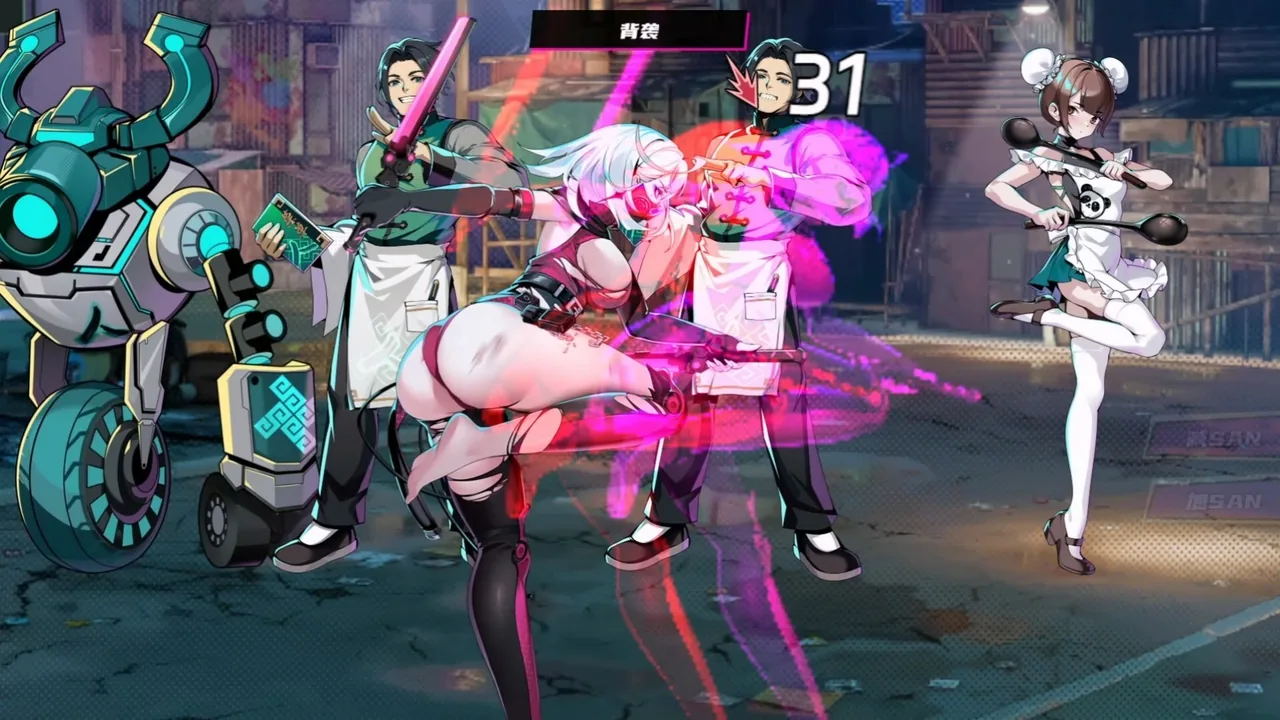
TK Punk Gold's own store description leads with its most talked-about system: characters take visible "outfit damage" as they approach death or enter a heightened combat state the game calls Cyber Frenzy, alongside physics-driven hit reactions the developer frames as part of making combat feel more visceral. Several reviewers treat this as the game's headline selling point rather than an afterthought, and more than one goes out of their way to say it's executed with more care than a simple two-stage clothing swap — poses, expressions and dialogue shift alongside it, and it's paired with idle animation on character portraits (breathing, blinking) that reviewers say makes the Live2D-style art feel more alive than a typical static visual novel.
Read across the full sample, the reaction to this system is enthusiastic but not uncomplicated. One reviewer specifically asks for the effect to extend to armoured female enemies, and separately requests a front-facing camera angle during combat rather than the current profile view — a concrete, specific piece of feedback rather than blanket praise. Another says they were drawn in purely by the art and came away slightly let down that the game's content didn't go as far as they expected, while still rating the overall experience positively. It's worth being precise about what this review can and can't confirm here: Steam's own content descriptor field for this listing returned empty at the time of this review, meaning no official mature-content disclosure accompanies a mechanic the developer's own store copy foregrounds. One critical reviewer frames the whole approach cynically, arguing the game leans hard on suggestive marketing without following through — that specific complaint carried real weight in the sample by vote count, though this review can't independently verify the business claims bundled into it, so it's reported here only as a documented sentiment, not a confirmed fact.
Combat: ambitious, and possibly overstuffed
The most substantive critical review in the sample is also the most useful one for gauging whether the combat holds up on its own terms, separate from the presentation around it. A long, detailed Traditional Chinese review — titled, translated, "art crafted with care, systems stacked with force, combat that comes down to luck" — praises the writing, character growth, equipment crafting and Live2D presentation without reservation, then argues the turn-based combat loses the plot. Character skills frequently carry several simultaneous effects, the reviewer says, so a single fight can leave a character carrying dozens of stacked positive and negative buffs at once — complexity that, in their account, never translates into a genuine sense of strategy, because outcomes still come down mostly to character and equipment stats plus hit-and-crit RNG. They describe switching to Easy mode assuming they'd simply misplayed, only to get the same swingy results, and say only their interest in the story and the review itself kept them playing through it.
That account matters more than a single star rating because of how specific and internally consistent it is — it isn't a drive-by complaint, and it sits alongside real praise for the same game's other systems from the same reviewer. Other reviewers corroborate pieces of the picture from different angles: one flags a small backpack with no warning when it's full, meaning loot earned mid-mission can go uncollected without the player realizing until later, and separately notes enemy squad sizes shift between three and four members without an obvious pattern. A different reviewer describes the difficulty as genuinely demanding rather than superficial busywork, saying resource, stat and character-growth planning all matter — read together with the buff-stacking critique, the fair read is a combat system whose difficulty is real, but whose legibility is still a work in progress.
Localization is the sharpest, most verifiable problem
Steam's own listing for TK Punk Gold names Simplified Chinese, English, Japanese and Traditional Chinese as supported languages, with Simplified and Traditional Chinese singled out as carrying full voice acting. Set against that claim, two of the three Japanese-language reviews in this sample are negative, and together they carry more votes than any other review pair in a very small corpus. One reviewer says calling this "Japanese support" is close to fraudulent — commands and UI text go largely unexplained, and even the kanji used reads as wrong or confusing compared to other Chinese-developed games they've played in Japanese. The second is blunter still, describing having wishlisted the game after seeing a trailer, buying it on release, and refunding it the same day after finding tutorial explanations absent and dialogue translations reading as raw machine output.
This is the single most concrete, verifiable problem this review found in the sample, precisely because it doesn't rely on translating tone or reading between the lines — it's a specific, repeated technical claim from players actually trying to use the feature as advertised. It's also worth flagging what this review can't tell you: there are no English-language reviews at all yet, so nothing in this sample speaks to whether the English text holds up any better. Anyone buying specifically for English or Japanese text should treat the store's language listing as unconfirmed until more reviews land.
A long road to a Day 1 launch
TK Punk Gold's Steam app ID and news history stretch back to a first announcement in February 2024, followed by a first closed test in September 2024, a second closed beta in August 2025, and a public demo released for Steam Next Fest in October 2025. One reviewer specifically recalls playing that earlier demo, noting it already contained a full ten weeks of content on the game's internal clock — a fraction of the fifty weeks in the finished release, which they read as reassurance the full game has real length rather than being padded out from a short demo loop. That two-and-a-half year runway, moving from closed tests through a public demo to a single Day 1 full release rather than a formal Steam Early Access period, is a genuinely different shape than most solo or small-studio launches this library covers, and it shows in the sample: reviewers describe a finished-feeling amount of content — 85 Steam achievements, four main-story endings plus character-specific ones, eight to thirteen playable companions depending on how you count squad versus story roles — even while flagging real rough edges in how the combat and localization currently work.
Achievement data this early tells you almost nothing about where players are stalling — the game launched a single day before this review, and the highest completion rate sits at 44.8% for an early character-recruitment achievement, falling off sharply from there. That's expected for a Day 1 sample on a fifty-week game and shouldn't be read as evidence of anything yet.
Value and monetisation
On the commercial side, there's little to criticize. TK Punk Gold sells as a one-time purchase — NZ$15.00 at the time of this review, discounted 20% off an NZ$18.75 base — with a single day-one DLC pack, a swimsuit skin bundle for three characters priced at NZ$6.39, and no review in the sample mentions an in-game store, currency or any other monetisation friction. Set against reviewer reports of fifty weeks of content, multiple endings, thirteen companions and 85 achievements, this reads as a fair, unambiguous one-time-purchase RPG rather than anything designed around post-purchase spending.
Final verdict
TK Punk Gold earns its Positive reception through a genuinely distinctive premise, executed with real visual and audio polish — the Three Kingdoms-meets-cyberpunk mashup, the Live2D-style character presentation, and a headline fan-service system reviewers describe as more considered than its marketing might suggest. What keeps this review from rating it higher is that the two most substantive, detailed reviews in a very small sample both raise real, specific problems: a combat system one experienced reviewer found buried under buff clutter and RNG rather than genuine strategy, and a Japanese localization that two separate reviewers, independently, describe as functionally broken despite being listed as supported.
Neither complaint is dressed up as a dealbreaker by the reviewers making it — the buff-stacking critique comes from someone who otherwise loved the game enough to keep playing for the story, and even the harsher Japanese-language refund review was written by someone who'd clearly been looking forward to the game. But both are concrete, and this is a twenty-nine review, one-day-old sample that could look very different by the time more players have had a real run at it.
Recommended for players who already know they enjoy Three Kingdoms bishoujo games, turn-based character-collection RPGs, or gal games with a management layer on top — go in expecting combat that leans more on stats and luck than deep tactics, and treat the game's claimed Japanese and English support as unconfirmed until a larger review sample says otherwise.
Players who want that same sense of a long, systems-heavy world worth settling into over many hours, built around genuine character investment rather than a short story loop, may also want to look at Wanderer.
Pros and cons
Pros
- A genuinely distinctive premise — Three Kingdoms warlords reimagined as cyberpunk bishoujo, running a bar by day and a rebellion by night on a 50-week clock — that reviewers repeatedly single out as the reason they bought in
- Character art and Live2D presentation draw specific, repeated praise, including idle breathing and blinking on portraits and distinct designs for each reimagined Three Kingdoms figure
- A full voice cast credited across the roster, which multiple reviewers call out by name as elevating scenes beyond static gal-game dialogue boxes
- The near-death "outfit damage" system is described by more than one reviewer as more deliberate than a cheap gimmick — poses and expressions change with it, not just clothing
- Monetisation is clean at launch: a one-time purchase plus a single cosmetic skin DLC, with no in-game store complaints anywhere in the review sample
Cons
- A detailed, highly-voted review argues combat skills stack so many simultaneous buffs and debuffs that fights stop feeling strategic and start turning on stat totals and hit/crit RNG, to the point the reviewer switched to Easy mode and saw no meaningful difference
- Two Japanese-language reviews, together carrying the most votes of any reviews in this small sample, report that despite Japanese being listed as a supported language, tutorial text and item descriptions remain in Chinese or read as raw machine translation; one reviewer says they refunded over it
- A refund-flagged review describes a small backpack with no warning when full, causing loot to go uncollected mid-mission, alongside new-character unlocks gated entirely behind fixed story beats rather than player choice
- The same review calls the background music thin enough, across a full playthrough, to name a single repeating track as actively tiring
- No English-language reviews exist yet to confirm how the game's English text holds up, despite English being listed among the supported languages
Screenshots
-
TK Punk GoldImage: 摸鱼游戏 via Steam -
TK Punk GoldImage: 摸鱼游戏 via Steam -

TK Punk GoldImage: 摸鱼游戏 via Steam -
How the review scores each part of the gameWanderer Editorial -
The game at a glanceWanderer Editorial -
The short versionWanderer Editorial