Game review
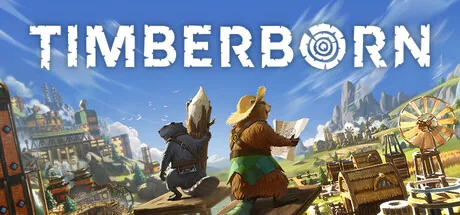
Timberborn
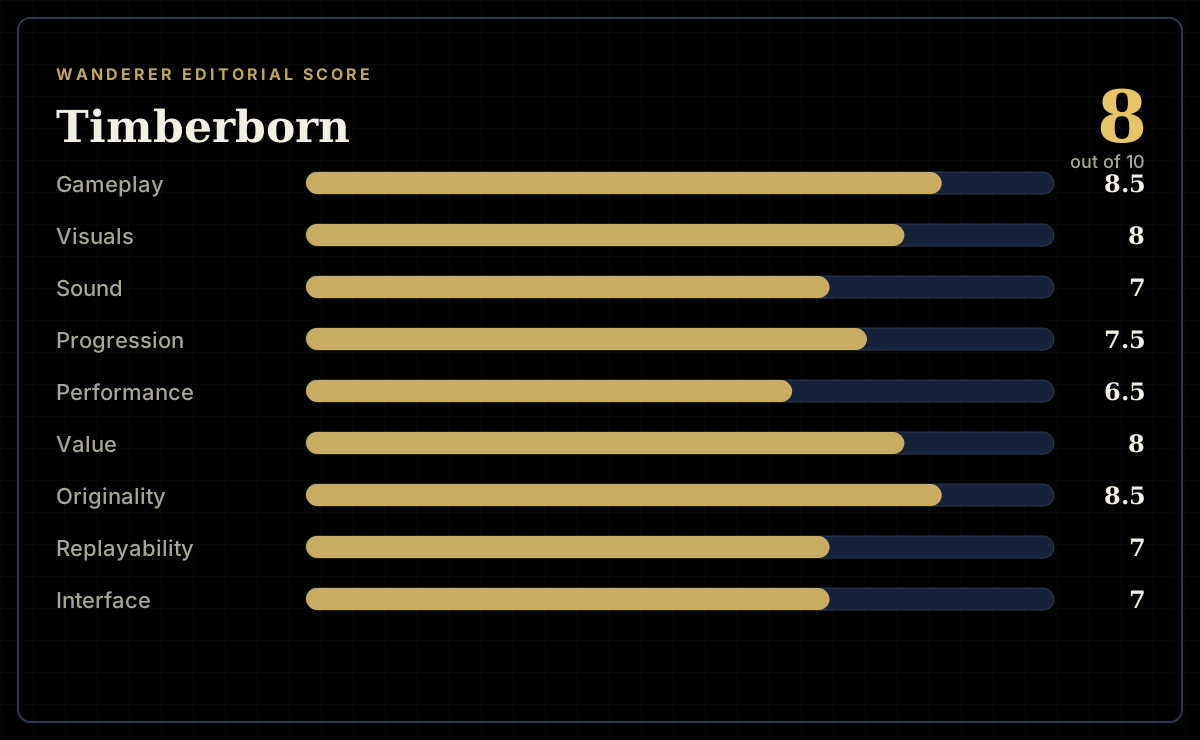
8 / 10
- Developer
- Mechanistry
- Publisher
- Mechanistry
- Released
- 12 March 2026
- Platforms
- Windows, macOS
- Genre
- City builder, simulation, strategy
- Monetisation
- Premium, one-off purchase. No in-game currency, ads or timers of any kind. The only paid add-on is an optional soundtrack; there is no gameplay DLC, and nothing sold changes the balance of a colony
- Players
- Single-player only; no co-op or competitive mode exists
The short version
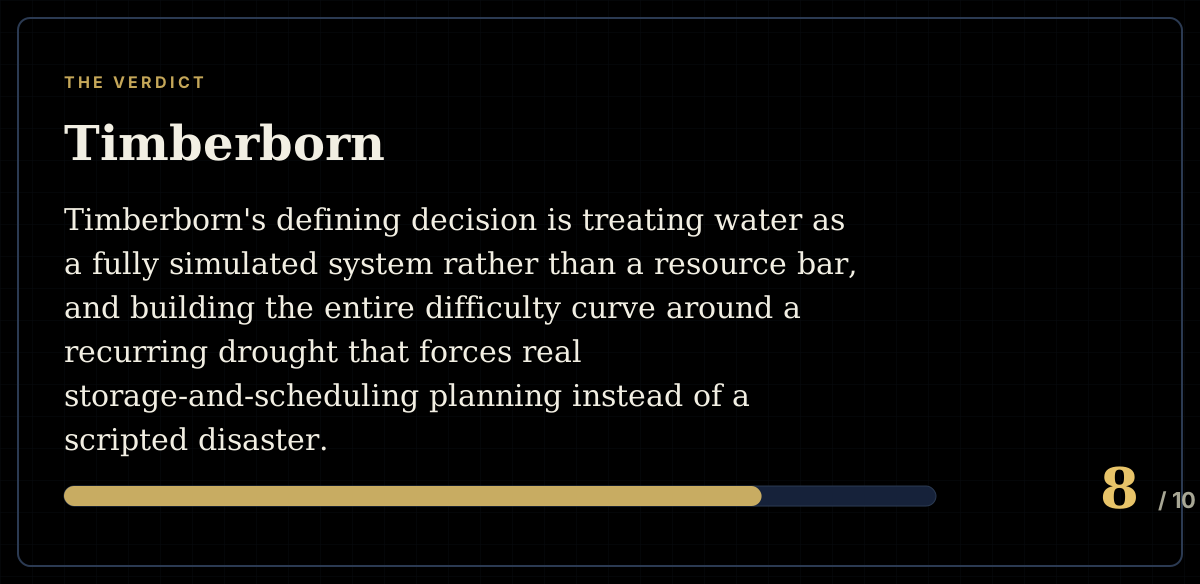
Timberborn's defining decision is treating water as a fully simulated system rather than a resource bar, and building the entire difficulty curve around a recurring drought that forces real storage-and-scheduling planning instead of a scripted disaster. Add genuinely different factions, meaningful vertical construction and a late-arriving automation layer, and you get one of the smartest city builders released in years.
It also runs out of new problems faster than its runtime suggests. Once a colony survives its first two or three droughts, the water puzzle stops evolving, beaver pathing and hauling become a persistent low-grade annoyance, and there's no scenario or win condition to chase — just a sandbox that keeps running until you decide to stop.
Biggest strengths
- The water simulation makes droughts a genuine storage-and-scheduling puzzle instead of a random event
- Folktails and Iron Teeth demand different infrastructure, not just different skins on the same buildings
- Vertical construction meaningfully changes how a map's limited footprint gets used, not just how it looks
Biggest weaknesses
- Once the first one or two droughts are survived, the central challenge stops escalating and the back half of a save becomes maintenance
- There is no scenario, objective or win condition beyond "keep going," which several players cite as the point where they stop
- Beaver pathing and hauling logic visibly strains once a settlement passes a couple hundred population
Who it's for: Players who want a colony sim where the core threat is a system you can actually master rather than a random event roll, and who don't need a campaign or win state to stay engaged. A poor fit for anyone who wants combat, narrative, or a game that keeps inventing new problems past the twenty-hour mark.
Our recommendation: Worth the asking price for the water simulation and the first faction's worth of droughts alone. Play Folktails first, finish a full drought cycle or two, and only reach for Iron Teeth once the first colony's basic water infrastructure feels solved — the two factions are different enough that starting with the wrong one can make the early game feel harder than it needs to be.
8 / 10
Most colony sims give you a threat you can point a defensive wall at. Timberborn gives you a clock. Every map runs on a drought cycle that isn't random and isn't an event roll — it's a predictable, repeating countdown to the day your rivers stop flowing, and the entire game is built around forcing you to prepare for it in advance rather than react to it in the moment. Mechanistry's beaver city builder is themed around lumberpunk rodents rebuilding civilisation after humanity vanished, and that's a charming enough hook, but the actual subject of the game is hydrology. Everything worth discussing here flows from that one decision.
Water is the system, not the scenery
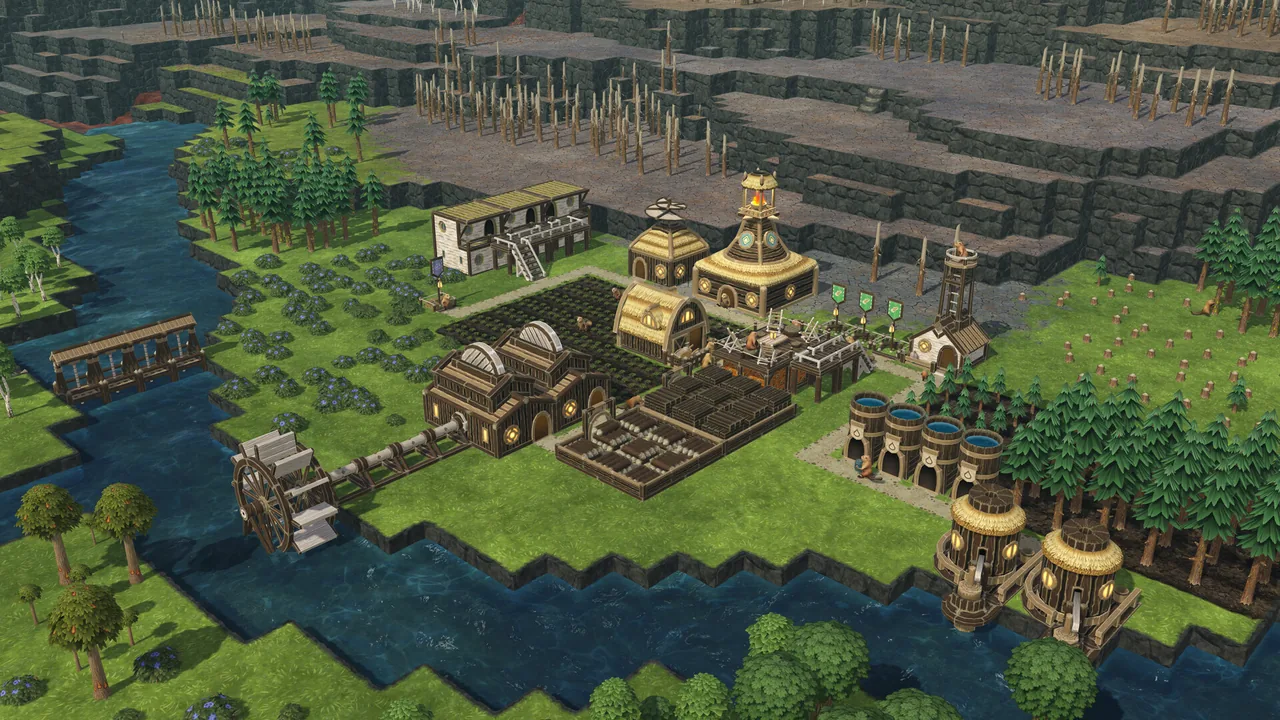
Strip away the beavers and Timberborn is a fluid simulation with a settlement built on top of it. Water isn't an ambient backdrop or a resource meter that fills and drains on a schedule set by the designers — it's tracked as a physically modelled substance that flows downhill, pools in low ground, backs up behind obstacles and responds to whatever you build in its path. Dams hold it back. Levees redirect it. Canals and aqueducts move it somewhere useful. Floodgates let you open and close flow on demand once you've wired up the infrastructure to control it. None of this is decorative: a dam placed one tile wrong genuinely floods the wrong field, and a channel that looked fine on the build screen can leave a reservoir half-empty because the terrain behind it doesn't hold water the way you assumed it would.
The drought cycle is what turns that simulation into a design, rather than just a physics toy. Rivers don't fail randomly — they recede on a schedule the game telegraphs, and the entire mid-game is about building enough reservoir capacity, irrigation reach and food stockpile to survive the dry stretch before it arrives. That's a genuinely different kind of pressure to what most of the genre offers. RimWorld and Going Medieval throw raids and random events at you and ask you to react; Timberborn tells you exactly when the crisis is coming and dares you to have solved it already. It's less about improvisation under fire and more about logistics planning against a deadline, and it rewards the kind of player who enjoys building the answer to a problem before the problem shows up. The closest thing in this section's library is Oxygen Not Included, where a gas and heat simulation is the real opponent behind the colony-sim dressing — Timberborn's water is less punishing and less opaque than ONI's thermodynamics, but it's cut from the same idea: the systems sandbox is the game, and the settlement management is what you do with it.
Badwater raises the stakes without breaking the puzzle
Clean rivers aren't the whole story. Timberborn also runs waves of toxic waste through its watershed — officially "badwater" in the game's own terminology, with dedicated Badwater Pressurizer buildings whose entire job is processing contamination out of your supply — and it functions as a second axis of pressure on top of the drought clock. A district that handles a normal dry season fine can still be poisoned by a badwater wave it wasn't built to filter, which means late-game infrastructure has to solve two related but distinct water problems at once rather than one. Community patch history shows Mechanistry has kept tuning this rather than leaving it static: buildings tied to contamination handling have been renamed and reworked more than once as the studio worked out what actually reads clearly to players, and 3D water particle effects added in the most recent experimental update make contamination easier to track visually than it used to be. It's a system that's been iterated on in public, and it shows.
Two factions that actually force different buildings
Timberborn's two playable societies aren't a cosmetic choice bolted onto identical mechanics. Folktails are the nature-leaning faction, built around simpler agrarian infrastructure and a gentler relationship with the terrain; Iron Teeth are the industrious counterpart, leaning into heavier construction and different production chains. Each faction gets its own building set, its own technology path and, as of the 1.1 experimental branch, its own faction-specific attraction buildings and tier-four monuments — the Hall of Abundance for Folktails against the Arch of Progress for Iron Teeth are a good shorthand for how differently the two societies present the same late-game goal. That divergence matters more in this game than in most "pick a skin" faction systems, because the water problem each faction is solving looks different depending on which starting buildings and production chains you have access to. Starting a first colony with the wrong faction for your temperament — Iron Teeth's heavier industrial footprint dropped into a beginner's first drought, say — can make an already demanding opening feel unnecessarily brutal, which is why it's worth treating Folktails as the intended tutorial faction even though the game doesn't say so directly.
Verticality is a genuine layout constraint, not a gimmick
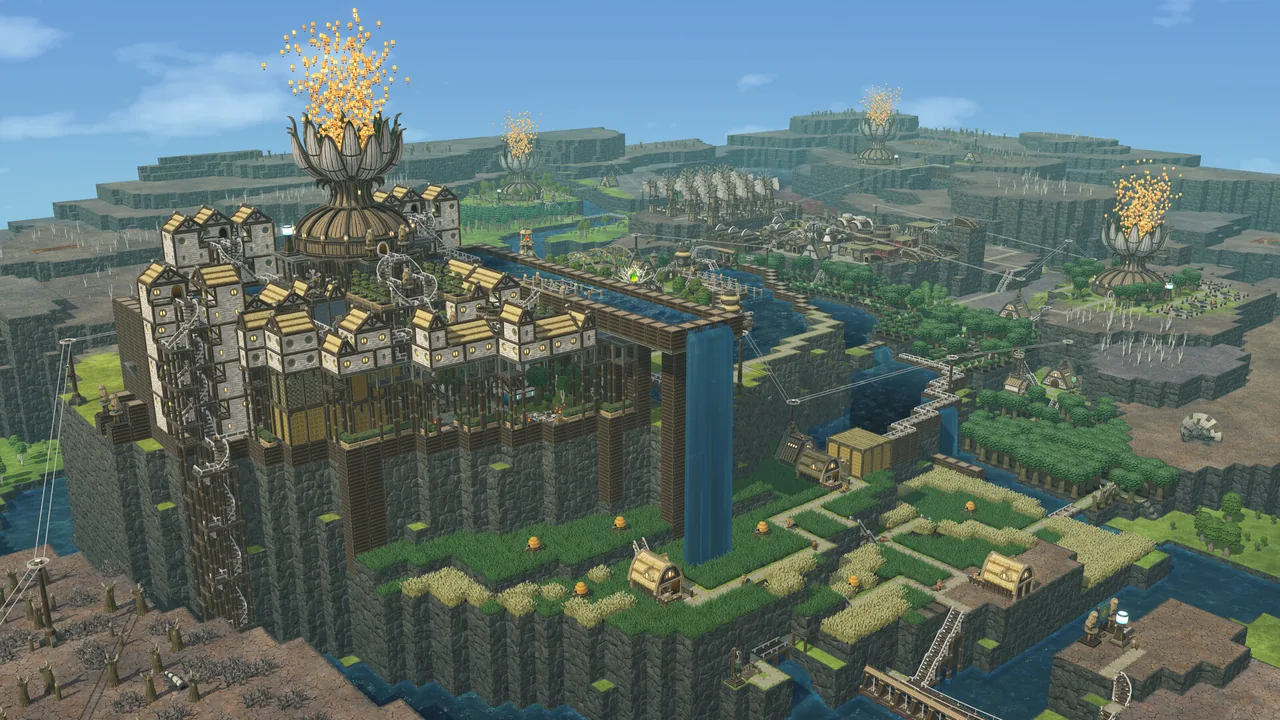
Because rivers and reservoirs claim so much of a map's usable footprint, Timberborn leans hard on stacking: lodges and workshops build on top of each other, platforms extend usable ground over water or ravines, and bridges connect terraces that would otherwise be cut off by the terrain you've reshaped. This isn't the token "build a tower for the skyline" verticality some city builders bolt on for visual variety — it's a direct answer to the fact that a chunk of every map is water you need for irrigation and can't also build a farm on top of. Planning a settlement here means thinking in cross-section as much as in plan view: what's on the ground floor, what's stacked above it, and how power and logistics routes climb between levels. It adds real spatial problem-solving rather than fiddliness, though it does mean the camera and the build UI are doing more work than a flat city builder's ever has to, and the interface hasn't entirely kept pace with how three-dimensional a mature base actually gets.
Automation is the game 1.0 was missing
For most of Early Access, Timberborn's endgame was "manage more of the same systems, at greater scale." The 1.0 release changed that by introducing a genuine automation layer — sensors, relays, counters and other logic tools that let a mature settlement start managing itself. It's a smaller, more focused version of the wiring layer Oxygen Not Included players will recognise: a self-regulating floodgate that opens only past a water-level threshold, a dam that reacts to sensor input instead of manual intervention, a factory that throttles itself without a player checking in every cycle. Update 1.1's experimental branch already builds on this by letting relays support more than two inputs, exactly the kind of incremental deepening the system needs to stay interesting. It's the single best thing to happen to the game's late hours, and honestly an admission that the late hours needed help — automation exists because the alternative was babysitting water infrastructure by hand indefinitely.
Where the loop runs out of road
Here's the part the drought-cycle pitch doesn't fully cover: the water puzzle has a solution, and once you've found it, the game doesn't reliably replace it with a new one. Survive a couple of drought cycles with adequate reservoir capacity and irrigation reach, and the central tension the whole game was built around stops escalating — what's left is executing the same playbook at larger scale, which several players in the current review pool describe bluntly as running out of things to do well before the hundred-hour mark some colony sims manage. There's no scenario mode, no defined win condition, no scored objective to chase once the sandbox stabilises; you keep playing because you want to, not because the game is handing you a new problem. That's a legitimate design choice — not every colony sim needs a campaign — but it means Timberborn's replayability leans almost entirely on switching factions and maps rather than the game itself generating fresh pressure.
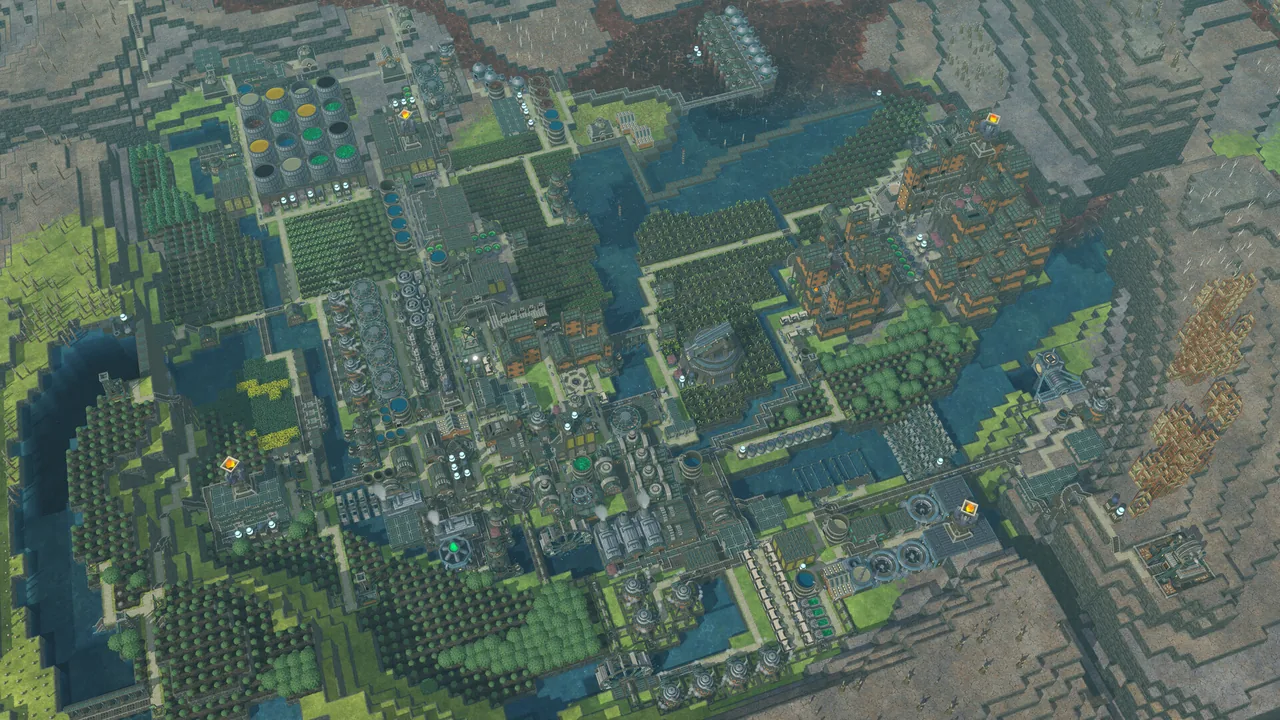
The other persistent friction is beaver behaviour. Pathing and hauling logic is functional at a small scale but visibly strains as population grows, and it's a common enough complaint that it's clearly not just bad luck: beavers queue inefficiently, hauling routes get congested, and a colony past a couple hundred population starts feeling less responsive than a smaller one, independent of automation. Performance follows the same curve for a related reason — this is a simulation cost, not a rendering one, and reports of stutter on high-end hardware once a settlement passes two or three hundred beavers show up regardless of GPU tier. Neither problem is severe enough to break a save, but both are the kind of thing that shows up specifically in the hours after the water puzzle stops being interesting, which is bad timing for a game whose late game already needs the goodwill.
The tutorial is the last soft spot. It walks through individual buildings competently but doesn't explain how droughts, badwater and automation are meant to interact once a colony scales past its first few buildings, which leaves new players reverse-engineering the interaction the same way Oxygen Not Included's tutorial leaves its own systems half-explained. It's a smaller gap than ONI's — Timberborn's individual systems are simpler and more visually legible — but it's the same shape of problem.
Value and where it sits in the genre
At NZ$49.99 full price (currently NZ$34.99 in an active discount), Timberborn is a premium indie asking premium-indie money, and it earns the comparison to Against the Storm and Oxygen Not Included's base price rather than to a budget survival game. What makes the monetisation picture simple is that there's nothing to complicate it: no premium currency, no battle pass, no gameplay DLC of any kind — the only paid add-on on the store page is a soundtrack. Steam Workshop mod support and a modding competition Mechanistry ran through mid-2026 both suggest a studio still treating the game as a live platform four months after 1.0, not a project coasting on its launch reviews. For readers weighing this against Against the Storm's roguelite structure or Oxygen Not Included's harsher simulation, Timberborn sits in the middle: friendlier to learn than either, less mechanically bottomless than both once its central puzzle is solved.
Verdict
Timberborn earns its reputation on the strength of one idea executed properly: water as a real, physically modelled system, with a drought cycle that turns resource planning into the game's actual antagonist instead of window dressing around a generic colony-management loop. Two meaningfully different factions, vertical construction that solves a genuine spatial problem, and a 1.0-era automation layer all build on that foundation well, and the fact that Mechanistry shipped a full release after four and a half years in Early Access — and kept updating it since, with 1.1 already live on the experimental branch — says the studio understands what it built.
What keeps this out of the genre's top tier is the second half of a save. The water puzzle that makes the opening hours so sharp doesn't keep generating new problems once it's solved, there's no scenario or win state to chase instead, and beaver pathing and performance both get worse exactly when the game most needs to be holding your attention on its own merits. Players who want a colony sim where the central threat is a system to master rather than a die roll to survive will find one of the best examples of that idea currently on Steam. Players who need the challenge to keep evolving all the way to the credits should treat this as a very good twenty-to-thirty-hour game rather than the hundred-hour sandbox its price tag implies.
Anyone who likes Wanderer's own approach to progress ticking along on a system rather than a script will find a lot to like in a game where the real opponent is hydrology.
Price and platform details checked 2 August 2026.
Pros and cons
Pros
- The water simulation makes droughts a genuine storage-and-scheduling puzzle instead of a random event
- Folktails and Iron Teeth demand different infrastructure, not just different skins on the same buildings
- Vertical construction meaningfully changes how a map's limited footprint gets used, not just how it looks
- Automation (sensors, relays, counters) added in 1.0 turns mature colonies into a real engineering layer
- No DLC, no premium currency, no timers — the one-off price is the entire monetisation model
- Steam Workshop mod support and a first modding competition show a developer still investing in the game post-1.0
Cons
- Once the first one or two droughts are survived, the central challenge stops escalating and the back half of a save becomes maintenance
- There is no scenario, objective or win condition beyond "keep going," which several players cite as the point where they stop
- Beaver pathing and hauling logic visibly strains once a settlement passes a couple hundred population
- Large settlements stutter even on high-end hardware, since the simulation cost scales with population and water tiles rather than graphics settings
- The in-game tutorial explains buildings individually but not how droughts, badwater and automation interact once a colony scales up
- Confirmation prompts on minor demolitions and menu friction slow down routine colony management
Screenshots
-
TimberbornImage: Mechanistry via Steam -
TimberbornImage: Mechanistry via Steam -
TimberbornImage: Mechanistry via Steam -
How the review scores each part of the gameWanderer Editorial -
The short versionWanderer Editorial