Game review
Thronefall
8 / 10
- Developer
- GrizzlyGames, Mythwright
- Publisher
- Mythwright
- Released
- 11 October 2024
- Platforms
- Windows, macOS
- Genre
- Minimalist Strategy / Tower Defense
- Monetisation
- One-time purchase, no in-game store, no IAP
- Players
- None; fully single-player
The short version
Thronefall asks you to run a kingdom in miniature: place your buildings by day, watch the gold come in, then grab a weapon and fight alongside your own troops when night falls and the waves arrive. It is a small, sharply-cut idea — Kingdom's economy loop crossed with a tower defense's night phase, rendered in a handful of flat colors — and it has held a 96% positive Steam rating across more than 23,000 reviews since Early Access launched in August 2023, through a full 1.0 release in October 2024, straight through to the developer selling the entire IP to a new publisher in December 2025 who is still patching it in mid-2026.
This review read the full sample of English reviews, checked the global achievement completion curve against the game's nine maps, and traced the update history from Early Access to the present. The finding underneath the headline score: a real, repeated complaint from committed players — some with well over a thousand hours logged — that the later maps lean on a narrower "solved formula" than the first few, and that the game's fixed building plots turn level design into flavor rather than a genuine tactical choice. The achievement numbers back that shape up almost exactly.
Biggest strengths
- A minimalist presentation that critics and players independently praise for staying legible under pressure — flat colors, clear silhouettes, and a day/night loop you can read at a glance
- A genuinely ethical monetisation model on every platform it ships on: one flat price on Steam, a free trial and a single unlock fee on mobile, no ads, no gacha, no ongoing store, confirmed across both storefronts
- Real longevity for a compact game — 9 maps, 9 weapons, over 50 perks and optional mutators — and the achievement curve shows players working steadily through that content rather than bouncing off immediately
Biggest weaknesses
- A specific, repeated complaint from high-playtime reviewers that later maps and mutator-driven high scores demand a narrower, more "solved" build order than the early game's freedom implies
- Fixed, preselected building plots pull level design toward cosmetic variation rather than real tactical choice, according to at least one detailed long-playtime review
- The global achievement curve falls steeply and consistently by map — 89.6% of players beat the first map, 9.9% beat the ninth — a shape consistent with the difficulty and balance complaints in the review sample rather than contradicting them
Who it's for: Strategy fans who want a short, legible, controller-friendly session rather than a sprawling 4X campaign, and anyone curious what a genuinely clean one-time-purchase strategy game looks like on both PC and mobile.
Our recommendation: Recommended, with the caveat that the back half of the map list rewards a narrower playstyle than the first half promises — go in expecting the difficulty curve to tighten your options rather than expand them.
8 / 10
Thronefall's pitch fits in one sentence: build your kingdom by day, then grab a weapon and defend it yourself when the sun goes down. That sentence has been true since Grizzly Games — a two-person studio — put it into Early Access in August 2023, and it's still true now, almost three years and one change of ownership later. The game currently sits at 96% positive across more than 23,000 Steam reviews, a score that has barely moved since 1.0 launched in October 2024. This review read the English review sample in full, checked the global achievement data against the game's nine maps, and traced the patch history from Early Access to the June 2026 update — and found a headline score that undersells a real, specific, repeated complaint sitting just underneath it.
A tiny idea, cut down to almost nothing
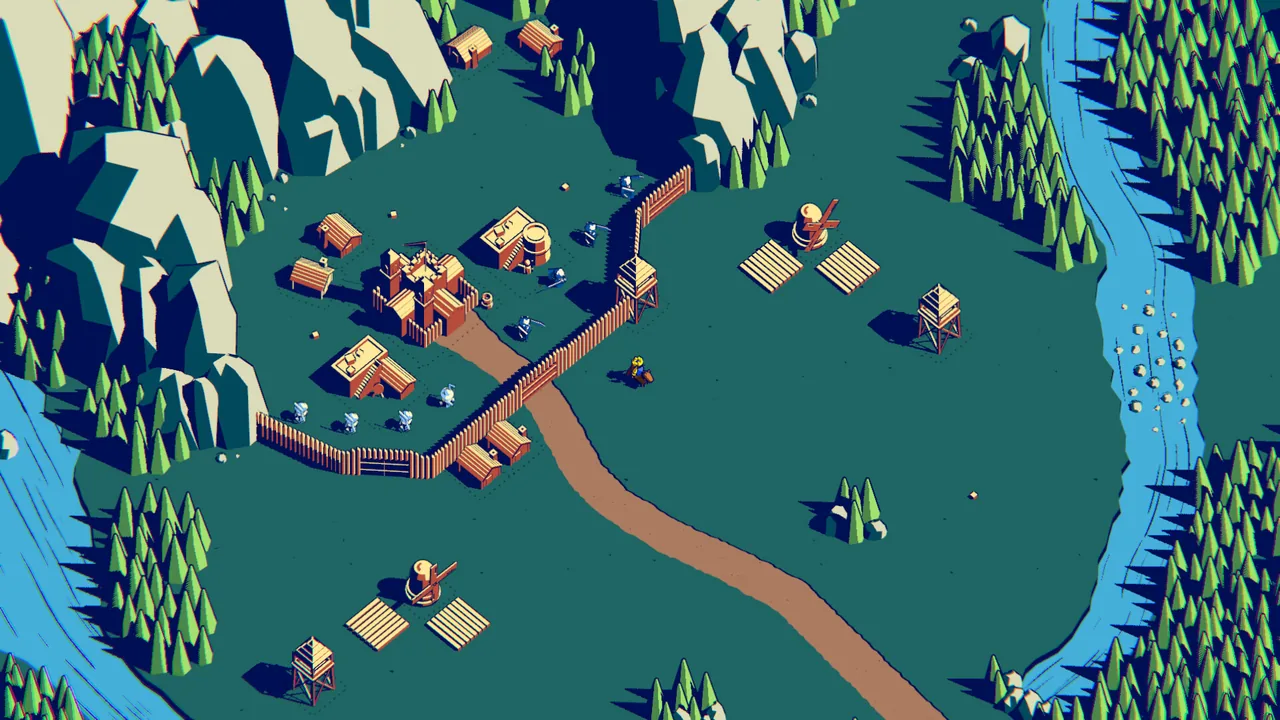
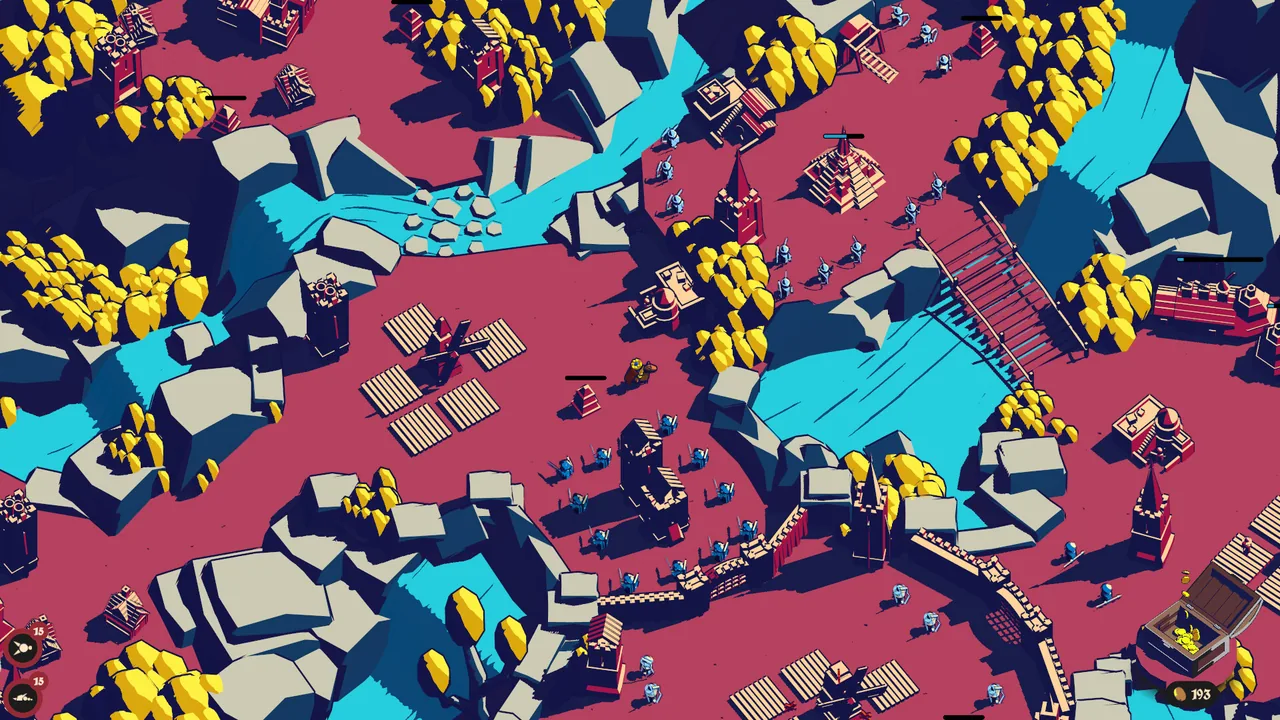
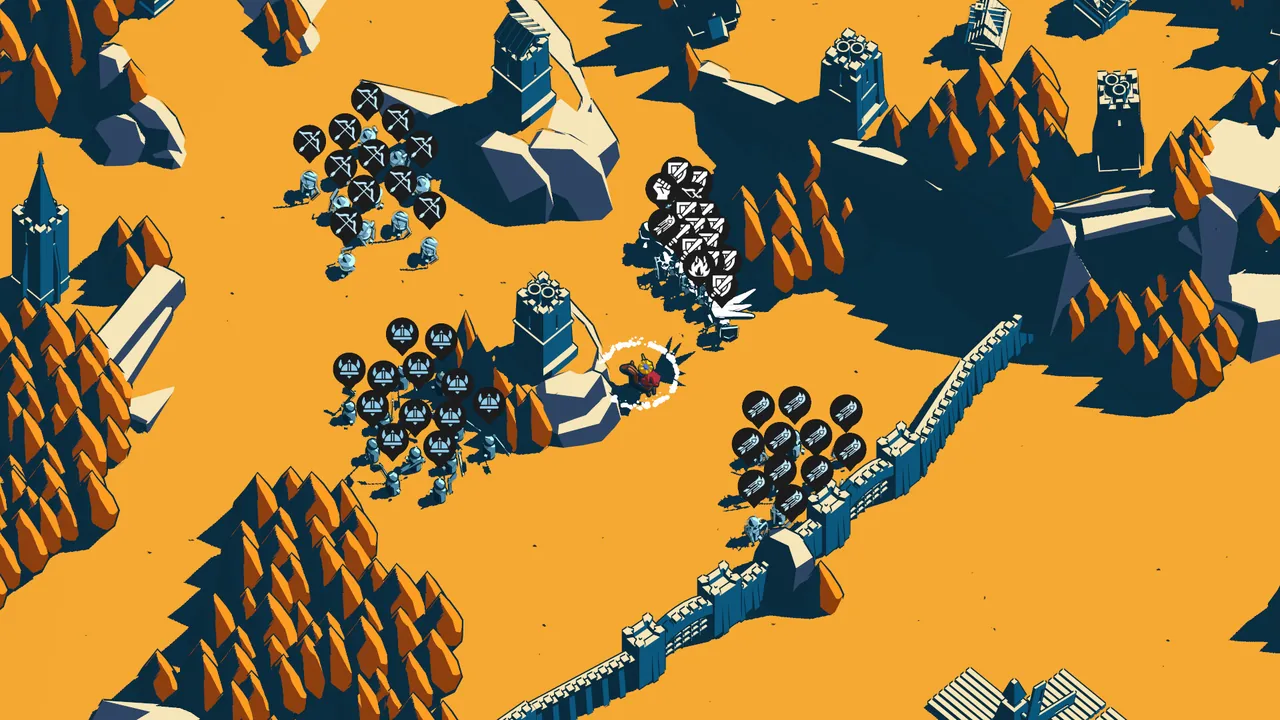
Thronefall strips the kingdom-builder down to its clearest possible shape. By day, you place buildings on a small set of fixed plots — houses and fields for gold, barracks and archery ranges for troops, walls and towers for defense — using the income those buildings generate each morning. By night, waves of enemies converge on your castle, and you fight alongside the troops you've trained, wielding one of nine unlockable weapons yourself. Lose the Castle Center and the run ends; survive to sunrise and you get to build again. The whole thing runs in flat, saturated color blocks with almost no UI clutter, and the official Steam page's own review pull-quotes — "Chic, sleek, addictive" from Eurogamer Germany, "Gives new meaning to the word 'replayability'" from Try Hard, "big in heart" from The Sixth Axis — all land on the same word players use unprompted in the review sample: legible. One detailed early review calls it "not like any other strategy game I have played before," praising a trailer that shows exactly what the game is rather than overselling it, and that honesty-in-presentation shows up again and again as a specific point of trust in the sample, not just a passing compliment.
The scope is genuinely compact — 9 maps, 9 weapons, and, per the store page, over 50 unlockable perks plus optional mutators to raise the difficulty for players chasing achievements or higher scores. That's a small footprint for a strategy game, and it's part of the pitch: this is built for short sessions as much as marathon runs.
What the achievement curve actually shows
Steam's global achievement data gives an unusually clean read on where players stop, because the map-completion achievements line up one-to-one with Thronefall's nine maps in order. The drop-off is steep and consistent: 89.6% of players beat the first map (Nordfels), 65.7% the second (Durststein), 52.1% the third (Frostsee), then 41.4%, 31.7%, 24.7%, 19.2%, 15.3%, and finally 9.9% for the ninth map, Totend. That's not a cliff at one specific point — it's a steady, almost geometric decay across the whole map list, the kind of curve you'd expect from a game that gets meaningfully harder with every stage rather than one with a single broken wall.
That shape matters because it corroborates, rather than merely coexists with, the review sample's most detailed criticism. A 2,200-hour reviewer writes: "It is fun at the beginning, then it is just too unbalanced and unforgiving... Often there's no coming back from the smallest mistake." A 1,746-hour reviewer goes further: "I suspect the high approval rating of the game right now is because this game is easy to like, but I feel there's not a lot to love. After a few hours, I feel like the game kind of just runs together. Using different loadouts doesn't really seem to change how a level goes." A separate, detailed review from a player with 1,417 hours logged singles out the building-plot system specifically: "Having preselected construction locations for your structures is a choice which has pros and cons... the level design is literally just flavor," arguing that because you can't build walls or towers wherever you want, each new map's terrain reads as scenery rather than as a real tactical variable. None of these are drive-by complaints — the playtimes on them are some of the highest in the entire negative sample, which is worth weighing against their volume.
The other half of the sample
Set against that, the praise in the sample is just as specific and just as often written by players who've clearly put in the hours. A 3,124-hour review calls the core idea "easy enough to wrap your head around... doesn't mean it's easy to breeze through," and an 8,202-hour review — one of the highest playtimes recorded in the sample — opens by describing falling for the game from its trailer alone and stays positive from there. Multiple reviewers independently reach for the same comparison point, Kingdom: Two Crowns, and generally conclude Thronefall does something distinct enough with the formula to stand on its own rather than feeling derivative. Checking sentiment specifically since launch rather than across the whole lifetime: 96 of the most recent 100 English reviews are positive, which says the balance and repetition complaints, real as they are, haven't meaningfully shifted the overall verdict even among people playing the current, patched build.
One recurring aside worth flagging honestly rather than ignoring: a cluster of reviews — several among the most-upvoted positive reviews in the entire sample — claim a mobile game called "Kingshot" runs ads that closely imitate Thronefall's gameplay and even reuses sound design from it, and urge other players to seek out the original. This review did not investigate Kingshot and can't verify the claim; it's reported here only because it recurs often enough, from enough independent reviewers, that a reader browsing Thronefall's own Steam page is very likely to run into it anyway.
A small studio, a full sale, and continued support
The business side of Thronefall's story is unusually worth telling. Grizzly Games — by the developer's own account, just two people, Paul Schnepf and a co-founder named Jonas — built the game from Early Access in August 2023 through to a full 1.0 launch on 11 October 2024, then kept patching it through a February 2025 update they billed at the time as the game's "final content update." In December 2025, Grizzly Games announced they had sold the entire Thronefall IP to Mythwright, a publisher, saying plainly that as a two-person team they'd "always felt we lacked the resources to wholly explore what Thronefall could potentially be" and that they wanted to move on to new projects. Rather than the game going quiet after that handover, Mythwright shipped a further Quality of Life update in June 2026 and has been running community surveys about what to add next — so "final content update" turned out not to be final after all, just the end of Grizzly Games' own run with it. Doghowl Games continues to publish the mobile ports (iOS from May 2025, Android from June 2025) under the new ownership.
Money is the other place Thronefall holds up unusually well for this audience. The Steam version is a flat one-time purchase — NZ$18.99, no in-game store, no IAP, no season pass — and this review's check of the mobile listings found the same shape on phones: a free download with a single unlock fee (around USD $9.99 at time of writing) rather than the ad-gated or gacha-adjacent structures that dominate mobile strategy games. Full controller support and Steam Deck verification round out a genuinely portable design; the one real platform gap is Linux, which has no native Steam build despite the game running through Proton well enough to earn Deck verification.
Final verdict
Thronefall earns its 96% not on hype but on a specific, well-executed idea: a kingdom-builder and a tower defense reduced to their clearest shared shape, sold once, played on almost anything with a screen, and still being supported nearly three years and one change of ownership after it started. The complaint worth taking seriously before buying is just as specific — the game's fixed building plots and its escalating difficulty curve genuinely narrow your options as you push through the map list, and the players saying so aren't casual critics; several have thousands of hours in. The achievement data backs their read almost exactly, map for map.
Recommended for strategy fans who want something legible and controller-friendly rather than sprawling, and it's hard to overstate how rare its monetisation model is in the genre right now — buy it once, on whichever platform you own, and that's the whole transaction. Go in expecting the back half of the map list to reward a narrower playstyle than the front half promises, and the disappointment several long-time players describe becomes a lot easier to see coming.
Players who like the idea of a small, well-defended stronghold worth returning to night after night may also want to look at Wanderer.
Pros and cons
Pros
- A minimalist presentation that critics and players independently praise for staying legible under pressure — flat colors, clear silhouettes, and a day/night loop you can read at a glance
- A genuinely ethical monetisation model on every platform it ships on: one flat price on Steam, a free trial and a single unlock fee on mobile, no ads, no gacha, no ongoing store, confirmed across both storefronts
- Real longevity for a compact game — 9 maps, 9 weapons, over 50 perks and optional mutators — and the achievement curve shows players working steadily through that content rather than bouncing off immediately
- Full controller support and Steam Deck verification, plus console and mobile ports (Nintendo Switch, iOS, Android) that extend a genuinely portable design to more screens
- An unusually clean support record for a two-person studio's first hit: content updates ran from Early Access through a "final" update in February 2025, and continued under a new publisher into mid-2026 rather than stopping at launch
Cons
- A specific, repeated complaint from high-playtime reviewers that later maps and mutator-driven high scores demand a narrower, more "solved" build order than the early game's freedom implies
- Fixed, preselected building plots pull level design toward cosmetic variation rather than real tactical choice, according to at least one detailed long-playtime review
- The global achievement curve falls steeply and consistently by map — 89.6% of players beat the first map, 9.9% beat the ninth — a shape consistent with the difficulty and balance complaints in the review sample rather than contradicting them
- No native Linux build on Steam (Windows and macOS only), despite Steam Deck verification running it through Proton
- A cluster of Steam reviews allege a mobile game called "Kingshot" copies Thronefall's concept and marketing closely; this review did not investigate that game and reports only that the claim recurs often enough in Thronefall's own review section to be worth knowing about
Screenshots
-
ThronefallImage: Mythwright via Steam -
ThronefallImage: Mythwright via Steam -
ThronefallImage: Mythwright via Steam -
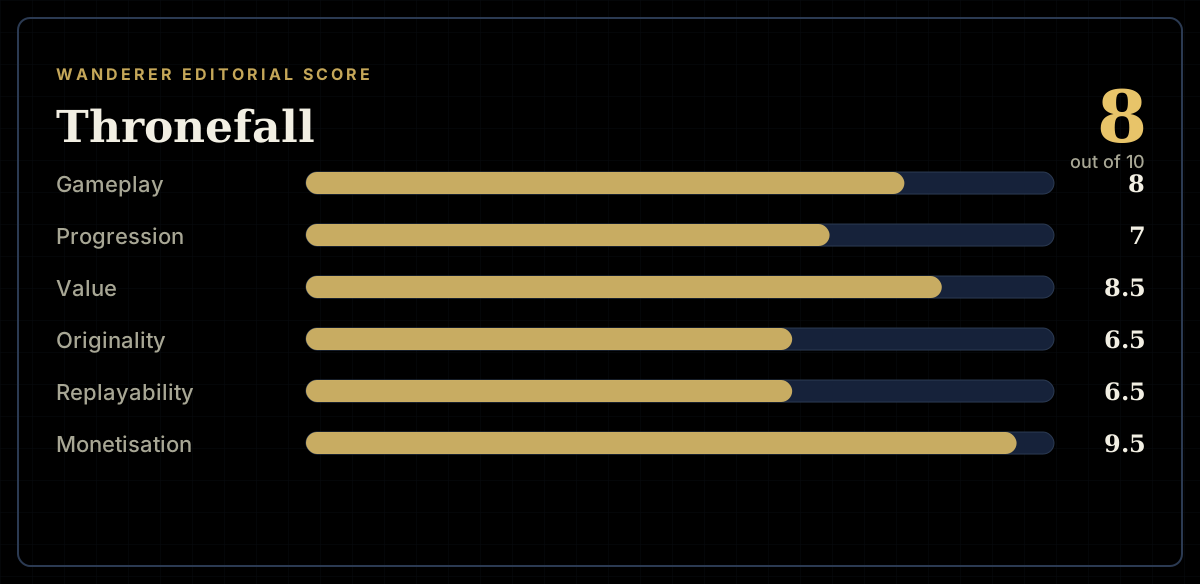
How the review scores each part of the gameWanderer Editorial -
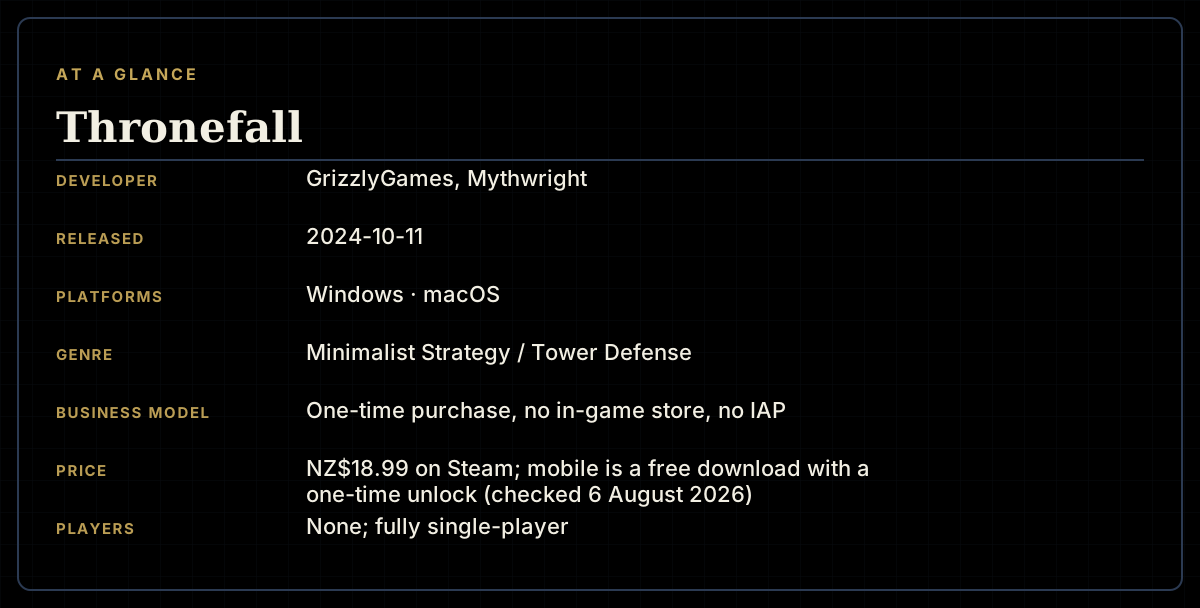
The game at a glanceWanderer Editorial -
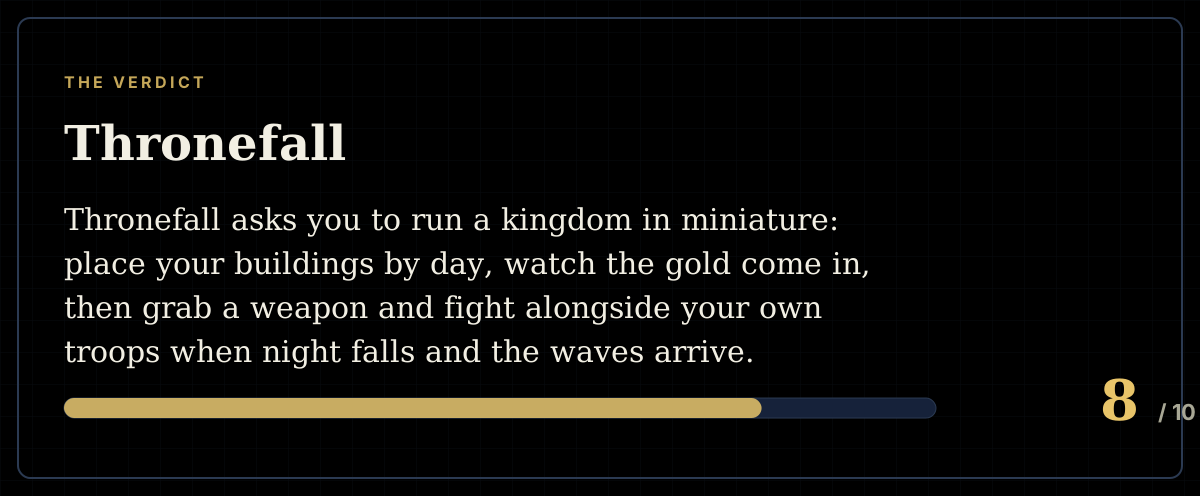
The short versionWanderer Editorial