
Game review
Super Mining Mechs
5.5 / 10
- Developer
- Delayed Victory
- Publisher
- Delayed Victory
- Released
- 26 October 2024
- Platforms
- Windows
- Genre
- Co-op mining and mech-customisation sim
- Monetisation
- One-time purchase, with a paid DLC pack available
- Players
- Online co-op, up to 8 players
The short version
Super Mining Mechs asks you to dig ever deeper into alien planets aboard a customisable mining mech, hauling ore back to the surface to fund upgrades and, eventually, to help replenish Earth's exhausted natural resources. It's an explicit modernisation of the classic Motherload formula, playable solo or with up to seven friends, and reviewers consistently praise it as a genuinely relaxing, low-stakes time-waster — a game where, notably, you cannot actually lose. That absence of risk is also this review's sample's most consistent point of contention: a meaningful share of reviewers, including several who loved the developer's earlier "Mining Mechs," describe upgrades as strictly linear power increases with no interesting choices to make, a loop that runs out of genuine novelty within a few hours, and a specific, repeated complaint about in-game advertising for the developer's other titles appearing inside the paid game itself. The developer has continued supporting the franchise with paid DLC, a console port, and a full spiritual successor since this release, suggesting real commercial staying power despite the mixed critical reaction to this specific sequel's design choices.
Biggest strengths
- The core dig-and-upgrade loop is repeatedly described as genuinely relaxing and low-pressure, with reviewers specifically praising the complete absence of danger or fail states as a deliberate, welcome design choice for unwinding
- Online co-op for up to eight players draws consistent praise as a genuinely fun, sociable way to experience the game, with several reviewers specifically recommending it as a group activity over solo play
- Reviewers who played the developer's earlier "Mining Mechs" credit this sequel with real, specific quality-of-life improvements, including the ability to build mines and platforms while actively digging and clearer progression gating tied to specific resources rather than money alone
Biggest weaknesses
- The single most repeated complaint concerns a lack of any meaningful upgrade choices, with numerous reviewers independently describing every new part as strictly better than the last, removing any real strategic decision-making from the core progression loop
- A specific, repeated complaint concerns in-game advertising for the developer's other titles appearing inside the UI of a paid, premium release, with several reviewers stating this alone was enough to draw a negative recommendation regardless of the game's other qualities
- Several reviewers who enjoyed the original "Mining Mechs" describe this sequel as stretching the same core loop across a larger scope without meaningfully deepening it, effectively lengthening rather than improving the experience
Who it's for: Players who specifically want a relaxing, zero-stakes digging game to play solo or with a large group of friends, and who don't need meaningful strategic depth or risk to stay engaged. Less suited to players who loved the tension of Motherload or wanted a sequel that meaningfully improves on the developer's first game rather than simply expanding its scope.
Our recommendation: Worth its very low price for a relaxed, sociable digging session with friends, especially if you go in without expecting genuine risk or deep strategic choices. Skip it if in-game advertising for other titles is a dealbreaker for you, or if you're hoping for something with more mechanical depth than the developer's first Mining Mechs offered.
5.5 / 10
Super Mining Mechs is an explicit modern update of a very specific, beloved formula: the classic browser game Motherload, where you dig ever deeper into alien soil, hauling ore back to the surface between trips to fund upgrades that let you dig further, faster, and more efficiently next time. This version adds mech customisation, up to eight-player online co-op, and a broader narrative framing about replenishing Earth's exhausted resources. Reviewers who remember the original genre fondly recognise the DNA immediately, and the review sample splits in an unusually clean, easy-to-summarise way around one specific design choice at the heart of the game.
A deliberately risk-free experience, and the audience that loves it for exactly that
Several reviewers treat the complete absence of danger as the entire point, and describe genuine satisfaction from that framing. "In this game you can't die which is super," one reviewer writes, describing the game as a decompression tool after a stressful job. Another compares it directly and favourably to its clear inspiration: "Love it. Reminds me of an old mining game I used to play on miniclip. (Motherlode.)" Co-op play draws its own specific praise, with reviewers describing genuinely fun group sessions distinct from the solo experience, and the achievement structure earns credit for being approachable without demanding excessive grinding.
The same design choice, read as a flaw by an equally sized group
Set directly against that praise, other reviewers read the lack of risk as the central problem rather than a feature. "I went into this to scratch my Motherload itch and was disappointed to find that you literally cannot lose in this game. There is no risk or danger, removing the sense of urgency," one reviewer writes, arguing the absence of stakes hollows out exactly the tension that made the original formula compelling. A related, specific complaint concerns the upgrade system itself: "each part is always strictly better than the previous one, so there is no reason to pick an older part or try out a different build," one reviewer writes, and several others independently make the same point about the total absence of meaningful strategic choice in how a player builds out their mech.
A specific, repeated objection to in-game advertising
One complaint stands apart from the risk-versus-relaxation debate entirely: multiple reviewers report in-game advertising for the developer's other titles appearing directly in the UI of this paid release. "There's at least three places in the UI that exist exclusively" to advertise other games, one long-session reviewer with over 12,000 minutes logged writes, stating this alone was enough to draw a negative review regardless of how much they otherwise enjoyed the game. That's a specific, easily verifiable complaint about a paid product's presentation rather than a subjective design disagreement, and it's worth taking at face value as a real point of friction for a meaningful share of buyers.
A sequel some feel stretches rather than improves
Reviewers who played the original "Mining Mechs" offer a particularly useful comparative lens. "SMM is a sequel that tries to be bigger and better. It succeeds in most areas but it introduces new problems that mostly affect the pacing," one writes, while another is more blunt: "this bigger scope doesn't change the game's main loop, but simply lengthens it. This is fundamentally the first game, but stretched out." A specific complaint about writing quality compounds this: multiple reviewers independently describe the added story content and dialogue as poorly written, a genuine downgrade from the simpler, largely dialogue-free structure of the original game.
A late-game progression change some found unwelcome
At least one reviewer describes a specific frustration with post-launch changes to the prestige system, reporting that a new "keys" requirement was added independently of accumulated in-game currency, effectively adding a fresh progression gate on top of resources players had already earned. That's a specific, concrete complaint about a design change made after initial release, distinct from the base game's original systems.
A developer with real, ongoing franchise investment
To its credit, this review can confirm Delayed Victory has continued investing in this game and its surrounding franchise well past launch. The partner-events feed documents a paid DLC expansion in February 2025, a console port in October 2025, and — most notably — a full spiritual-successor title, "Mining Merchant," released in May 2026. That's a genuinely sustained commercial and creative trajectory for a small studio, suggesting the underlying format has found a real, durable audience even accounting for this specific sequel's mixed critical reception.
What the achievement data adds to the depth debate
Steam's own completion figures offer a useful independent read on how the "shallow but relaxing" criticism plays out across the actual playerbase. Early achievements sit extremely high, in the 90-98% range, confirming the opening hours are broadly accessible and engaging for nearly everyone who buys the game. But the curve drops sharply toward the later, more demanding challenges, with several sitting around 11-14% — a real, if not extreme, falloff consistent with reviewers' accounts of the core loop losing its grip on a meaningful share of players well before full completion, even though the game clearly retains enough of its audience to keep a large number of buyers engaged deep into its content.
A reasonable middle position worth naming
Not every reviewer lands cleanly on either side of the risk-versus-relaxation divide. One offers a genuinely balanced read: "Its okay? Game runs out of steam and variety when you do all the unlocks, then you're just stuck with mining exponential amounts of minerals for incremental upgrades. Its cheap so I didnt feel bad about dropping it when it got there, but it makes it hard to say its a must play either." That's a fair, honest summary that doesn't fully align with either the game's biggest fans or its harshest critics — a genuinely pleasant experience for its first several hours, with diminishing returns afterward that the very low price makes easier to accept than it would be at a higher cost.
Final verdict
Super Mining Mechs succeeds cleanly at being exactly what a real share of its audience wants: a relaxed, risk-free, sociable digging game with no pressure and no fail states, playable solo or with a large group of friends. For another, equally sized share of reviewers — including many who loved the developer's first game — that same lack of risk and meaningful choice is precisely what keeps this sequel from being a genuine improvement rather than simply a longer version of the same idea. Worth its low price for exactly the relaxed, low-stakes experience it promises; skip it if in-game advertising or a lack of real strategic depth are dealbreakers for you.
Pros and cons
Pros
- The core dig-and-upgrade loop is repeatedly described as genuinely relaxing and low-pressure, with reviewers specifically praising the complete absence of danger or fail states as a deliberate, welcome design choice for unwinding
- Online co-op for up to eight players draws consistent praise as a genuinely fun, sociable way to experience the game, with several reviewers specifically recommending it as a group activity over solo play
- Reviewers who played the developer's earlier "Mining Mechs" credit this sequel with real, specific quality-of-life improvements, including the ability to build mines and platforms while actively digging and clearer progression gating tied to specific resources rather than money alone
- The developer has sustained a genuinely active, multi-year support record for the franchise, including a paid DLC expansion, a console port, and continued patches well into 2025
- Achievements are described by multiple reviewers as easy and low-stress to obtain, making the game a genuinely approachable pick for completionists who don't want a demanding grind
Cons
- The single most repeated complaint concerns a lack of any meaningful upgrade choices, with numerous reviewers independently describing every new part as strictly better than the last, removing any real strategic decision-making from the core progression loop
- A specific, repeated complaint concerns in-game advertising for the developer's other titles appearing inside the UI of a paid, premium release, with several reviewers stating this alone was enough to draw a negative recommendation regardless of the game's other qualities
- Several reviewers who enjoyed the original "Mining Mechs" describe this sequel as stretching the same core loop across a larger scope without meaningfully deepening it, effectively lengthening rather than improving the experience
- Writing and dialogue quality draw specific, repeated criticism, with multiple reviewers independently describing the story content added for this sequel as poorly written and a weak addition relative to the previous game's simpler, dialogue-free structure
- A specific late-game progression complaint concerns a "keys" system gating further prestige progress independently of accumulated in-game currency, which at least one reviewer describes as an unwelcome, unrequested addition that undermines existing player investment
Screenshots
-

Super Mining MechsImage: Delayed Victory via Steam -

Super Mining MechsImage: Delayed Victory via Steam -

Super Mining MechsImage: Delayed Victory via Steam -
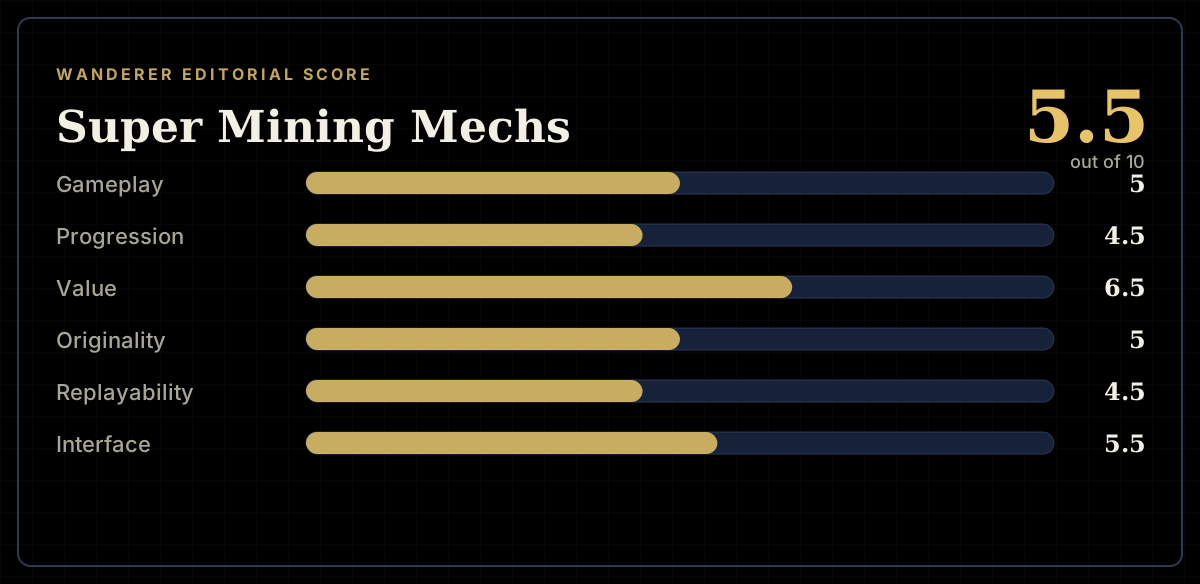
How the review scores each part of the gameWanderer Editorial -
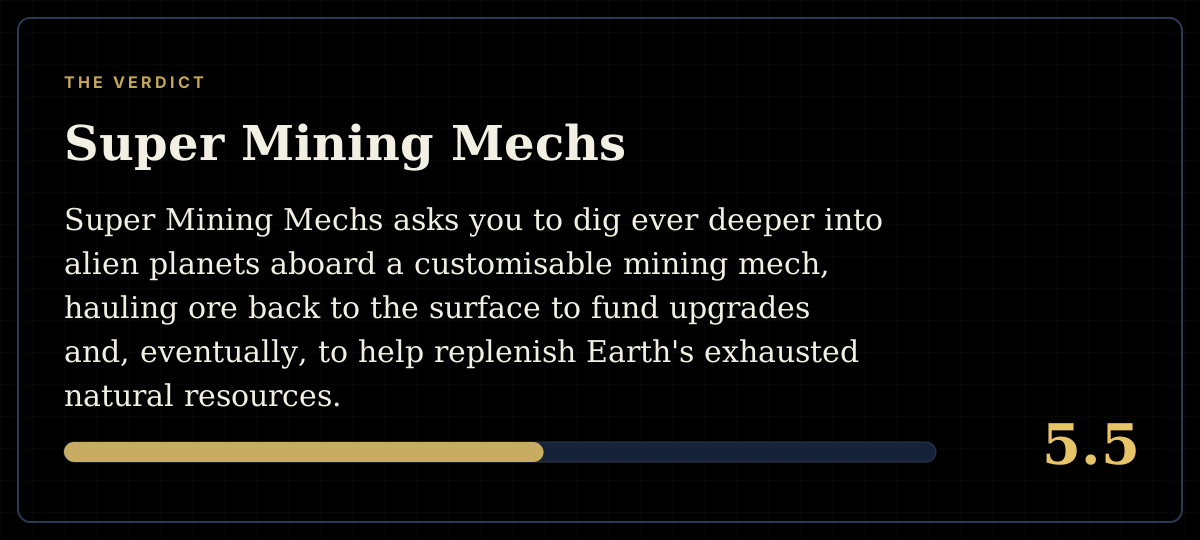
The short versionWanderer Editorial