
Game review
Star Haul Tycoon Review
5.5 / 10
- Developer
- sugames
- Publisher
- sugames
- Released
- 6 August 2026
- Platforms
- ["Windows"]
- Genre
- Simulation
A Debt-Ridden Space Trucker Sim From a Solo Developer
Star Haul Tycoon launched August 6, 2026 from solo developer sugames, casting the player as a space-logistics operator who owes a massive corporate debt and has to pay it off one trade route at a time: connect resource-producing planets to processing worlds and consumer worlds, manage a growing fleet of transport ships, and keep fuel costs from eating your margins while an unseen corporate supervisor watches your every move. At $9.99 it's priced like most solo-developer sim debuts, and at review time it carried a small pool, 14 all-language reviews (11 positive) with an English subset of exactly 10, 7 positive and 3 negative, "Mostly Positive," all 10 read in full.
Connect the Dots: The Core Trading Loop
The mechanical premise is straightforward and reviewers describe it in almost identical terms regardless of whether they liked it: orange planets produce a raw resource, red planets process that resource into a finished good, and blue planets consume the finished good, and the player's job is to string together profitable supply chains between them with a fleet of ships. One reviewer who liked the loop summarized the appeal plainly: "you want a grind? Ignore the special orders," describing a difficulty curve where "the first couple games you'll probably get hopelessly into debt" before players learn to build efficient routes. Another simply called it "an inexpensive and novel game" that "requires a mind for logic and planning," while a third, shorter review captured the addictive pull in four words: "Now I need to go back to build my galaxy trading empire."
Where the Simplicity Becomes a Complaint
The same core loop that some reviewers found satisfyingly minimal is exactly what others found thin. The pool's most detailed negative review draws an unflattering comparison directly: "This game, unfortunately, isn't fun at all. It's like Cookie Clicker in space and does not feel like an automation game," going on to specifically criticize how "upgrades are locked behind meaningless gatekeeping levels that can be bought out with money" and that as trade routes multiply, "there isn't really an organized way in which you could build up an empire" since the game gives players no way to "identify bottlenecks easily nor... easily compare/contrast profitability" between routes. A second negative review echoed the depth complaint from a different angle, noting each route can only make a single stop, "unlike a train logistics game you don't have to worry about pathing," and concluding it's "the most dead simple boring game imaginable" by comparison to genre peers. A third, much shorter negative review put it bluntly: "Not enough of a game here." Notably, none of the three negative reviews reported bugs or technical problems, all three engaged with the core trading mechanics specifically and found them too shallow to sustain interest, which is a different and arguably more serious critique for a game built entirely around one central loop.
A Real, If Narrow, Fanbase
Set against those complaints, the positive reviews in the pool aren't shy about their enthusiasm, several specifically describe long play sessions and a genuine desire to keep optimizing their trade networks. "I played a lot of this game's demo and have enjoyed seeing it grow," one reviewer wrote, framing their playtime as following the game across its development rather than a one-off purchase. Another simply wrote "Love this game would recommend, addictive!" while a third called it a game that "requires a mind for logic and planning" and warned, not unkindly, that "there are likely folks out there that will not find it entertaining at all, being of the simple," an unusually self-aware caveat from a reviewer who otherwise recommended the game. Playtimes among the positive reviewers skew meaningfully higher than the negative ones, one logged 422 minutes and another 329, suggesting the loop does hold up for players willing to invest the time to learn its rhythms, even if that same rhythm reads as repetitive to others within an hour or two.
A Single Developer's First Trading Sim
It's worth noting Star Haul Tycoon skipped a traditional Early Access phase entirely, going from a public demo, including a Steam Next Fest appearance, directly to a 1.0 launch, with a steady cadence of small "system update" patches since release addressing fleet efficiency and economic rebalancing. That's a reasonable path for a scoped, narrow-focus debut from a solo developer, but it also means the deeper systems some reviewers wanted, multi-stop routes, clearer profitability tools, more meaningful upgrade gating, aren't present at launch and there's no confirmed roadmap promising them. For a first commercial release built around a single core mechanic, the game does what it sets out to do; whether that's enough depends heavily on how much a given player enjoys the specific rhythm of planet-connecting logistics puzzles versus wanting a deeper automation or supply-chain simulation.
Verdict
Star Haul Tycoon is a small, tightly scoped space-logistics sim that succeeds for players who enjoy its specific brand of route-optimization puzzle and struggles to hold the attention of players expecting more systemic depth from the genre. Its debt-paying narrative hook and fuel-cost pressure give early runs some tension, and the reviewers who stuck with it describe real, sustained engagement measured in hours rather than minutes, but the pool's negative reviews raise a consistent and specific complaint, single-stop routes, no bottleneck-identification tools, and upgrade gating that feels arbitrary rather than earned, that a $9.99 asking price doesn't fully insulate against. For fans of low-stakes, casual trading-network puzzles from a solo developer clearly still iterating on the formula, it's a reasonable pickup; anyone hoping for a deeper automation or logistics simulation should look toward more established genre entries instead.
Screenshots
-
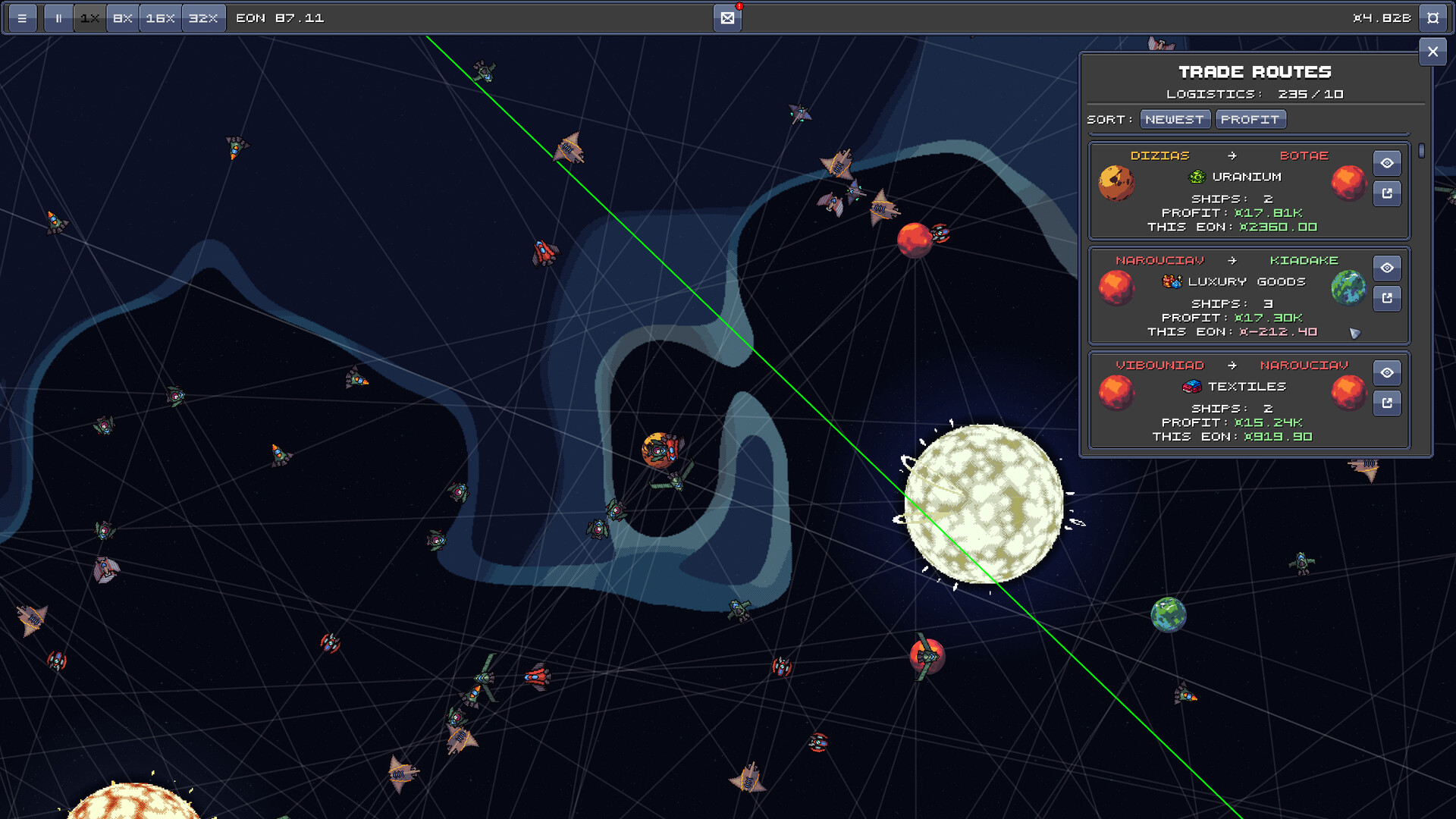
The trade-route management panel, showing a handful of active routes and their per-eon profit, the core interface players spend most of their time in.Image: sugames via Steam -
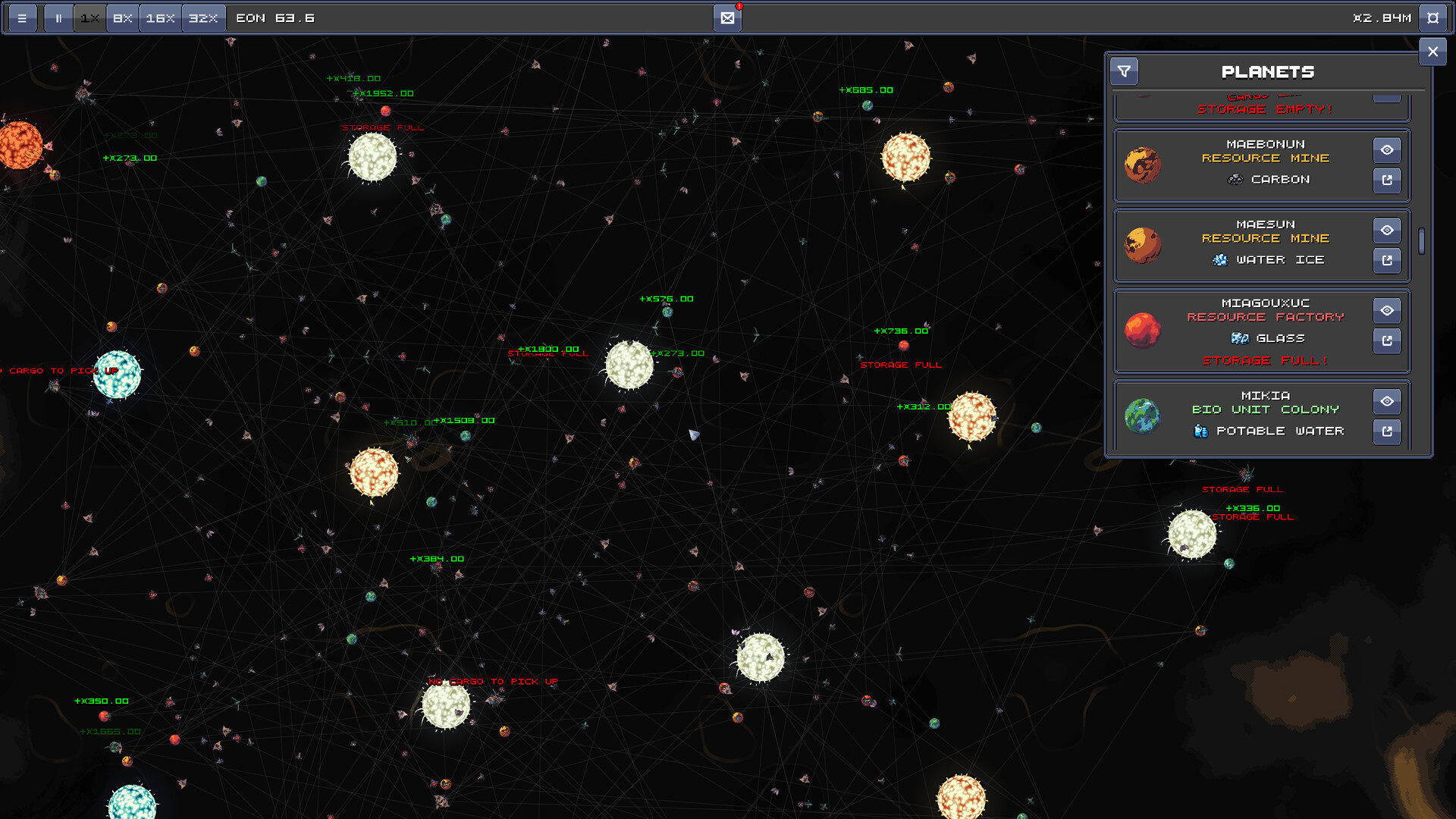
The planet list, showing the producer/processor/consumer chain reviewers described as the game's entire strategic puzzle.Image: sugames via Steam -
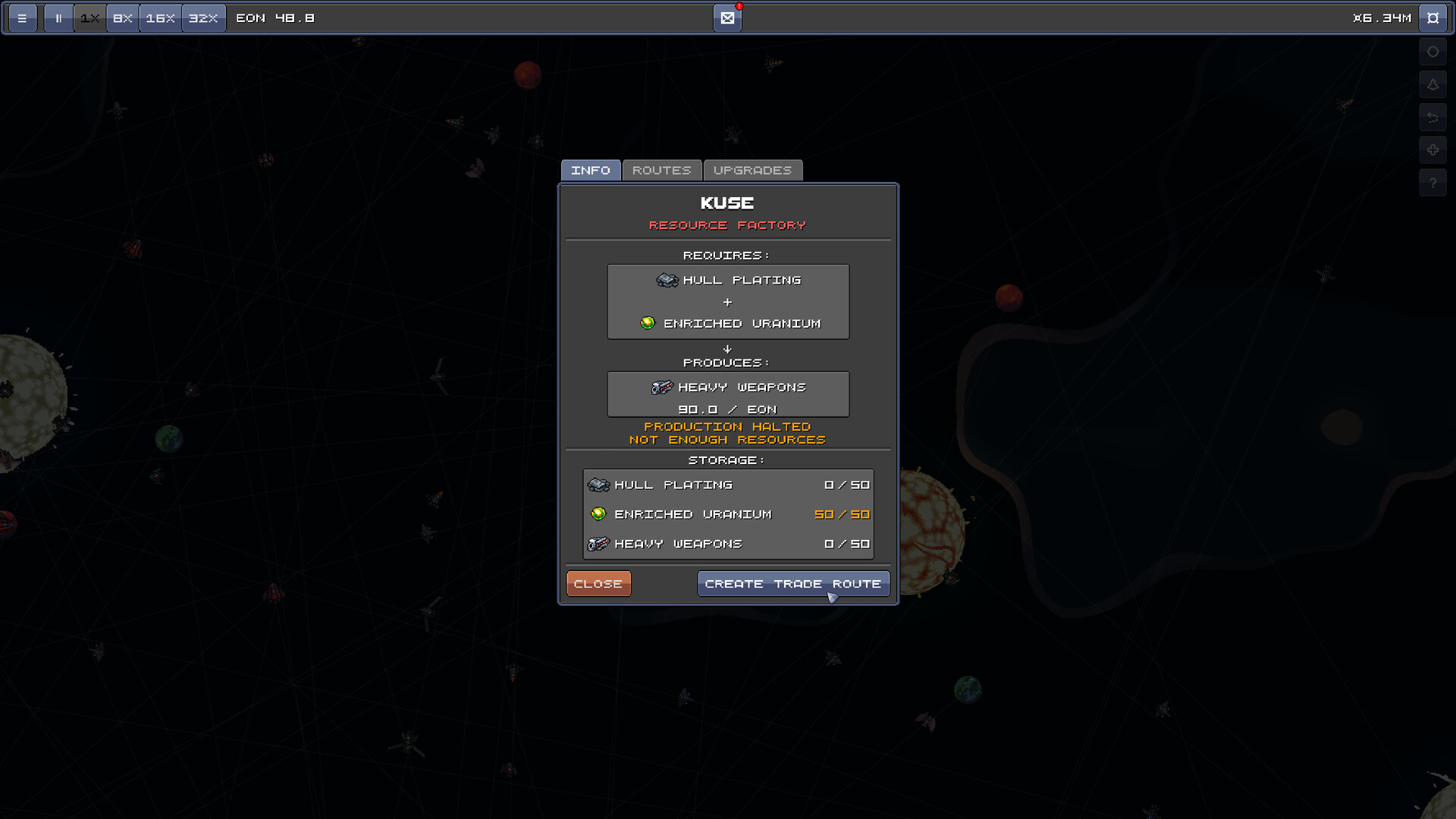
A resource factory with production halted for lack of an input good, the kind of supply-chain bottleneck one negative reviewer said the game gives players no easy way to diagnose.Image: sugames via Steam