
Game review
Stage Break Idle
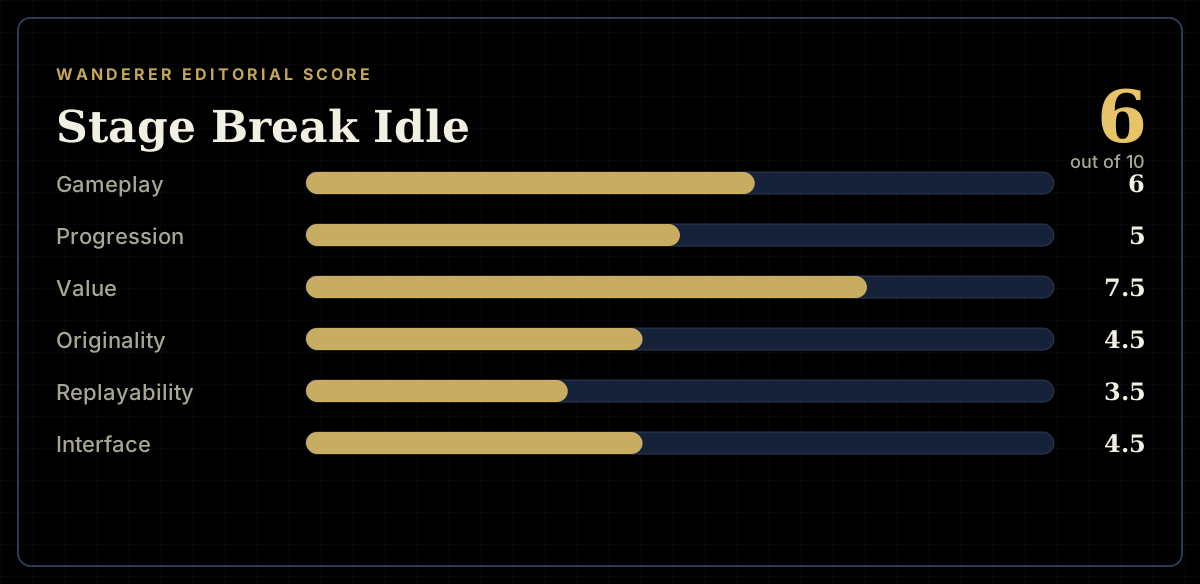
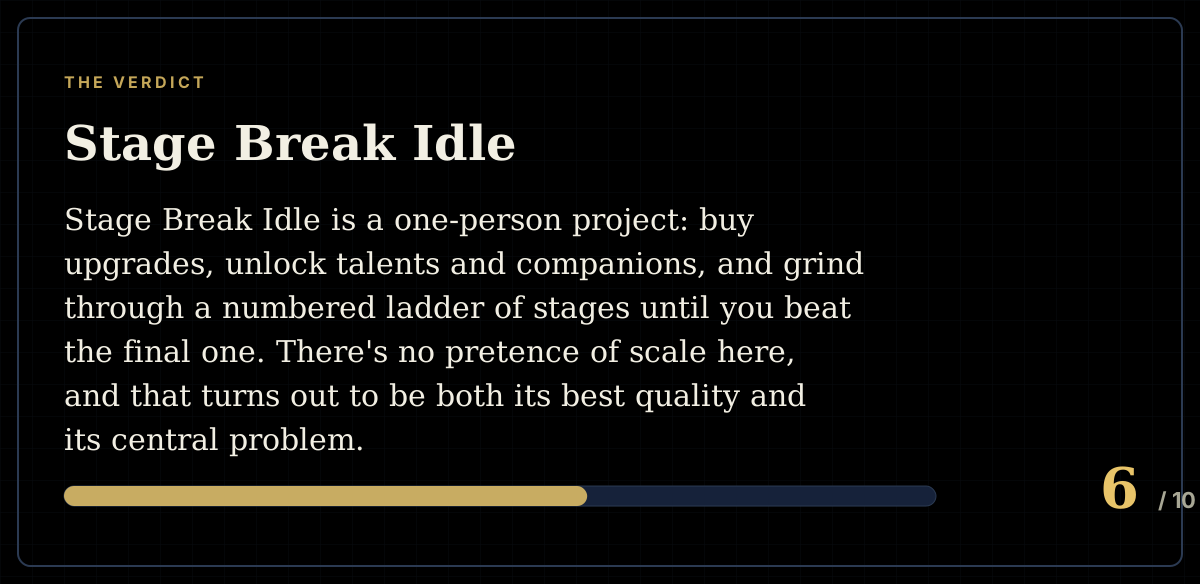
6 / 10
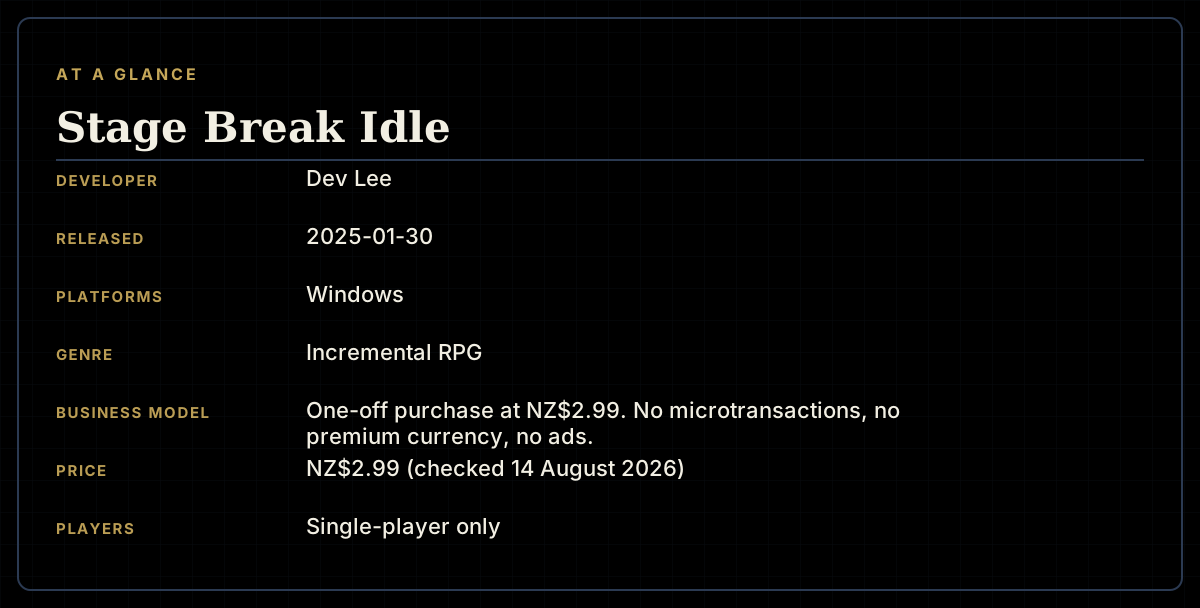
- Developer
- Dev Lee
- Publisher
- Dev Lee
- Released
- 30 January 2025
- Platforms
- Windows
- Genre
- Incremental RPG
- Monetisation
- One-off purchase at NZ$2.99. No microtransactions, no premium currency, no ads.
- Players
- Single-player only
The short version
Stage Break Idle is a one-person project: buy upgrades, unlock talents and companions, and grind through a numbered ladder of stages until you beat the final one. There's no pretence of scale here, and that turns out to be both its best quality and its central problem. Almost every review, positive or negative, frames its judgment around the same two words: for $2. "It's not bad, cheap as hell and kept me entertained for long enough for the price," reads one typical response. That near-unanimous framing is rare for any game, and it means Stage Break Idle mostly succeeds on its own modest terms.
The catch is that those terms are genuinely modest. Reviewers who've spent real time in the incremental genre single this out directly: "Classic idle games like Hero Clicker, AdVenture Capitalist, and Idling to Rule the Gods are far longer and don't cost" as much relative to the playtime on offer, argues one of the game's few detailed negative reviews. Most players report finishing the whole game -- reaching the final stage -- in a handful of hours or less, which is an unusual thing to say about a genre built around long-tail, months-long prestige loops.
Biggest strengths
- Priced honestly for what it delivers -- reviewers across both positive and negative reviews independently converge on the same "worth it for $2" framing, a rare point of consensus
- A complete, self-contained loop with a defined ending rather than an endless grind, which some reviewers explicitly appreciate as a change of pace from the genre's usual infinite scaling
- The companion and talent systems give the otherwise simple stage-clearing loop some layered decision-making, with one reviewer noting how much the companions matter once you're not actively controlling the run yourself
Biggest weaknesses
- Multiple reviewers report the game can be completed in well under a day, and one directly compares it unfavourably on length-per-dollar against established incrementals like Hero Clicker, AdVenture Capitalist and Idling to Rule the Gods
- The prestige system resets active skills and talents on every run, forcing players to manually reactivate everything rather than carrying meaningful choices forward, which reviewers describe as tedious rather than strategic
- Specific, reproducible bugs are reported in multiple reviews, including a stamina-training cap that behaves inconsistently and an on-screen "next upgrade" counter that stops updating partway through the game
Who it's for: Idle-game collectors looking for a short, cheap, complete entry to add to a list, and anyone curious what a single developer can put together in this genre for the price of a coffee. Not for players who want the genre's usual appeal -- weeks or months of prestige loops and escalating numbers -- or who need clear tooltips and a polished interface to enjoy a management layer.
Our recommendation: A low-risk, low-reward purchase. At NZ$2.99, reviewers are consistently comfortable calling it a fair trade even when they list real complaints, and there's something to be said for a small game that doesn't overstay its welcome or nickel-and-dime you afterward. Just don't expect the length or polish of the genre's bigger names -- go in expecting an afternoon, not a habit.
6 / 10
Stage Break Idle doesn't pretend to be anything more than what it is: a one-developer incremental RPG where you spend resources on upgrades, unlock companions and talents, and push a numbered stage counter upward until you beat whatever is waiting at the end. At NZ$2.99, it's cheap even by the standards of a genre built on cheap games, and that price tag ends up doing most of the heavy lifting in how the game gets talked about. Nearly every review, whether the reviewer recommends buying it or not, circles back to the same framing: it's fine, for the money.
A loop that works, at a scale that doesn't stretch far
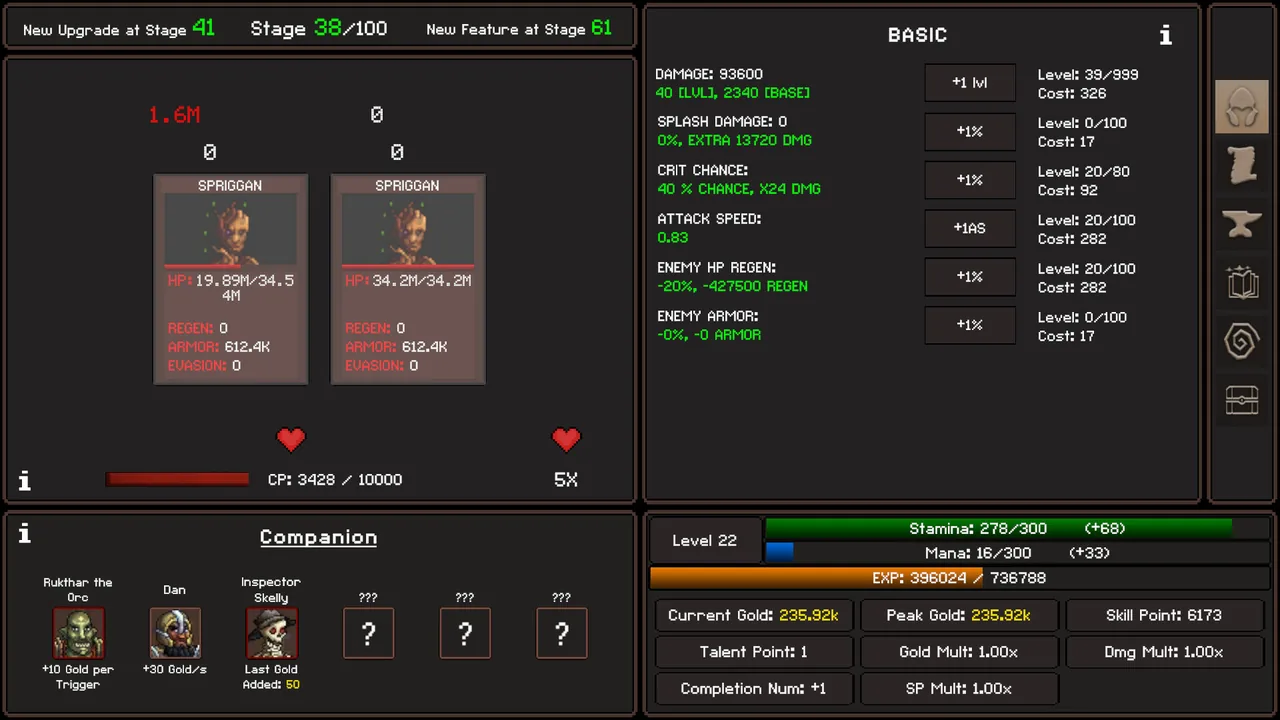
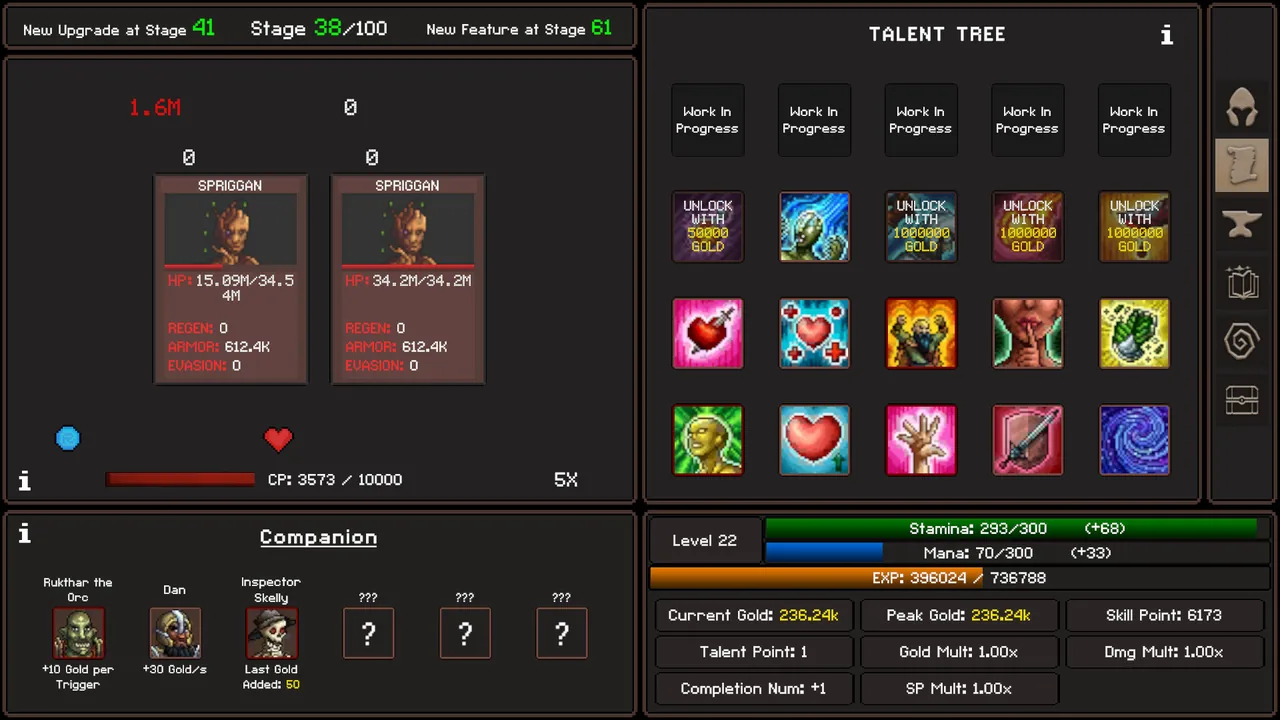
The mechanics are recognisable to anyone who's played an incremental before. You defeat enemies at each stage, spend the resulting currency on upgrades, and layer in systems as you go -- a talent tree that can convert certain stats into damage, a magic system that both deals damage and speeds up progress, and companions who keep contributing while you're not actively watching the screen. One reviewer put it well: without companions, "you'd be running around like a chicken with your head cut off," but with them running things in the background, the idle half of the loop actually works as intended. None of this reinvents the genre, but it's assembled competently, and the core feedback loop of buy-upgrade-progress does what it's supposed to.
Where it departs from convention is length. The genre's biggest names -- AdVenture Capitalist, Idling to Rule the Gods, Hero Clicker -- are built to be returned to for weeks or months, with prestige loops designed to keep paying off long after the first session. Stage Break Idle isn't built that way. Reviewers routinely describe finishing the entire game -- reaching its final stage -- within a handful of hours, sometimes in a single sitting. One player who logged 28.5 hours called it a complete, working experience that "does what it says it does" without aiming very high; another who beat it in under a day called it "worth the 2$" regardless. But the most detailed critical review draws the length comparison explicitly, naming three established incrementals that deliver substantially more playtime for a comparable or lower price. For a genre where the whole pitch is usually "there's always another number to grow," a game you can finish before dinner is an unusual proposition, and not every reviewer is convinced it's a good one.
Rough edges that a solo project doesn't quite smooth over
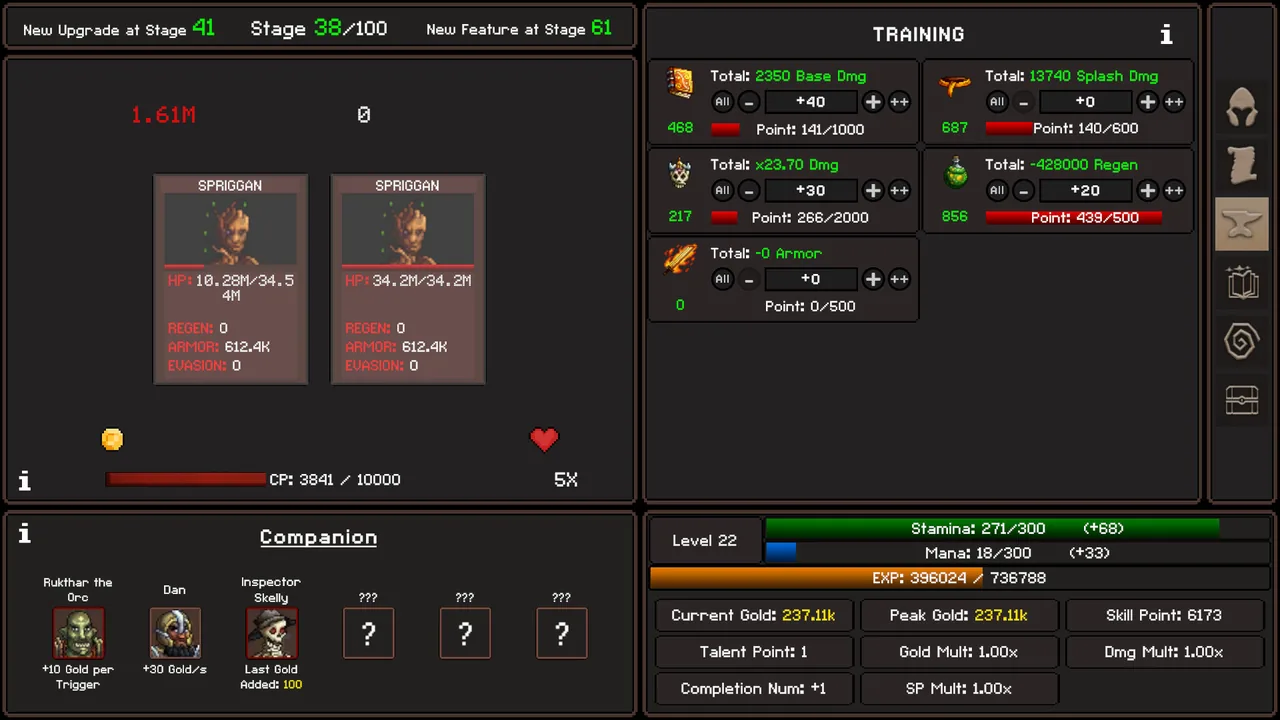
Being a one-person game isn't a strike against Stage Break Idle on its own -- plenty of good idle games come from small teams. But several of its reviews point at the same kind of friction that tends to show up when a single developer is building, balancing and testing everything alone. Multiple players report a stamina-training mechanic that behaves oddly around specific thresholds -- investing exactly 300 points into it stops working where 299 doesn't, according to one review -- and an on-screen counter meant to tell you when your next upgrade unlocks that simply stops updating partway through, stuck reporting "stage 61" long after the player has passed it. Neither bug is described as game-breaking, but both are the kind of small, specific, reproducible thing that erodes trust in a genre where players are staring at numbers for hours and expect them to mean what they say.
The interface draws similar complaints. More than one reviewer says the game doesn't clearly explain what several of its own stats and numbers actually do, and the talent system in particular is singled out as hard to read -- it's not obvious at a glance which talents are active and which aren't. The prestige system, meanwhile, works but resets all active skills and talents on every run, meaning players have to manually reactivate everything from scratch each time rather than carrying forward meaningful strategic choices. One reviewer calls this "generally a bit tedious" rather than engaging, which is a fair description of a prestige loop that's supposed to be the genre's core hook.
Pacing has its own wrinkle, too. A player who otherwise enjoyed the game describes moving through the first eight stages briskly, only to hit stages nine and ten and find the game turning into "a waiting game while your stats automatically improve" -- a sudden shift from active decision-making to passive watching that several other reviews echo in less specific terms. And there's been no visible follow-up since launch: Stage Break Idle's Steam news feed carries no posts at all, so there's nothing to point to either confirming ongoing support or ruling it out -- it simply reads as a finished, static release.
A fair price for a slight game
Judged as a piece of software doing exactly what its store page promises, Stage Break Idle mostly delivers. It's Mostly Positive on Steam, at 73.7% across its full 19-review English-language corpus -- a small sample, but one this review has been able to read in its entirety rather than sampling from. Global achievement data backs up the shape of the reviews: rather than the steep early drop-off you'd expect from a game people bounce off quickly, completion rates decline gently from 93% for the first milestone down to 36% for the last of its five achievements, consistent with a game that most buyers actually see through to some meaningful point rather than abandoning outright.
That's the best case for Stage Break Idle: a cheap, honest, finishable idle game that mostly avoids overselling itself. It's also the whole case against it -- there just isn't much game here relative to what the genre's better-known names offer for similar money, and the bugs and interface issues that do show up are the visible seams of a solo project that hasn't had much post-launch polish.
6.0 out of 10. Stage Break Idle is a small, honestly priced incremental RPG that does what it sets out to do and rarely pretends otherwise, but it's short enough and rough enough around the edges that it's hard to recommend over the genre's more established, more generous alternatives. Buy it if you want a cheap afternoon with a working idle loop and don't mind a few unpolished corners; look elsewhere if you want the genre's usual long-tail hook.
Pros and cons
Pros
- Priced honestly for what it delivers -- reviewers across both positive and negative reviews independently converge on the same "worth it for $2" framing, a rare point of consensus
- A complete, self-contained loop with a defined ending rather than an endless grind, which some reviewers explicitly appreciate as a change of pace from the genre's usual infinite scaling
- The companion and talent systems give the otherwise simple stage-clearing loop some layered decision-making, with one reviewer noting how much the companions matter once you're not actively controlling the run yourself
- No monetisation beyond the upfront price -- no ads, no premium currency, nothing to upsell after the sale
Cons
- Multiple reviewers report the game can be completed in well under a day, and one directly compares it unfavourably on length-per-dollar against established incrementals like Hero Clicker, AdVenture Capitalist and Idling to Rule the Gods
- The prestige system resets active skills and talents on every run, forcing players to manually reactivate everything rather than carrying meaningful choices forward, which reviewers describe as tedious rather than strategic
- Specific, reproducible bugs are reported in multiple reviews, including a stamina-training cap that behaves inconsistently and an on-screen "next upgrade" counter that stops updating partway through the game
- The interface doesn't clearly communicate what several of its own numbers and stats mean, and the talent system in particular is singled out as hard to read when trying to tell which talents are active
- The pacing is uneven late on -- one reviewer describes breezing through the first eight stages only to hit a wall at the ninth and tenth where progress becomes largely passive waiting
- No news posts, patches or announcements appear on the game's Steam news feed since launch, so there's no visible post-release support history to point to either way
Screenshots
-
Stage Break IdleImage: Dev Lee via Steam -
Stage Break IdleImage: Dev Lee via Steam -
Stage Break IdleImage: Dev Lee via Steam -
How the review scores each part of the gameWanderer Editorial -
The essentialsWanderer Editorial -
The short versionWanderer Editorial