Game review
Solasta: Crown of the Magister
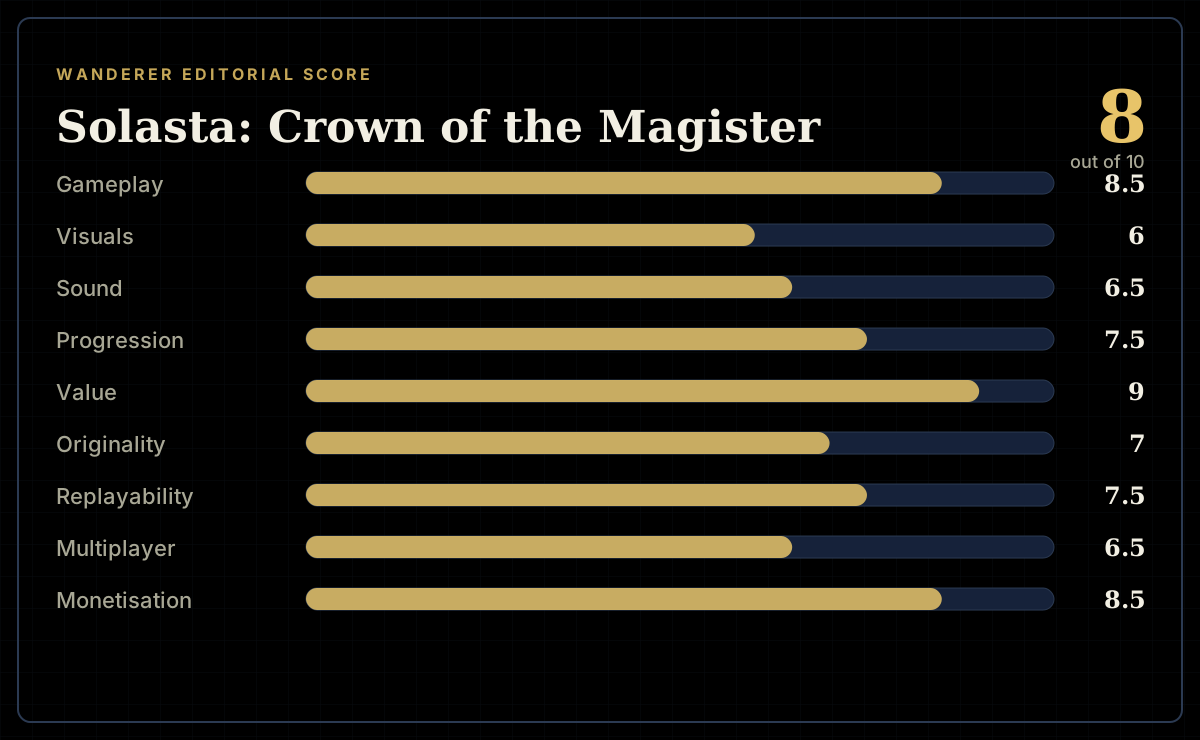
8 / 10
- Developer
- Tactical Adventures
- Publisher
- Tactical Adventures
- Released
- 27 May 2021
- Platforms
- Windows, macOS (Steam); Xbox One and Xbox Series X/S (5 Jul 2022); PlayStation 5 (6 Mar 2024)
- Genre
- Tactical CRPG
- Monetisation
- Premium, one-off purchase; four paid DLC packs (two story campaigns, two class/feat content packs), a cosmetic Supporter Pack, a soundtrack, and a Lightbringers Edition bundling base game plus DLC. No in-game currency or live-service system of any kind
- Players
- Online co-op for up to four players across the full campaign and custom Dungeon Maker creations, cross-platform per Steam's own listing; arrived as a free update in April 2022, not present at the May 2021 launch
The short version
Solasta: Crown of the Magister is built on Dungeons & Dragons' free 5.1 System Reference Document rather than a paid Wizards of the Coast brand license, and that one decision explains almost everything about the game. It can't use the Forgotten Realms, beholders or the D&D name on its box, so Tactical Adventures built an original world and put every spare resource into making the open ruleset play exactly as written — attacks of opportunity, saving throws, rolled stats, and combat where climbing to high ground or toppling a column onto an enemy is a genuine tactical option, not a scripted set piece. Light and darkness matter too: torches attract monsters, and some enemies simply won't follow a party into the dark.
What it can't do is compete with Baldur's Gate 3 or Pathfinder: Wrath of the Righteous on scale, cast size or narrative ambition, and it doesn't try to. The writing is thin, the animation is functional rather than memorable, and the character-option roster is smaller than either rival's out of the box. None of that changes what the combat systems achieve, or what a 75%-off price tag buys right now.
Biggest strengths
- The D&D 5.1 SRD ruleset plays out with genuine attacks of opportunity, saving throws and traditionally rolled stats rather than a simplified approximation of them
- Verticality and light-versus-darkness are real tactical variables — toppled columns, collapsing bridges and torches that attract monsters change how individual fights play out
- Party creation covers race, class, background and personality, with dialogue reacting to the personality traits chosen at creation
Biggest weaknesses
- Visuals and animation are budget-tier next to Baldur's Gate 3 or Pathfinder: Wrath of the Righteous — functional, and rarely memorable
- Launch critics specifically singled out clichéd, thin writing that the combat systems have to carry almost entirely on their own
- The free SRD license caps the starting roster at five races and seven base classes, well short of the deeper rosters a full D&D or Pathfinder license affords its rivals
Who it's for: D&D 5e players who want the actual rules on a screen rather than a loose approximation, and tactics fans who want verticality, light and darkness to be real mechanical variables rather than set dressing.
Our recommendation: Exceptional value at its current 75%-off price, and still fair at full price for anyone who cares more about rules fidelity than production values. Go in expecting a lean, systems-first CRPG rather than Baldur's Gate 3's cast or Pathfinder's scale, and the trade makes complete sense.
8 / 10
Every CRPG that licenses Dungeons & Dragons makes a decision about which version of "D&D" it's actually buying. Larian paid Wizards of the Coast for the full brand and the Forgotten Realms, and Baldur's Gate 3 spends that license on a cast of fully voiced companions and a story that remembers everything a player does. Tactical Adventures, a small Paris studio founded by former Amplitude developers, took the other route entirely: Solasta: Crown of the Magister runs on the 5.1 System Reference Document, the free, open portion of D&D's ruleset that anyone can build a game on without cutting Wizards a cheque. No Forgotten Realms, no beholders, no "Dungeons & Dragons" on the box — just the rules themselves, implemented about as faithfully as a video game has ever managed, in an original world built specifically to carry them.
That's the whole review in one decision, really. Everything Solasta does well follows from spending its budget on systems instead of a license fee. Everything it does poorly follows from having a noticeably smaller budget than the rivals it invites comparison with.
An open ruleset, not an open license fee
It's worth being precise about what "based on D&D 5e" means here, because it isn't the same claim Baldur's Gate 3 or the Pathfinder games are making. The SRD is Wizards of the Coast's own free release of the core mechanical skeleton of 5th Edition — classes, races, spells, monsters and the maths that runs all of it — deliberately kept separate from the "product identity" content the company actually licenses out: named settings, iconic monsters, and the Dungeons & Dragons trademark itself. Anyone can build on the SRD without WotC's involvement at all, which is exactly what Tactical Adventures did. Solasta takes place in an original world, not the Forgotten Realms, and its bestiary leans on generic fantasy threats — oozes, undead, giants, dragons — rather than the setting-specific monsters a full trademark license would unlock.
The trade-off is honest, and worth stating plainly rather than treating as a hidden asterisk: a free ruleset means a smaller starting content pool. Character creation launched with five races and seven base classes, expanded since through paid DLC rather than free content patches, and that's a noticeably shorter list than either Baldur's Gate 3's twelve-races-and-counting roster or Pathfinder's sprawling multiclass system built on top of an entire tabletop line. Players who came to this genre through either of those games should adjust their expectations for scope before adjusting anything else.
Verticality and darkness as mechanics, not scenery
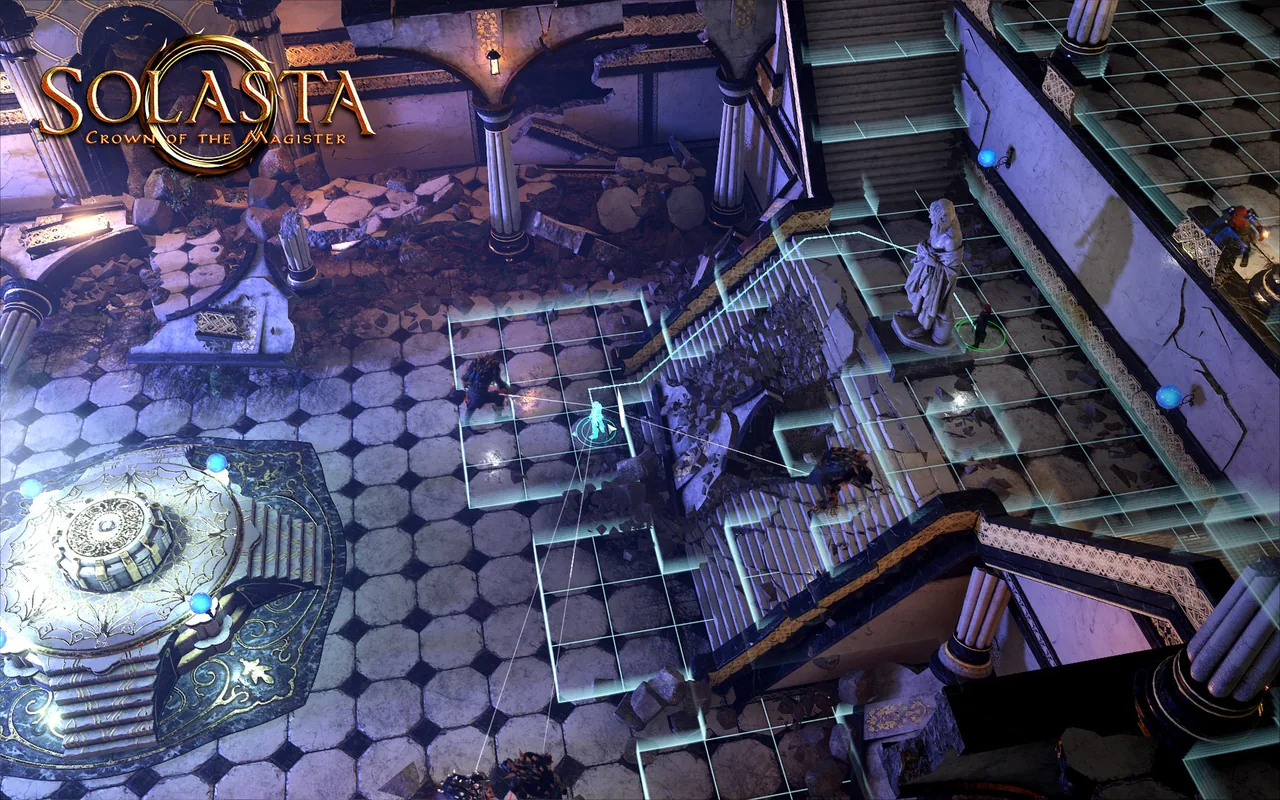
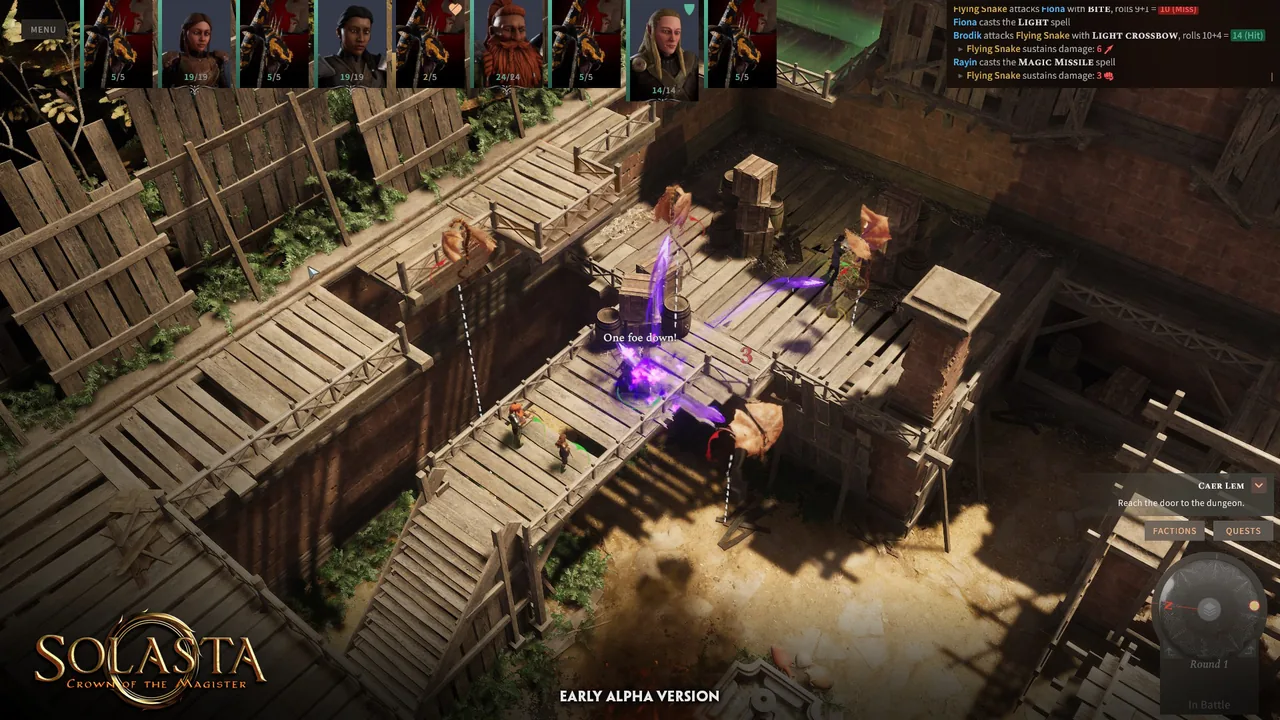
Where Solasta earns its reputation is in how seriously it takes the parts of 5th Edition that most CRPG adaptations quietly simplify away. Combat happens in genuine 3D space: characters climb, jump, and in some cases fly, and high ground grants a real mechanical advantage rather than a cosmetic camera angle. Environmental interaction isn't a scripted moment reserved for set pieces — a column can be toppled onto whoever's standing beneath it, a bridge can be collapsed to strand pursuers on the wrong side of a gap, and a small character can slip through a passage a larger enemy physically cannot follow into. That size mechanic alone does something few tactical RPGs bother with: it makes party composition matter for traversal, not just damage output.
Light and darkness get the same treatment. Some enemies have darkvision and hunt in the dark without penalty; others are drawn toward a lit torch, and a careless light source can pull a fight a player wasn't ready for. Managing illumination becomes an actual tactical decision rather than a visibility slider, and it's one of the clearest examples in the genre of a rule that exists on a character sheet actually surviving the trip into a video game engine intact. Baldur's Gate 3 implements a version of verticality and light too, to its credit, but Solasta builds entire encounters around the assumption that a player will use both, which gives its combat a distinct identity rather than feeling like a smaller echo of its bigger rival.
Character creation the tabletop way
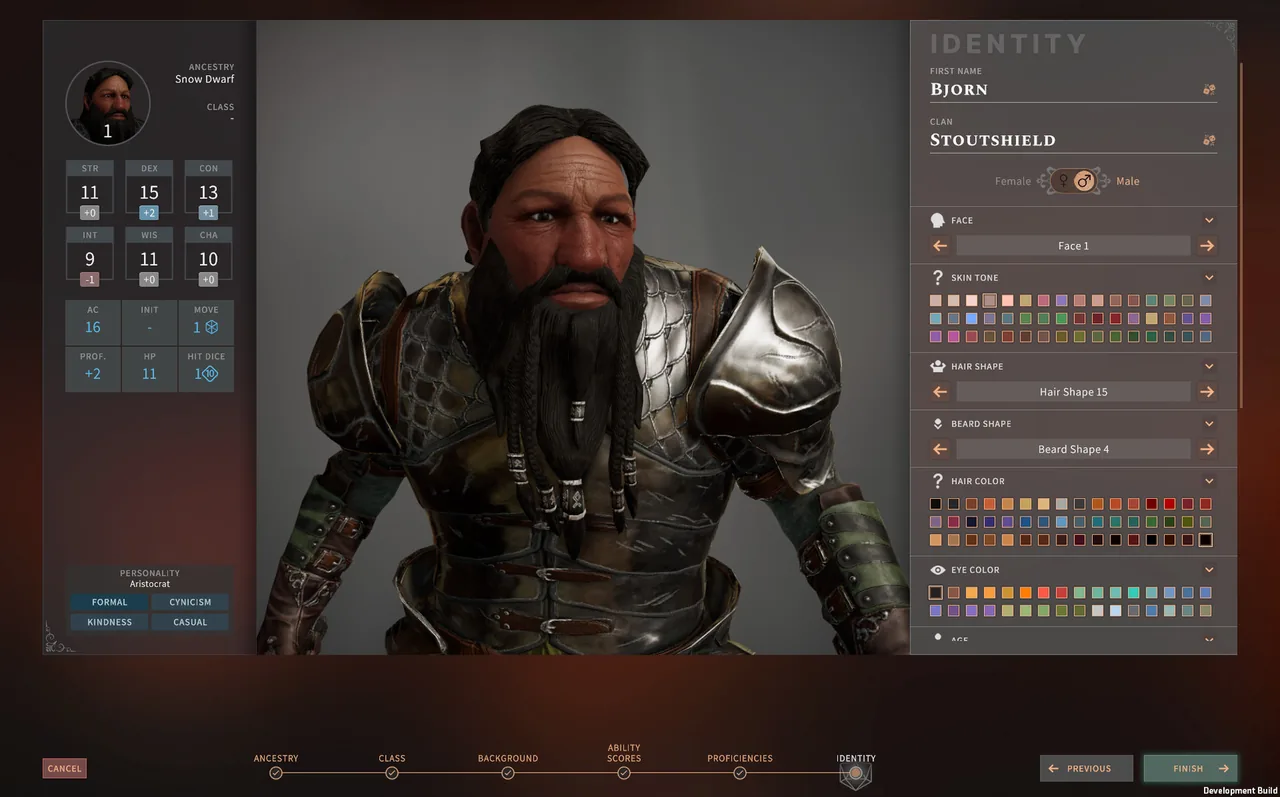
Party creation follows the same instinct toward fidelity: race, class, background and a chosen personality, then stats rolled the traditional way rather than assigned from a point-buy menu alone. Personality choices aren't cosmetic flavour text either — they surface in dialogue and narration, giving even a fairly thin story some texture at the level of individual character voice, even where the plot around them doesn't earn much attention on its own. Four heroes with complementary skills is the expected party shape, and building one well rewards actually knowing the ruleset rather than picking whichever class icon looks strongest.
That system-literacy requirement cuts both ways. A player who already understands 5th Edition will recognise the shape of every encounter almost immediately and get real mileage out of build planning. A player who doesn't will find less onboarding here than Baldur's Gate 3 offers, which at least explains its jargon once even if it never revisits it. Solasta assumes familiarity more than it teaches it.
Where the budget shows
None of the mechanical fidelity comes with the production values the genre's biggest names can afford, and it's worth being honest about exactly where that shows rather than gesturing vaguely at "lower budget." Visual presentation is functional — clean, legible tactical spaces rather than anything built to be admired — and animation doesn't carry the weight or personality of Baldur's Gate 3's combat. Launch reviews were consistent on the game's biggest weakness: PC Gamer praised the tactical combat and its accessibility to newcomers while criticising the writing directly, and RPGFan put it bluntly, calling the combat and systems an excellent foundation that "will feel a bit empty" without a more compelling story around them. That critical consensus settled at 77 on Metacritic, "generally favorable" rather than a genre-defining score, and it's an accurate summary: the story here is competent scaffolding for the tactics, not a reason to play on its own.
Steam's own player base disagrees more than the critics did, at least on balance — Very Positive across more than 22,000 all-time reviews, sitting around 87% approval as of this review. That gap between critic and player sentiment tracks with what the game actually is: reviewers scoring the whole package dinged it for a story it was never trying to lead with, while the players who bought it specifically for the tactics rate it accordingly.
The Dungeon Maker, and what "complete" actually costs
Past the main campaign, Solasta's clearest advantage over its full-price rivals is the Dungeon Maker: a toolset for building custom rooms, monster composition, treasure, lighting and even music track selection, extended by a Campaign Creator that adds custom NPCs, merchants, quest logic and full loot tables on top. Neither Baldur's Gate 3 nor Pathfinder ships anything comparable — Baldur's Gate 3's officially released toolkit is aimed at modding the existing game rather than building shareable original campaigns from scratch. For a tactics-first audience willing to use it, that's a genuine, ongoing source of new content that doesn't depend on Tactical Adventures shipping more of it.
Online co-op is a real addition too, though it's worth knowing it wasn't part of the package at launch: the full Windows release shipped single-player only in May 2021, and co-op for up to four players arrived as a free update alongside the paid Lost Valley campaign expansion almost a year later, in April 2022. It now covers the main campaign and Dungeon Maker creations alike, with cross-platform support listed on Steam.
The DLC lineup is where the value case gets more complicated. Four paid packs exist: Primal Calling and Inner Strength add new classes, subclasses and feats; Lost Valley and Palace of Ice add separate campaigns at higher difficulty and level range; a cosmetic Supporter Pack and a standalone soundtrack round things out, with a Lightbringers Edition bundling the base game and DLC together. None of it is required to finish the core campaign, and there's no currency, loot box or subscription anywhere in the model — but a player who wants everything is looking at a noticeably larger total than the headline price suggests. At the current 75%-off rate of NZ$10.89 for the base game, that math still overwhelmingly favours the buyer; at full price, it's a fairer but less lopsided deal.
A sequel already changes the calculus
Solasta II entered Early Access on 12 March 2026, built on the newer SRD 5.2 ruleset and published with Kepler Interactive alongside Tactical Adventures, moving toward open-world exploration rather than the original's more contained dungeon-crawling structure. It's a genuinely different, still-unfinished product, not a remaster of this one, and worth flagging clearly for anyone searching for "Solasta" and landing on the wrong storefront page. What it means for this review is straightforward: Crown of the Magister is now the complete, stable, deeply discounted version of the studio's approach, while its successor is still finding its shape in Early Access. For anyone who wants a finished game today rather than a promising one still in development, the original remains the better-defined purchase.
Verdict
Solasta: Crown of the Magister succeeds at exactly what it set out to do: take Dungeons & Dragons' free ruleset and implement it more faithfully than any of its better-funded rivals manage, with verticality, light and darkness treated as real systems a player has to actually use rather than atmospheric dressing. That focus is also its ceiling — a thinner story, a smaller starting roster, and visuals that were never going to compete with a AAA-backed production are the direct cost of building on a license that came free rather than one that came with Wizards of the Coast's marketing budget attached.
Eight reflects a genuinely excellent tactical CRPG that knows precisely what it is and doesn't overreach past it, sold right now at a price that makes the decision easy. Players who want Baldur's Gate 3's cast or Pathfinder's scale should look there instead; players who want the actual rules, played properly, in genuine three-dimensional space, will get more of exactly that here than almost anywhere else in the genre.
Players who like a party they keep building indefinitely, rather than across one campaign, might also find something to like in Wanderer.
Price and Steam review data checked 30 July 2026.
Pros and cons
Pros
- The D&D 5.1 SRD ruleset plays out with genuine attacks of opportunity, saving throws and traditionally rolled stats rather than a simplified approximation of them
- Verticality and light-versus-darkness are real tactical variables — toppled columns, collapsing bridges and torches that attract monsters change how individual fights play out
- Party creation covers race, class, background and personality, with dialogue reacting to the personality traits chosen at creation
- The Dungeon Maker and Campaign Creator let players build and share entire custom adventures, complete with monster composition, loot tables, quests and lighting
- Currently 75% off at NZ$10.89 for a full campaign plus years of post-launch content (checked 30 July 2026)
- No microtransactions, loot boxes or ongoing live-service system anywhere in the package
Cons
- Visuals and animation are budget-tier next to Baldur's Gate 3 or Pathfinder: Wrath of the Righteous — functional, and rarely memorable
- Launch critics specifically singled out clichéd, thin writing that the combat systems have to carry almost entirely on their own
- The free SRD license caps the starting roster at five races and seven base classes, well short of the deeper rosters a full D&D or Pathfinder license affords its rivals
- Online co-op didn't exist for nearly a year after the Windows launch, arriving as a free update alongside the paid Lost Valley campaign in April 2022
- Buying every campaign and content DLC costs meaningfully more than the discounted base game alone
- Solasta II is already in Early Access on a newer SRD 5.2 ruleset, which makes the original read as the smaller, tighter prequel it now is
Screenshots
-
Solasta: Crown of the MagisterImage: Tactical Adventures via Steam -
Solasta: Crown of the MagisterImage: Tactical Adventures via Steam -
Solasta: Crown of the MagisterImage: Tactical Adventures via Steam -
How the review scores each part of the gameWanderer Editorial -
The short versionWanderer Editorial