
Game review
SLUDGE LIFE 2
6.5 / 10
- Developer
- Terri Vellmann, Doseone
- Publisher
- Devolver Digital
- Released
- 27 June 2023
- Platforms
- Windows, macOS
- Genre
- Vandalism Exploration Sim
- Monetisation
- One-time premium purchase; no ads, DLC or in-game store found
- Players
- Single-player only; no online, co-op or PvP modes
The short version
SLUDGE LIFE 2 sends Ghost searching for a missing rapping frog, Big Mud, through Ciggy City Suites, a grimy hotel-tower riff on the original SLUDGE LIFE's slacker-anarchist open world. Reviewers who loved the first game's surreal humor, spray-paint vandalism loop and genuinely distinctive musical identity find all of that fully intact here, and several call it a worthy, bigger-scale continuation of exactly what made the original beloved.
A substantial share of returning fans push back hard on that "bigger" framing specifically, though. The game's own official description promises a world "twice as dense" than the original, but reviewers consistently report the opposite experience: tag spots that require little to no puzzle-solving to reach, reduced verticality and environmental creativity, fewer meaningful new items despite the marketing, and an overall runtime several reviewers estimate at well under two hours for a full completion. For fans expecting a genuine expansion, that gap between marketing and delivery is the single most consistent complaint in this game's reception.
Biggest strengths
- Fully intact surreal humor, absurdist dialogue and distinctive slacker-utopia atmosphere that reviewers say preserves everything that made the original SLUDGE LIFE a cult favourite
- A genuinely excellent, widely-praised soundtrack that multiple reviewers specifically nominated for Steam Awards recognition in 2023
- A distinctive, colorful, stylized visual identity that stands apart clearly from typical indie exploration games
Biggest weaknesses
- The game's own official store description promises a world "twice as dense" than the original, but a substantial share of reviewers report the opposite experience — less verticality, fewer secrets, and reduced environmental creativity relative to its predecessor
- Tag spots, the core collectible driving exploration, are consistently described as far easier to locate and reach than in the original, removing much of the puzzle-solving traversal challenge that gave the first game its addictive pull
- Several reviewers estimate a full completion runtime of roughly 90 minutes to two hours, considerably shorter than the original, with at least one reviewer explicitly regretting a full-price purchase as a result
Who it's for: Fans of the original SLUDGE LIFE looking for more of its exact tone and humor at a low price, and newcomers curious about a genuinely distinctive first-person exploration comedy. Less suited to anyone expecting the promised "twice as dense" scale increase, or wanting a genuinely challenging traversal puzzle like the original offered.
Our recommendation: Worth it at its low price for the humor, music and vibe alone, but temper expectations set by its own marketing — this plays much closer to an expansion than a doubled-in- scale sequel.
6.5 / 10
Big Mud, everyone's favourite rapping frog, has gone missing, and it falls to Ghost, his closest friend, to track him down through Ciggy City Suites — a grimy, multi-floor hotel tower standing in for the sun-baked island of the original SLUDGE LIFE. That original built a genuine cult following around its specific blend of first-person exploration, spray-paint vandalism, absurdist dialogue and a soundtrack reviewers still describe in reverent terms years later. SLUDGE LIFE 2 inherits all of that tone intact, and for reviewers who just want more of exactly that, it largely delivers.
Everything that made the original click, still here
The humor, music and atmosphere draw essentially unbroken praise. Reviewers describe the same surreal, low-stakes "slacker utopia" feeling that made the first game a comfort watch as much as a game, and the soundtrack specifically drew enough acclaim that multiple reviewers nominated it for Steam Awards recognition in 2023. New traversal tools — a double-jump-and-sprint upgrade and a portable launcher — add some fresh movement options, and reviewers who come to the sequel without strong expectations set by the original's marketing describe a genuinely fun, if familiar, continuation of the first game's specific charm.
A marketing promise the game doesn't keep
Where the reception turns sharply critical is on a claim made not by reviewers but by the game's own official Steam description, which promises a world "twice as dense" than the original with a "huger, weirder, gnarlier open world." A substantial share of returning fans report the opposite experience directly. One detailed critical review states it bluntly: "despite the advertising this isn't any bigger or denser than the first game... if anything there are less gags and interesting things to stumble on." Multiple independent reviewers make the same specific point about tag spots — the core collectible driving exploration — describing them as trivially easy to locate and reach compared to the genuine environmental puzzle-solving the original demanded, removing a meaningful part of what made that game's traversal so satisfying to master.
A noticeably shorter experience
Tied directly to the density complaint is a consistent runtime observation: several reviewers estimate a full completion, including collecting every tag and reaching every ending, at somewhere between 90 minutes and two hours — considerably shorter than most reviewers recall from the original. At least one reviewer explicitly frames this as buyer's remorse at full price, describing the experience as feeling "closer to a DLC than a sequel," a phrase that recurs across multiple independent critical reviews with enough consistency to treat as a genuine, shared impression rather than one outlier's complaint.
What the patch record and achievement data confirm
Checking the density and scope complaints against the public record supports the reviewer accounts rather than the marketing copy. Post-launch support consisted of five small patches released within about two and a half weeks of the 27 June 2023 launch, addressing minor bugs, localization fixes and a double-jump glitch — no content expansions or scope additions followed, meaning the version reviewers criticize as underscaled is, as far as the public record shows, the final, complete release. Global achievement figures back this up in an unusual way: rather than the steep, front-loaded difficulty curve typical of longer games this lane has covered, SLUDGE LIFE 2's achievements cluster tightly together, from 30.5% to 43.1% of the playerbase — a flat distribution consistent with a short, low-friction experience where most engaged players who start finish nearly everything, rather than a long game that loses players gradually over many hours.
Weighing the price against the length fairly
It's worth being precise about how the length complaint interacts with the game's price, since several reviewers who criticize the runtime still land on a positive overall verdict specifically because of it. One reviewer frames the calculation directly: "no game offers more vibes per dollar," even while acknowledging the experience is comparatively brief. That's a fair, coherent position distinct from the reviewers who feel outright misled by the marketing — the length itself isn't the core complaint for most critics so much as the gap between what was promised and what shipped. A buyer who ignores the "twice as dense" claim entirely and treats this as a short, cheap continuation of the original's atmosphere is likely to have a considerably more satisfied experience than one who takes the marketing at face value.
Where a sequel like this typically goes right
For comparison, it's worth noting what reviewers say the original SLUDGE LIFE did differently: tag spots required genuine lateral thinking to reach, often demanding players notice an easy-to-miss ledge, secret passage or environmental interaction rather than simply walking toward a visible marker. That puzzle-solving loop, more than the collectible count itself, is what several reviewers say they miss most in the sequel — not that there's necessarily less content in a raw numerical sense, but that engaging with what's there asks less of the player than the original did, which changes the fundamental feel of exploration even if the map itself is comparable in scale.
Where it lands
SLUDGE LIFE 2 succeeds at preserving everything that made its predecessor a genuine cult favourite — the humor, the music, the specific surreal charm — and reviewers coming in without inflated expectations describe a fun, if brief, continuation of that identity. The "twice as dense" marketing claim is a real, specific, well-documented overpromise that a substantial and consistent share of returning fans say the actual game doesn't deliver on, and the shortened runtime and reduced traversal challenge are fair, corroborated complaints rather than nostalgia-tinted nitpicking. At its low asking price, this remains a worthwhile pickup for the atmosphere and humor alone — just don't expect the doubled scale the store page promises.
Pros and cons
Pros
- Fully intact surreal humor, absurdist dialogue and distinctive slacker-utopia atmosphere that reviewers say preserves everything that made the original SLUDGE LIFE a cult favourite
- A genuinely excellent, widely-praised soundtrack that multiple reviewers specifically nominated for Steam Awards recognition in 2023
- A distinctive, colorful, stylized visual identity that stands apart clearly from typical indie exploration games
- A low asking price that most reviewers, even critical ones, describe as fair for what's on offer, softening the impact of the scope complaints below
- New traversal items, including a double-jump-and-sprint tool and a portable launcher, that reviewers who enjoyed the sequel describe as genuinely fun additions to movement
Cons
- The game's own official store description promises a world "twice as dense" than the original, but a substantial share of reviewers report the opposite experience — less verticality, fewer secrets, and reduced environmental creativity relative to its predecessor
- Tag spots, the core collectible driving exploration, are consistently described as far easier to locate and reach than in the original, removing much of the puzzle-solving traversal challenge that gave the first game its addictive pull
- Several reviewers estimate a full completion runtime of roughly 90 minutes to two hours, considerably shorter than the original, with at least one reviewer explicitly regretting a full-price purchase as a result
- New items are criticized by some reviewers as functionally minor, making traversal easier without meaningfully expanding what players can creatively do with the world
- The game's endings are described by multiple reviewers as feeling more like fan-service callbacks than substantial narrative payoffs, a step down from the original's more meaningful conclusions
Screenshots
-

SLUDGE LIFE 2Image: Devolver Digital via Steam -

SLUDGE LIFE 2Image: Devolver Digital via Steam -

SLUDGE LIFE 2Image: Devolver Digital via Steam -
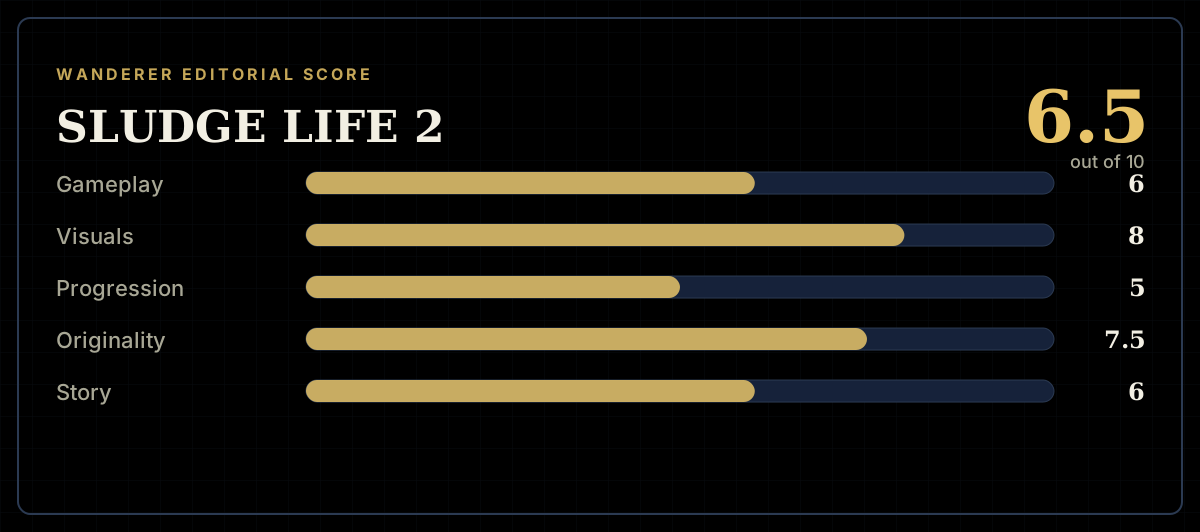
How the review scores each part of the gameWanderer Editorial -
The short versionWanderer Editorial