
Game review
Skate Story
7 / 10
- Developer
- Sam Eng
- Publisher
- Devolver Digital
- Released
- 8 December 2025
- Platforms
- Windows
- Genre
- Skateboarding, Narrative, Art Game
- Monetisation
- One-time purchase, no DLC or in-game currency
- Players
- Single-player
The short version
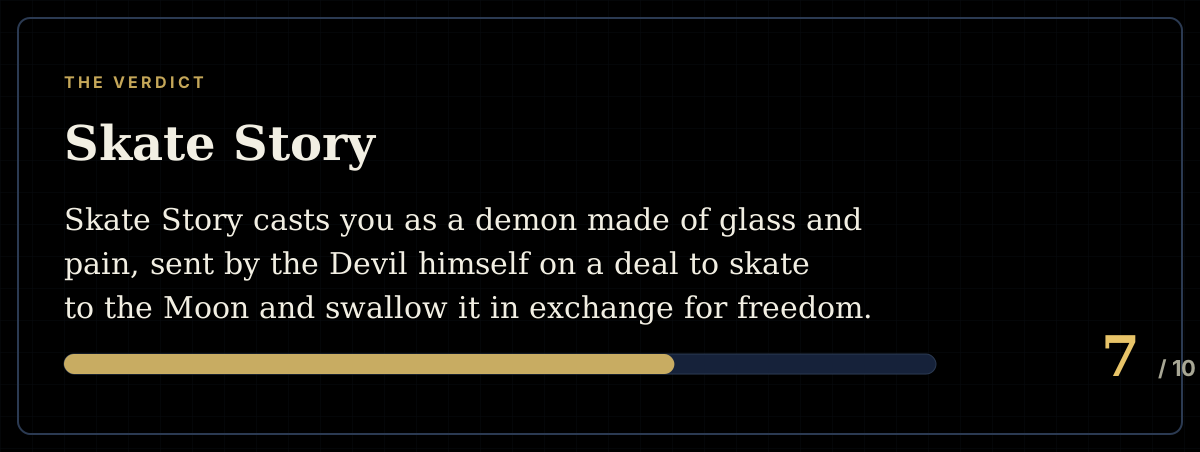
Skate Story casts you as a demon made of glass and pain, sent by the Devil himself on a deal to skate to the Moon and swallow it in exchange for freedom. Across nine surreal layers of a low-poly, PS2-inspired Underworld, you ollie, kickflip and grind past tortured souls and demons to a Blood Cultures soundtrack reviewers repeatedly call legendary. The presentation lands overwhelmingly: visuals, music and tone draw near-universal, often deeply personal praise, with reviewers describing the experience in unusually poetic, reflective terms rather than standard genre enthusiasm. What a substantial and detailed minority pushes back on, though, is the skating itself — several reviewers argue the trick-chaining mechanics are shallow and repetitive compared to genre touchstones, directly and specifically unfavourably comparing them to Tony Hawk's Pro Skater games from a quarter-century ago, and describing a game more interested in cutscenes and mood than in the actual feel of skateboarding it's ostensibly about.
Biggest strengths
- The soundtrack, largely built around the band Blood Cultures, draws exceptional, specific praise across nearly the entire review corpus, with multiple reviewers naming it among the best in any game they've played recently
- Visual art direction — low-poly, PS2-inspired environments rendered with a distinct "shatter" effect and surreal, dreamlike level design — earns consistent, often emotionally-invested praise, with several reviewers describing individual scenes as genuinely moving rather than simply pretty
- Reviewers who connect with the controls specifically compare them favourably to classic Tony Hawk's Pro Skater games, describing tight, responsive movement that rewards players who take time to learn its rhythm
Biggest weaknesses
- A substantial, detailed minority of reviewers argue the actual trick system is shallow and repetitive, with one describing it as little more than cycling through a handful of button-and-trigger combinations to "stomp the board and cash in," lacking pipes, grabs or the depth genre veterans expect
- Multiple reviewers directly and specifically compare the mechanics unfavourably to Tony Hawk's Pro Skater titles from over two decades ago, arguing those much older games achieved a level of sophistication and flow this one doesn't reach
- Several reviewers describe the game as cutscene-heavy relative to actual skating time, with at least one saying they spent more time skipping cutscenes than skating, and another arguing the whole project "should have just been a music video"
Who it's for: Players drawn to short, atmospheric, narrative-forward art games with exceptional music and visual style, who don't need deep, technical skating mechanics to be satisfied. Less of a fit for dedicated skateboarding-game fans expecting Tony Hawk-level trick depth and flow, since several detailed reviewers argue that specific expectation goes unmet.
Our recommendation: Worth experiencing for the art direction, music and surreal tone alone, which are genuinely exceptional by most accounts — but temper expectations for the actual skateboarding mechanics, which a real, detailed portion of the game's own audience found thin, fidgety or secondary to the cutscenes surrounding them.
7 / 10
A deal with the Devil, on four wheels
Skate Story's premise commits fully to its own strangeness: you're a demon made of glass, offered freedom by the Devil in exchange for skating all the way to the Moon and swallowing it whole. That journey takes you through nine surreal layers of a low-poly, PS2-inspired Underworld, ollying and kickflipping past tortured souls and demonic obstacles while a soundtrack built largely around the band Blood Cultures plays underneath. The presentation is where the game earns its reputation most decisively — reviewers reach for unusually personal, reflective language to describe it, with one comparing the experience to "a snippet out of one of William Burroughs' books" and another describing an early hub area that "never asks you to think... it asks you to feel." That's a higher bar of praise than typical genre enthusiasm, and it recurs across enough of the corpus to trust as a real, widely-shared reaction rather than a few unusually effusive outliers.
A real disagreement about the skating itself
Set against that presentation is a genuine, detailed split over the mechanics the whole game is ostensibly built around. A substantial minority of reviewers argue the trick system doesn't hold up: one describes it as repeatedly cycling through a small set of trigger-and-button combinations to "stomp the board and cash in," with no pipes or grabs to add depth, calling the underlying game "thoroughly mediocre" beneath its graphics and music. More than one reviewer makes the comparison explicit and pointed, arguing that Tony Hawk's Pro Skater games from more than two decades ago achieve a level of mechanical sophistication Skate Story doesn't reach — a specific, checkable claim about genre history rather than vague dissatisfaction. A related complaint concerns pacing between skating and story: several reviewers describe spending more time skipping cutscenes than actually skating, and one bluntly suggests "this game should have just been a music video."
That's not the majority view, though, and it's worth stating the opposing case with equal weight. Plenty of reviewers describe the controls as tight and responsive, with more than one directly invoking Tony Hawk's control scheme as a positive comparison rather than a negative one — the same franchise the critics cite is, for these players, the compliment rather than the standard the game fails to meet. The truth the corpus suggests is that Skate Story's mechanics reward a specific kind of patient, rhythm-focused play, and reviewers who approached it that way report genuine satisfaction where others, expecting more conventional trick-chaining depth, came away disappointed.
What's missing for now
Beyond the core disagreement, one specific, repeated request unites reviewers on both sides: a free-skate mode outside the structured campaign. Several reviewers who otherwise loved the game specifically wish for a sandbox space to practice tricks and explore the game's striking environments without the pressure of story progression, arguing it would meaningfully extend a short experience's replay value. Camera behaviour draws separate, more critical attention — multiple reviewers describe losing speed quickly enough during tricks that chaining together anything resembling a flowing run becomes a fight against the game's own systems rather than a skill worth mastering.
Progression through 70-plus tricks
Beneath the narrative, Skate Story layers a genre-appropriate progression system: souls sold for decks, wheels and trucks keep your equipment fresh, and skate trials scattered through the Underworld let you level up, learn new tricks from a roster the store page counts at more than 70, and earn new gear. Reviewers engaging with this system describe it as a reasonable, if not especially deep, structure for pacing out the campaign's roughly nine chapters — few single it out for praise the way they do the music or visuals, but few call it actively broken either, positioning it as competent scaffolding for the experience built around it rather than a highlight in its own right.
A largely solo vision
Skate Story is credited to Sam Eng working essentially alone, and that solo authorship is a relevant frame for weighing both the praise and the criticism above. Reviewers who describe the game in personal, almost reverent terms are often responding to exactly that — a single, clear creative vision expressed with unusual confidence across art, music curation and tone, rather than a committee-designed product. That same solo scope plausibly explains why the mechanical depth some reviewers wanted is thinner than a larger studio's dedicated skateboarding game might achieve: Skate Story reads less like a skateboarding game with a story bolted on, and more like a narrative art project that happens to use skateboarding as its verb, which is precisely the framing that satisfies one half of its audience and disappoints the other.
The verdict
Skate Story is, by a wide consensus, a genuinely exceptional audiovisual experience — the soundtrack and art direction earn some of the most personally invested praise this review has encountered, and that alone justifies its reputation for many players. Whether the skateboarding underneath that presentation satisfies depends heavily on what you're bringing to it: reviewers who wanted Tony Hawk-level trick depth report real disappointment, while those who approached it as a rhythm-driven, atmosphere-first experience describe something close to a small masterpiece. Both reactions are well represented and well argued in the game's own review corpus, and this review's honest advice is to watch footage of the actual skating before buying, since your reaction to that footage will likely predict which side of this genuine split you land on.
Pros and cons
Pros
- The soundtrack, largely built around the band Blood Cultures, draws exceptional, specific praise across nearly the entire review corpus, with multiple reviewers naming it among the best in any game they've played recently
- Visual art direction — low-poly, PS2-inspired environments rendered with a distinct "shatter" effect and surreal, dreamlike level design — earns consistent, often emotionally-invested praise, with several reviewers describing individual scenes as genuinely moving rather than simply pretty
- Reviewers who connect with the controls specifically compare them favourably to classic Tony Hawk's Pro Skater games, describing tight, responsive movement that rewards players who take time to learn its rhythm
- The narrative's surreal, allegorical tone — described by one reviewer as reading like "a snippet out of one of William Burroughs' books" — is treated as a genuine strength for players receptive to ambiguous, mood-driven storytelling over conventional plotting
- As a short, complete, one-time-purchase experience with no monetisation beyond the box price, several reviewers frame it as a confident, low-risk way to support a distinctive solo or small-team creative vision
Cons
- A substantial, detailed minority of reviewers argue the actual trick system is shallow and repetitive, with one describing it as little more than cycling through a handful of button-and-trigger combinations to "stomp the board and cash in," lacking pipes, grabs or the depth genre veterans expect
- Multiple reviewers directly and specifically compare the mechanics unfavourably to Tony Hawk's Pro Skater titles from over two decades ago, arguing those much older games achieved a level of sophistication and flow this one doesn't reach
- Several reviewers describe the game as cutscene-heavy relative to actual skating time, with at least one saying they spent more time skipping cutscenes than skating, and another arguing the whole project "should have just been a music video"
- Camera behaviour and speed-loss during tricks draw specific frustration from multiple reviewers, who describe losing momentum quickly enough that chaining anything resembling a satisfying run becomes a fight against the game's own systems rather than a skill to master
- The absence of a free-skate mode outside the main campaign is a specific, repeated request even from reviewers who otherwise loved the game, several of whom say a sandbox space to simply practice tricks in the game's beautiful environments would meaningfully extend its appeal
Screenshots
-

Skate StoryImage: Devolver Digital via Steam -

Skate StoryImage: Devolver Digital via Steam -

Skate StoryImage: Devolver Digital via Steam -
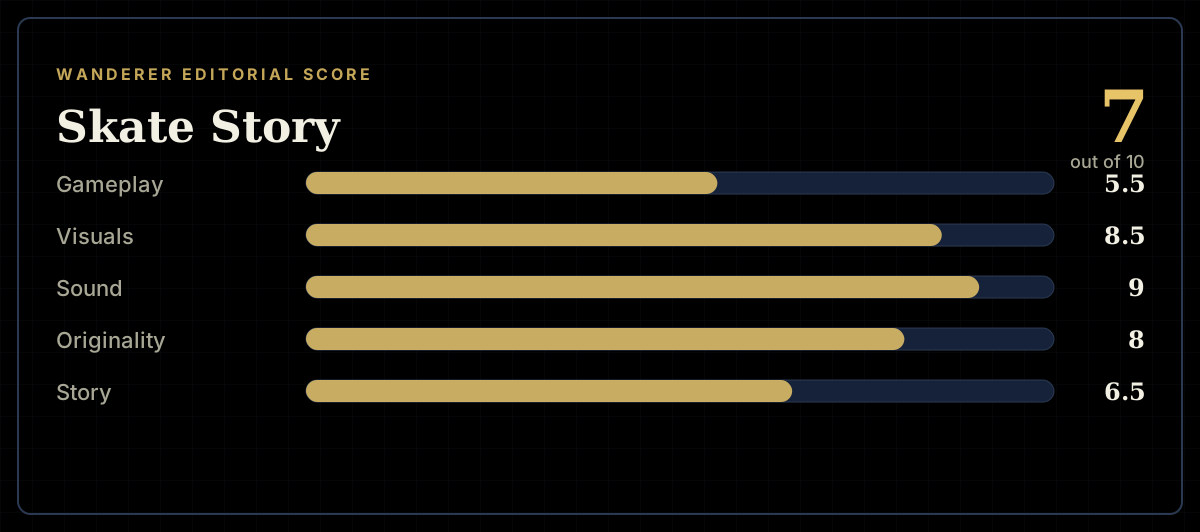
How the review scores each part of the gameWanderer Editorial -
The short versionWanderer Editorial