
Game review
SIMULACRA
6.5 / 10
- Developer
- Kaigan Games OÜ
- Publisher
- Kaigan Games OÜ
- Released
- 26 October 2017
- Platforms
- Windows, macOS, Linux
- Genre
- Found-footage horror narrative
- Monetisation
- One-off purchase, no in-game currency, ads or gameplay-affecting purchases
- Players
- None; single-player only
The short version
SIMULACRA's premise — investigate a missing woman's phone as her texts, photos, and voicemails reveal something increasingly wrong with the world around her — still earns genuine praise for its atmosphere and jump scares, and reviewers describe real tension exploring a device that behaves less predictably the deeper they dig. Set against that is an unusually consistent, detailed thread of criticism aimed at the writing and localization: multiple reviewers independently call the English dialogue and voice acting weak or unintentionally funny, several describe the branching-choice logic as opaque enough that consequences don't track with the choices that caused them, and more than one reviewer found the cast of characters uniformly unpleasant enough to undercut investment in their fates. A specific structural complaint — waiting in real time for new messages to arrive as a core mechanic — draws direct criticism as padding rather than tension. The horror concept remains genuinely effective for a real share of players; whether the writing and systems around it hold up depends heavily on how much rough localization and confusing consequence logic a reader can tolerate.
Biggest strengths
- A genuinely effective found-footage horror atmosphere with jump scares multiple reviewers specifically praise as well-executed
- An interesting underlying philosophical hook, drawing explicitly on the concept of simulacra and simulated reality, that rewards players who engage with the deeper lore
- Multiple distinct endings, including a full "good" and "bad" resolution to Anna's fate, give dedicated players a real reason to revisit key decision points
Biggest weaknesses
- English localization and voice acting draw sustained, specific criticism as weak, awkward, or unintentionally funny across a large share of the review sample
- Branching-choice consequences are described by multiple reviewers as opaque and counterintuitive, with more than one detailed account of trusted characters meeting bad ends despite consistent player support
- A real-time "wait for new messages" mechanic is directly criticized as padding that interrupts pacing rather than building tension
Who it's for: Fans of "found phone" horror narratives who prioritize atmosphere and jump scares over polished writing, and anyone curious about an early, influential entry in the genre alongside contemporaries like Replica and A Lost Phone. Less suited to players who need sharp, natural dialogue or predictable choice-and-consequence logic to stay immersed.
Our recommendation: Worth its low price for the atmosphere and a couple of hours of found-footage horror; temper expectations about the writing quality and don't expect choices to always lead where they seem to point.
6.5 / 10
SIMULACRA opens with a simple, unsettling hook: you've found a lost phone belonging to a woman named Anna, and the more you dig through her texts, photos, and voicemails trying to locate her, the more the device itself starts behaving like something is watching back. Billed as a spiritual successor to the earlier "Sara is Missing," it released in October 2017 to a Very Positive reception — 93.2% across 2,366 English reviews — built substantially on YouTube and streamer coverage that helped the found-phone horror niche find its audience. Reading closely through the review sample reveals a game whose central premise still works for most players, alongside a detailed, specific critical thread about everything the premise is built out of.
An atmosphere that still lands
The horror elements themselves draw consistent, specific praise. One reviewer recalls: "I think the jumpscares and horror elements of the game were done really well. I remember yelping and getting spooked by a loud noise." Another frames the game's deeper ideas approvingly, connecting it explicitly to "a philosophical idea that originated in an essay called 'Simulacra and Simulation' from 1981" and describing a genuinely unsettling vision of what an AI takeover might look like from the inside of one person's phone. That combination — surface-level scares that land, backed by a real conceptual hook for players willing to dig into the lore — is what keeps the atmosphere recommendation-worthy even from reviewers with real complaints about everything else.
Writing and voice acting reviewers can't get past
The most consistent, most specific criticism concerns the English localization. One reviewer states it directly: "The English is awkward, and I laughed out loud at how bad some of the acting is." Another: "the writing is pretty bad, the chat conversations interrupt too much." A third simply calls large stretches of dialogue "cringy and clu[nky]." This isn't a matter of a few players disliking the tone — it's the same specific complaint, about the same specific aspect of the game, recurring across a meaningful share of the critical review sample, and worth weighing seriously against the atmosphere praise above rather than treating as incidental.
Choices that don't track with their consequences
A more specific, structural complaint concerns the branching narrative itself. One detailed reviewer's frustration captures it precisely: "i didn't side with taylor ONCE JUST ONCE. and he [...] died thinking he met anna. like GANG I SIDED WITH YOU A LOT. yet greg who i barely trusted or sided with was super chill." A second reviewer describes being "punished" for trying to talk to a character's best friend instead of two men the game seemed to be steering the player toward trusting. That's a real, specific design problem distinct from ordinary difficulty — a choice system whose outcomes don't appear to follow intuitively from the choices that produced them, undermining the sense of agency the branching structure is meant to provide.
A mechanic several reviewers call padding, not tension
One specific structural choice draws direct, pointed criticism: waiting in real time for new messages to arrive as part of the core loop. One reviewer's entire complaint distills to a single, sarcastic line about "how about we don't make waiting for messages to come in a core gameplay feature." A separate reviewer frames the same issue more generously but reaches a similar conclusion, noting the game "could have been over a few hours earlier" if not for what they call "bloat content." Combined with reports of thin, repetitive puzzles mostly reducible to "read through chat history to find X detail," this suggests the game's actual playtime is padded beyond what its mystery and horror content alone would sustain.
What the achievement data shows about engagement
Global achievement statistics offer a useful, more measured check against the review sample's mixed impressions. The earliest story milestones sit above 80% of the playerbase, confirming most buyers do get invested enough to push well into the mystery rather than bouncing off immediately. The curve tapers meaningfully at the ending-specific achievements, with each individual named outcome held by a smaller, roughly even slice of players rather than one dominant "true" ending claiming the bulk of completions. That pattern is consistent with reviewers who describe genuinely branching, differentiated endings rather than a single main path with token variations bolted on — a small, concrete point in the game's favor on exactly the structural question its harshest critics raise about the choice system elsewhere.
Where it sits against its genre neighbors
SIMULACRA arrived early in what became a small but recognizable "found phone" horror niche, and reviewers frequently measure it directly against the genre's other entries — Replica, A Lost Phone, and the slower-paced, non-horror Her Story as an interface touchstone. The comparisons tend to favor SIMULACRA specifically for atmosphere and scares, while conceding ground to sharper writing elsewhere in the genre. That positioning matches this review's own read of the evidence: a game whose core hook — a phone that starts acting like something else has gotten into it — remains one of its era's more effective executions of the idea, even as the dialogue and puzzle design around that hook show their age and budget more plainly than the concept itself does.
Verdict
SIMULACRA's found-phone horror premise still works, and its jump scares and underlying conceptual hook earn real, specific praise years after release. What keeps it from a stronger recommendation is an equally specific, equally consistent set of complaints about the writing, localization, and branching-choice logic that the horror is built on top of — problems detailed enough, and repeated often enough across independent reviews, to treat as accurate characteristics of the game rather than a taste mismatch. Play it for a short, effectively creepy couple of hours; don't expect the writing or the choices to hold up to close scrutiny.
Sources: Steam store page and appdetails API (release date, pricing, platform data); Steam's aggregate review data (query_summary totals, English-language sample); individually read user reviews, both positive and negative, sorted by helpfulness and recency; Steam's global achievement statistics API.
Pros and cons
Pros
- A genuinely effective found-footage horror atmosphere with jump scares multiple reviewers specifically praise as well-executed
- An interesting underlying philosophical hook, drawing explicitly on the concept of simulacra and simulated reality, that rewards players who engage with the deeper lore
- Multiple distinct endings, including a full "good" and "bad" resolution to Anna's fate, give dedicated players a real reason to revisit key decision points
- A distinctive smartphone-interface presentation that several reviewers say still holds up as an effective framing device for the genre
- Achievement data confirms real engagement with the branching structure, with multiple ending- specific milestones each reached by a meaningful share of the playerbase
Cons
- English localization and voice acting draw sustained, specific criticism as weak, awkward, or unintentionally funny across a large share of the review sample
- Branching-choice consequences are described by multiple reviewers as opaque and counterintuitive, with more than one detailed account of trusted characters meeting bad ends despite consistent player support
- A real-time "wait for new messages" mechanic is directly criticized as padding that interrupts pacing rather than building tension
- Most of the supporting cast is described as unpleasant or difficult to care about, undercutting investment in the central mystery for several reviewers
- The puzzle content is described as thin and repetitive by more than one reviewer, mostly reducible to reading chat logs for a specific detail rather than genuine deduction
Screenshots
-

SIMULACRAImage: Kaigan Games OÜ via Steam -
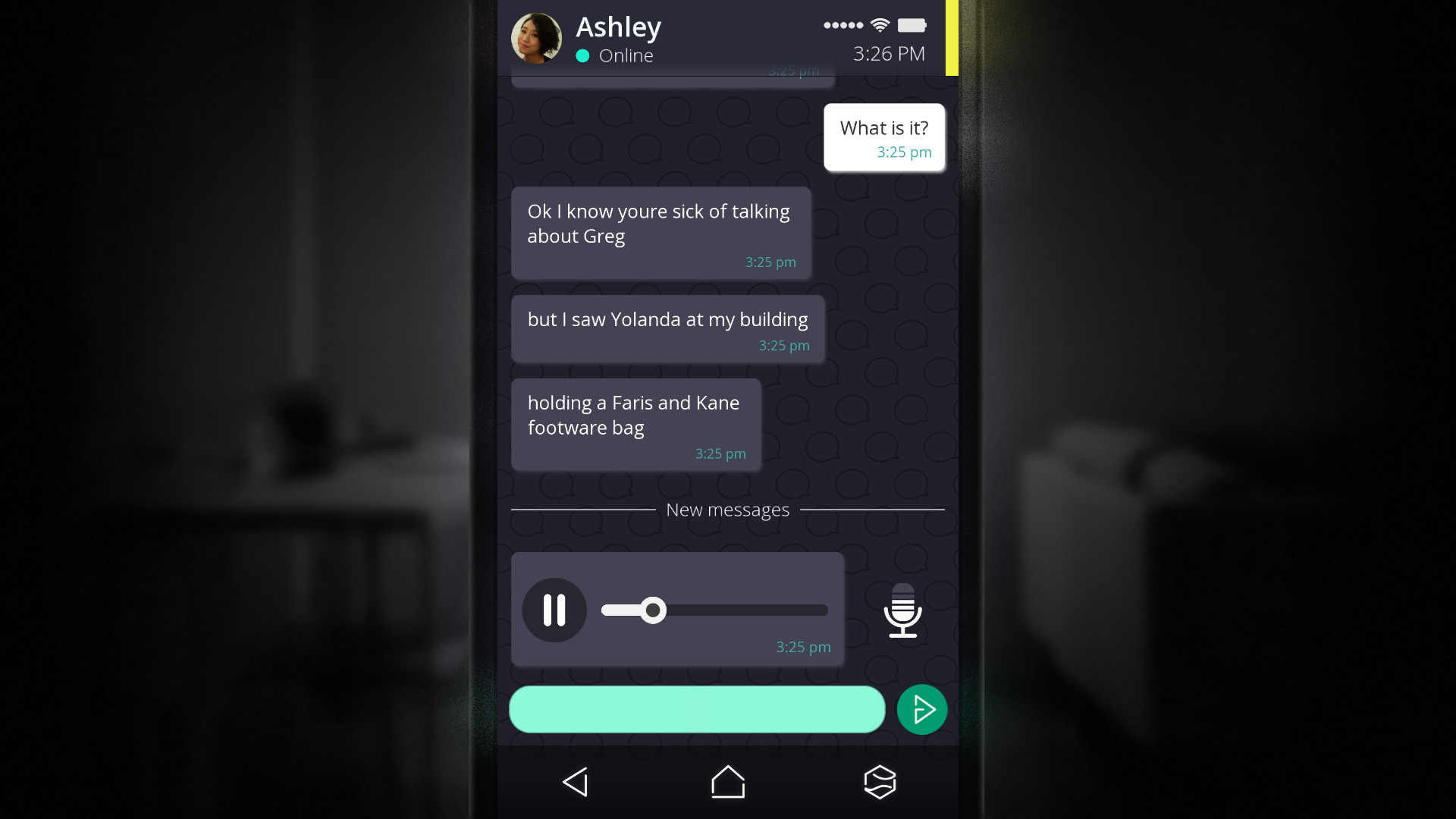
SIMULACRAImage: Kaigan Games OÜ via Steam -

SIMULACRAImage: Kaigan Games OÜ via Steam -
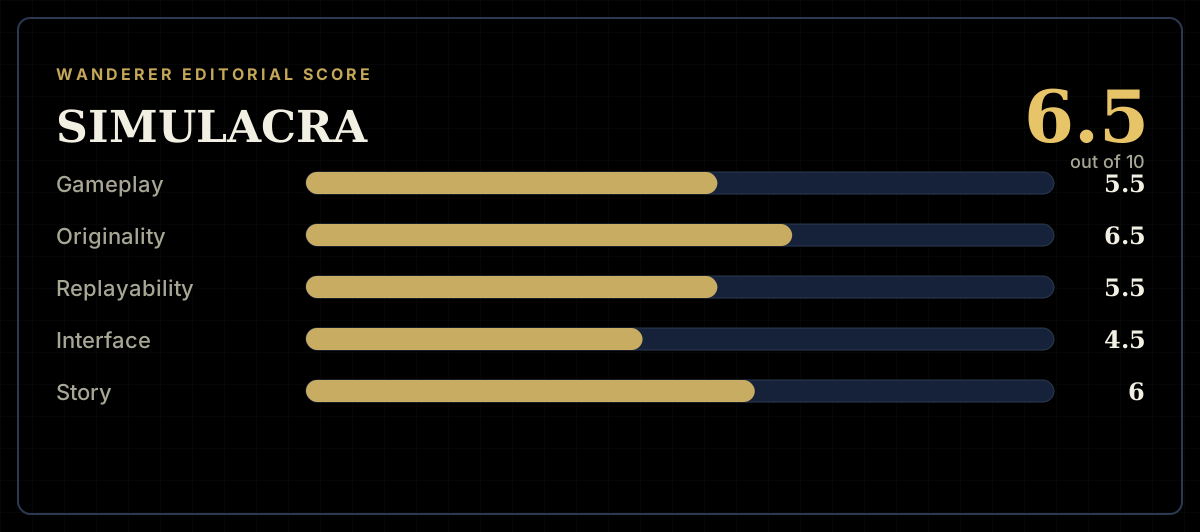
How the review scores each part of the gameWanderer Editorial -
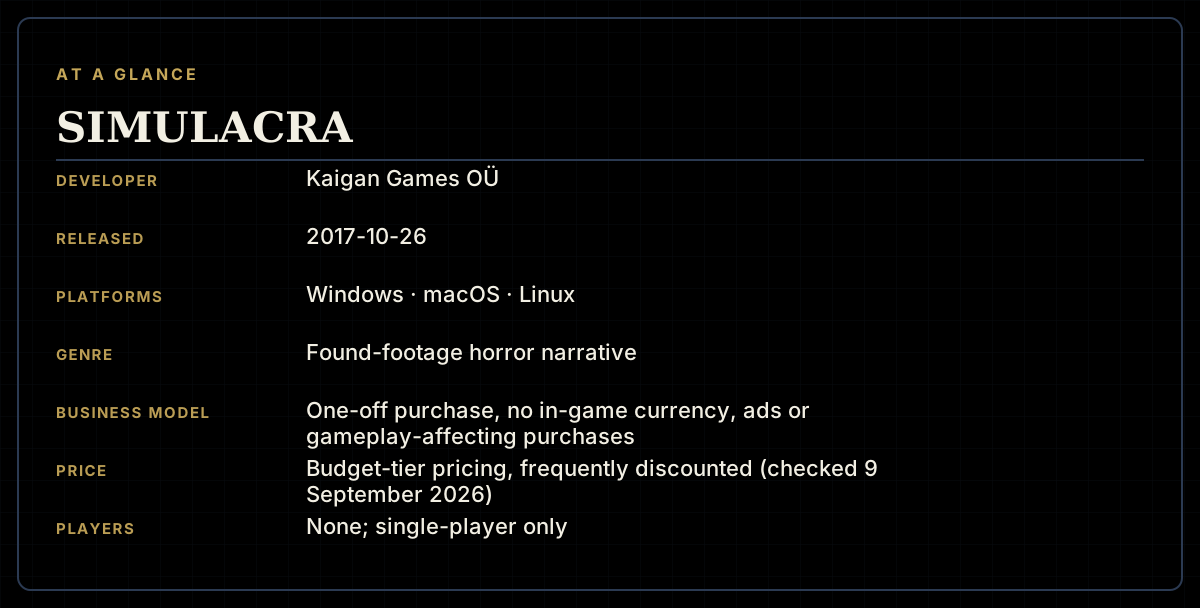
The specsWanderer Editorial -
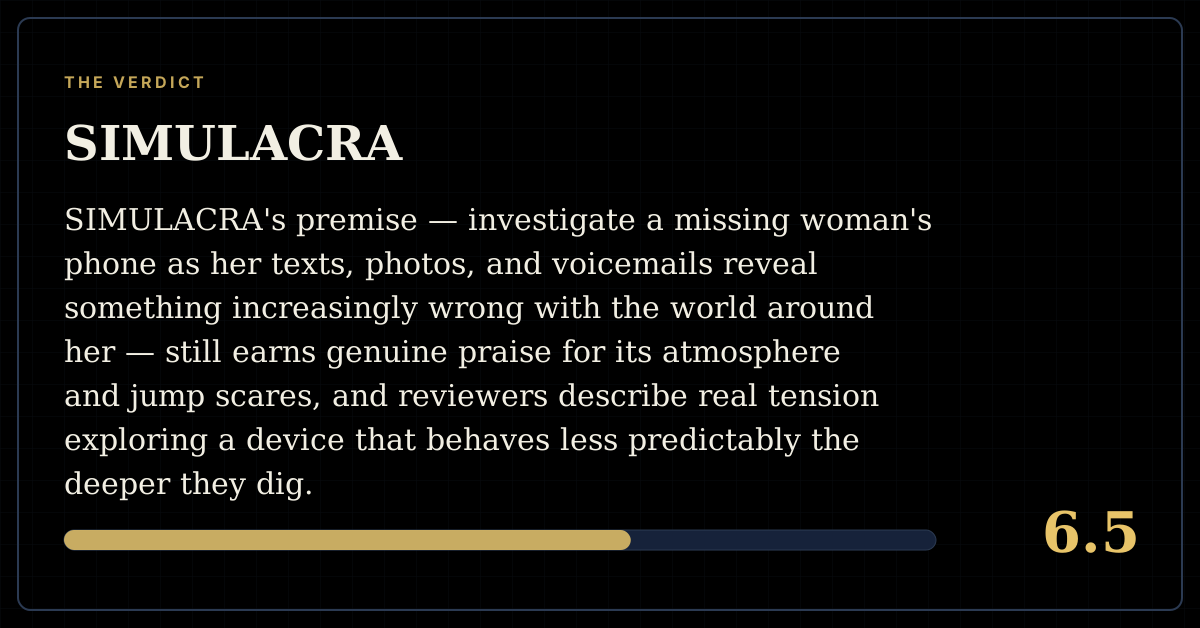
The short versionWanderer Editorial